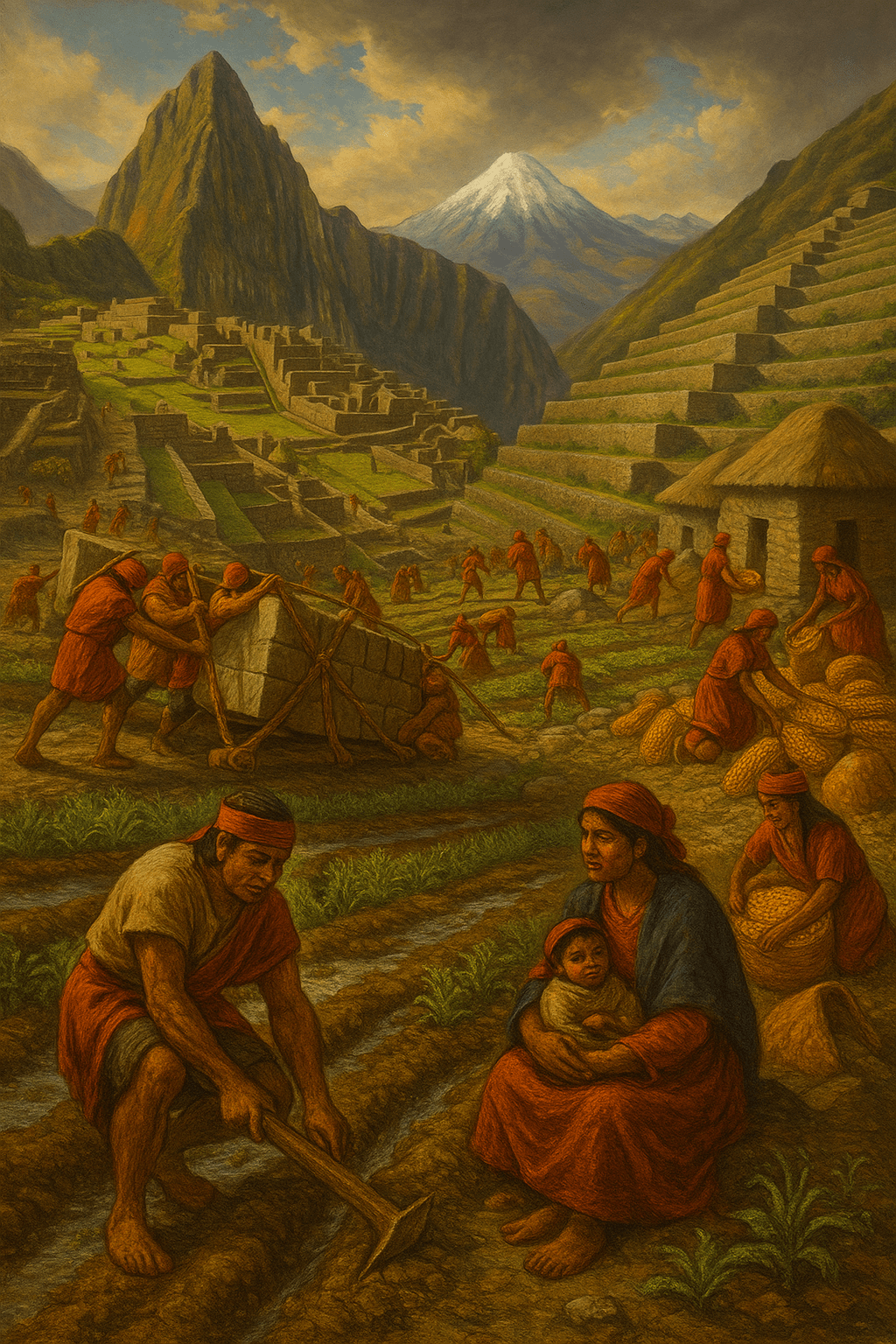
Land without landlords, labor without wages, surplus without profit—what Tawantinsuyu reveals about the socialist future buried beneath empire
By Pablo Katari | Weaponized Information
| July 23, 2025
I. History in Chains
The conquest of the Americas was not merely the theft of land, gold, or labor—it was the extinguishing of another world. The chroniclers of empire, armed with muskets and metaphysics, claimed that civilization arrived on horseback. But this was not civilization; it was its suppression. What they found upon the Andean highlands was not savagery but a communism more advanced in the organization of production than anything yet witnessed in the West. And they destroyed it, precisely because it revealed that capital was not destiny.
To understand the future, one must begin in the past—not the mythologized past of philosophers who imagine men sprung naked from a state of nature, nor the abstract anthropology of bourgeois academicians who catalogue difference only to affirm their own superiority. No, the past must be grasped as it really was: a battleground of social forms. Among these, the most formidable adversary to capital was not the feudal lord, whose parasitism could be accommodated and transformed, but the communal society, in which land was held collectively, labor was organized for use, and surplus was returned to the people.
Such a society existed in the Andes. Its name was Tawantinsuyu, the fourfold realm of the Inca. It was no mere despotism, as Montesquieu would have it, nor a primitive communism, as certain Marxists might claim. It was, in truth, what we must call an artificially developed communism—a society in which the absence of private property did not preclude large-scale coordination of labor, monumental architecture, agricultural sophistication, and a conscious social provisioning of needs.
The Western economists and scholars who dismiss such societies as stagnant betray only the narrow limits of their historical imagination. That which cannot be reduced to exchange-value is deemed invisible; that which does not produce profit is called backward. But the Incan system, though alien to the categories of capital, was a monument to the social power of labor when organized without markets. Roads stretching from Quito to Chile; storehouses filled not for profit but for famine; terraces carved into mountains to resist erosion and feed millions—these were not miracles of nature but of the human hand, the conscious application of labor guided by the needs of the whole.
Let us then state clearly: the Incan commune was not the negation of civilization but its redefinition. Its law was not competition but reciprocity. Its measure was not surplus-value but social use. And its tragedy lay not in its internal contradictions, but in the external violence that annihilated it. What Pizarro brought was not progress but plunder; not the unfolding of reason but the suppression of a rationally organized society.
History, we must remember, does not proceed in straight lines but in ruptures, reversals, and revolutions. The Incan mode of production was not a step on the way to capitalism—it was a different path altogether, buried under the weight of muskets and missionaries. But it left behind a trace, a sediment of possibility. And in that trace, we may yet discover the key to another future.
II. The Ayllu: Collective Labor as the Foundation of Life
What Western historians call “primitive” in the Incan world arises only from their ignorance of forms of property and production that do not obey the commandments of capital. But history, for the materialist, is not measured by coin or commodity. It is measured by the organization of labor, the relationship to the means of subsistence, and the mode by which society reproduces itself across generations. By these standards, the ayllu—the fundamental cell of Incan life—stands as a singular expression of collective rationality.
The ayllu was not a village in the modern sense, nor a mere clan in the ethnographic imagination. It was a self-organizing productive commune, in which land was not owned, but held in trust by the community and redistributed annually according to the composition and capacity of each household. This redistribution, far from chaotic, followed customary rules passed through oral tradition, administered by elected curacas, and informed by a logic of social necessity rather than market demand.
In this system, there was no buying or selling of land, no alienation of labor through wage contracts, no fragmentation of the soil into petty private plots. The land remained indivisible, eternal—pachamama, mother earth, not commodity. Every adult was entitled to a parcel sufficient for their family’s sustenance. This parcel could not be mortgaged, speculated upon, or transferred by inheritance. Its purpose was not to generate profit, but to maintain life. Thus was property social in its essence and use-value sovereign over exchange.
But the genius of the ayllu extended beyond redistribution. It lay in the trifold organization of labor: personal, communal, and state. Each member worked their family plot (suyus), then participated in collective tasks on communal land (minka), and finally contributed labor to state infrastructure and reserves (mita). This layered structure ensured that the needs of the household, the commune, and the broader polity were all met—not through coercion, but through obligation, ritual, and recognition. Here labor was not abstract, but always socially situated. The peasant did not work for a wage, nor for an employer, but for the sustenance of all.
There was no need for money. Surplus was stored, not sold. Great networks of warehouses—qullqas—were stocked with maize, quinoa, dried meats, medicinal herbs, and textiles, all produced through collective labor and distributed in times of scarcity, migration, or festival. These were not “markets” in the capitalist sense; they were communal safety nets. And unlike the grotesque glut of commodities that rot in capitalist warehouses while the hungry starve, the Incan reserves were organized with one goal: the preservation of the people.
What emerges here is a rational metabolism between human beings and nature—a metabolism regulated not by blind competition, but by social planning rooted in custom, astronomy, ecological observation, and collective deliberation. Terracing, crop rotation, and vertical archipelagos of ecological zones ensured food security without ecological destruction. This was not the anarchy of capitalist agriculture, which exhausts the soil for profit, but the deliberate stewardship of the earth by the community.
To call this society “backward” is to expose the backwardness of capital’s own logic. For all its technological marvels, capitalism has not solved hunger, has not rationalized distribution, has not prevented waste, and has not guaranteed life. The Incan system, by contrast, subordinated production to social necessity and tied consumption to collective well-being. It produced not poverty in the midst of plenty, but sufficiency in the midst of scarcity.
The ayllu, then, is no anthropological curiosity. It is a historical witness to the possibility of a society where land is not owned but shared, where labor is not exploited but honored, and where nature is not ravaged but revered. In the rubble of empires, it stands as a monument to what humanity can be when it refuses to kneel before the altar of capital.
III. The State Without Capital
The apologists of capitalist society, whose imaginations are shackled by the fetishism of the market, insist that large-scale coordination of labor requires money, capital, and a managerial elite. But this assertion collapses in the face of history, and no example is more damning to their dogma than that of Tawantinsuyu. The Incan state achieved what modern capitalism claims as its exclusive domain: unified production across vast territories, surplus storage on a continental scale, and infrastructural integration from mountain to coast. And it did so without banks, without private ownership, and without a single coin of currency.
This was not accomplished through spontaneous localism. The communal structure of the ayllu existed within a broader matrix of coordination administered by a centralized state. But this state did not operate according to the logic of exploitation. It did not extract surplus in the form of rent, interest, or profit. Nor did it commodify land, labor, or food. Instead, it levied labor—mita—as a social obligation, a rotational duty owed not to a sovereign individual but to the body politic itself. The labor rendered was not alienated from the laborer; it returned in the form of roads, canals, bridges, temples, and grain reserves.
The Incan state thus performed the function of what elsewhere has been called the “general intellect”—a social synthesis of knowledge, planning, and coordination, but not one in service to capital. It was a state that redistributed rather than accumulated, that stored rather than speculated, and that guaranteed subsistence rather than imposed precarity. The surplus it marshaled was not hoarded by a bourgeoisie, nor traded for profit, but mobilized for the reproduction of society as a whole.
This is why Marx himself termed the Incan system an “artificially developed communism.” Artificial not in the sense of falsehood or artifice, but in the sense of conscious construction. The Incan mode of production was not the spontaneous outgrowth of tribal custom; it was the deliberate architecture of a society that understood labor as social, land as sacred, and survival as collective. It was communism mediated through state planning, yet uncorrupted by class division in the modern sense.
Still, this form bore its own contradictions. The coordination of surplus from above, though not capitalist, could harden into hierarchy. The Sapa Inca—divinized as the child of the sun—stood at the summit of authority, surrounded by a priestly and administrative stratum whose reproduction required increasing labor inputs from below. The potential for class differentiation existed, latent within the very success of centralization. This contradiction, however, had not yet matured into antagonistic class society. Unlike the ruling class of Europe and its settler colonies, the Incan elite did not own the land; they administered it. Their legitimacy rested not on property but on ritual obligation and redistributive function.
Thus, while the Incan state cannot be idealized as classless, neither can it be reduced to despotism. It was a historical form in transition, embodying both the promise of collective labor and the perils of centralized command. It stands as a unique case in the history of modes of production: a tribute-based system without private landlords, a planned economy without capital, and a state without a bourgeoisie.
To render such a formation invisible, or to dismiss it as pre-modern, is to perpetuate the ideological violence of capital, which must deny that any rationality can exist outside its own. But the Incan state proves that surplus coordination and labor planning can emerge from non-capitalist foundations. It is not a deviation from progress, but an alternative to capitalist barbarism—a road not taken, buried beneath the ruins of conquest.
We do not exhume these social forms out of antiquarian nostalgia. We recover them to reveal that the path to human freedom does not lie solely through the wreckage of capital, but also through the reclamation of that which capital could not comprehend, and therefore sought to destroy.
IV. The Communal Form and the Multiplicity of Historical Roads
History, as written by the victors of the bourgeois epoch, pretends to universality while tethered to the narrow trajectory of Western development. It erects a single ladder of progress: tribalism, feudalism, capitalism, socialism. But such linear schema collapses upon contact with the real movement of peoples. The deeper one excavates the soil of the world, the clearer it becomes: humanity has not walked a single road but many. And among these, the road of communal production—trampled underfoot by conquistadors and erased by imperial historiography—demands its return.
In the Andes, as in parts of Africa, Asia, and among the Indigenous peoples of North America, we find societies in which collective labor, shared land, and social provisioning were not the horizon of utopia, but the ground of everyday life. These forms, however distinct in custom and cosmology, shared a historical logic irreducible to capital. Their destruction was not the unfolding of necessity, but the work of cannon and cross, the imposition of commodity relations by fire and famine.
By the end of Marx’s life, it had become clear to him that the path to communism would not, and need not, replicate the European experience. The Russian peasant commune (obshchina), the Indian village community, the Andean ayllu—each contained within them elements of a higher social form, not yet alienated, not yet commodified, not yet disfigured by the wage relation. These were not vestiges to be swept away by the supposed march of history. They were prefigurations—fragments of a future buried in the past.
What was required was not their extinction, but their transformation—in alliance with the global revolutionary movement of the proletariat. In Marx’s correspondence with Vera Zasulich, he argued precisely this: that the Russian commune, if supported by a socialist revolution in the West, could serve as the basis for a direct transition to communism, bypassing the misery of capitalist accumulation altogether. This was no longer speculation; it was a strategic imperative grounded in the uneven development of the world system.
The case of Tawantinsuyu reinforces this thesis. It demonstrates that complex social organization, centralized coordination, and ecological rationality do not require the market, do not require capital, do not require the bourgeoisie. Indeed, they flourish in its absence. The task of the communist movement, then, is not to reproduce the logic of capitalism in reverse, but to retrieve and revitalize the suppressed legacies of communal life, fusing them with the scientific understanding of labor, value, and dialectical transformation.
Let no one say that communism is a Western invention. It was born wherever humanity labored collectively, wherever land was not property but inheritance, wherever the product of labor returned to the hands that made it. It was born in the ayllu, in the obshchina, in the clan systems and agricultural commons now paved over by capital’s triumph.
And it will be reborn—not as a return to the past, but as its conscious reconstruction. The historical materialist does not idolize tradition. But neither does s/he ignore its utility. S/he draws from it what is living, discards what is dead, and forges from it the steel of a new society.
The Incan commune is one such fragment—burned by empire, buried under rubble, yet still smoldering in the memory of the oppressed. The peasant, the Indigenous, the colonized—they do not require instruction in collectivity. They require the weapons to defend it. It is from them, not from the industrial remnants of the West, that the next revolution may well arise.
V. Metabolism and the Earth: The Rational Ecology of Communal Production
The development of agriculture under capitalism has not proceeded in accordance with reason, but in the service of accumulation. Its aim is not to nourish but to profit. Its method is not stewardship but exhaustion. The soil is treated not as a living system but as a passive substrate—stripped, poisoned, and rendered dependent on chemical inputs whose only virtue is that they can be sold. Under the whip of capital, agriculture becomes industry, the earth a machine to be exploited, and the peasant a disposable instrument of extraction.
But the ayllu organized its metabolic relation to the earth on another basis altogether. It neither fetishized nature as divine nor reduced it to dead matter. The land was sacred, yes—but not in the mystified sense of the feudal serf’s submission to lord and cross. Rather, its sacredness expressed the recognition of a material dependence between human life and the ecological systems that sustain it. This recognition, far from breeding passivity, gave rise to practices of extraordinary technical and social sophistication.
Terracing, for example, was not merely an architectural feat but an ecological intervention. By carving agriculture into the mountain, the Inca expanded the zone of cultivation while stabilizing the soil, regulating moisture, and preventing erosion. They understood what Western capitalists do not: that agriculture is a metabolic exchange between humanity and nature, and that the health of one determines the survival of the other.
Even more remarkable was the system of vertical archipelagos—a form of ecological zoning in which dispersed but interdependent communities cultivated different altitudes, climates, and crops, exchanging goods without monetary mediation. This was not primitive trade. It was a form of ecological rationality that distributed labor and resources in accordance with the natural rhythms of the environment. It coordinated not only across space, but through time, through crop cycles, festivals, and the collective anticipation of drought or frost.
Storage, too, was not hoarding but planning. The state storehouses (qullqas) were situated with knowledge of altitude and airflow, and stocked with freeze-dried potatoes (chuño) and other staples preserved without artificial inputs. These reserves were not private fortunes but public guarantees—released during famine, used to provision labor armies, and redistributed during communal rites. There was no market logic here, no profiteering from scarcity. There was planning in anticipation of necessity—a prefiguration, however embryonic, of the socialist principle: from each according to ability, to each according to need.
Capitalism, by contrast, has produced an ecological contradiction so vast that it now threatens the entire planet. It has severed the metabolic rift between society and nature, expropriated Indigenous and peasant communities from the land, and subjected agriculture to an irrational calculus of global trade, monoculture, and chemical dependence. The soil is exhausted, the water poisoned, the air choked—and all in the name of profit.
But the Incan system reminds us that another relation is possible—one in which land is not commodified, labor not alienated, and production not detached from the renewal of natural life. Here lies the germ of what has been termed the rational regulation of the metabolism between man and nature—a regulation to be achieved through collective planning, conscious coordination, and scientific understanding, not the blind anarchy of the market.
Let us be clear: the ayllu was not a utopia. It bore its own contradictions, limitations, and historical finitude. But it achieved something capitalism has never dared attempt: the coordination of human labor across generations, terrains, and climates without the mediation of private property or profit. It offers no blueprint, but it does offer proof—that the rational reorganization of production in harmony with nature is not only imaginable, but historical. It was done. It can be done again.
And when the commune returns—not as memory but as movement—it must return not to the past, but through it. To reestablish the metabolism between humanity and nature, we must reclaim that which was buried beneath the rubble of conquest, and wield it as weapon against the catastrophe of capital.
VI. The Return of the Commune
It is one of history’s bitterest ironies that the societies most attuned to the rhythms of the earth, most capable of meeting human need without exploitation, were declared uncivilized by those who built their empires on death. The conquistador did not civilize the Andes; he silenced it. And what he buried beneath muskets and crosses was not savagery, but a form of life that stands in judgment of the modern world.
Today, the capitalist order presents itself as eternal. Its ideologues speak of history as concluded, of alternatives as fantasies, of socialism as failure. But these are the frightened declarations of a class whose system is collapsing under its own weight—riven by crisis, wracked by war, haunted by the specter of ecological ruin. Their confidence is a mask. Their permanence, a lie.
For if the Incan commune teaches us anything, it is that capitalism is not the only road. That a society can be organized without private property, without money, without wage labor, and yet still build roads, coordinate surplus, and nourish millions. It proves that collective labor is not a dream but a reality—that a mode of production rooted in solidarity, reciprocity, and reason is not only possible, but precedented.
The bourgeoisie would have us believe that history moves only through the gears of competition and accumulation. But the ayllu tells another story—one of planning without despotism, of labor without exploitation, of abundance without greed. It is not that the Incan system must be restored in its totality. That is neither possible nor desirable. It is that its principles—its rational organization of life, its ecological humility, its social centrality of the commons—can and must inform the construction of a new world.
Communism will not be the repetition of Europe’s path. It will not emerge solely from the contradictions of industrial capital. It will rise from the ruins of colonialism, from the memory of the landless, from the rhythms of the peasant, the forest-dweller, the communalist. The future does not lie in the mechanical repetition of the past, but in its dialectical transformation. And in this, the Incan example is not a relic. It is a weapon.
To the revolutionaries of the world—the dispossessed, the Indigenous, the workers of the South and the slum dwellers of the North—I say: study the commune. Not only Paris, but the ayllu. Not only the factory, but the field. The commune is not behind us. It is beneath us, waiting. Beneath the ecomiendas, beneath the clearcuts, beneath the cities built on stolen soil—it endures, hidden but living.
Let the capitalist call this madness. Let the professors sneer. History will not be written by them, but by those who reclaim the earth and reweave the bonds of life. The return of the commune is not a prophecy. It is a necessity. And when it comes, it will not wear the mask of the past. It will wear the face of the future—armed with memory, armed with science, and armed, at last, with power.
References
- Murra, John V. The Economic Organization of the Inka State. Originally PhD dissertation, University of Chicago (1955); JAI Press, 1980.
- Murra, John V. “El ‘control vertical’ de un máximo de pisos ecológicos en la economía de las sociedades andinas.” In Formaciones económicas y políticas del mundo andino. Instituto de Estudios Peruanos, Lima, 1975.
- Van Buren, Mary. “Rethinking the Vertical Archipelago: Ethnicity, Exchange, and History in the South Central Andes.” American Anthropologist 98, no. 2 (1996): 338–351.
- Arizmendi, Luis‑Felipe. “Agricultural Economics and Innovation in the Inca Empire.” arXiv preprint, April 2025.
- Arizmendi, Luis‑Felipe. “Barter and Hierarchy: A Practical Perspective on Food, Society, and Knowledge in the Inca Empire.” arXiv preprint, April 2025.
- University of Michigan Journal of Economics. “Labor and Power in the Incan Economy.” December 19, 2022.
- Wikipedia contributors. “Economy of the Inca Empire.” Wikipedia, accessed July 23, 2025.
- Library of Economics and Liberty. “The Socialism of the Incas.” 2015.
- Puenteluna, José Carlos de la. “Of Widows, Furrows, and Seed: New Perspectives on Land and the Colonial Andean Commons.” Hispanic American Historical Review 101, no. 3 (2021): 375–407.
- Palma, Gabriel et al. “Multiethnicity, Pluralism, and Migration in the South Central Andes.” PNAS 112, no. 30 (2015): 9216–9221.
- Reddit /r/AskHistorians. “How ‘Communist’ Was the Incan Empire?” Discussion thread, February 2020.
 Weaponized Information
Leave a comment