By Prince Kapone, Weaponized Information
Capitalism Begins with the Seed
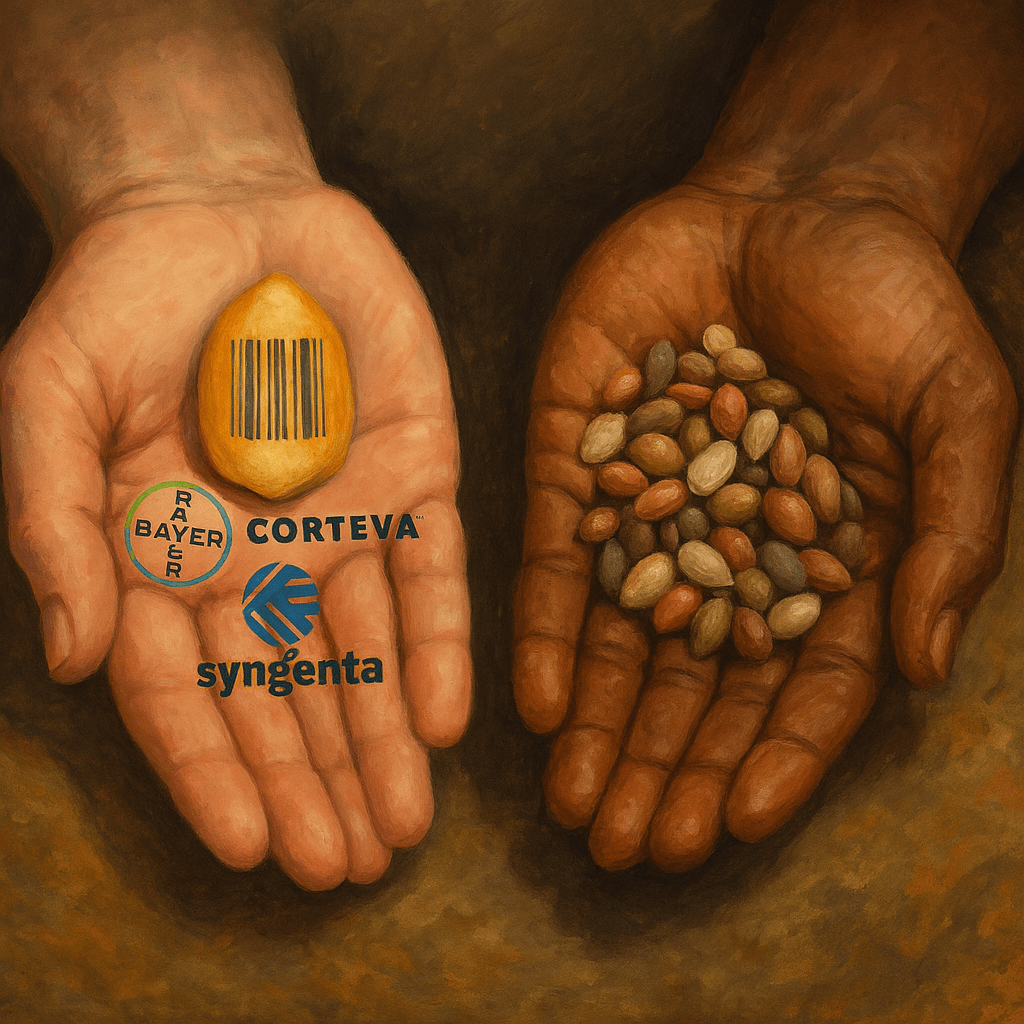
Just as Karl Marx began Das Kapital with the analysis of the commodity—the “economic cell-form” of bourgeois society—we begin our inquiry into agricultural capitalism and ecosocialist transition with the seed. Not the seed in a purely biological sense, but the seed as commodity: the form in which capital has seized, enclosed, and monetized the very basis of human life.
The seed is no longer simply the bearer of nutrition and biodiversity—it is now a financial instrument, a biotechnological patent, and a node in a digitally integrated supply chain managed by monopoly capital. The capitalist seed is the point where human-nature metabolism is subordinated to imperial profit-making. It is where monopoly finance capital meets biotech, Big Data, and food sovereignty—an entry point into the world system of technofascism.
The Dialectic of the Seed: From Use-Value to Exchange-Value
In its organic form, the seed embodies use-value: nourishment, continuity, and the accumulated intelligence of generations of human and ecological co-evolution. In every Indigenous and peasant society, seeds have been held collectively, exchanged freely, and stewarded in relation to territory, seasonality, and cultural memory.
Under capitalism, however, the seed undergoes a profound transformation. Its use-value is eclipsed by its exchange-value. It becomes a commodity—sold, standardized, and embedded in a global market governed by finance, intellectual property law, and imperialist trade regimes. What once reproduced life becomes a tool of control.
The Seed and Primitive Accumulation
This transformation is not new. It follows the long arc of what Marx called primitive accumulation: the separation of the producer from the means of production. In this case, the separation of farmers, communities, and ecosystems from the autonomous reproduction of seed itself.
The colonial theft of seeds—such as Britain’s seizure of cotton and indigo strains from India—or the export of maize and cassava from the Americas—laid the foundation for global monocultures and plantation economies. Today, this process continues through what Vandana Shiva calls “bio-piracy”—the extraction and patenting of traditional seeds by corporations like Bayer-Monsanto under regimes like the WTO’s TRIPS agreement and the UPOV Convention.
Monopoly Capital and the Global Seed Oligopoly
The modern seed industry is controlled by fewer than five conglomerates—Bayer, Corteva, Syngenta, BASF, and Limagrain—all integrated into broader networks of agrochemical, data analytics, and finance capital. These firms are not merely selling seeds. They are embedding farmers in vertically integrated platforms of dependency: proprietary pesticides, cloud-based “smart” farming tools, AI-generated planting schedules, and climate insurance products—all under corporate control.
This is the agricultural wing of technofascism: the fusion of monopoly capital, digital surveillance, and state violence to impose a planetary food regime governed by private finance, data monopolies, and agro‑imperialist institutions like the World Bank, AGRA, and the Gates Foundation.
Contradictions within the Seed Commodity
The commodified seed is riddled with contradictions:
- It is biologically designed to reproduce, but legally forbidden to be replanted.
- It emerges from collective historical knowledge, but is owned as private intellectual property.
- It promises food security, but creates dependency and biodiversity loss.
- It claims to solve hunger, but contributes to the destruction of peasant economies and rural autonomy.
These contradictions are not accidents—they are expressions of the broader contradiction of capitalism itself: the drive to commodify everything necessary for life, even when doing so threatens the reproduction of that life.
Technofascism and the Crisis of Imperial Agriculture
In the current phase of imperialist crisis, the commodified seed has become a weapon of geopolitical leverage and internal counterinsurgency. From the destruction of Iraq’s national seed bank under U.S. occupation to the Gates Foundation’s role in shaping African seed laws, the control of seed is central to the control of populations.
Technofascism extends this logic: through the use of drone-enforced patent policing, satellite surveillance of farmer compliance, and blockchain-enforced seed licensing systems. Under this regime, the act of seed saving—a sacred duty in most cultures—is criminalized as theft of intellectual property. Farmers become data-generating contract laborers for the digital empire of agro-finance capital.
Toward the Negation of the Seed Commodity
But the contradiction cuts both ways. The commodified seed can be, and is being, negated. Across the world, movements like Navdanya, La Vía Campesina, and the MST in Brazil are building systems of seed sovereignty: collective seed banks, anti-patent organizing, agroecological training schools, and peasant-to-peasant exchanges rooted in solidarity, not speculation.
This is not nostalgia. It is strategy. The path toward ecosocialist reconstruction begins by reclaiming the means of life at its origin point. By reasserting the commons where capital has imposed commodity. By reuniting the metabolic rift between human beings and the soil through the revolutionary decommodification of food and land.
Conclusion: The Seed as Historical and Revolutionary Cell-Form
The seed is the starting point of all agriculture. But in capitalist society, it is also a mirror of the system’s most violent logics—enclosure, control, and accumulation by dispossession.
To analyze the seed as a commodity is to expose the entire architecture of imperialist agriculture. But it is also to glimpse its overthrow. In the seed lies the contradiction between reproduction and exploitation. In the seed lies the possibility of rupture.
In the next chapter, we will trace the evolution of the industrial farm as a spatial and technological expression of this same logic—and the emerging insurgencies that are dismantling it from below.
 Weaponized Information
Leave a comment