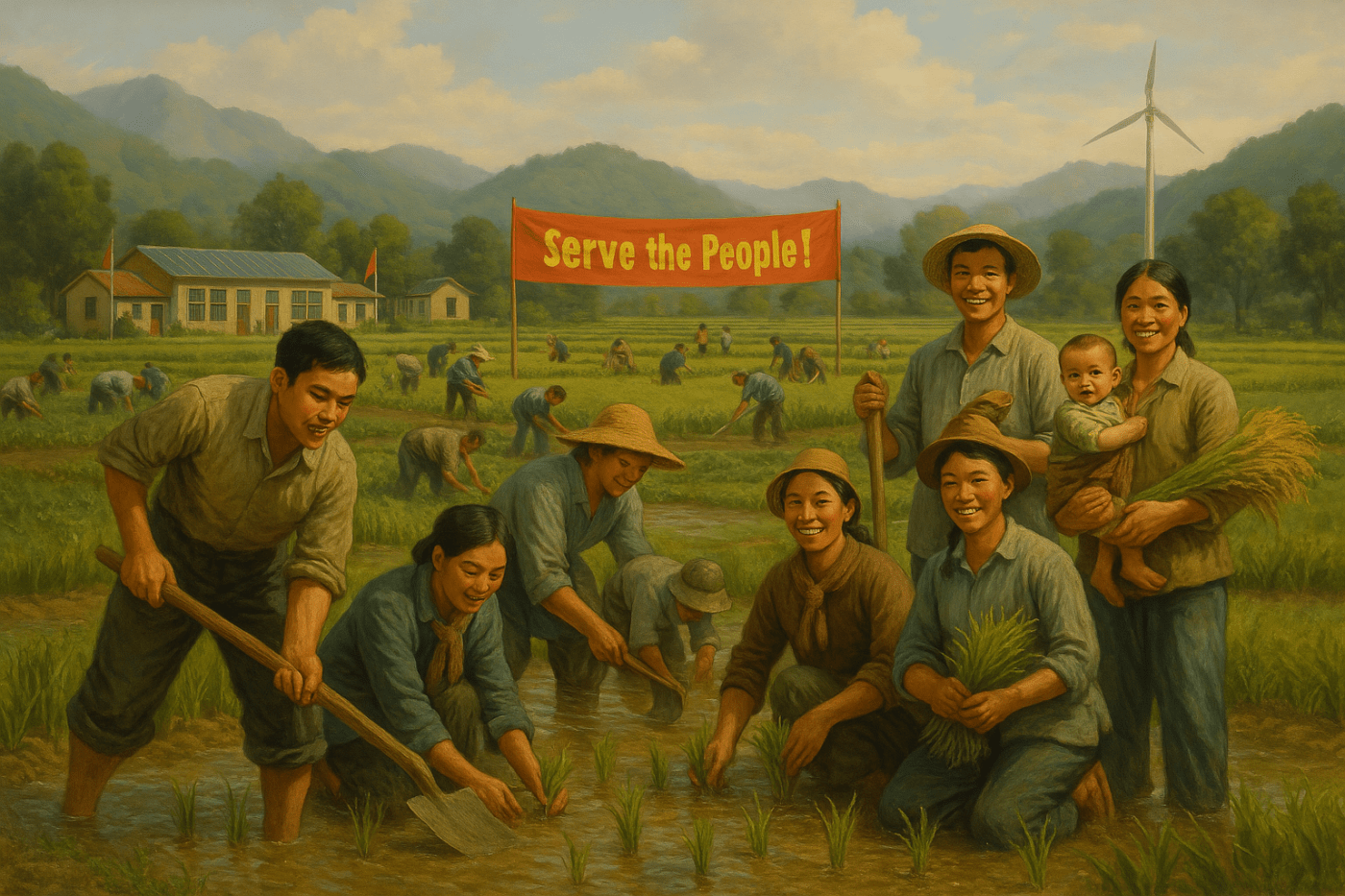
By Prince Kapone, Weaponized Information
Memory as Counteroffensive
The capitalist narrative tells us the People’s Communes of Maoist China were a disaster—chaotic, coercive, inefficient. This lie has been repeated so often it has become common sense in both liberal academia and neoliberal policy circles. But this story is not history. It is counterrevolutionary propaganda, designed to bury the most advanced experiment in democratic socialist planning ever attempted at the base of society.
In this installment, we reject the lie and recover the truth: the People’s Commune was not a failure, but a bold and necessary attempt to build the politico-economic cells of a communist society—ahead of its time, under contradictory conditions, and ultimately dismantled not by the masses, but by the capitalist-roaders within the Party.
The Commune as a Revolutionary Leap
Launched during the Great Leap Forward in 1958, the People’s Commune was not merely an administrative structure—it was a radical break with capitalist logic:
- It abolished private landholding and integrated agriculture, industry, militia, education, and governance under one collective authority.
- It centralized planning at the grassroots level and encouraged collective production, collective consumption (canteens, nurseries), and collective living.
- It aimed to overcome the urban-rural split by integrating manual and mental labor, industry and agriculture, men and women, politics and production.
The communes emerged amidst ecological constraints, technological limits, and internal contradictions. But they marked the first serious attempt to construct a non-capitalist civilization from the countryside up.
Democracy, Not Bureaucracy
The communes were not imposed from above in the way Western caricatures imply. In their best form—particularly in provinces like Anhui and parts of Sichuan—they were structured around mass participation, rotating leadership, criticism and self-criticism, and the fusion of production with political education.
Through the mass line method (“from the masses, to the masses”), cadres were expected to investigate conditions and act accordingly—not dictate them. The commune created space for a new kind of social consciousness: not individualist, not commodity-centered, but collective, revolutionary, and practical.
Contradictions and Setbacks: A Dialectical View
Were there problems? Absolutely:
- Overzealous implementation and grain procurement targets led to famine in several regions, exacerbated by natural disasters and international blockade.
- Bureaucratism and deviation from the mass line undermined the communes in practice in many areas.
- The attempt to leap directly to full communism without sufficient productive forces or cultural transformation was prematurely ambitious.
But these were not failures of the commune as a form—they were the result of material contradictions, missteps, and sabotage from within. To reject the commune because of these problems is like rejecting socialism because capitalism exists.
Why the Commune Was Dismantled
After Mao’s death in 1976, Deng Xiaoping and the capitalist-roaders seized control. The People’s Communes were dismantled in favor of the Household Responsibility System—reintroducing private plots, wage incentives, and market discipline.
This wasn’t modernization. It was restoration—a counterrevolution masked as “reform.” In one stroke, collective ownership was broken, rural collectives were atomized, and the ideological horizon was narrowed to GDP growth and consumption.
The Commune and the Future of Socialism
Today, in the age of planetary crisis and technofascist imperialism, the logic of the People’s Commune is more relevant than ever:
- It offers a model of socialist planning rooted in local democracy and ecological rationality.
- It shows how collective labor, when freed from profit imperatives, can sustain both people and planet.
- It integrates education, healthcare, child-rearing, and production into a single holistic system—not as services, but as rights and responsibilities.
- It reveals that the road to socialism must pass through the transformation of daily life—not just state policy.
The Commune Was Not a Mistake—It Was a Beginning
In the long view of history, the People’s Commune may be seen not as a relic of the past, but as the prototype of a future society: ecosocialist, decolonized, and humanized. It may not have succeeded fully in its time—but that time is not over.
Today, as the earth burns and empire collapses, we must return to the commune—not to imitate it mechanically, but to revive its revolutionary essence, update its strategy, and embed it in the struggles of our era.
The People’s Commune was not a failure. It was a rupture. And it remains our roadmap to the end of empire and the rebirth of the world.
Part IX Coming Soon: “From Commune to Ecosocialist Civilization: Revolutionary Planning for the Planetary Future”
 Weaponized Information
Leave a comment