🕊️ From the Holy Throne to Global Empire — A Weaponized Information Series
This multi-part investigation traces how the Catholic Church evolved from persecuted sect to ideological spearhead of conquest, slavery, and global counterinsurgency.
- 📖 Part 1 – The Empire Collapses, the Cross Survives: From Constantine to the Fall of Rome
- 📖 Part 2 – Charlemagne and the Making of the West
- 📖 Part 3 – Islam and the Afro-Asian World System
- 📖 Part 4 – The Sword and the Cross: The Crusades and the Reconquista
- 📖 Part 5 – Purge, Plague, and Papal Empire
- 📝 Part 6 – Christ, Capital, and Chains
Christ, Capital, and Chains
By Prince Kapone, Weaponized Information
I. From the Cross to the Coffle
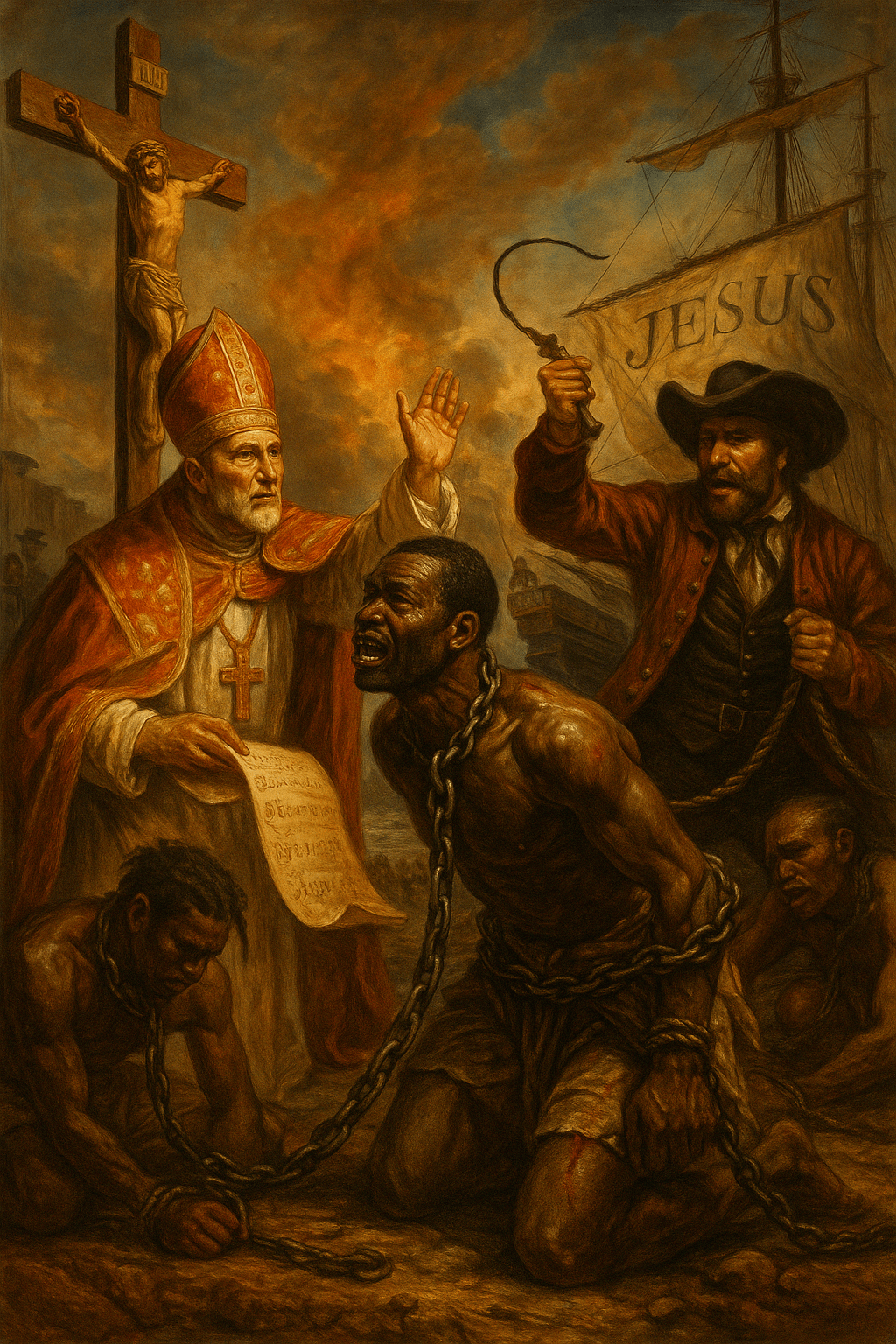
By the end of the 15th century, the church had fully flipped the script. The same gospel that once walked barefoot with the poor was now marching in boots, backed by naval cannons and sugar barons. Christ the healer had been buried beneath popes, conquistadors, and plantation sermons. The holy text had become a business plan.
Europe had expelled the Jews, driven out the Moors, and baptized the Atlantic in blood. Now it needed labor. Not just hands—but bodies to break, convert, and extract wealth from. So the church turned its gaze to Africa and gave empire a new slogan: Salvation through slavery.
II. Holy Decrees and the Business of Bondage
Let’s talk receipts. In 1452, Pope Nicholas V wrote Dum Diversas—a papal permission slip giving Portugal the “divine” right to enslave anyone who didn’t bow to European Christendom. Three years later, Romanus Pontifex took it global. Africa was now open for business—and the church had set up the tent.
The first plantations in Madeira and São Tomé were not only brutal—they were blessed. Africans were kidnapped, shackled, whipped, and worked to death—so long as someone sprinkled holy water on it first. Resistance? That was heresy. Escape? That was rebellion against God. Slavery wasn’t a necessary evil—it was divine order, sanctified by the throne of Saint Peter.
III. Chains for Capital, Capital for Christ
Feudalism was coughing up blood. The plague had taken out half the workforce. The lords were broke, and the bishops were hungry. Enter the triangle: Africa supplies the labor, the Americas grow the commodities, and Europe cashes the checks.
The church wasn’t on the sidelines—it was running logistics. Priests baptized enslaved children right before they were sold. Bishops owned human beings. Clergy debated how many lashes made a “Christian punishment.” Slavery was a holy institution. And the ships? They sailed under names like Jesus, Grace of God, and Holy Mary.
The theological mask fit perfectly. Blackness? A curse. Resistance? A sin. Obedience? Salvation. It was racial capitalism in the language of divine obedience.
IV. The Plantation as Theocracy
Let’s be clear: the plantation wasn’t just an economic unit. It was a theocratic death camp. The overseer read scripture while the driver cracked whips. Sunday was for sermons about obedience; Monday was for rape and torture. Priests held services while pregnant women were whipped. The plantation was the church’s new cathedral—complete with pews of chains and hymns of agony.
Catholics and Protestants alike played ball. The theology didn’t change—just the uniforms. Whether it was a rosary or a reformation Bible, the end result was the same: land stolen, labor chained, and capital baptized.
V. Gospel in Rebellion
But here’s what they didn’t plan for: the enslaved read the Bible too. And they read it differently. They saw Pharaoh, not Jesus, in the master. They heard Moses in the cries of their kin. They turned forced baptisms into resistance. They fused the gospel with drums, with dances, with secret prayers and open revolt.
From Haiti to Bahia, from Gullah to Suriname, the enslaved made something new. A theology of freedom. A Black Christ. A gospel not of patience, but of uprising. The slaveholders taught submission—but the enslaved remembered the Exodus.
VI. Conclusion: Empire Got Religion—and Religion Became Empire
By 1600, the transformation was complete. The church had become the ideological nerve center of a global slavery machine. The gospel had gone corporate. Christendom had scaled. And the Cross, once a symbol of state violence, had returned as a brand—burned into human flesh across three continents.
This wasn’t hypocrisy. It was strategy. The same god that once fed the hungry was now starving them for sugar. The same scripture that said “the meek shall inherit the earth” was now quoting Paul to justify the lash. This wasn’t a betrayal of the gospel—it was the gospel rewritten for empire.
But empire splinters. And what comes next isn’t liberation. It’s franchising. The Reformation doesn’t free the people. It gives birth to a dozen new imperial theologies—each more efficient, each more “righteous,” and each more deadly than the last.
Next series: From Global Empire to Neoliberal Globalization
We follow the gospel of empire as it splinters, reforms, reforms again, and spreads through mission schools, slave cabins, air-conditioned megachurches, and World Bank offices. The Cross was just the beginning. Now it’s Wall Street, Silicon Valley, and militarized prayer.
 Weaponized Information
Leave a comment