By Prince Kapone, Weaponized Information
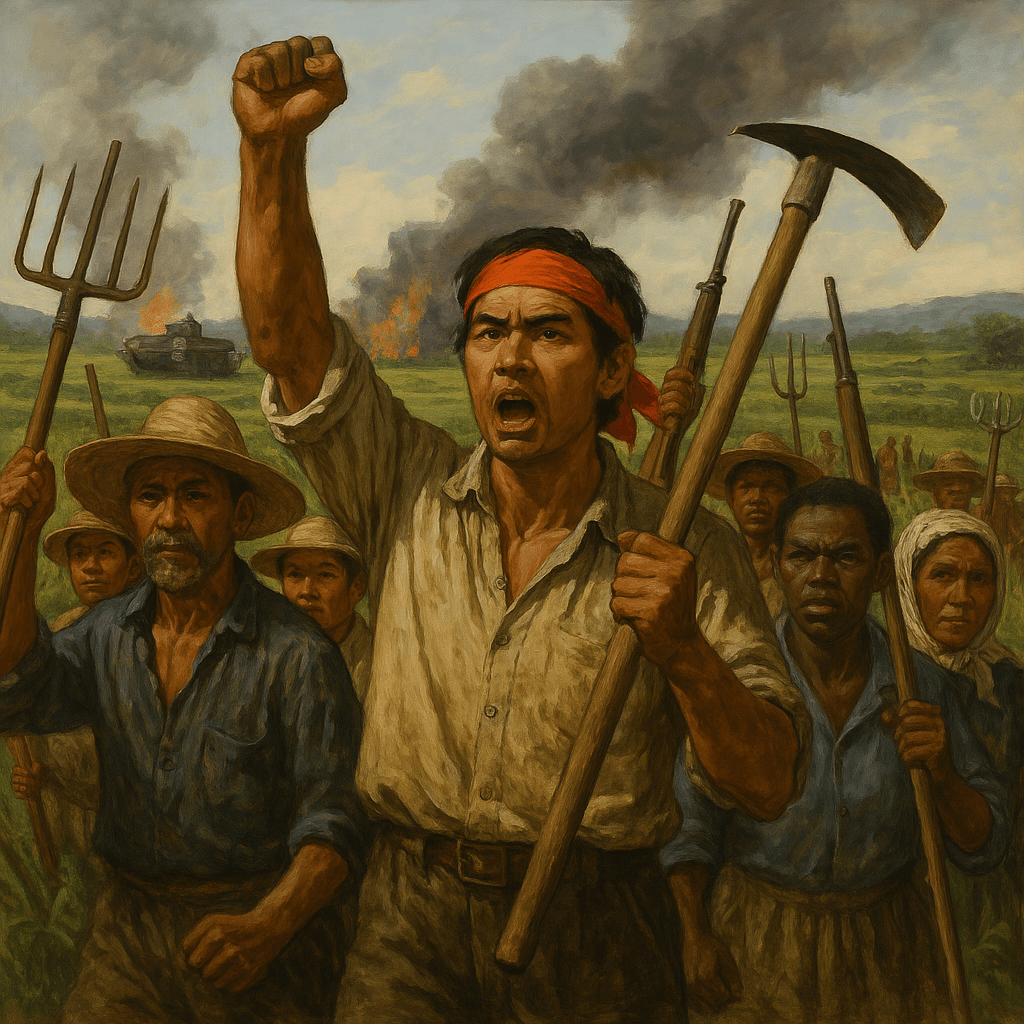
The Battle for the Soil
We are living through a planetary crisis engineered by capitalist agriculture. Land is being poisoned by monocultures, privatized by speculators, and surveilled by drones. The peasantry is dispossessed, and food is no longer grown to nourish people, but to fuel profits, export quotas, and commodity markets. And yet, the dominant narrative insists that this system is “efficient”—that private ownership, corporate logistics, and capitalist incentives are the only viable way to feed humanity.
This is a lie. In every region of the world, collective agriculture has proven itself more productive, more sustainable, and more socially just than private capitalist farming. This essay is not a neutral comparison—it is a declaration of allegiance: with the landless, the tillers, the cooperatives, the communes, and the movements resisting agricultural capitalism from below.
Capitalist Agriculture Is a Death Cult
Let’s begin with the system we’re up against. Market agriculture is not just inefficient—it is destructive by design:
- It produces 30% of global greenhouse gas emissions.
- It causes 80% of global deforestation.
- It wastes over one-third of all food produced while nearly a billion people go hungry.
- It has displaced over 300 million small farmers over the last three decades through land grabs and trade liberalization.
Meanwhile, a handful of corporations—Bayer-Monsanto, Cargill, ADM, and Syngenta—control seeds, patents, markets, and data. This is not efficiency. It is imperialist land theft, repackaged as “agricultural modernization.”
Collective Agriculture: Grounded, Proven, Revolutionary
Now contrast that with the collective systems already flourishing against all odds:
- In Brazil, the Landless Workers’ Movement (MST) has reclaimed millions of hectares of land, built agroecological settlements, and educated a generation in the politics of land and liberation.
- In Venezuela, cooperatives aligned with communal councils have organized food sovereignty in the face of U.S. sanctions and economic warfare.
- In India, Dalit and Adivasi women’s collectives have transformed barren plots into green cooperatives through rotational labor and seed sharing, bypassing caste and market hierarchies alike.
- In Guatemala, Indigenous communities managing collective forests have outperformed government and private actors in biodiversity conservation and carbon retention.
These aren’t experiments. They are the embryos of a new civilization, already proving superior by every metric that matters: sustainability, justice, dignity, autonomy, and survival.
Empirical Proof Against Market Myths
Let the data speak:
- Smallholder farms (mostly collective or family-run) produce over 30% of the world’s food on less than 25% of agricultural land.
- In Honduras, soil conservation collectives tripled grain yields after abandoning chemical-intensive monocultures.
- Peru’s revival of Inca-era waru waru systems boosted potato yields by up to 10 metric tons per hectare with no synthetic inputs.
- During COVID-19, capitalist food supply chains collapsed. It was CSA networks, landless peasant co-ops, and neighborhood gardens that fed the people.
Market agriculture needs fossil fuel subsidies, export infrastructure, and speculative finance to survive. Collective agriculture needs only land, labor, water, and solidarity.
Strategy for Revolution: From Resistance to Seizure
We do not merely want to coexist with capitalist agriculture. We aim to abolish it. Our strategy must be clear:
- Seize land from landlords, agribusinesses, and speculators. No more compensation. No more reform. Land back to those who work it.
- Expand agroecological collectives tied to revolutionary political education. Build dual power from below.
- Fuse the urban and rural proletariat through food sovereignty campaigns, mutual aid, and peasant-worker alliances.
- Nationalize agro-industrial infrastructure under democratic control of federated communes—not the bureaucratic state.
This is not technocratic reform. It is revolutionary transition: from the death logic of capitalist agriculture to the life logic of ecosocialism.
Conclusion: Land, Labor, Liberation
There is no green future under capitalism. There is no food security under monopoly. There is no justice in the marketplace.
There is only the land. And those who organize to reclaim it.
Collective agriculture is not a utopia. It is the historical task of our time.
Part VII Coming Soon: “Building the Agroecological Commons: Strategies for Global Solidarity and Resistance”
 Weaponized Information
Leave a comment