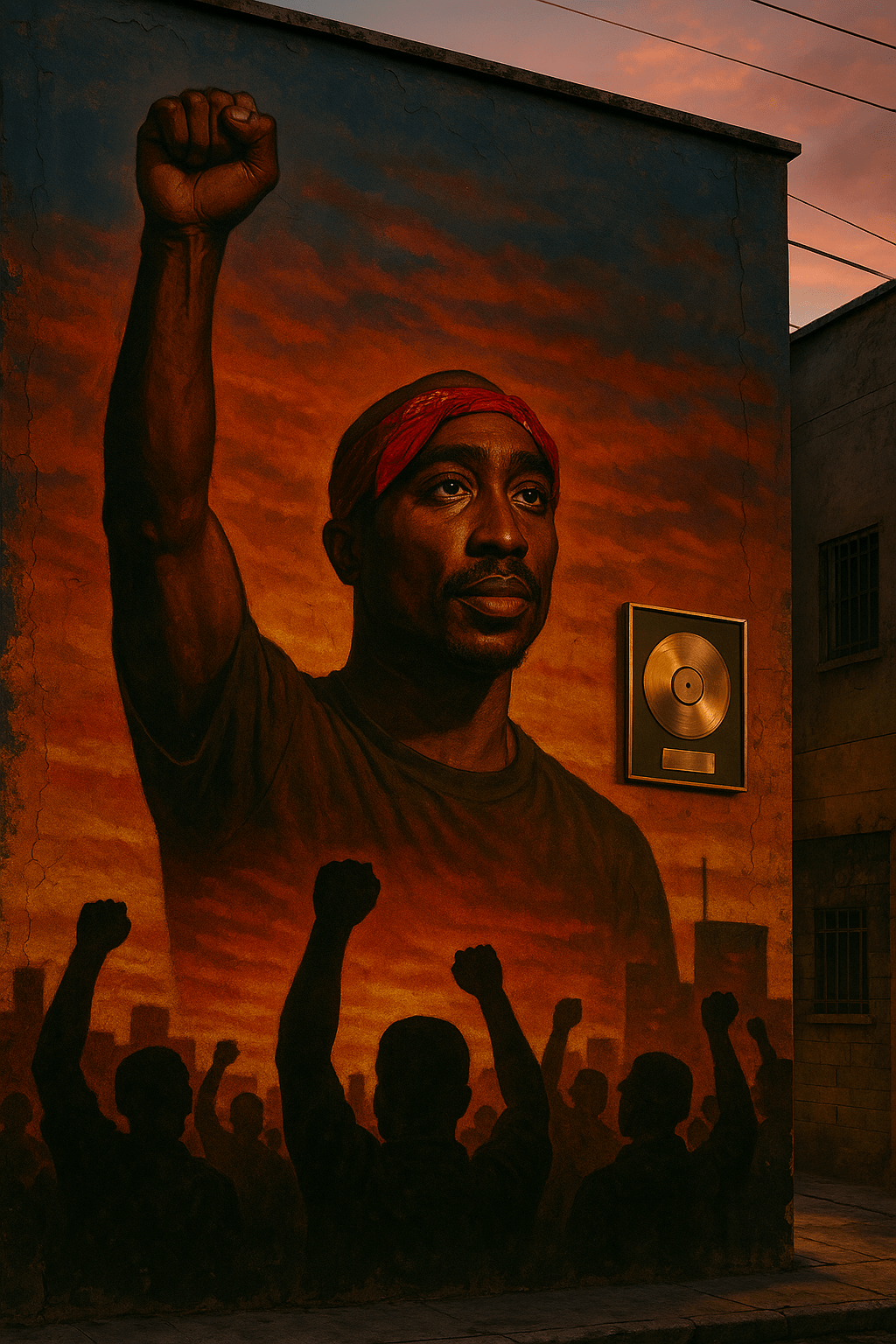
From the hoods of Los Angeles to the murals of Soweto, from prison notebooks to platinum plaques, Tupac Shakur lived—and died—like a soldier of the people. This is not a eulogy. It is a call to arms.
By Prince Kapone | Weaponized Information | June 16, 2025
Born of Panthers, Named for an Uprising
“I’m not saying I’m gonna change the world, but I guarantee that I will spark the brain that will change the world.” — Tupac Shakur
Tupac Amaru Shakur was born into struggle—both symbolically and materially. His birth name was Lesane Parish Crooks, but it was soon changed by his mother, Afeni Shakur, to reflect the revolutionary hopes she carried for her son. She named him after Túpac Amaru II, the 18th-century Andean revolutionary who led an Indigenous uprising against Spanish rule and was executed in public, dismembered as a warning to the colonized. But as with the original Túpac, the warning failed. A symbol was born instead.
Tupac was the son of two political soldiers. His mother, Afeni, was a member of the Black Panther Party and part of the New York 21, a group of Panthers arrested in 1969 on conspiracy charges later revealed to be fabricated by the FBI. She defended herself in court while pregnant with Tupac and won acquittal, a revolutionary act in itself. His stepfather, Dr. Mutulu Shakur, was a key figure in the Black Liberation Army and a trained acupuncturist who developed revolutionary medical practices for the poor and incarcerated. He would later be hunted by the state and imprisoned as a political prisoner, accused of aiding in the escape of Assata Shakur and robbing banks to fund revolutionary activity.
This was the family Tupac was born into—a tribe of exiles, militants, and freedom fighters, constantly pursued by the police and the press, always ready to relocate, reassemble, and resist. His godmother, Assata Shakur, remains exiled in Cuba to this day, a living reminder of the unfinished war between the U.S. empire and the Black revolutionary tradition. These were not abstractions to Tupac—they were his aunties, his uncles, his heroes. Revolution was not a slogan. It was dinner-table conversation, bedtime story, and survival tactic.
Tupac’s early years were spent bouncing between boroughs and safehouses, from Harlem to the Bronx, from Baltimore to the Bay. The FBI watched the family closely. Welfare checks were weaponized. Jobs were denied. He grew up with hunger, eviction, and surveillance—not as side effects of poverty, but as deliberate tactics of state repression. The Shakurs were not poor because they were unlucky. They were poor because they were targeted.
By the time he was a teenager, Tupac had already internalized the truth of the Black condition in America: that even the most gifted must fight to survive, and that survival itself could be a form of resistance. His mother, battling drug addiction in the 1980s amid the U.S.-engineered crack epidemic, told him stories of Huey Newton and George Jackson. But it wasn’t nostalgia. It was instruction. The Panthers had been defeated—but not erased. And Tupac was expected to continue the work.
In many ways, Tupac was the first hip-hop child of the Panther generation—a vessel for their memory, contradictions, and rage. He didn’t just inherit a name from the Andes. He inherited a mission from the underground. And though he never joined the Panthers as an adult, he embodied their spirit in a new era. A time when the state had shifted from direct repression to mass incarceration, from assassinations to cultural cooptation. Tupac understood that his art had to fight on that terrain—and he prepared himself accordingly.
Before he was a rapper, he was a revolutionary son. Before he held a mic, he carried the burden of a movement that had been driven underground. Before he learned to rhyme, he learned to remember. And it was that memory—panther-born, prison-forged, people-tethered—that would one day make his voice more dangerous than a gun.
Stage Left: Art School Guerrilla
“It takes skill to be real, time to heal each other.” — Tupac Shakur
Long before Tupac became the most electrifying voice of the post-Panther generation, he was a young actor, a poet, and an organizer-in-training. After years of movement and instability, Tupac’s family landed in Baltimore in the mid-1980s. It was there—among rotting row houses, Reaganomics, and rising police occupation—that Tupac found a weapon sharper than any blade: the arts.
At the Baltimore School for the Arts, Tupac studied theater, poetry, jazz, and ballet. He performed Shakespeare with raw conviction and recited Langston Hughes with a warrior’s cadence. Here, he didn’t learn how to perform. He learned how to channel. His pain, his politics, his Panther inheritance—they all became fuel for a style that blended theater and truth-telling with revolutionary intent. Teachers recalled him as brilliant, intense, and unrelenting—just as likely to quote Machiavelli as to freestyle battle in the hallway. This was not performance for applause. It was rehearsal for struggle.
During this time, Tupac also gravitated toward grassroots organizing. He joined the New Afrikan Panthers, a youth formation rooted in the revolutionary Black nationalist tradition. Their goal was to politicize the Black working-class youth who were being consumed by drugs, prisons, and unemployment. Tupac canvassed, organized community meetings, and handed out literature—merging theory with practice, lecture with lived experience. His fluency in both revolutionary politics and street survival would become his signature.
But Baltimore could only hold him for so long. After his mother relocated to the Bay Area in the late 1980s, Tupac followed. In Oakland, he began his formal entry into hip-hop—not as a gangsta, but as a digital underground militant. Literally. He started as a backup dancer and hype man for the alternative hip-hop group Digital Underground, whose funky, satirical performances gave Tupac his first national exposure. He first appeared on their 1991 track “Same Song,” with just one verse—but it was enough. His delivery had the ferocity of a preacher and the composure of a trained actor. People noticed.
That same year, he released his solo debut, 2Pacalypse Now. The title alone was a declaration. Inspired by the chaos of empire’s collapse and the Black rage bubbling underneath, the album was a street-level dispatch from the warzone of America’s ghettos. Tracks like “Brenda’s Got a Baby,” “Trapped,” and “Soulja’s Story” spoke directly to the structural genocide being carried out against Black people in the form of police violence, economic neglect, and media erasure. The FBI took note. Vice President Dan Quayle denounced the album publicly. Retailers refused to carry it.
Tupac had arrived.
But what most didn’t yet see was that his art was not entertainment—it was insurgency. He was a cultural guerrilla, trained in the discipline of Panther ideology and the precision of theater. He understood the mic as both a mirror and a machete. He wielded it accordingly. As he transitioned from local activist to national artist, Tupac did not abandon the struggle. He brought it with him—into the studio, onto the stage, and through the television screen. And unlike most entertainers, he didn’t run from the contradictions. He made them his battleground.
THUGLIFE: Code of the Street Parliament
“Everybody against me. Why? Why me? I have not brought violence to you. I have not brought Thug Life to America. I didn’t create Thug Life. I diagnosed it.” — Tupac Shakur
By the early 1990s, Tupac’s name was becoming synonymous with controversy, brilliance, and confrontation. But behind the headlines and the hysteria was a calculated strategy—a blueprint forged in the crucible of poverty, Black nationalism, and revolutionary thought. That strategy was called THUGLIFE.
THUGLIFE was not a marketing slogan. It was a political program. The acronym—The Hate U Give Little Infants Fucks Everybody—was a theory of systemic oppression wrapped in the vernacular of the street. Co-authored with his stepfather, Dr. Mutulu Shakur, from behind prison walls, the THUGLIFE Code was a set of guiding principles for the so-called “lumpen” youth—those left behind by the formal economy, abandoned by the state, and targeted by the police. It instructed street organizations to avoid harming civilians, to resolve disputes without violence, and to treat the hood as sacred territory to be protected, not preyed upon.
Tupac knew that the gangs were not inherently criminal—they were distorted expressions of collective survival in a society that had waged war on Black life. Where liberals saw criminals, Tupac saw soldiers without generals. His mission wasn’t to romanticize gang life, but to politicize it—to redirect its energy toward community defense and self-determination. And he put that into practice.
In 1992, Tupac played a key behind-the-scenes role in facilitating a peace summit between Bloods and Crips in Watts, Los Angeles. Known as the “Truce Picnic,” this historic ceasefire was not the result of police mediation or political intervention. It was the result of years of work by community members—and Tupac used his growing influence and access to help support and amplify it. He saw the truce not as an endpoint, but as a foundation for a unified street army that could defend the people, feed the children, and rebuild the neighborhoods left in ruins by COINTELPRO and crack cocaine.
But such efforts did not go unnoticed by the state. In that same year, Tupac was assaulted by Oakland police for “jaywalking”—a petty pretext used as cover for police harassment. He sued the department and won. Not long after, in Atlanta, he was involved in a shootout with two off-duty white police officers who were reportedly intoxicated and harassing a Black motorist. Tupac drew his weapon and fired. Charges were eventually dropped when it was revealed that the officers were in possession of stolen guns. But the message was clear: Tupac wasn’t just rapping about resistance—he was practicing it.
These weren’t isolated incidents. They were part of a larger arc. Tupac was increasingly being seen by the state as more than a rapper. He was a political problem. A mobilizer. A street intellectual. Someone who could unite the factions that the state had spent decades dividing. Someone who could awaken the “tribes” of the inner cities and turn them into something organized, disciplined, and revolutionary.
And that made him dangerous.
THUGLIFE was Tupac’s attempt to merge the revolutionary theory of the 1960s with the concrete conditions of the 1990s. It was both survival strategy and insurgent pedagogy. It spoke in the language of the streets but carried the legacy of Fanon, Malcolm, and Huey. And for a generation abandoned by both the state and the traditional left, it was a lifeline—a code to live by when the world offered no laws worth obeying.
Death Around the Corner
“And even if I did die young who’d care? All I ever got was mean mugs and cold stares.” — Tupac Shakur
By late 1993, the contradictions of Tupac’s life were tightening like a noose. He was simultaneously one of the most politically charged voices in hip-hop and one of the most vilified men in America. His commitment to his people was real, but so were the traps laid out before him. And in 1994, the walls began to close in.
That year, Tupac was accused and later convicted in a sexual assault case in New York—a charge he always maintained was a frame-up, manipulated by opportunists and weaponized by the state. The trial was soaked in media sensationalism, with Tupac depicted as the embodiment of Black male criminality. But the case itself was riddled with inconsistencies. Tupac insisted he was being targeted, not simply for who he was, but for what he represented: a politically conscious, influential Black artist with street credibility and revolutionary instincts. It was lawfare before the term was fashionable—using the courts to neutralize insurgent figures.
Then came November 30, 1994.
On the eve of his sentencing in the sexual assault case, Tupac was shot five times in the lobby of Quad Recording Studios in Manhattan. He survived, but the circumstances were murky. He accused associates of Sean “Puffy” Combs and the Notorious B.I.G. of being involved or complicit in the attack—not necessarily pulling the trigger, but knowing more than they admitted. The media spun it into a coastal rap beef, but Tupac saw something deeper. He believed he was being set up by forces both inside and outside the industry—corporate handlers, state agents, and rival factions all converging to neutralize him before he could grow more powerful.
From his hospital bed, bandaged and betrayed, Tupac checked himself out against doctors’ orders and showed up in court in a wheelchair the next day—only to be sentenced to prison. It was theater and tragedy all at once. A young Black man with a bullet still lodged in his body, wheeled into the belly of the system he’d spent his life resisting.
While incarcerated at Clinton Correctional Facility, as we shall see, Tupac entered a new phase of reflection and recalibration. He read voraciously—Sun Tzu, Machiavelli, George Jackson. He wrote letters to fans, comrades, and critics alike, warning of the dangers of celebrity, the illusions of the industry, and the urgency of organizing. The physical bars didn’t silence him. They sharpened him. From behind the wall, he continued to write, to scheme, to plan.
He began to see his enemies not just as rival rappers or opportunists, but as participants in a broader counterinsurgency—willingly or not. He recognized that the music industry was not simply corrupt—it was an apparatus of control, designed to pacify the poor through spectacle and to profit from Black death while silencing Black resistance. He called it out. And he plotted how to dismantle it.
The Quad shooting changed Tupac. So did the trial. So did the cage. He came out of prison different—harder, more paranoid, more militant, and more resolved. The revolution had already taken his freedom, nearly taken his life, and smeared his name. And yet, he returned to the battlefield.
He didn’t just want to make music anymore. He wanted to make war.
Enter Makaveli
“I don’t have no fear of death. My only fear is coming back reincarnated. I’m not trying to make people think I’m in here faking it, but my whole life is going to be about saving somebody. I got to represent life. If you saying you going to be real, that’s how you be real—be physically fit, be mentally fit. And I want n**gas to be educated. — Tupac Shakur, Clinton Correctional Facility Interview
Locked inside a six-by-nine-foot cell at Clinton Correctional Facility, Tupac Shakur was buried alive by the state—but not silenced. This was not the end. It was a metamorphosis. Incarcerated on charges he always maintained were politically motivated, Tupac spent his months behind bars sharpening his mind, confronting his contradictions, and preparing for war. It was here that Tupac died—and Makaveli was born.
The prison became a forge. Deprived of entourage, media static, and industry distractions, Tupac returned to the texts that had first armed his spirit. He studied Sun Tzu’s Art of War, Machiavelli’s The Prince, and George Jackson’s Soledad Brother. In these writings, Tupac found both clarity and confirmation: that systems of domination demand deception, that revolution requires strategy, and that the ruling class will use every tool—judges, journalists, jailers—to destroy a rebellious voice before it becomes a rebellious movement.
“What I learned in jail,” he said in an interview, “is that I can’t change. I can’t live a different lifestyle – this is it. This is the life that they gave and this is the life that I made.
The Tupac that emerged in prison was no longer just a cultural critic. He had become a revolutionary tactician. In multiple interviews, he denounced the entertainment industry as a plantation system: ““They see us as slaves: we work, they profit.” He described major labels as collaborators with the state, profiting from violence in the ghetto while pacifying youth through fantasies of fame.
But it wasn’t only the industry he indicted. It was the entire American order. The United States “is the biggest gang in the world,” he said. Later he would stress how all Black folks in this country we’re “living in a war zone… we live in hell.”
Tupac’s letters during this time—sent to comrades, fans, activists, and journalists—revealed a political program in embryo. He wrote about creating a self-sufficient media network for Black youth. He dreamed of a New Afrikan community organization that would blend Panther ideology with 1990s survival strategies. He advocated gang truce expansions, prison literacy programs, and underground networks of solidarity between lumpen formations across state lines. “This ain’t about rap beef,” he wrote. “This is about liberation or death.”
The name Makaveli was no gimmick. It was a rebirth, a declaration. Like the Florentine tactician he studied, Tupac was now obsessed with subversion, deception, and revolutionary cunning:
“Like, Machiavelli. My name is not Machiavelli. My name is Makaveli. I took it, that’s mine. He gave me that… It’s not like I idolize this one guy Machiavelli. I idolize that type of thinking where you do whatever’s gonna make you achieve your goal.” His presence behind bars didn’t lessen his threat—it amplified it. But he was broke. Isolated. And felt betrayed.
That’s when Suge Knight arrived.
The infamous CEO of Death Row Records flew across the country, met with Tupac in prison, and offered him a deal: $1.4 million in bail, immediate release, and the full backing of the West Coast’s most powerful label—if Tupac signed with Death Row. It may have been a Faustian pact, but Tupac knew how to weaponize contradiction. He saw Death Row not as a retirement plan, but as a battlefield.
In October 1995, Tupac posted bond. Cameras flashed. Reporters swarmed. But even though he smiled and celebrated, he was steeled for battle
He walked out of Clinton Correctional with Machiavelli in one hand and a contract in the other.
War was coming.
Welcome to Death Row
“So many battlefield scars while drivin’ in plush cars—this life as a rap star is nothin’ without God.” — Tupac Shakur, “Ambitionz Az a Ridah,” 1996
When the gates of Clinton Correctional clanged shut behind him in October 1995, Tupac did not walk out alone. He stepped into the waiting arms of Marion “Suge” Knight, a towering Compton native who had transformed his own hustler pedigree into the most successful Black-owned record label the industry had ever seen. The mainstream press painted Death Row as a criminal syndicate; Pac saw a sovereign base of operations—a majority-Black company that cut its checks in Watts slang, blasted Funkadelic in the boardroom, and turned gang members into paid engineers, bodyguards, accountants, and fledgling entrepreneurs. America was a cartel in three-piece suits; Death Row was simply honest about the trenches it came from. Pac called Suge “big bro,” and Suge called Pac “the missile.” They were inseparable, twin firebrands determined to scorch every gatekeeper standing between the hood and the spoils of multinational culture.
In a frenzy of sleepless nights at Can-Am Studios, Pac cranked out All Eyez on Me—the first double-album in hip-hop history—alongside enough unreleased material to stuff half a dozen future LPs. He treated the booth like a war room: verses drafted at lightning speed, engineers huddled like radio operators, Outlawz posted up with red eyes and notebooks. And the Outlawz were not a random formation; each member carried a name that struck terror in Washington press briefings. Yaki Kadafi (Muammar Gaddafi). Hussein Fatal (Saddam Hussein). E.D.I. Mean (Idi Amin). Kastro (Fidel Castro). Komani (Ayatollah Khomeini). The roll call alone was a diss track against U.S. hegemony. Pac wanted every kid in the projects—and every senator on C-SPAN—to understand that the ghetto, like the Global South, produced its own guerrilla statesmen.
Death Row’s offices became a sanctuary and an arsenal. Bloods from Campanella Park shared security posts with Crips from Long Beach; former stickup kids learned to balance tour ledgers; women from the welfare line answered phones beneath chandeliers Suge installed just to prove South Central could shine as bright as Rodeo Drive. Record-label politics were still capitalist quicksand, but for Pac the alliance was tactical: funnel the label’s millions into community defenses, legal funds, and—privately—blueprints for a self-sufficient media network that could bypass corporate newsrooms altogether.
The State watched this fusion of art, capital, and insurgent pedagogy with rising alarm. They were right. From West Virginia trailer parks to Oregon suburb cul-de-sacs, white teenagers scrawled THUG LIFE on lockers and memorized Pac’s indictment of a system “eating the babies of the poor.” A Black rapper who could electrify both the colonized and the sons and daughters of Empire was a threat no riot squad could neatly contain.
Pac felt the crosshairs tighten. “Everywhere I go, helicopters,” he said backstage one night, half-joking, half-haunted. Yet he doubled down—plotting Death Row East as a bicoastal bridge that would end the manufactured “War of the Coasts,” unite young warriors from Harlem to Watts, and redirect their aim toward the real enemy: the empire that fed on their funerals. In the months after his release, he shot nine music videos, filmed two movies, financed a community center in Compton, and mapped out a political-education curriculum for truce-bound gangs. Friends begged him to slow down; Pac shook his head. “I can sleep when the work is done,” he replied. He knew the clock was ticking, but he also knew what George Jackson taught—that a short life spent in total service to the people is longer than a century of compromise.
And then, in the shadows of industry deadlines and government crosshairs, he crafted what would become his final testament: The Don Killuminati: The 7 Day Theory. Recorded in a fevered, prophetic rush—seven days from start to finish—it was not just an album, but a spiritual manuscript, a deathbed confession, a coded war map from a man who knew the storm was closing in. Released under the name Makaveli, it stripped away the gloss and glamour. This was Tupac at his most raw, most militant, most apocalyptic. He warned of traitors in his midst. He predicted his own death. He called out the industry, the media, the state. Every beat carried urgency. Every verse was a bullet.
The 7 Day Theory was no longer about platinum plaques—it was about prophecy. It opened with a fake news report of his death. It closed with him still breathing fire. In between, he cast himself as a resurrected outlaw, crucified by the American state and reborn through resistance. The album cover showed him on a cross, censored and bound—just like his words had been. But the message was clear: they could kill the body, but not the blueprint.
If All Eyez on Me was the sound of a liberated soldier marching to war, The Don Killuminati was the sound of that same soldier making peace with martyrdom—smiling in the face of death, weaponizing it. Makaveli wasn’t a stage name. It was the mask Tupac put on to walk through Babylon with no fear. And though he knew the walls were closing, he didn’t flinch. He aimed higher.
Revolutionaries Don’t Die, They Multiply
“Eternally, and my mission is to be more than just a rap musician/ The elevation of today’s generation, if I could make em listen.” — Tupac Shakur
On September 13, 1996, Tupac Amaru Shakur was assassinated in Las Vegas. That is the only accurate way to describe it. A political execution carried out in the belly of the empire, cloaked in the spectacle of hip-hop rivalry, but orchestrated under conditions that mirrored the darkest pages of the COINTELPRO playbook. As John Potash and others have shown, the deep state doesn’t always pull the trigger. They cultivate chaos, manipulate informants, redirect bullets, and manufacture climates of hostility that eliminate threats while keeping their fingerprints off the weapon. Tupac had become too powerful, too unmanageable, too principled, and too dangerous. He had united factions the system had spent decades dividing. He spoke not only to the Black and Brown ghettos—but to the poor white trailer parks, the immigrant neighborhoods, and the locked-down cells of political prisoners from New York to Pelican Bay. He had refused to play the game. So the game removed him.
The mainstream media responded with character assassination. They framed it as gang violence, East Coast vs. West Coast, ego vs. ego. But those who had been listening knew the truth: the streets had lost a general, the people had lost a poet, and the revolution had lost one of its loudest voices. But it was not a silence. It was a spark.
In the decades since his death, Tupac’s image has not faded—it has multiplied. Murals bearing his likeness stretch from Soweto to São Paulo, from the back alleys of Belfast to the bullet-riddled walls of Gaza. His lyrics are still blasted from rickety radios in Lagos, translated into Spanish in Caracas, and tattooed on the arms of Palestinian youth in the West Bank. There are more murals of Tupac across the globe than any other cultural figure in history—not because he was a celebrity, but because he was a symbol. A rebel. A fallen warrior of the people. In every oppressed corner of the earth, there is a generation that sees itself in the man who said, “They got money for war, but can’t feed the poor.”
But murals are not enough. They are only reminders. Tupac did not live, fight, and die so we could post his quotes beneath selfies. He died trying to build something. He died chasing unity, building infrastructure, politicizing the abandoned, and giving street kids a sense of mission. And if we are honest, that torch has yet to be carried all the way forward.
That’s where we come in.
We—the guerilla intellectuals, the children of empire and riot, the ones who read The Coldest Winter Ever in juvenile hall and bootlegged Makaveli from burned CDs—we are the spark he spoke of. We are the flames, fanned by the winds of empire’s decay, lit by the example of a soldier who never once begged for mercy or sold his people out. And we carry a responsibility: to finish what he started. To weaponize culture, to radicalize consciousness, to organize the unorganized, and to transform the poetry of resistance into the practice of liberation.
Tupac Amaru Shakur may be physically gone, but his name is no longer a name. It is a code. A signal. A war cry. A reminder that revolutionaries don’t die— we multiply.
 Weaponized Information
Leave a comment