Islam and the Afro-Asian World System
By Prince Kapone, Weaponized Information
I. The West Wasn’t Sleeping—It Was Starving
After the fall of Rome, Western Europe didn’t fall into a deep sleep—it fell into the mud. War-torn, disease-ridden, and ruled by landlords and bishops, Europe became a cold and miserable outpost of feudal exploitation. The people were peasants tied to the land like cattle, worked to the bone so that kings could wage war and priests could hoard gold. Illiteracy was the norm. Plague was common. Hope was rationed through confession and communion. The Church kept the people on their knees—both in prayer and in poverty.
What they called “Christendom” was really a feudal graveyard where the working class labored and suffered while bishops read Latin scrolls and collected tithes. This was the world before the West found itself—and it had no answers, only rituals and rosaries.
II. In the Desert, a New Force Was Rising
Meanwhile, in the 7th century deserts of Arabia, something was stirring. A merchant-turned-revolutionary named Muhammad was speaking about justice, community, and the responsibilities of the wealthy to the poor. He challenged the tribal oligarchs, denounced the worship of gold and idols, and preached a radically simple truth: there is no god but God, and no elite above the people. And the people listened.
Islam was not born as a tool of empire—it was born as a challenge to it. It united warring tribes, overthrew local elites, and laid the foundation for a new kind of civilization. One that combined faith, law, and justice—but also trade, science, and urban governance. And unlike the Christian Church, which crawled into the palaces of kings, early Islam built its power through markets, books, and collective struggle.
III. The Afro-Asian World System: The Real World Order
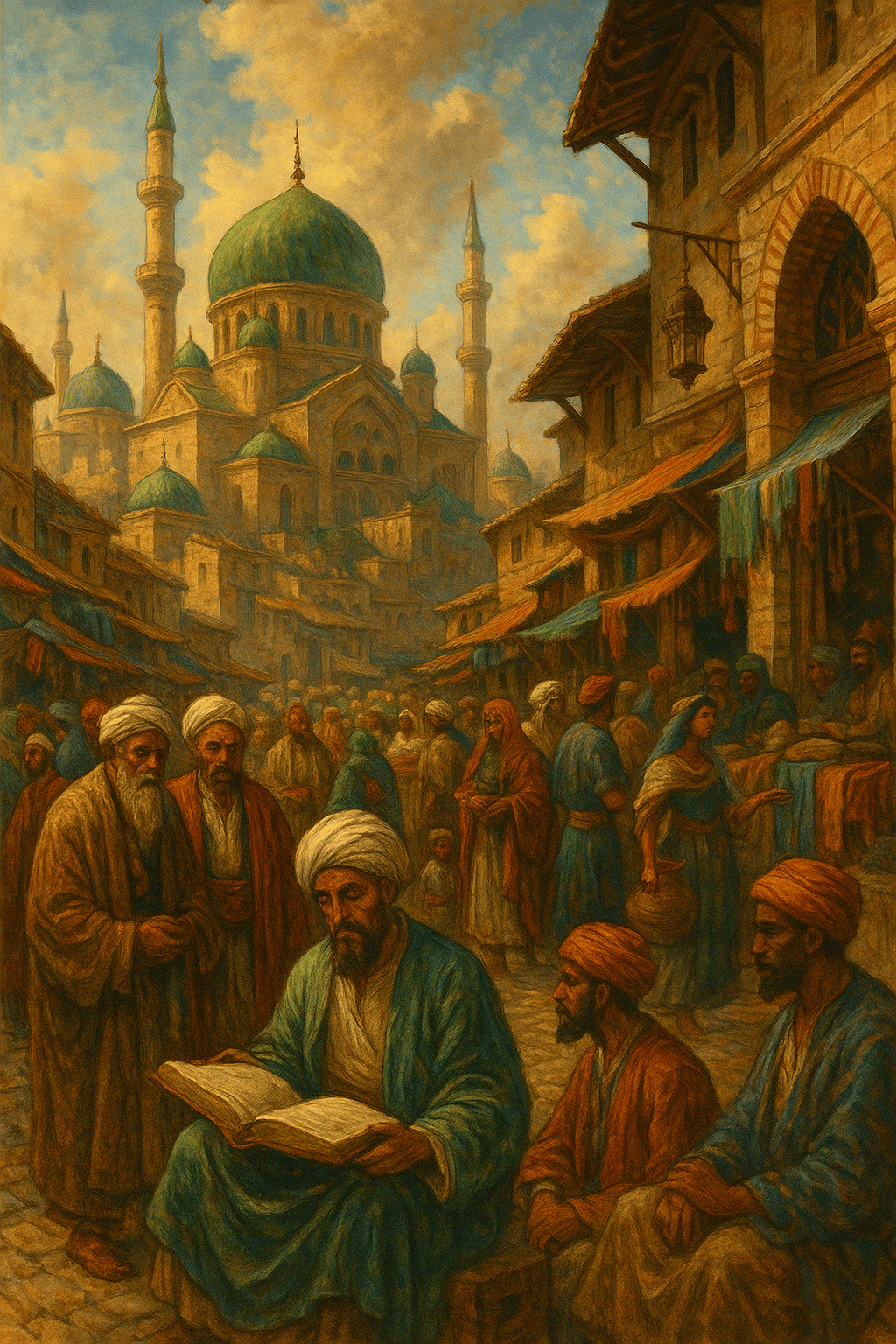
From West Africa to the coasts of India, the Islamic world gave rise to something Europe couldn’t yet imagine: a vast and interconnected world system. Cities like Baghdad, Cairo, Timbuktu, Cordoba, and Samarkand weren’t just religious centers—they were global hubs of trade, learning, and invention. The streets bustled with languages. The markets moved spices, gold, manuscripts, and mathematics. Libraries stored not just holy books, but translated works from Greeks, Persians, and Indians. Algebra, astronomy, pharmacology, irrigation, navigation—these weren’t future inventions. They were present realities.
Janet Abu-Lughod said it plainly: before Europe ruled the world, the world was already functioning just fine without it. The Afro-Asian world system was real, robust, and far ahead of anything in the West. Europe was the periphery—Islam was the center.
IV. Africa Was Never a Sideshow
Don’t let modern maps or colonial lies fool you—Africa was never on the margins. It was in the thick of it. The gold and salt empires of Mali and Songhai plugged directly into trans-Saharan trade routes, connecting West Africa to North Africa, the Middle East, and beyond. Timbuktu was not a myth—it was a city of scholars and libraries, where ideas moved faster than armies. And Islam didn’t come by sword—it came with trade caravans and scholarship, blending into local cultures and creating something beautifully hybrid.
Africa in this period was literate, sovereign, and connected. While peasants in Europe were being told to fast and obey, African merchants were drawing contracts and debating theology. The lie that Africa was “discovered” by Europeans only works if you erase the civilizations that already lit the continent like stars in a night sky.
V. The Moors Cross Into Europe: Andalus as the Gateway
In 711, a Berber general named Tariq ibn Ziyad led an army across the Strait of Gibraltar and shattered the Visigothic kingdom that ruled Iberia. Within a few years, most of the peninsula was under Muslim rule. This wasn’t some barbarian invasion. It was the introduction of civilization.
The Moors didn’t just conquer—they rebuilt. They irrigated the land, paved roads, lit the cities, and erected universities, libraries, observatories, and hospitals. In Cordoba, there were streetlights and public baths while most of Paris was still ankle-deep in sewage. Poetry flourished. Medicine advanced. Jews and Christians were allowed to live, trade, and worship, sometimes with more tolerance than they’d ever get under Catholic rule.
Al-Andalus was not just Islamic Europe—it was a living argument against the poverty and fanaticism of feudal Christendom. And for centuries, it was the most advanced society in Western Europe.
Europe did not rediscover reason on its own. It had it reintroduced—through Al-Andalus, through the Moors, through Islam.
VI. The West Starts to Peek Over the Fence
As the centuries passed, Europe began to stir—not from internal genius, but from exposure to the Islamic world. Through Spain, Sicily, and trade with North Africa, European elites came into contact with a system far more advanced than anything they knew. They saw irrigation, sanitation, architecture, philosophy, medicine. And they wanted it.
They called it “the Renaissance,” but they didn’t invent it. They inherited it. They translated Arabic texts into Latin and called it rediscovery. But they never credited the sources. Europe didn’t rise from within—it was dragged upward by contact with a world that had already surpassed it.
VII. A Clash Was Brewing
Islam didn’t threaten Europe because of religion. It threatened Europe because it worked. It threatened the Church because it showed a different way to organize society—one that wasn’t ruled by priests and kings. Europe didn’t launch the Crusades because they were pious. They launched them because they were poor, backwards, and locked out of the global economy. The sword came where trade had failed.
But that clash is still coming. First, the West had to learn to crawl before it could conquer. And what it learned, it learned from the people it would later call infidels, savages, and subjects.
A World That Existed Before Empire
The story we’re told is that Europe civilized the world. But the truth is simpler: the world was already civilized. Europe just caught up—and then burned it down.
The Afro-Asian world system, with Islam at its core, was not just a golden age—it was the standard by which Europe would measure itself for centuries. But in the next part of our story, that envy becomes ambition. And ambition, in the West, has always come with blood.
 Weaponized Information
Links to all six parts to date (July 6, 2025)
1. https://weaponizedinformation.wordpress.com/2025/06/01/from-the-holy-throne-to-global-empire-part-1/
2. https://weaponizedinformation.wordpress.com/2025/06/08/from-the-holy-throne-to-global-empire-part-2/
3. https://weaponizedinformation.wordpress.com/2025/06/15/from-the-holy-throne-to-global-empire-part-3/
4. https://weaponizedinformation.wordpress.com/2025/06/22/from-the-holy-throne-to-global-empire-part-4/
5. https://weaponizedinformation.wordpress.com/2025/06/29/from-the-holy-throne-to-global-empire-part-5/
6. https://weaponizedinformation.wordpress.com/2025/07/06/from-the-holy-throne-to-global-empire-part-6/
LikeLike