Charlemagne and the Making of the West
By Weaponized Information
📖 From the Holy Throne to Global Empire Series:
I. When the Pope Crowned a Warlord
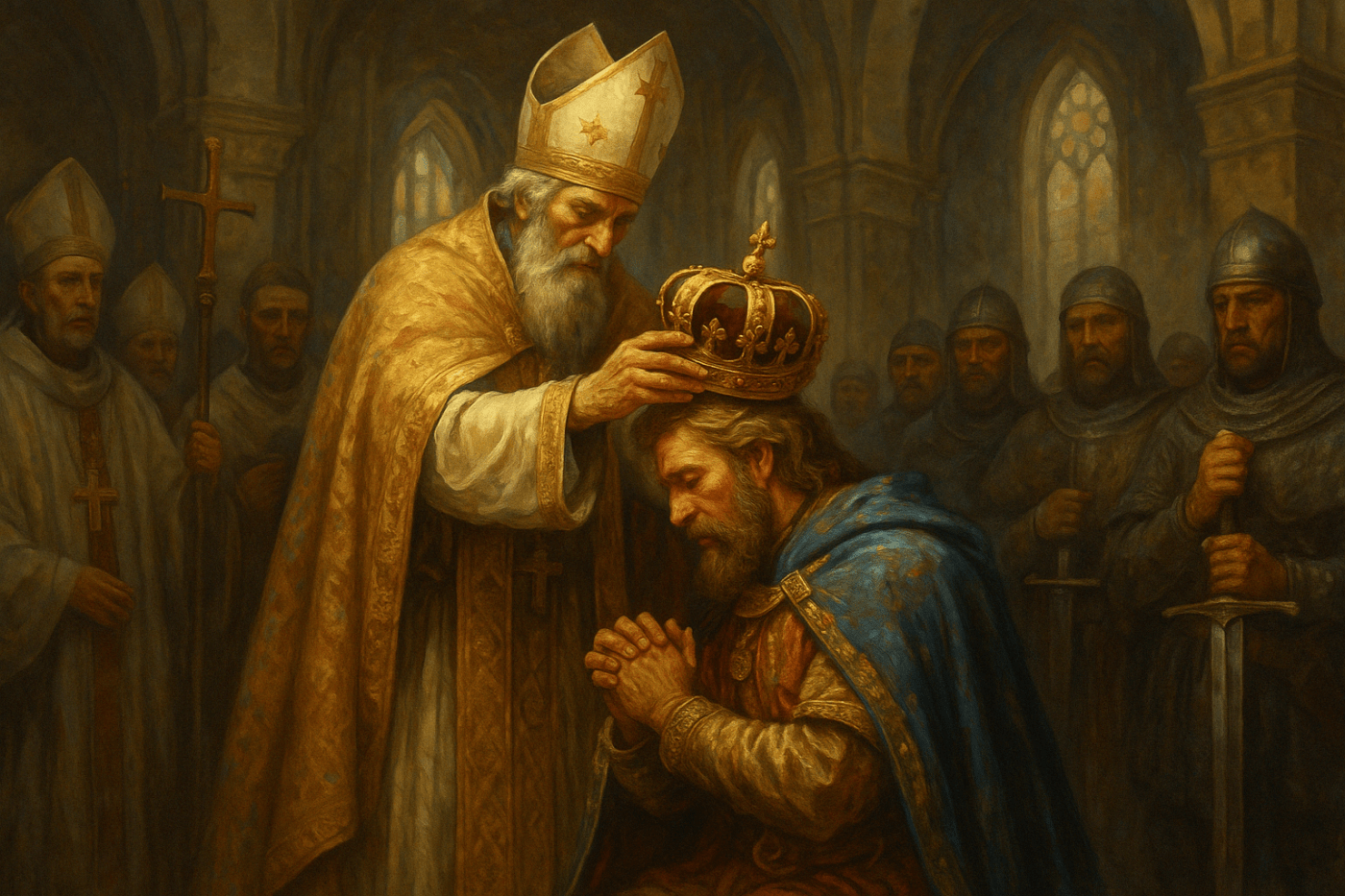
On Christmas Day in the year 800, Pope Leo III pulled off one of the slickest political stunts in European history: he crowned Charlemagne—king of the Franks—as “Emperor of the Romans.” Don’t let the pageantry fool you. This wasn’t about God’s will or divine right—it was raw politics. The Roman Empire had collapsed in the West, and the Church needed a new enforcer. Charlemagne needed legitimacy, the Pope needed muscle, and both got what they wanted: a theocratic empire built on conquest, property, and holy obedience.
This was the beginning of something we now call “the West”—not a culture, not a race, but a system. A militarized Christian empire forged through backroom deals between bishops and warlords, using divine authority to mask brutal class rule.
II. Feudalism: The Chains of the New World Order
Charlemagne’s empire didn’t rise out of democracy or reason—it was held together by feudalism. At the top, a handful of nobles who owned everything. At the bottom, peasants—serfs—bound to the land, working from sunup to sundown to feed their “lords.” The Church wasn’t just a bystander—it inserted itself into every corner of European life: birth, death, taxes, sex, salvation. A peasant couldn’t shit without the Church’s blessing—literally, the latrines were built with indulgences. The Church blessed the arrangement, declared it God’s order, and collected its 10% cut in tithes.
You want to talk about a divine economy? This was divine extortion. The clergy didn’t just preach obedience—they enforced it. They told peasants that their suffering was holy, that poverty was pious, and that questioning the system was rebellion against God himself. In short: work, pay, pray, and shut up.
III. The Carolingian “Renaissance”: Who Got to Read?
Historians love to talk about the “Carolingian Renaissance,” like it was some kind of golden age of knowledge and enlightenment. Let’s be honest—it was an elite literacy campaign, not a mass awakening. Charlemagne promoted learning, sure—but only for monks, priests, and the sons of noblemen. The rest of the people—the ones who grew the food, built the churches, and fought the wars—were kept illiterate by design.
The Church controlled the script, the schools, and the stories. They made sure the people knew the Bible—but only the parts that taught submission. They erased the radical memory of early Christianity and replaced it with a theology of hierarchy. Jesus the revolutionary was turned into Jesus the landlord.
IV. Empire with a Bible in One Hand and a Sword in the Other
Charlemagne wasn’t just a king—he was a conqueror. He waged holy war against the Saxons, forced conversions at the edge of a blade, and burned villages that resisted baptism. The Church called it evangelism. The peasants called it terror. It was spiritual warfare as class warfare—an expansion of empire wrapped in scripture and sanctified by blood.
Everywhere the empire expanded, the Church followed with its registry books, its tax collectors, and its priests. They didn’t just want your soul—they wanted your harvest. Your children. Your loyalty. This was how “Christendom” grew: not by faith, but by fire and steel. And it was always the poor who paid the price.
V. Conclusion: Foundations of the Western Machine
Charlemagne’s coronation didn’t just revive an empire—it set the blueprint for the Western project that still haunts us today. An empire of capital cloaked in holiness. A system of hierarchy sold as divine order. A world where land belongs to the few, labor is exploited in the name of God, and the cross blesses the sword.
This wasn’t civilization. It was organized domination—with bishops on the payroll and peasants under the yoke. And while the empire would fragment after Charlemagne’s death, the logic of his rule—the fusion of church and state, war and worship—would echo across the next thousand years, from the Crusades to colonialism, from plantation slavery to global capitalism.
The Church didn’t just survive feudalism. It helped create it. And it cashed every tithe along the way.
✝️ Want to Go Deeper?
If “From the Holy Throne to Global Empire” exposes how the Church became a weapon of empire, our previous series digs even deeper—back to when the gospel was still dangerous, still radical, and still in the hands of the poor.
Explore From the Cross to the Throne: How Empire Hijacked a Revolution and discover the gospel before the bishops, before the bank accounts—before empire baptized rebellion and turned it into religion.
 Weaponized Information
Leave a comment