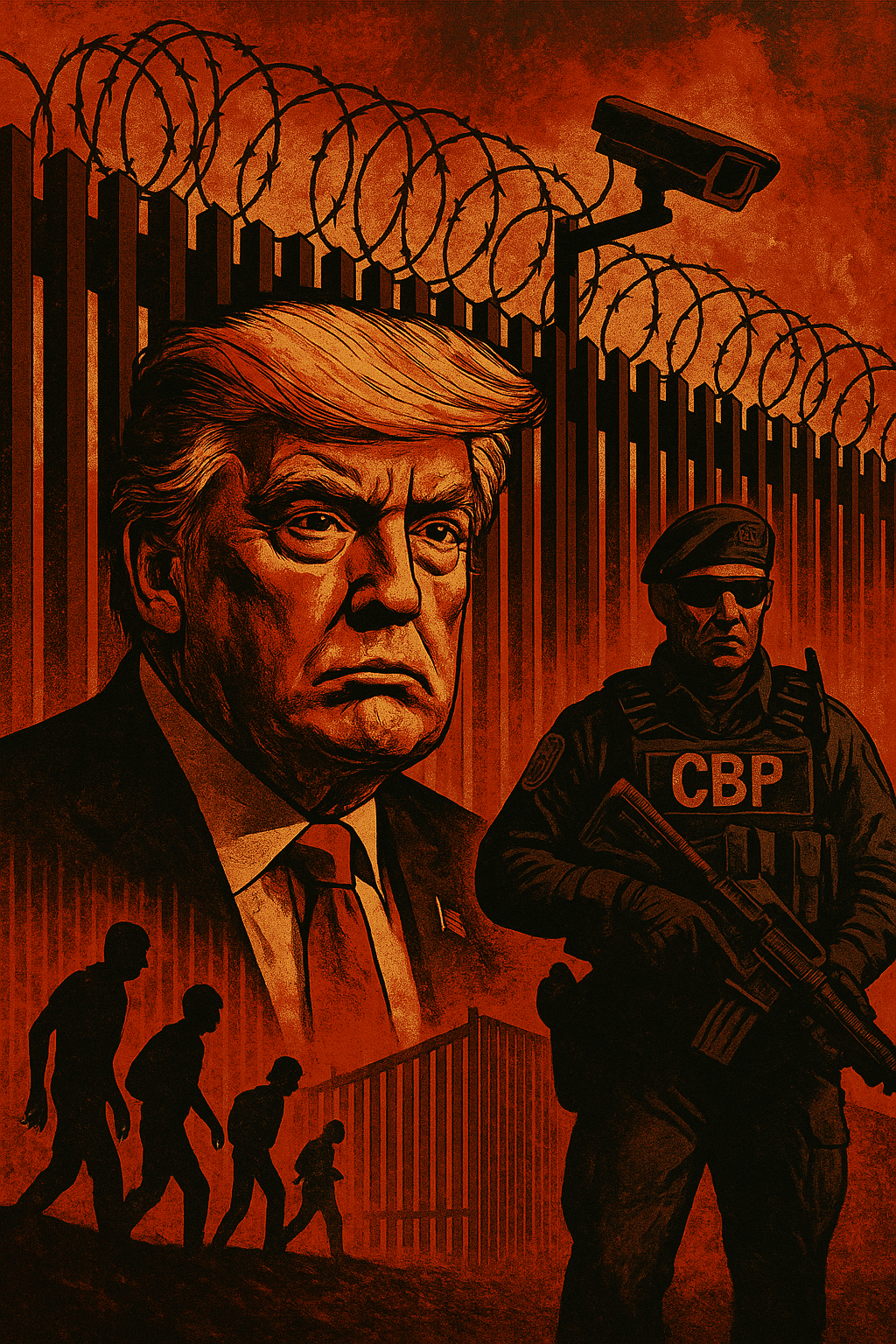
Trump’s revived travel ban is not a break from liberalism—it is its logical evolution. The technofascist state consolidates by criminalizing movement from the nations it has destroyed.
By Prince Kapone | Weaponized Information | June 4, 2025
Administrative Empire: How Technofascism Wields the Travel Ban
The article “Trump announces travel ban affecting a dozen countries set to go into effect Monday” was co-written by Chris Megerian and Farnoush Amiri—trusted stenographers of state policy within the corporate press. Megerian, a White House correspondent with years of experience buffering presidential narratives, and Amiri, a UN beat reporter embedded in diplomatic channels, serve as ideological technicians for U.S. empire. Their careers have been built on refining the language of repression into palatable administration. The article appears in the Associated Press (AP), a century-old media cartel operating as an arm of consensus manufacturing for Western imperialism, sustained by partnerships with corporate news giants, state departments, and transnational advertisers whose interests hinge on a compliant and sanitized public discourse.
The travel ban’s rollout aligns with the technocratic priorities of the Department of Homeland Security, the National Counterterrorism Center, and Palantir’s predictive surveillance operations. Boeing, Anduril, and Northrop Grumman—contractors of empire’s border regime—stand to profit from increased militarization, biometric tracking, and data-driven exclusion.
The article’s primary narrative technique is bureaucratic euphemism: violence is rebranded as policy, racial exclusion becomes “national security,” and imperial aggression is reduced to a logistical update. By omitting the violent historical role of the U.S. in every country targeted—Somalia, Yemen, Iran, Libya, Haiti, Eritrea, Afghanistan, Sudan, among others—the authors erase the dialectical relationship between imperial intervention and forced migration. The reader is not told that these nations were sanctioned, invaded, destabilized, or subjected to regime change operations. They are framed instead as spontaneously “hostile,” with their peoples rendered threats by fiat.
The tone is clinically neutral, but the effect is ideologically charged. Legalistic language shields the racist, imperial essence of the policy, allowing readers to interpret the ban as a protective measure rather than a continuation of global apartheid. Historical continuity with Trump’s original “Muslim Ban” is noted but not condemned—framed as a legal hiccup rather than the codification of racialized state violence. The language of security and sovereignty is deployed without question, masking the true function of the ban: to consolidate imperial control over human movement, criminalize resistance, and discipline nations that refuse subordination.
In presenting the ban as a response to “risk,” the article constructs a fiction of threat that justifies repression. There is no mention of the real threat posed by U.S. military bases, sanctions, or CIA destabilization in the very regions targeted. This sleight of hand transforms victimized nations into suspects, and aggressors into defenders. The AP, in this role, is not reporting—it is translating empire into grammar, laundering war through syntax, and narrating a police order as a political norm.
Global Apartheid by Design: Extracting the Truth from Technocratic Obscurity
The article confirms that President Donald Trump has signed a new executive order banning travel from a dozen countries—Afghanistan, Burma, Chad, the Republic of the Congo, Equatorial Guinea, Eritrea, Haiti, Iran, Libya, Somalia, Sudan, and Yemen—with heightened restrictions placed on Burundi, Cuba, Laos, Sierra Leone, Togo, Turkmenistan, and Venezuela. It quotes Trump’s justification: that the ban protects “national security” by targeting nations allegedly expressing “hostile attitudes” toward the U.S. The policy follows a report compiled by the State Department, Homeland Security, and the Director of National Intelligence. No details are provided about the process, criteria, or definitions of “hostile.” Instead, imperial suspicion is treated as self-evident.
What’s omitted is more damning than what’s included. Nearly every country on the list has been bombed, sanctioned, overthrown, or colonized by the U.S. or its imperial allies. Iran, Libya, and Yemen have been destabilized through direct war or proxy conflict. Somalia and Sudan were torn apart by Cold War counterinsurgency and neoliberal ruin. Haiti was subjected to multiple U.S.-backed coups. Afghanistan and Iraq were invaded and occupied. Venezuela and Cuba have resisted U.S. regime change and crippling sanctions. These are not “hostile nations”—they are survivors of empire. The framing of their exclusion as a “security measure” flips the script of violence: the empire that maims now claims victimhood, while its victims are branded threats.
This ban is not about travel—it’s about logistics. These restrictions are extensions of a broader technofascist regime of biometric surveillance, militarized border control, and economic warfare. The Department of Homeland Security’s biometric tracking systems, powered by firms like Palantir, fuse state and corporate data into tools for racial profiling and algorithmic exclusion. Militarized tech platforms such as Anduril, Clearview AI, and Raytheon feed into this apparatus, turning mobility into a site of battle. The same machinery that drones weddings in Yemen builds virtual walls on the U.S. border and flags African migrants in European airports.
The AP also ignores the domestic function of such bans: to rally a settler public behind the theater of imperial strength. In the midst of economic decline, political instability, and class contradiction, immigration bans offer the illusion of control. They manufacture an enemy abroad to discipline rebellion at home. They suppress migrant labor flows not to enhance security, but to regulate labor markets, suppress wages, and consolidate social control through fear. This is technofascism: not simply a revival of white nationalism, but a computational, data-driven restructuring of borders and bodies in the interests of capital.
Historical amnesia is central to the propaganda. The article references the 2017 “Muslim ban” as if it were an isolated controversy, not the opening act in a long-term strategy of imperial labor recalibration. As Weaponized Information has documented, deportations, visa bans, and refugee restrictions serve as tools of economic warfare, designed to isolate disobedient regimes and extract maximum value from vulnerable populations. The AP article erases these logics, flattening systemic policy into shallow news.
Ultimately, this executive order is part of a broader pattern of imperial decline. As the U.S. loses ground globally—to multipolar alliances, sovereign resistance, and economic de-dollarization—it tightens control over human movement. Mobility becomes a weapon. Those deemed surplus, dangerous, or noncompliant are excluded—not merely from borders, but from the category of humanity itself.
From National Security to Neocolonial Strategy: Reframing the Logic of the Ban
This isn’t about “protecting Americans.” It’s about protecting an empire in crisis. Trump’s executive order is not an irrational outburst of xenophobia—it is the rational operation of technofascism. The real targets of this ban are not just the people of the listed countries, but the political possibilities they represent: resistance, survival, sovereignty, and noncompliance. Every nation named in the proclamation is a living reminder of empire’s failures—failed invasions, failed coups, failed markets, failed domination. The U.S. seeks to quarantine not terrorism, but the contagion of defiance.
The framing of “hostile attitudes” is imperial projection: the violence the U.S. has inflicted—on Libya, Somalia, Yemen, Haiti, and others—is rebranded as threat. But the real threat to U.S. capital is a world no longer willing to bow. What Trump calls “hostility” is really sovereignty. What the AP calls “security” is the systematic recalibration of imperial management under the banner of counterterrorism. It’s the logistical fine-tuning of who gets to move, who gets to stay, and who gets to live.
From a proletarian and anti-colonial standpoint, we must reframe this ban not as a blunder, but as a blueprint. It is a strategic consolidation of the technofascist state—designed to manage labor flows, militarize logistics, and preemptively crush rebellion. The system isn’t broken; it’s functioning exactly as intended. Deportation, exclusion, and surveillance are not bugs—they are features of a settler empire attempting to reassert its dominance through data, force, and fear.
This also reframes the so-called “immigrant crisis” as a capitalist crisis. These bans are not just racist—they’re economically strategic. The labor of Black and Brown migrants—undocumented, surveilled, hyper-exploited—has long been a pillar of the U.S. economy. By criminalizing movement while maintaining imperial pillage abroad, the U.S. keeps migrant labor precarious and cheap. This is not border control. This is labor control.
The contradictions are stark: the same empire that destabilizes these nations refuses their refugees. The same corporations that profit from militarized surveillance also profit from private detention centers and forced deportations. The same state that bans Somali families builds AFRICOM bases in their homelands. This isn’t hypocrisy—it’s coherence. It’s the logic of empire under strain, desperate to maintain the illusion of order while the world it dominated slips away.
We reframe the narrative: this is not a ban. It is a blockade. A blockade against freedom, dignity, and the inevitable collapse of a system built on plunder. And just as all blockades eventually break, so too will this one. The tides of history are not on Trump’s side. They are with the people he tries to wall out.
Breaking the Blockade: What Must Be Done
In the face of empire’s tightening grip, we declare solidarity not in words but in struggle. This is not merely about opposing a travel ban—it is about dismantling the global architecture of domination that made such a ban both possible and profitable. We unite with the peoples of Somalia, Yemen, Haiti, Libya, and every other nation strangled by imperial sanctions, occupation, proxy war, and debt bondage. These nations are not “threats”—they are frontline casualties of a technofascist world order, and their resistance is our collective horizon.
Around the world, mass movements are rejecting the myth that empire protects. From Port-au-Prince to Sana’a, from Tripoli to Tehran, people have fought back—not only against bombs and sanctions, but against the erasure of their humanity. In the U.S., the immigrant justice movement, Black liberation forces, abolitionist organizers, and worker-led coalitions have long resisted the weaponization of borders and the criminalization of migration. This moment demands we escalate that resistance and connect it to a broader anti-imperialist front.
The following actions are necessary and urgent:
- Expose the material class function of travel bans and deportations as tools of labor discipline and imperial control—not merely as expressions of bigotry.
- Build internationalist alliances between immigrant communities in the U.S. and revolutionary movements in their homelands, particularly in the Global South.
- Support legal and extralegal resistance to immigration enforcement—from community sanctuary networks to targeted economic disruption of ICE contractors and surveillance firms.
- Refuse collaboration with the machinery of border militarization in every institution—from tech firms to universities to city councils.
- Agitate for a people’s foreign policy rooted in reparations, demilitarization, decolonization, and the dismantling of imperial logistics infrastructure worldwide.
We must not simply resist this new ban—we must resist the system that produced it. That system will not fall by lawsuits, nor be reformed by elections. It will fall through organized, coordinated, international struggle. And that struggle begins with clarity: clarity that the enemy is not the refugee or the migrant—it is the empire that made them so.
We know the names of the firms that profit from detention. We know the routes of the drones and the investors behind the surveillance systems. We know that behind every travel ban lies a blueprint for global apartheid. And we know the only solution is abolition—not just of ICE, not just of DHS, but of the entire settler-imperialist order that birthed them.
Let the walls tremble. Let the checkpoints fall. Let the borders bleed open until nothing remains but people—moving, living, rising.
 Weaponized Information
Leave a comment