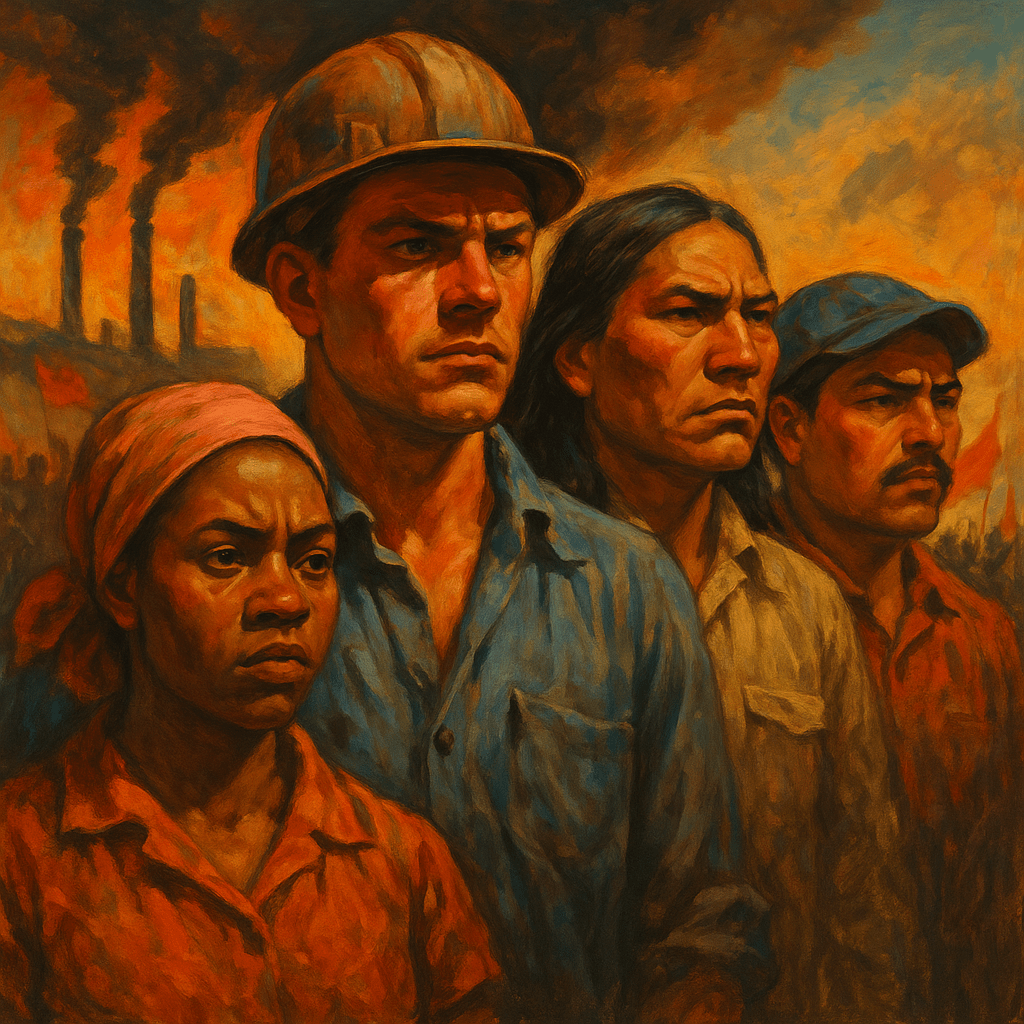
There are 20 million poor white people. That doesn’t mean we’re all on the same side.
By Prince Kapone | Weaponized Information | May 31, 2025
A Line in the Sand: Class Unity or Colonial Reality?
There’s a familiar chant echoing through union halls, protest marches, and socialist podcasts: “We’re all working class.” It’s offered like a unifying truth, a kind of political gospel meant to build bridges between Appalachia and the barrio, the Rust Belt and the rez. And on the surface, it sounds noble. It even sounds radical.
But it’s not true. Not here. Not in the belly of the beast. Not in a settler-colonial empire built on genocide, slavery, land theft, and global plunder. “Working class” is not a magic word that erases contradiction. It doesn’t flatten centuries of colonial domination. And it sure as hell doesn’t put white folks and colonized peoples on the same side of the barricade.
Let’s be real. There are tens of millions of white people in poverty across the U.S. But poverty alone is not the measure of oppression—not in a colonial system. Misery exists at different altitudes. A white worker may be broke, but still benefits from the stolen land beneath their feet, the militarized police protecting their neighborhoods, the inherited structures of settler power built to serve them, not surveil them.
I’m not writing this as one of the colonized. I’m writing this as someone born into empire, handed the wages of whiteness, and told to see solidarity where there was only hierarchy. I come from the white lumpenproletariat—broke, criminalized, cast out—but still tethered, materially and ideologically, to the settler project. That’s why this isn’t a call for guilt or charity. It’s a call for defection.
Defection from the lies. From the settler illusions. From the colonial alliance that turns our misery into a weapon against the truly oppressed. This is a line in the sand—a refusal to pretend that whiteness and liberation can coexist. Because they can’t.
The point of this essay is simple: if white workers want to be part of the revolutionary struggle, they have to make a break. A break with settlerism. A break with imperialism. A break with the fantasy that we’re all in the same boat just because we’re all catching hell.
The colonized proletariat—Black, Indigenous, Chicano, and beyond—is not waiting for white redemption. They’re already leading the fight. The question is whether white workers will join them—not as leaders, not as equals, but as defectors. Not as allies in comfort, but as comrades in struggle.
Revolution doesn’t start with unity. It starts with choosing a side.
Class is Not an Identity: The Dialectics of Labor in a Colonial Empire
One of the most damaging lies handed down through white leftist culture is the idea that class is a fixed identity—you know, “the working class” as some gritty badge you earn through a paycheck, a warehouse shift, or a hard time getting health insurance. But Marx never said class was a vibe. He said it was a relationship. A material one. Rooted in production. And in an empire like the U.S., that relationship is inseparable from colonialism.
Class, in real terms, is about your position in the chain of extraction. Who produces, who profits, who polices, and who gets policed. And that chain doesn’t just stretch from Wall Street to Walmart—it runs through the Congo, the sweatshops of Bangladesh, the fields of Central America, and the carceral plantations of Mississippi. So when someone says “we’re all working class,” the question is: working for whom? Against whom?
Let’s make it concrete. Enslaved Africans picking cotton under the lash weren’t “just like” Irish factory workers in New York. Native people getting massacred and displaced to make way for railroads weren’t “fellow workers” with the settler construction crews. The landless Chicano laborer, sprayed with pesticides and deported at will, is not in the same class position as the white trucker hauling Walmart goods subsidized by global superexploitation.
Even today, colonized people—Black, Brown, Indigenous—are locked into a condition of superexploitation. They don’t just get paid less. Their very life conditions—housing, health, schooling, water, police contact, state surveillance—are shaped by domination. Their labor is not just exploited, but controlled through force, discipline, and exclusion. Their reproduction is policed. Their nations—yes, nations—exist under occupation.
That’s not just racism. That’s colonialism. And if you can’t tell the difference, you’ll never understand class inside the U.S.—because there is no “working class” without colonial contradiction. There is no class analysis that can skip over the land it’s built on and the people it’s stolen from.
So no, class isn’t an identity. It’s a structure. It’s historical. It’s global. And in the U.S., it’s settler-colonial. White workers have a choice: cling to a false sameness, or step into the clarity of contradiction. But there is no revolution in this empire without a reckoning with the colonial foundations of class itself.
Poverty ≠ Oppression: The Myth of “20 Million Poor Whites”
Let’s get one thing straight—there are millions of white people in America living in real, grinding poverty. Rural Appalachia. Meth-stripped towns in the Midwest. Working-class suburbs gutted by deindustrialization. That’s all real. But here’s what’s also real: being broke doesn’t make you colonized. Poverty isn’t the same as oppression—not in a settler-colonial empire.
The liberal and left response to any mention of colonial contradiction is often a knee-jerk: “Well what about the 20 million poor white people?” But this argument collapses as soon as you step back and ask: poor compared to whom? And poor in what structure? Because even in their poverty, most white Americans are insulated by the stolen wealth, land, and privileges of empire.
Let’s run the numbers. White poverty exists, but per capita, it’s lower than for every single colonized group in the U.S. White households still have more generational wealth, higher rates of homeownership, better access to credit and legal protection, and drastically lower chances of being brutalized by police or funneled into prison. Even in the trailer park, whiteness pays dividends.
And this isn’t just a matter of domestic racial capitalism. Poor whites benefit from imperialism abroad. The phones in their pockets, the cheap meat in their freezers, the Walmart shirts on their backs—all subsidized by the blood and labor of the Global South. The U.S. doesn’t have a poverty problem—it has a parasite problem, where even its poorest citizens draw some material benefit from the global system of plunder.
That doesn’t mean white poverty isn’t real. It means it’s not revolutionary by default. In fact, the historical record shows the opposite: from the slave patrols to the Klan to MAGA, the white poor have often served as the front line of reaction. Not because they’re genetically doomed, but because their class position has been shaped by petty-bourgeois dreams and colonial bribes. They’re trained to punch down, not rise up.
So when we talk about 20 million poor white people, the question isn’t just “Are they suffering?” The question is: *What side are they on?* Because in a colonial empire, you don’t get to be neutral. You either cling to the wages of whiteness, or you defect. And until that choice is made, poverty is just another weapon wielded against the oppressed—camouflaged in class, but still soaked in empire.
Reactionary by Design: Historical Role of the White Poor
The story of the white poor in the U.S. isn’t one of uninterrupted struggle against the ruling class—it’s a story of incorporation into empire. From the very beginning, white poverty has been managed not with liberation, but with bribes. Not with solidarity, but with settler privilege. The poor were never offered a revolution—they were offered a deal: stay white, and you’ll never be at the bottom.
After Bacon’s Rebellion in 1676, the colonial elite saw the danger of cross-racial alliances between African slaves and European indentured servants. Their solution? Split the class. Offer the white poor land access, legal status, and entrance into the settler project. Give them proximity to power in exchange for loyalty to white supremacy. It worked. And it’s been working ever since.
White workers—especially in the South—defended slavery even though they owned no slaves. Why? Because the racial caste system guaranteed them superiority over Black people. Because they were taught that their interests aligned not with the enslaved, but with the master. Because whiteness was the currency of safety, dignity, and upward mobility.
Fast forward to the 20th century. Many poor whites filled the ranks of the Klan. They attacked Black communities during the Red Summer of 1919. They resisted civil rights. They became the stormtroopers of Jim Crow. And when the Black Power movement rose up in the ’60s, they fell in line behind Nixon’s Southern Strategy and Reagan’s “welfare queen” dog whistles. The backlash wasn’t just coming from above—it had a mass base from below.
And today? The tradition continues. From George Wallace to Donald Trump, poor and working-class whites have repeatedly thrown their weight behind open reaction—not because they’re inherently fascist, but because empire offered them a stake in whiteness. Because colonialism taught them to trade solidarity for superiority. Because without revolutionary leadership, contradictions don’t just sharpen—they get weaponized.
None of this means white people are doomed. It means their historical class consciousness has been distorted by a system that made them junior partners in genocide. The question now, as always, is: will they defect? Because if they don’t, they won’t be just neutral bystanders—they’ll be cannon fodder for the next phase of fascism. That’s the role empire has written for them. The task is to rewrite it.
The Prison House of Nations: Black, Indigenous, and Chicano Liberation as the Motor of Revolution
America is not a nation. It’s a prison. A settler colony welded together by conquest, maintained through force, and dressed up in democratic drag. What exists inside the borders of the United States is not a singular working class with a shared destiny—but a layered hierarchy of nations, with white settlers perched atop the rubble of genocide and slavery.
The so-called “racial minorities” in this empire are not just victims of discrimination—they are colonized peoples. Black people in the U.S. are not merely oppressed—they are a nation, forged through the crucible of forced labor, resistance, cultural cohesion, and geographic concentration. Indigenous peoples are not an ethnic group—they are sovereign nations with stolen land, broken treaties, and ongoing struggles for survival. Chicanos and Mexicano peoples in the Southwest are not immigrants—they are the colonized remnants of a nation dismembered by U.S. settler expansion.
These aren’t poetic claims. They are political realities, grounded in Marxist theory and revolutionary history. Lenin understood that a genuine revolutionary movement in a multinational empire must center the self-determination of oppressed nations. The U.S. isn’t a melting pot—it’s a pressure cooker, and the heat comes from the colonial contradiction at its core.
Look to history. The Black Panther Party wasn’t a charity—it was a national liberation movement. The American Indian Movement wasn’t asking for inclusion—it was defending land, culture, and sovereignty. The Brown Berets didn’t want assimilation—they demanded an end to U.S. occupation and the return of stolen territory. These struggles were—and are—fights for liberation from colonial domination, not for better seats at the settler table.
And these struggles aren’t over. From the streets of Ferguson to the frontlines at Standing Rock, from the migrant caravans defying borders to the prisoners waging hunger strikes in the belly of the beast—colonized people are still fighting. Still leading. Still resisting empire at every turn.
Revolution in the U.S. will not be a rerun of the Russian Revolution with cowboy hats. It will not be led by white workers with good politics. It will be forged in the fire of national liberation struggles. White revolutionaries can be comrades—but they must never forget: this is not their stage, not their script, and not their leadership. The road to socialism runs through the right of nations to determine their own fate—by any means necessary.
Real Solidarity Requires Defection, Not Guilt
Solidarity is one of the most abused words in the white left’s vocabulary. It gets tossed around like confetti at a protest—sweet, vague, and harmless. But real solidarity is not about shared slogans or performative guilt. It’s about rupture. It’s about choosing a side. And in a settler-colonial empire like the U.S., that choice must take the form of defection—ideological, material, and organizational.
Too many white radicals think solidarity means feeling bad and then marching next to oppressed people. But the colonized don’t need white pity. They don’t need moral cheerleaders. They need traitors to empire. They need white revolutionaries willing to burn the bridge that whiteness built, and fight like hell on the other side.
Defection means cutting ties with the ideological assumptions of settlerism—the belief that white perspectives are default, that white struggles are universal, that liberation must be legible to white understanding. It means interrogating every impulse to lead, center, or correct colonized people. It means shutting up, showing up, and submitting to the leadership of those who’ve been fighting this war for generations.
It also means material defection. Rejecting the comforts that empire provides—even when you’re broke. Understanding that cheap rent on stolen land is still colonial plunder. That food, fuel, and tech subsidized by sweatshops and mines aren’t neutral goods—they’re the spoils of war. You can’t fight empire while feeding off its body.
Organizationally, defection means building structures of struggle that are accountable to colonized leadership. It means joining formations that don’t just include oppressed people, but are shaped and led by them. It means refusing to reproduce the racial hierarchies of capitalism within the movements supposedly fighting it.
Fred Hampton understood this. That’s why he built the Rainbow Coalition—not to flatten difference, but to forge principled unity on anti-colonial terms. The Young Patriots didn’t become revolutionaries because they were poor—they became revolutionaries because they defected. Because they stopped trying to lead and started following the Black Panther Party’s political line. That’s not guilt—that’s commitment.
Real solidarity doesn’t feel good. It feels like tearing something out of yourself. It feels like loss—of illusion, of comfort, of false belonging. But that’s the cost of switching sides. And for white revolutionaries in the empire’s core, switching sides is the only way forward.
False Friends: How the White Left Obscures Colonialism
The greatest obstacle to revolutionary clarity in the U.S. isn’t always the ruling class. Sometimes it’s the people claiming to oppose it. The white left—especially its loudest, most institutionally visible wings—has made a habit of obscuring the colonial foundations of this empire. Whether through ignorance, opportunism, or outright refusal, these forces become buffers for the very system they claim to fight.
Start with the class reductionists: your DSA types, your podcast Marxists, your electoral socialists who think capitalism is the root of all evil but somehow forget that capitalism was born out of genocide, slavery, and colonial conquest. They preach “working-class unity” while ignoring the fact that the “working class” they imagine is overwhelmingly white, suburban, and hostile to any analysis that centers land theft or Black liberation. For them, racism is a side hustle—something to be fixed after Medicare for All.
Then there’s the liberal-identitarian left—the NGOs, the nonprofits, the diversity trainers, the DEI departments of corporate America. These folks use the language of justice to rebrand empire in woke fonts. They treat colonized people as marketing demographics, teach middle managers how not to say the N-word, and call it revolution. What they erase is the material relationship between race and capital, land and power, imperialism and labor. Their politics is identity without struggle—liberalism with a tan.
And don’t forget the anarchists. Not all, but enough to note. The ones who fetishize spontaneity, reject political organization, and think direct action means dressing in black and breaking windows without any mass base. They love to scream “no gods, no masters” while refusing to listen to the actual revolutionary leadership of colonized people. Their anti-authoritarianism too often becomes a cover for white autonomy—a refusal to be disciplined, accountable, or led.
Across all these tendencies, a common thread: the colonial contradiction is either erased or downplayed. The result? Movements that center white fear instead of Black liberation. Campaigns that demand economic justice but leave Indigenous sovereignty off the table. Organizations that tokenize oppressed people while keeping settler politics in the driver’s seat.
The left in the U.S. has had centuries to get it right. It has failed—again and again—because it refuses to confront the foundational truth: this is stolen land. This is a settler state. And no amount of policy proposals or protest signs can undo that. Only a revolutionary break can.
Until the white left gets honest about its role—its history, its betrayals, its material interests—it will continue to serve as a brake on struggle, not a vehicle for liberation. Because false friends are more dangerous than open enemies. They don’t just block the road—they claim to pave it.
The Principal Contradiction: Colonialism as the Foundation of Empire
You can’t fix a house built on a mass grave. You burn it down and start again—somewhere else, under someone else’s direction. That’s the level of clarity we need when we talk about revolution in the United States. Because colonialism isn’t one contradiction among many—it is the principal contradiction. It is the root system feeding every crisis, every injustice, every form of exploitation in this settler empire.
The U.S. wasn’t founded by workers. It was founded by colonizers. The wealth that built its factories came from stolen land and stolen labor. Its democracy was designed as a dictatorship over Black bodies, Indigenous nations, and the Global South. Its economy runs on war, its borders are walls around plunder, and its workers—especially white ones—have been conditioned to defend the system as if it were theirs.
Lenin taught us that the national question is a class question. That no proletarian struggle can succeed unless it supports the right of oppressed nations to self-determination—even to secession. That means socialism in the U.S. doesn’t look like a universal welfare state—it looks like Indigenous land back. It looks like Black reparations. It looks like decolonization.
If you’re a white revolutionary in the U.S. and you haven’t come to terms with this, then you’re not fighting for socialism—you’re fighting for a fairer distribution of colonial spoils. You’re demanding a bigger piece of a stolen pie. And that’s not revolution. That’s reformism in settler drag.
The colonized working class is not an interest group. It’s the vanguard. The Black, Indigenous, and Chicano nations within U.S. borders are not “marginal communities”—they are the core of any possible liberation. Without their leadership, there is no path forward. With it, there is a chance to bring this empire to its knees and build something new from the ruins.
So the question isn’t whether white workers are exploited. They are. The question is whether they are ready to turn their backs on the empire that exploits others more viciously—and from which they still benefit. The contradiction is clear. The line has been drawn. It’s time to choose.
Whose Side Are You On?
Let’s bring it home. There’s a lot of noise in this empire—about unity, about class, about the “real” working class. But strip all the slogans away, and the question remains brutally simple: whose side are you on?
Because we don’t got the same problems. White workers aren’t policed like Black communities. They aren’t disappeared like Indigenous women. They aren’t caged and deported like migrants. They aren’t occupied like Palestinians or bombed like Yemenis. They aren’t colonized. They’re exploited—yes—but not in the same structure, not under the same boot.
If you’re white and poor in this empire, your pain is real. But it’s not the foundation for solidarity. The foundation is rupture. A break. A line in the sand. A conscious defection from the systems that have given you crumbs in exchange for your silence, your fear, and your complicity.
You don’t get to claim comradeship with the colonized just because you’re broke. You don’t get to march next to liberation movements while holding onto settler identity. Solidarity is not a sticker—it’s a sacrifice. It’s a daily struggle to unlearn empire, to reject its comforts, and to place yourself in service to those it seeks to destroy.
That means letting go of the fantasy that we’re all on equal footing. We’re not. Colonized peoples don’t owe white workers their allegiance. They don’t need your validation or your apologies. What they need—what this moment demands—is commitment. Material, political, and ideological.
Not with the flag. Not with the police. Not with the unions of empire. But with the barricades. With the hunger strikes. With the land back camps. With the uprisings. With the prison rebellions. With the people.
Defection isn’t symbolic—it’s strategic. Because the empire has no future. But the struggle does. And every white worker who breaks ranks, who rejects settlerism, who submits to the leadership of the colonized proletariat—that’s one more crack in the foundation. One more rupture in the machine.
So again, the question stands: whose side are you on?
 Weaponized Information
Leave a comment