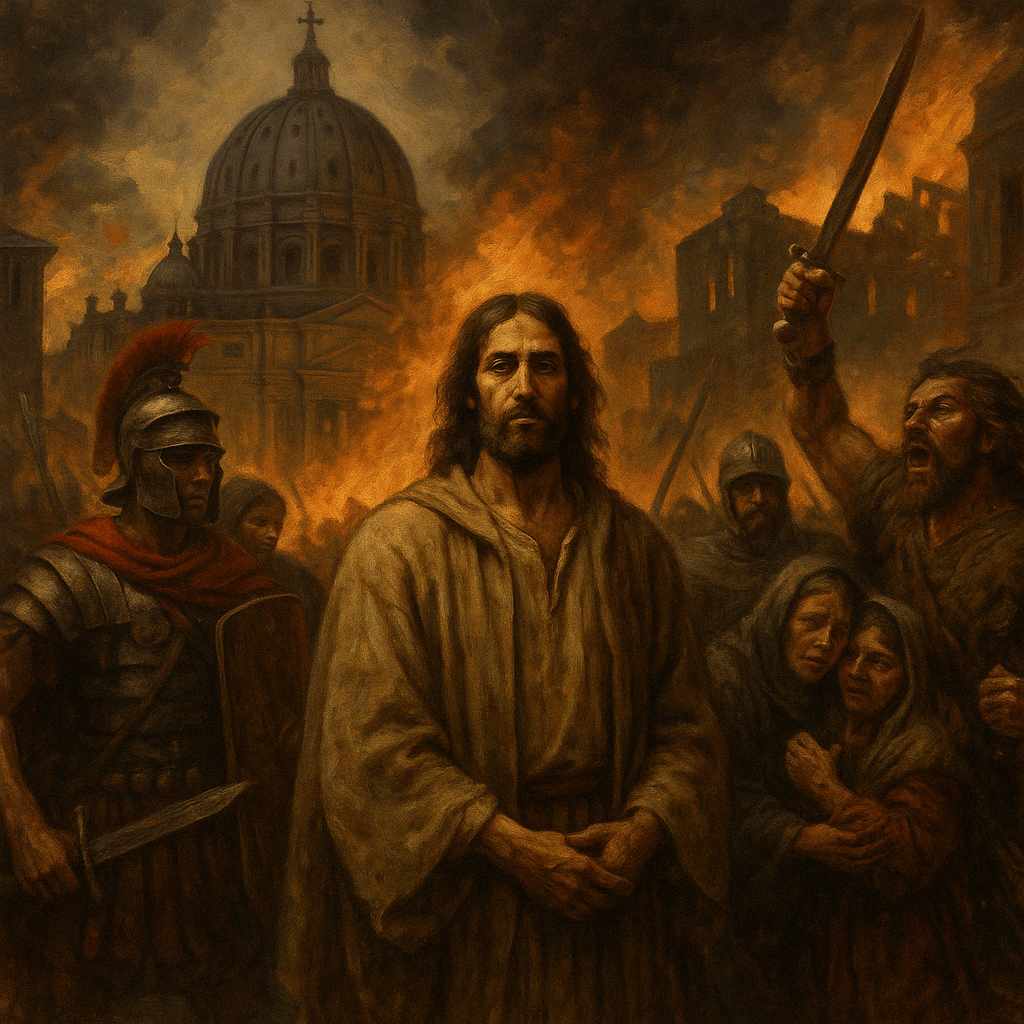
The Empire Collapses, the Cross Survives: From Constantine to the Fall of Rome
By Weaponized Information
I. The Constantinian Shift: Christianity’s Imperial Co-optation
When Constantine declared Christianity legal in 313 CE with the Edict of Milan, it wasn’t because he had a sudden epiphany about salvation. No, Constantine saw the rise of a powerful movement and realized it was more pragmatic to co-opt it than to destroy it. The Church, once a persecuted group of rebels, now became the very thing it had opposed: the enforcer of order, the pacifier of dissent, and a servant of the imperial state.
By 380 CE, with Theodosius I declaring Christianity the state religion, the church didn’t just join the empire—it became the empire’s ideological arm. Bishops took on the power of governors, religious doctrine became law, and those who opposed imperial rule were branded as heretics. Constantine may not have been baptized yet, but he sure as hell understood how to use the Church to keep the masses in line. The cross was no longer a symbol of resistance—it became a symbol of imperial control.
II. Internal Decay: Economic and Social Strains
The Roman Empire wasn’t just politically collapsing—it was rotting from the inside out. The economy, reliant on slaves, conquest, and pillage, had hit a brick wall. The empire could no longer sustain itself on imperial expansion alone. The elites hoarded wealth, taxing the peasants into submission, while corruption, overextension, and military overstretch made the empire ripe for collapse. And who stepped in to patch up the holes? The Church.
Church leaders were quick to seize on the crisis. They claimed to offer spiritual salvation, but their material power grew as well. They became landlords, owners of vast estates, and powerful players in the emerging feudal economy. The Church wasn’t just offering people a way to save their souls—it was also offering a system to legitimize the new social order, one built on the backs of the poor. The feudal order that emerged in the wake of the empire’s collapse wasn’t just a return to pre-imperial chaos—it was a new structure of power that the Church helped secure.
III. External Pressures: Barbarian Invasions and Military Overreach
The Visigoths, Vandals, and Huns didn’t just barge in from outside—they had already been part of the Roman Empire’s military structure. The so-called “barbarians” were often hired mercenaries who had been promised land and stability, but when the empire couldn’t deliver, they took matters into their own hands. Alaric’s sack of Rome in 410 CE wasn’t a random act of violence—it was a clear message: the empire was a shell of its former self. Rome’s military might had been overextended and depleted by corruption, and the collapse was inevitable. But when Rome fell, the Church was already there to pick up the pieces, turning from a persecuted sect to the most powerful institution in the West.
IV. The Church’s Ascendancy Amidst Imperial Decline
As the Western Roman Empire crumbled, the Church didn’t just survive—it thrived. Bishops took over administrative functions. Churches became centers of political power. The rise of the Church was not about spreading salvation—it was about consolidating power. The clergy became advisors to kings, landowners, and military leaders. The memory of Jesus—the carpenter, the rebel—was lost in favor of a new, domesticated Christ who blessed the ruling class and their systems of oppression.
So, while the empire collapsed, the Church kept the imperial project alive—through ideology. It offered no material change for the poor, no challenge to the economic order. Instead, it promised them the afterlife, which was conveniently beyond the reach of the rulers who controlled the world they lived in. The Christian idea of salvation was no longer about liberation—it was about enduring suffering in this life to gain paradise in the next. This was no longer a revolutionary movement. It had been institutionalized, and its message co-opted by those in power.
V. The Fall of the Western Roman Empire
In 476 CE, Romulus Augustulus was deposed by the Germanic chieftain Odoacer, and with it, the Western Roman Empire effectively ended. The political structure of the empire may have crumbled, but its spiritual successor, the Church, not only remained intact, it expanded. Rome fell, but the power of the papacy grew stronger. This was no tragedy for the Church—it was an opportunity. With no more emperors to answer to, the Church began to wield political power across Europe. This wasn’t just a Christian resurgence—it was the rise of Christian imperialism. The Church wasn’t just a spiritual entity anymore—it was a global political institution.
VI. The Cross Replaces the Eagle
The fall of the Western Roman Empire didn’t mark the end of empire—it marked the beginning of a new form of empire. Christianity, which once opposed Roman domination, became the very vehicle of it. As feudalism took hold across Europe, the Church became the ideological glue holding the system together. Kings ruled by divine right, and bishops became political players. The cross, once an instrument of terror against rebellious slaves, became a tool of domination, a symbol of the state. The transition was complete: Christianity had become empire’s faithful servant.
The world was about to enter a new era of conquest, colonialism, and oppression. The fusion of Church and empire would set the stage for the brutal history that followed—from the Crusades to the Inquisition, from the colonization of the Americas to the global spread of capitalism. But in the midst of all this, the revolutionary memory of the early Christian movement—the memory of a poor man from Galilee who fought empire—would be buried beneath the weight of empire itself.
 Weaponized Information
Leave a comment