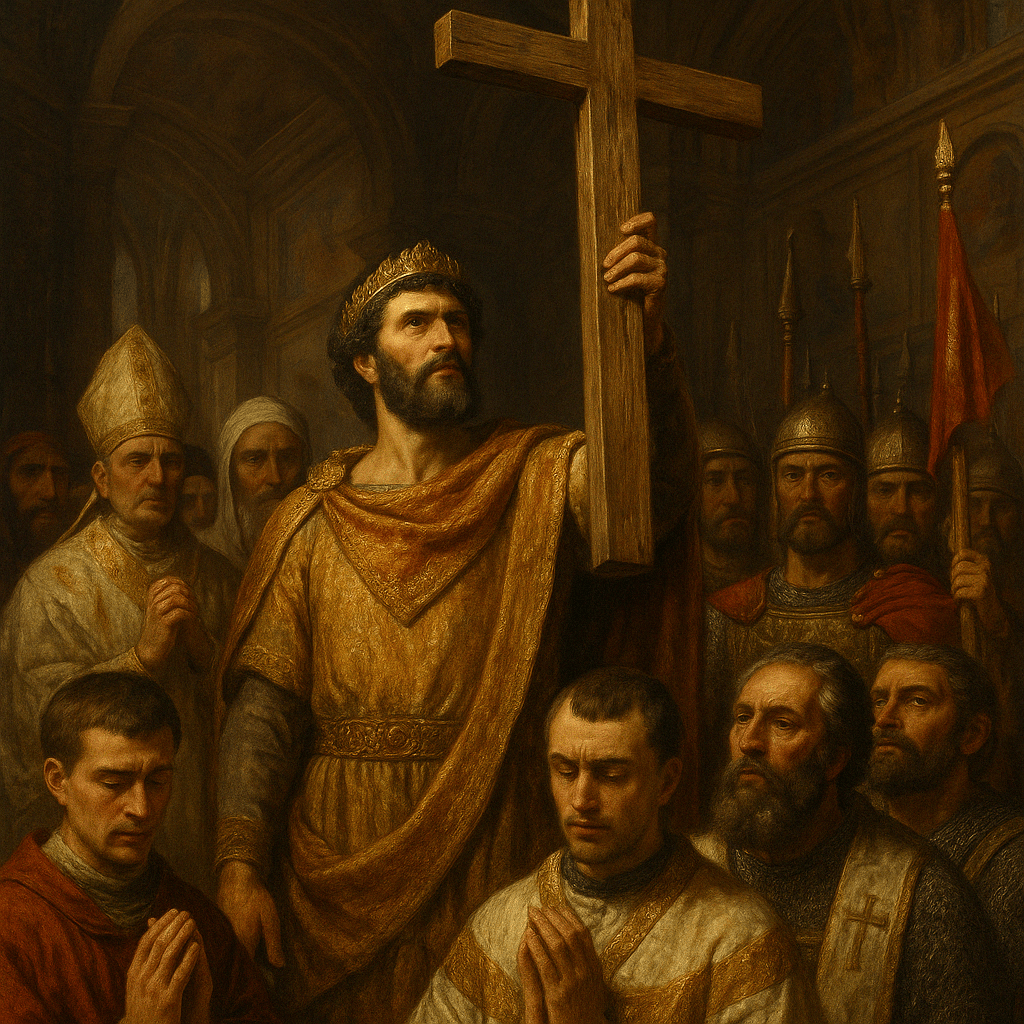
✝️ From the Cross to the Throne: A Weaponized Information Series
How empire hijacked a gospel of the poor—and how the oppressed kept it alive. Explore the full series below:
Baptizing the Empire: Constantine, the Council, and the Birth of Holy Conquest
By Weaponized Information
The Empire Learns to Pray
Christianity, once a movement of the oppressed, was now embraced by the oppressor. Constantine’s conversion was not a spiritual awakening but a strategic maneuver. The Edict of Milan in 313 CE legalized Christianity, not to liberate it, but to harness its growing influence for imperial stability.
I. The Council of Nicaea (325 CE): Empire as Theologian
To quell theological disputes threatening imperial unity, Constantine convened the First Council of Nicaea. The council condemned Arianism and formulated the Nicene Creed, enforcing doctrinal conformity. Arius and his followers were exiled, and their writings ordered to be burned, marking the beginning of state-enforced orthodoxy.
II. The New Christian State: Bishops Become Bureaucrats
Bishops gained political authority, wealth, and land. Church buildings were state-funded, and Sunday was declared a day of rest. The same empire that once crucified Christ now crowned his representatives, transforming the cross into a symbol of imperial power.
III. Dissent Doesn’t Disappear—It Gets Crushed
The Donatists in North Africa rejected the imperial church’s authority, insisting on a church of the pure and persecuted. Constantine responded with military force, confiscating their churches and exiling their leaders. Similarly, Arian Christians faced persecution, with their writings burned and leaders exiled, as the empire enforced theological conformity.
IV. The Theological Counterrevolution
Salvation became individualized, focusing on personal sin rather than collective liberation. Heaven was promised as a reward for obedience, and earthly justice was deferred. The state was reimagined as divinely ordained, with Romans 13 used to justify obedience to imperial authority.
V. From Martyrs to Mercenaries: The Birth of Christian Militarism
The memory of nonviolence was erased, and pacifism became heresy. Augustine’s “Just War” theory justified killing in the name of Christ. The church no longer flipped tables—it flipped alliances, aligning with imperial power to suppress dissent.
VI. The Holy Roman Empire: A New World Order
By the late 4th century, Christianity became the state religion of Rome. Paganism was outlawed, and Christian emperors began campaigns against heresy and idolatry. The Roman Empire did not collapse—it mutated into the Holy Roman Empire, with the church as its ideological engine.
A Crucified God, Now Weaponized by Caesar
What began with a poor man from Galilee and a broken loaf became an empire’s justification for global conquest. The memory of Jesus remained—but only in fragments, preserved by mystics, rebels, and the oppressed. Part 5 ends this series but opens the next arc: how Western empire weaponized the church for a thousand-year campaign of domination across the globe.
 Weaponized Information
Leave a comment