I. The Crisis of Metabolism, the Possibility of Renewal
Humanity’s rift with the earth is no longer abstract. It burns in the lungs of migrant workers in Shenzhen, spreads with desert winds across Gansu, and bleeds through the eroded hills of the Loess Plateau. It pulses in the Mekong’s dammed currents and echoes in the remnants of abandoned communes. Yet in the very terrain where metabolic rupture is most acute, there also emerge the seeds of revolutionary repair. This essay maps an emerging synthesis—a Chinese road to ecosocialism, rooted in Marx’s ecological critique of capital, animated by the socialist legacy of China’s revolution, and guided by the evolving theory and struggle of the Chinese people themselves.
II. Marx’s Ecology: Metabolism, Rupture, and the Socialist Commons
Marx was not merely an analyst of class struggle; he was a theorist of metabolic harmony. As John Bellamy Foster has demonstrated, Marx’s late work—especially his correspondence with Liebig and studies of soil depletion—formulated the concept of the “metabolic rift.” Capital, in its relentless drive to extract surplus, ruptures the cyclical relation between human labor and the natural world.
For Marx, the resolution of this rift required the rational, collective regulation of human interaction with nature—a planned social metabolism. In short, the overcoming of private property and the restoration of the commons were not simply social goals, but ecological necessities. The commune becomes not just a political unit, but an ecological one.
III. China’s Revolutionary Ecology: From the Commune to Eco-Civilization
China’s revolutionary tradition has always included an ecological dimension. During the Maoist period, especially in the Dazhai and Daqing movements, mass mobilizations undertook large-scale terracing, reforestation, and land reclamation. These early forms of revolutionary ecological planning treated the peasantry and the land not as problems to be managed, but as forces of transformation.
With the Reform and Opening period, many of these institutions were dismantled. Yet the modern Chinese state has not abandoned ecological planning altogether. The doctrine of ecological civilization (生态文明) signals a different ambition: to integrate ecological limits into national development strategy. As Tings Chak and Xiong Jie note, China’s concept of ecological civilization is distinct from Western green capitalism because it aims to subordinate markets to ecological needs and public goals, rather than vice versa (Wenhua Zongheng, Vol. 2, No. 2, 2024).
IV. The Erhai Model: Socialist Governance and Ecological Transition
In Erhai Lake, Yunnan Province, a model of integrated ecological governance has taken root. Over ten years, coordinated efforts by local Party organs, ecological experts, fisherfolk, and farmers reversed the degradation of the lake through a mix of top-down enforcement and grassroots participation. Traditional livelihoods were protected while ecological functions were restored.
This approach included relocation compensation, ecological job creation, long-term restoration of lake buffer zones, and the involvement of *Science and Technology Courtyards*—state-run rural innovation centers that bridge scientific planning with peasant experience. These institutions recall the mass line of Maoist development, where the people and Party co-plan their transformation. The Erhai case demonstrates that socialist state capacity, if mobilized with ecological clarity and popular oversight, can repair even the most damaged social-ecological systems (Wenhua Zongheng, 2024).
V. Ecosocialist Theory: Beyond the Limits of Green Capitalism
As Monthly Review authors like Foster, Brett Clark, Ian Angus, and João Pedro Stédile have argued, there can be no ecological transition within the capitalist mode of production. Green capitalism commodifies nature, financializes climate, and reproduces ecological debt.
Stédile, writing from the trenches of Brazil’s Landless Workers’ Movement (MST), underscores that the global food crisis is a crisis of capitalism, not of nature. His critique of the Green Revolution—its external inputs, dependence on agrochemical capital, and destruction of biodiversity—applies not only to Latin America, but also to China’s post-reform industrial agriculture (Wenhua Zongheng, 2024).
Ecosocialism offers an alternative based on principles of:
- Public ownership of land, water, and ecological commons
- Democratic ecological planning grounded in science and participation
- Agroecology and food sovereignty over industrial monoculture
- Local autonomy and rural revitalization
- Restored metabolic balance between production, reproduction, and nature
VI. A Chinese Road to Ecosocialism: Historical Continuity and Strategic Leap
The five case studies—Mekong, Loess Plateau, Desert Belt, Tangyue, and the Pearl River Delta—along with the Erhai example, offer different models of what ecosocialism with Chinese characteristics might entail:
- Mass mobilization for desertification reversal in the North
- Democratic collectivization and agroecological revival in Tangyue
- Scientific-popular ecological restoration in Erhai
- Anti-capitalist urban-rural planning in the PRD
Each of these examples links back to the revolutionary foundations of the People’s Republic: public ownership, peasant leadership, and central planning. But they also point forward—toward a new synthesis of ecological civilization and class struggle.
VII. Conclusion: The Commune in the Anthropocene
China is not simply a site of ecological crisis—it is a site of ecological possibility. It holds in its hands the legacy of the commune, the power of socialist coordination, and the latent energy of rural transformation. If it can overcome bureaucratic obstacles and deepen democratic participation, the world may yet witness the emergence of an ecological model built on human emancipation and planetary repair.
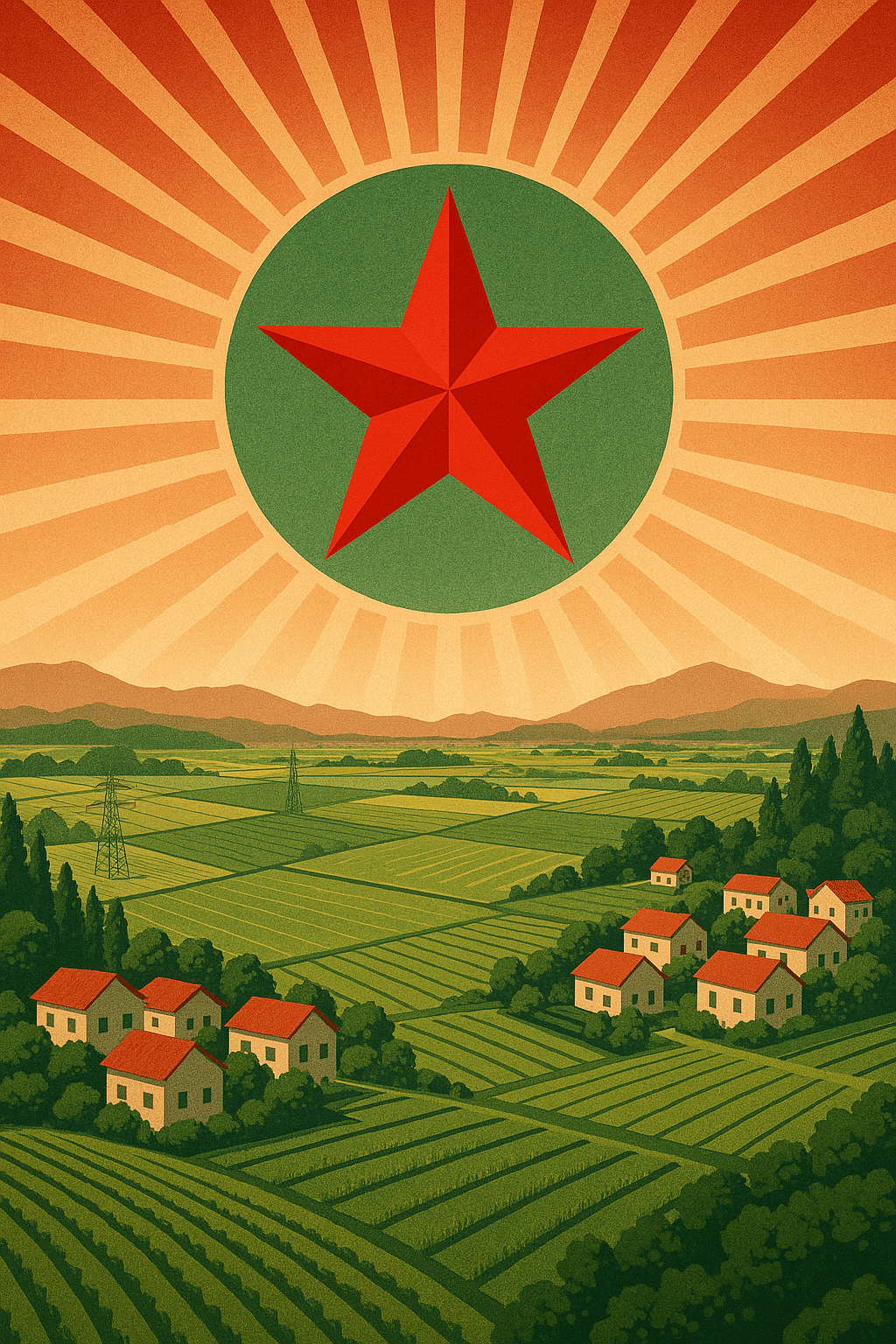
The ecological civilization of tomorrow cannot be built on capital. It must be built in the spirit of Dazhai, Erhai, and Tangyue. The commune must return—not as a nostalgic form, but as a practical future. A red-green star rising in the East.
Sources:
- Lu, Xinyu. Neoliberalism or Neocollective Rural China: A Critique and Prospect. Shanghai Jiaotong University Press, 2023.
- Foster, John Bellamy. Marx’s Ecology. Monthly Review Press, 2000.
- Wenhua Zongheng, Vol. 2 No. 2, 2024.
 Weaponized Information
Leave a comment