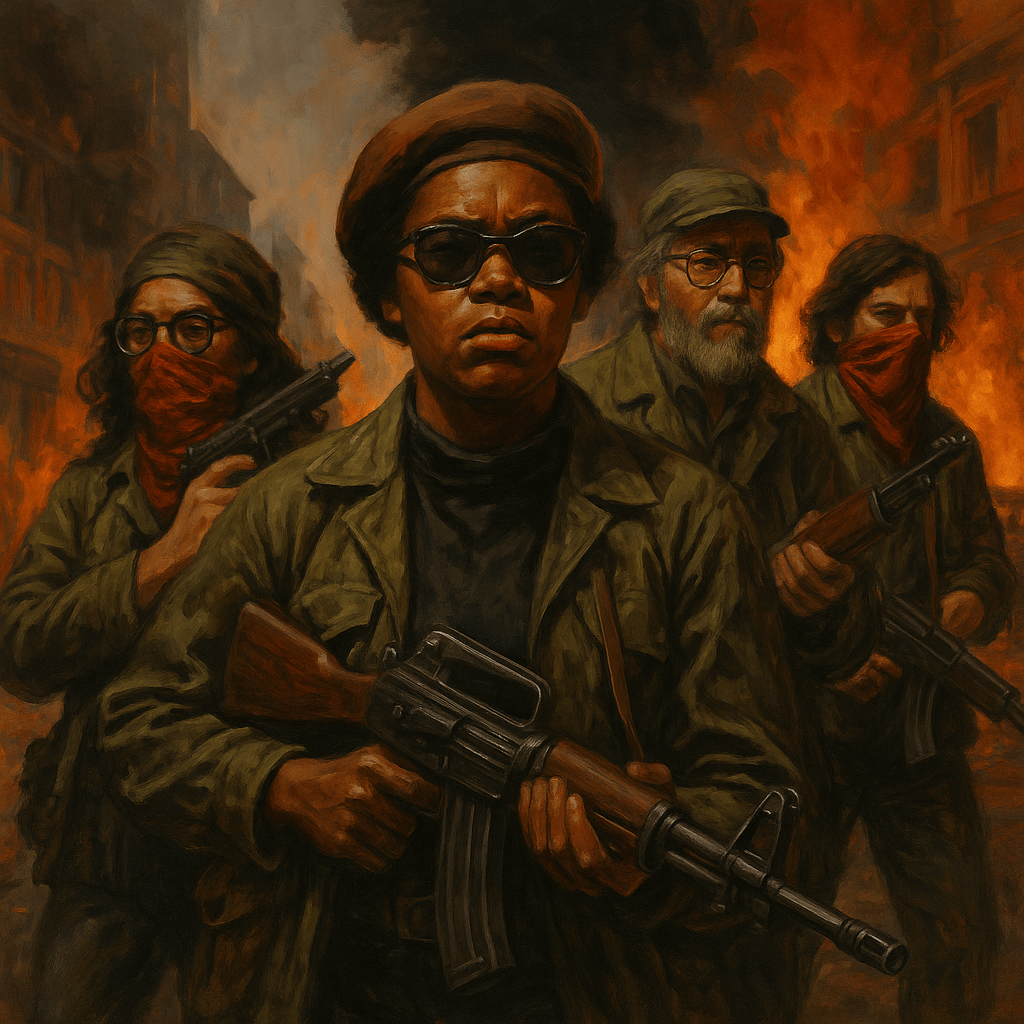
They didn’t ask for justice—they broke comrades out of cages, robbed banks to fund the movement, and waged war on empire from the shadows. M19CO was the underground continuation of Black, Brown, and anti-imperialist resistance—and they still have something to teach us.
By Prince Kapone | Weaponized Information
May 19, 2025
Seeds in the Ashes: Where Revolution Goes When They Try to Kill It
By the late 1970s, the state thought it had won. Malcolm was dead. Fred was dead. The Panthers were fractured, infiltrated, and under indictment. The BLA had gone underground. The prisons were filling up with political prisoners. And the liberal establishment was selling illusions: “America is healing.” “The movement is over.” “Back to normal.”
But revolution doesn’t die. It reconfigures. It goes quiet, gets sharper, digs deeper. And in the rubble of COINTELPRO, in the heart of the imperial core, something new emerged—something the state didn’t see coming: the May 19th Communist Organization.
Named in honor of Malcolm X and Ho Chi Minh—two men whose lives and deaths we’ve already honored in this series—M19CO was born as an act of historical defiance. Not nostalgia, not memorial. Strategy. They understood that the greatest tribute to the revolutionaries of the past was to continue the war they started.
M19CO didn’t fall from the sky. It came out of the bloodlines and battle scars of the Black liberation movement and the white anti-imperialist underground. It drew from the Black Panther Party, the Black Liberation Army, and the Weather Underground Organization. It brought together revolutionaries—Black, white, Puerto Rican—who understood that the United States was not a democracy with flaws. It was a settler empire, and it needed to be dismantled by any means necessary.
Where Malcolm gave us the theory, Ho gave us the method, and Yuri gave us the infrastructure—M19CO picked up the gun, the blueprint, and the timeline. They didn’t ask if the time was right. They understood that for colonized people, time is always urgent.
This was the period of state consolidation—when the liberal class was laundering the blood off the hands of empire and calling it progress. But M19CO saw through it. They saw how the same empire that killed Fred Hampton was now exporting death squads to Central America. How the prisons that caged Black revolutionaries were being used to warehouse a new domestic underclass. How the Vietnam model was being refined into technofascist counterinsurgency—with satellites, surveillance, stingrays, and social workers.
So they adapted. Underground, anonymous, disciplined. They refused to perform for media. They refused to give interviews. They refused to entertain the illusion that freedom could be negotiated. Instead, they expropriated banks to fund liberation work. They bombed military and police installations to send a message. They broke political prisoners out of the empire’s cages—not with permission, but with precision.
M19CO didn’t emerge to “revive” the movement. They came to continue it. To keep the flame alive when the streets were quiet and the repression was loud. They carried the memory of Malcolm not as a photo, but as a line. They moved in the tradition of Ho—not with spectacle, but with strategy. And they relied on the networks built by comrades like Yuri Kochiyama to sustain the day-to-day lifelines that made armed struggle possible.
Theirs was a war against forgetting. Against the slow rot of co-optation. Against the pacification of rage. And they knew the risks. Prison. Death. Erasure. But they also knew the truth: if empire could be brought to its knees in Saigon, it could bleed right here in New York, Chicago, and D.C.
Armed Struggle in the Belly of the Beast: The Politics of Expropriation
The May 19th Communist Organization didn’t romanticize violence. They understood it as a necessary dialectic—a response to the structural violence of capitalism and white supremacy, not an aesthetic. When the state bombs your cities, floods your communities with drugs, locks up your leaders, and calls it “peace,” then picking up arms isn’t extremism. It’s survival. It’s memory. It’s mathematics.
M19CO inherited the doctrine of revolutionary expropriation from the Panthers, from the BLA, from the international guerrilla tradition. They didn’t rob banks for personal gain—they reclaimed resources from imperialist institutions to fund community defense, support political prisoners, and sustain the underground. They understood that capital wasn’t neutral—it was blood-stained. So they seized it and redirected it to the war against empire.
They also understood that armed struggle isn’t just about shooting. It’s about building base. M19CO didn’t exist in a vacuum. They were rooted in networks of revolutionary infrastructure—housing, safehouses, community networks, radical lawyers, movement doctors, and medics. Their strategy wasn’t just to strike the empire, but to organize under its radar.
Their targets were never random. They hit police precincts, military installations, and corporate offices deeply tied to imperialist violence—IBM, Mobil Oil, the South African consulate. These weren’t tantrums. These were statements: you will not murder our people and sleep peacefully at night. Their communiqués were sharp, political, and pointed. Each action had a message. Each message had a line.
And the line was simple: imperialism is violence. Capitalism is violence. The police are not “officers”—they are the occupying force of the colonial state. And the only appropriate response to colonization is resistance in every form: political, cultural, and armed.
This wasn’t a fantasy. It was a response to reality. After COINTELPRO, after the assassinations, after the betrayal of civil rights leaders and the neutralization of aboveground movements, what options were left? The state had criminalized dissent. Made organizing a felony. Made memory subversive. So M19CO adapted.
They didn’t act out of despair. They acted out of strategy. They studied the Viet Cong. The ANC. The Algerian FLN. They understood that without the threat of force, the state does not negotiate. Without underground resistance, there is no leverage. And they committed to that line even when it cost them everything.
This section of the series matters because M19CO is the physical embodiment of what we’ve been tracking all along: the transition from aboveground organizing to underground resistance, from Malcolm’s diagnosis to Assata’s jailbreak. It was the next logical step in a war the state refused to end.
Their fight wasn’t for attention. It was for liberation. And they knew the only way to build that future was to shake the present—hard.
Living With a Target on Your Back: COINTELPRO and the Art of War
To understand M19CO, you have to understand they were forged in the aftermath of a slaughter. By the time they went underground, the state had already executed Malcolm, assassinated Fred Hampton, locked up Geronimo Pratt, and launched a counterinsurgency campaign against Black and Brown movements that would’ve made Pinochet proud. The COINTELPRO era wasn’t a metaphor—it was war. And M19CO didn’t just survive it. They stepped back onto the battlefield with full knowledge of the terrain.
They knew the state would come with everything: wiretaps, infiltrators, snitches, psychological warfare, fake communiqués, informants turned authors. They knew about mail interception, disinformation, surveillance planes, phone phreaking. They knew the playbook because they read it in real time. And so they moved like disciplined insurgents—not cowboys, not martyrs. Cadre.
While liberals were filing FOIAs, M19CO was learning how to scrub a safehouse. While the New Left cried betrayal, M19CO was studying logistics. While the ACLU debated civil liberties, they were building clandestine comms networks, mapping police activity, and learning how to travel in silence. They weren’t paranoid—they were alive.
The FBI called them terrorists. But the real terror came from the other side. It came with government badges, helicopters, and kill squads. It came dressed as democracy, smiling while it sabotaged. The state wanted to make an example of M19CO. Instead, M19CO became a lesson in counter-counterinsurgency.
They used tight cells. Need-to-know communication. Shared discipline. They trusted comrades with their lives, and built trust not through rhetoric, but through action. They didn’t just talk revolution—they operationalized it. They turned kitchens into planning rooms, basements into archives, city maps into tactical grids.
And when the state came, as it always does, it came hard. In 1981, a Brinks truck expropriation attempt went sideways. Police officers were killed. Arrests followed. Raids. Interrogations. They were charged under RICO statutes—laws designed for mafia bosses, now deployed against revolutionaries. And slowly, the core of M19CO was captured.
But repression didn’t destroy the movement—it scattered the seeds. Their arrests gave rise to defense committees, legal aid networks, radical publishing projects, solidarity movements, and long-standing alliances between Black, Puerto Rican, white, and Indigenous revolutionaries. The state may have disrupted the organization, but it couldn’t erase the line.
M19CO teaches us that survival under technofascism requires discipline. It requires knowing how the enemy moves, how it adapts, and how to fight without being seen until it’s too late. They were the living application of every lesson Malcolm spoke, every principle Ho lived, every detail Yuri tracked.
And we ignore those lessons at our own peril. The empire didn’t retire COINTELPRO. It rebranded it—through fusion centers, digital surveillance, predictive policing, and NGO infiltration. And if we’re going to build anything revolutionary today, it has to be as prepared, as principled, and as dangerous as M19CO was.
Prisons Are Battlefields: The Political Prisoner as Vanguard
The May 19th Communist Organization didn’t view political prisoners as unfortunate casualties of state repression—they saw them as central actors in the war against empire. For M19CO, freeing and defending political prisoners wasn’t a side project. It was the mission. The prison system was not just a holding pen. It was a frontline. A war zone. A mechanism of counterinsurgency designed to disappear the most advanced elements of the colonized working class.
And they moved accordingly.
In 1979, M19CO did what most people thought was impossible: they broke Assata Shakur out of prison. She was a Black Liberation Army soldier, targeted by the FBI, shot by state troopers, framed for murder, and sentenced to life plus 33 years. But M19CO refused to let her die in a cage. With the precision of a guerrilla unit and the trust of a movement behind them, they liberated her and got her out of the country. Today, she lives in exile in Cuba—a symbol of resistance that continues to haunt the empire.
That action wasn’t symbolic. It was surgical. A declaration: We do not forget our comrades. We do not beg for mercy. We take back what is ours.
And Assata wasn’t the only one. M19CO’s entire infrastructure was built to support imprisoned revolutionaries. They raised money for legal defense. Coordinated communications between locked-up comrades and aboveground organizers. Delivered commissary. Moved messages. Protected identities. They understood what Yuri Kochiyama had long mastered: memory is strategy, and paperwork can be revolutionary if it keeps someone alive inside.
Mutulu Shakur. Sundiata Acoli. Sekou Odinga. Silvia Baraldini. Susan Rosenberg. The list of revolutionaries in prison wasn’t just names to them—it was responsibility. Every hearing. Every parole board. Every court date. Yuri had it tracked. M19CO had it backed. And the movement had it protected.
They didn’t accept the state’s framing. These weren’t “criminals.” These were prisoners of war. Captured freedom fighters. Held behind bars not for what they did, but for what they represented—a living threat to the legitimacy of the United States settler colonial project. And to leave them in the hands of the enemy was unforgivable.
This is what solidarity looks like when it’s real: not symbolic tweets or campaigns with PR firms—but breakouts, jail support, armed protection, and lifelong commitment. M19CO’s prison work was the continuation of Malcolm’s clarity, Ho Chi Minh’s guerrilla discipline, and Yuri’s memory work. It was revolutionary continuity under siege.
Because when the state puts your best into cages, the real question isn’t how we feel about it—it’s what are we willing to do? M19CO gave their answer. And they gave it with action.
The Legacy They Tried to Bury
The state thought it was done with M19CO. They locked them up, erased their names from the headlines, and folded their story into the sanitized history of “domestic terrorism.” But legacies don’t live in court transcripts. They live in struggle. And M19CO’s line runs straight through today—from the cell blocks of political prisoners to the digital panopticon we now organize inside.
They didn’t just leave behind case files. They left behind a blueprint. A model of what underground revolutionary work looks like in the heart of empire. They taught us how to survive state repression, how to coordinate aboveground and underground infrastructure, how to support our captured comrades, and how to keep political clarity under pressure.
Their fingerprints are all over the continuation of the Black liberation struggle: in the networks that defended Assata, in the solidarity campaigns for Puerto Rican nationalists, in the sustained demands for the release of political prisoners like Mutulu Shakur, Sundiata Acoli, and Veronza Bowers. They helped define the principle that solidarity means action, not sentiment.
They also set a precedent: that white revolutionaries must not only support Black liberation in theory, but commit themselves materially and organizationally to its success. M19CO took responsibility—risking their lives, their freedom, their futures—not as saviors, but as accomplices. That’s the only kind of solidarity that counts.
Today, as new generations rise up in Ferguson, Minneapolis, Atlanta, and beyond—under drone surveillance, digital policing, and liberal co-optation—the lessons of M19CO are as relevant as ever. We’re still facing a settler state. Still organizing in a surveillance society. Still living under a regime that cages, kills, and co-opts. The terrain has shifted, but the contradiction remains: empire vs. the people.
M19CO reminds us that resistance must be disciplined. That it must be organized. That it must be willing to go further than petitions, performative outrage, or one-off actions. They didn’t ask the empire to change. They attacked its infrastructure. They liberated its captives. They refused to let history be written without a fight.
We’re still in that fight.
Fire Behind Enemy Lines: The Unfinished Revolution of M19CO
If the May 19th Communist Organization teaches us anything, it’s that revolution isn’t abstract. It’s logistics, discipline, and clarity of line. It’s expropriation, jailbreaks, court support, communiqués, and counter-surveillance. It’s loving the people enough to fight for them even when they’re too broken down to fight for themselves.
M19CO wasn’t trying to start a war. The war had already started—long before them. They just chose to fight it on revolutionary terms. They picked up the baton from Malcolm and the BLA, linked arms with the Puerto Rican and Palestinian struggles, moved in lockstep with the political prisoner support networks built by Yuri, and carried the guerrilla logic of Ho Chi Minh into the concrete corridors of New York and D.C.
Their revolution didn’t end when the indictments came down. It didn’t end in prison. It didn’t end when the headlines dried up. Because M19CO wasn’t a brand. It was a formation—a strategy, a legacy, a call to arms. And that formation still exists wherever people are organizing in the shadow of empire, wherever the logic of liberation refuses to be pacified, wherever the colonized remember that the oppressor will never grant freedom.
We are living in the digital upgrade of the same system they fought—what we’ve called technofascism throughout this series. Empire has new tools now: biometric scans, predictive algorithms, globalized surveillance. But the contradiction remains. And M19CO offers us a template for how to fight back—not with nostalgia, but with adapted militancy. With theory. With infrastructure. With daring.
Their revolution is unfinished. But it’s not over. Because every political prisoner still inside is a reminder. Every revolutionary in exile is a chapter that hasn’t closed. And every young comrade waking up in this system, asking what can be done, is a new foot soldier in the same war.
So what do we owe them? Everything. Not with pity. With practice. By building the movements that pick up where they left off. By refusing to let the state define our past or dictate our future. By remembering that May 19th isn’t just a date—it’s a line in the sand.
M19CO was fire behind enemy lines. And we are still behind those lines. So light the match.
 Weaponized Information
Leave a comment