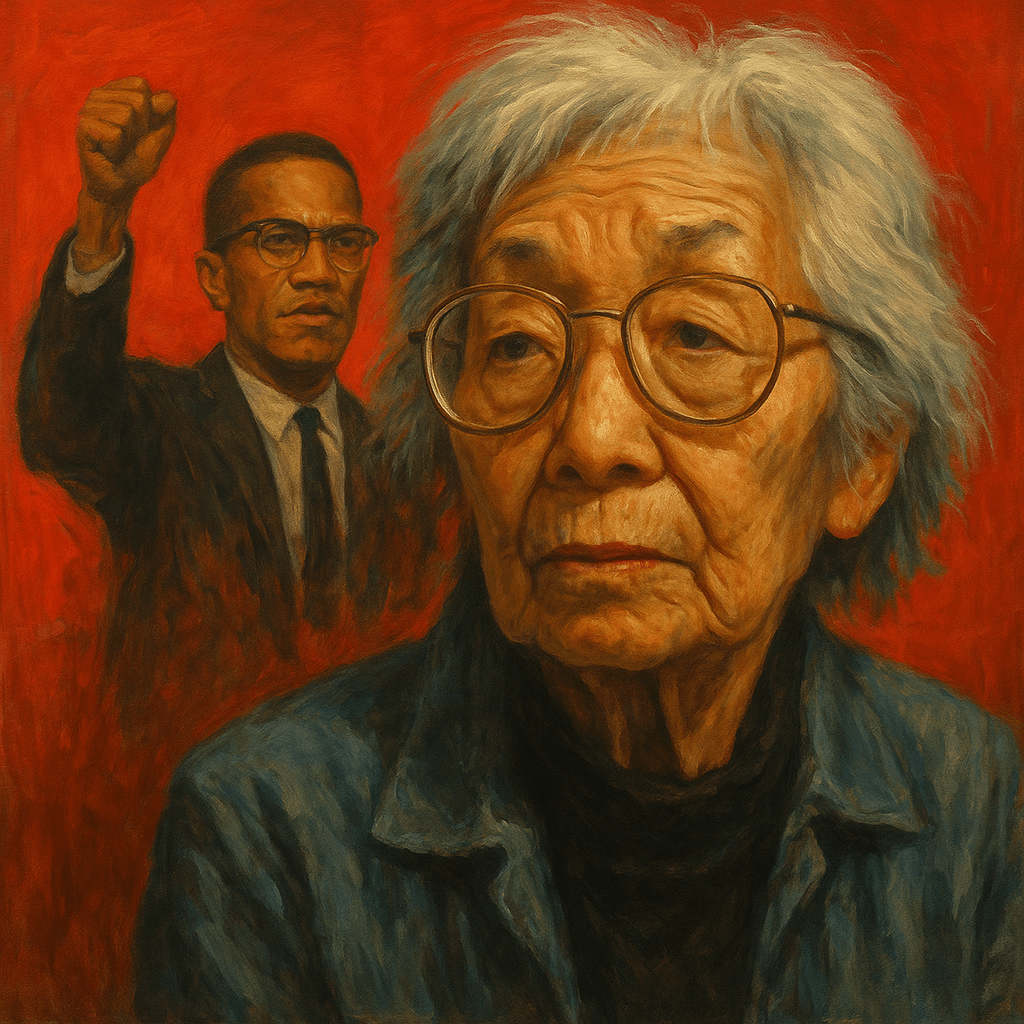
She held Malcolm as he died, but she held the movement together while it lived. From internment camp to Panther meetings, from trial dates to prison visits, Yuri Kochiyama built the infrastructure of solidarity that empire couldn’t break.
By Prince Kapone | Weaponized Information
May 19, 2025
Born on the Wrong Side of the War: Internment, Injustice, and the Making of Yuri Kochiyama
Yuri Kochiyama didn’t become a revolutionary because she read the right books. She became one because the U.S. government put her in a concentration camp. Born Mary Yuriko Nakahara on May 19, 1921—the same day that would later mark the birth of Malcolm X and Ho Chi Minh—Yuri was raised in a working-class Japanese American family in San Pedro, California. She was a Sunday school girl, a student, a regular American kid. But in the eyes of the state, she was never really American. She was always marked.
That mark turned into a sentence in December 1941. Just days after the bombing of Pearl Harbor, the FBI stormed into her family’s home and arrested her father, a community leader and Japanese immigrant. He was sick. They took him anyway. They held him for weeks without charges and released him only when he was near death. He died the day after he got home. That was Yuri’s first political education: the state can kill your father with paperwork and silence.
Then came the barbed wire. Yuri, her mother, and her brothers were rounded up with over 110,000 other Japanese Americans and shipped to Manzanar—a government-run internment camp in the California desert. They were stripped of homes, rights, and dignity. The land of liberty had drawn a line: whiteness inside, yellow danger outside. And Yuri stood on the outside.
But she wasn’t broken. She watched, learned, recorded. In those camps, Yuri developed the skills that would later serve entire movements. She became a meticulous organizer, a chronicler of names, dates, details. While the state kept ledgers of enemies, Yuri started keeping ledgers of comrades. Not for revenge—but for memory. And later, for resistance.
After the war, she married Bill Kochiyama, a Black veteran, and moved to Harlem. There, her second political education began—not in a classroom, but on the block. In the projects. In the streets. In the kitchens and basements where the real work happened. Surrounded by Black working-class neighbors, Yuri began to see clearly: that what was done to her people wasn’t an exception. It was a blueprint. What was done to Japanese Americans during wartime had been done to Black folks for centuries. The ghetto, she realized, was its own internment camp—just with no release date.
That clarity didn’t turn her into a spectator. It turned her into a worker. Yuri didn’t just “support” the Black struggle—she joined it. She attended meetings, took notes, kept records. She began building relationships with radical Black organizers, especially those linked to the growing tide of revolutionary nationalism sweeping Harlem in the early 1960s.
This was not abstract solidarity. It was proximity. It was politics built from the bottom up, forged in shared pain and mutual commitment. By the time she first met Malcolm X in 1963, Yuri was already on the move—already building the infrastructure that would support revolutionaries for decades to come. She wasn’t looking for permission. She was looking for power—and the people ready to seize it.
From Internment to Insurrection: Yuri’s Awakening in the Heart of Empire
Yuri’s time at Manzanar didn’t just scar her—it shaped her. When she emerged from that barbed-wire hell, she carried more than trauma. She carried clarity. She had seen the full weight of the American state: how it stripped you of home, dignity, and humanity with the stroke of a pen. But she had also seen what survival looked like. What resilience looked like. And it wasn’t found in waiting for justice—it was in organizing for power.
In the years after the war, as she raised six children in Harlem with her husband Bill, Yuri watched the early civil rights movement unfold—but she also saw its limits. Petitions and marches alone wouldn’t shake this system. Real change, she began to understand, didn’t come from pleading with empire—it came from confronting it. And when she met Malcolm X in 1963, that understanding was lit like a match.
Their meeting wasn’t accidental. Yuri had sought him out after hearing him speak and seeing the raw honesty in his voice. While liberals and conservatives alike called Malcolm “divisive,” Yuri saw truth. Where others heard anger, she heard analysis. And more than that, she heard a challenge. Malcolm didn’t speak in euphemisms. He spoke in revolutionary clarity. And that’s what drew her in.
She invited Malcolm to her home to meet with Japanese-American families still traumatized by internment. She wanted them to hear from someone who understood what it meant to be targeted by the state and still rise. But what unfolded wasn’t just a dialogue—it was an alliance. Malcolm respected Yuri deeply, and Yuri took on his vision with militant seriousness. She didn’t just quote him—she followed the line.
As Malcolm broke from the Nation of Islam and began building the Organization of Afro-American Unity (OAAU), Yuri was right there—attending meetings, taking notes, providing logistical support. She became part of the machinery that kept the movement running. She wasn’t on the mic, but she was in the room. Recording minutes, maintaining records, making sure people showed up, and keeping track of everything the state wanted forgotten.
This was the work most never see, but every real organizer knows is essential. Yuri was not a cheerleader. She was a strategic node—a hub of memory, logistics, and revolutionary infrastructure. And when Malcolm was gunned down in the Audubon Ballroom on February 21, 1965, it was Yuri who rushed to his side. It was her hands that cradled his head. Her blood that mingled with his. That moment was not the end of her political life—it was the point of no return.
After Malcolm’s death, Yuri didn’t mourn by stepping back. She went deeper. She moved toward the Panthers, toward the underground, toward the imprisoned and the exiled. She turned her grief into grind. Every trial, every raid, every betrayal by the state was fuel. She knew what the enemy looked like. And she knew her task: to build the communication lines, maintain the memory banks, and support the fighters who had nowhere else to turn.
From internment to insurrection—Yuri Kochiyama had crossed the line. And there was no going back.
Malcolm Was the Match—Yuri Became the Flame
There are those who find revolution in books. Yuri found hers in Malcolm. Not because she needed a hero, but because Malcolm spoke a truth that made everything else irrelevant. He didn’t ask for dignity—he demanded liberation. He didn’t beg for justice—he called out empire. And Yuri, forged in the trauma of internment and hardened by the lies of American democracy, knew he was right.
Her first meeting with Malcolm X in 1963 wasn’t a fan encounter. It was a political convergence. By then, Yuri had already been working in Harlem with tenant groups, veterans, and working-class families. But Malcolm gave her analysis a framework. He wasn’t preaching reform—he was naming the system. Racism wasn’t a glitch in America—it was its operating system. And capitalism wasn’t some neutral engine—it was the bloodsucker of the world. That was the clarity she had been waiting for.
After that first meeting, Yuri became more than a supporter—she became part of Malcolm’s emerging organizational universe. She helped promote the OAAU, organized meetings, coordinated logistics, and helped maintain connections across political formations. She wasn’t a guest—she was a builder. And behind every successful meeting was Yuri’s presence: filing contacts, writing summaries, logging names, dates, and affiliations.
But her role was more than administrative. Yuri was trusted. She was reliable. And most importantly—she was ready. When Malcolm was assassinated in 1965, Yuri was not in the audience—she was on the front line. She rushed to his body, cradled his head, and watched as the man who helped radicalize her was torn from history by the very state he exposed.
That image—Yuri holding Malcolm as he died—became iconic. But it also risks flattening her into a symbol of grief. She was far more than that. She didn’t just weep—she organized. She didn’t just mourn—she mobilized. And in the years following Malcolm’s death, she would become a critical node in the revolutionary infrastructure of the Black liberation movement.
Yuri became a bridge—not just between movements, but between operational realities. Aboveground and underground. Legal and clandestine. She built trust across formations that didn’t always trust each other. She kept records when others were fleeing raids. She maintained communications when COINTELPRO was working overtime to disrupt everything.
If Malcolm was the theorist who dared to dream beyond empire, Yuri was the organizer who made sure the phone numbers worked, the dates were tracked, the bail was paid, and the files were safe. She turned revolutionary love into logistical precision. And every serious cadre in the Black Liberation Army, the Panthers, the support networks around Assata and Mutulu, knew her number by heart. Because if you got booked, if you got followed, if you needed help—Yuri knew who to call. And she never fumbled.
This was not charity. This was revolutionary discipline. She wasn’t “helping out”—she was helping hold it together. And in doing so, she became something few ever become in a movement: irreplaceable.
The Organizer’s Organizer: Yuri, the Panthers, and the Underground
By the late 1960s, Yuri Kochiyama had become a familiar face in Harlem—but not in the ways the media cared to notice. She wasn’t running for office or hosting rallies. She was doing the work that held revolutions together: organizing, archiving, coordinating, and moving between political spaces with purpose and precision. And when the Black Panther Party emerged, Yuri didn’t hesitate. She got to work.
She recognized the Panthers as more than a militant spectacle—they were a proletarian formation rooted in the colonial contradiction of the U.S. empire. She aligned with their analysis of the U.S. as a settler state, their rejection of police legitimacy, and their insistence that armed self-defense was not extremism—it was survival. She knew this truth already; it had lived in her since Manzanar.
Yuri built relationships with Panther leadership in New York and Oakland, but it was in the Panther’s infrastructure—their community programs, prison work, legal defense, and underground support—that her impact was felt most directly. She helped coordinate political education forums, stood outside courtrooms to support comrades facing trumped-up charges, and kept track of everything: dates, bail schedules, parole hearings, aliases, points of contact. She was an archive and a command post rolled into one.
And then came the BLA. As the state escalated its war on the Panthers—raids, assassinations, prison time—many comrades went underground. The Black Liberation Army emerged as a continuation of the armed resistance line: prison breaks, expropriations, clandestine sabotage. And Yuri didn’t flinch. She didn’t scold. She supported. Quietly, effectively, and always on point.
Every BLA cadre knew it: if you were arrested, the first number you memorized was Yuri Kochiyama’s. Not because she had power, but because she had capacity. She knew who to call, where to find legal help, how to get a message out. She was the emergency switchboard for an entire underground movement. And she did it all without ego, without spotlight, and without a single mistake that cost anyone their freedom.
This wasn’t charity. This was movement discipline. Yuri didn’t serve movements—she fortified them. When factions were divided, she maintained ties. When comrades were locked up, she maintained contact. She didn’t just offer solidarity—she engineered it. Through letters, visitations, fundraising, and above all: consistency.
And she wasn’t only focused on Black struggles. Yuri helped found the Asian American Political Alliance (AAPA), organizing other Asian radicals to reject the “model minority” lie and align with Black and Brown liberation. She called out white supremacy in Asian communities. She named U.S. imperialism as the enemy in Vietnam, Korea, the Philippines, and back home. But she always returned to one truth: Black liberation was the strategic center of the revolution in the U.S.
In a world full of liberal allies who disappear when things get real, Yuri stood firm in the fire. She didn’t hide behind identity or distance herself when the heat came down. She got closer. And that’s why every serious revolutionary—Black, Brown, Yellow, or otherwise—knew her name. Because Yuri Kochiyama wasn’t a symbol. She was a system.
The Prison Doors Never Closed: Yuri and the Long War for Liberation
For Yuri Kochiyama, the struggle didn’t end when the doors slammed shut—it intensified. While liberal reformers waved signs for prison “reform” and policy tweaks, Yuri knew the truth: prisons are war zones. They are colonial containment units designed to crush revolutionaries, neutralize movements, and erase memory. And she made it her life’s mission to make sure the state never succeeded.
She didn’t support political prisoners like a concerned outsider—she moved as part of the resistance. Yuri built relationships with incarcerated revolutionaries that spanned decades, never wavering even when it meant harassment, isolation, and surveillance. Her name appeared on the visitation logs of nearly every major figure in the Black liberation underground—from Assata Shakur to Mutulu Shakur, Sundiata Acoli to Mumia Abu-Jamal. And her letters weren’t symbolic. They were lifelines.
Mutulu Shakur said it best: “All BLA soldiers had her number memorized.” Why? Because when the state came down, Yuri knew who to contact, how to mobilize legal defense, how to alert allies and family, how to ensure that even inside the cage, you weren’t alone. She tracked every trial, every hearing, every appeal. She organized support committees, raised bail funds, wrote affidavits, visited prisons, and documented everything. She was a one-woman defense network, running on love, rage, and militant precision.
But her commitment wasn’t confined to U.S. borders. Yuri was a fierce advocate for Puerto Rican independence fighters, including the Nationalist prisoners held for decades in U.S. jails. She supported the Cuban Revolution, defended the Palestinian resistance, and denounced Zionism and U.S. imperialism with the same clarity she brought to every local fight. For Yuri, internationalism wasn’t theory—it was duty. Every struggle against U.S. empire, from Vieques to Gaza, was her struggle.
She was particularly fearless in naming Palestine as a frontline of imperial violence long before it became a fashionable hashtag. She connected the prison bars in the Bronx to the checkpoints in Ramallah, the FBI raids in Oakland to the Israeli bulldozers in Rafah. And when others stayed quiet, afraid to speak against Zionism for fear of liberal backlash, Yuri spoke louder.
She saw all political prisoners—Black, Brown, Indigenous, Asian—not as isolated cases, but as prisoners of war. They were evidence of the state’s permanent counterinsurgency campaign against the colonized. And she fought for their freedom not just through appeals or petitions, but by building revolutionary memory: by ensuring they were never forgotten.
In a political landscape where movements are often loud in the streets but silent in the aftermath, Yuri remained constant. She built the connective tissue that kept people alive inside. She reminded us that the war doesn’t end when the comrades are captured—it just moves to a different theater. And she made sure we didn’t lose the map.
The Unfinished Legacy of Yuri Kochiyama
Yuri Kochiyama didn’t want sainthood. She wanted struggle. She didn’t perform radicalism for cameras or clout. She did the work. The letters, the legal calls, the trial support, the prison visits, the fundraising, the reminders, the footnotes in history that only exist because she wrote them down and kept the files. She was the kind of revolutionary who made sure things didn’t fall apart when the cameras were gone. That is the legacy.
And it’s a legacy that must be continued. Because the war she fought didn’t end. The same empire that locked up Assata now targets Palestinian youth with AI-powered drones. The same system that interned her family now runs ICE concentration camps. The same surveillance state that hunted the BLA is now embedded in every phone, every feed, every cloud. The faces have changed. The function hasn’t.
If Yuri were here, she wouldn’t be on a panel. She’d be in a kitchen, planning logistics for a court date. She’d be coordinating support for political prisoners the press won’t name. She’d be helping youth understand that their struggle has ancestors, and those ancestors won by fighting—not by negotiating with empire, but by confronting it. Every time.
Her legacy demands more than reverence. It demands replication. It demands that we build structures to protect our freedom fighters. That we track every arrest, know every comrade’s number, and never let the state isolate those who dare to resist. It demands that we connect struggles—not just in rhetoric, but in real material solidarity. Between Gaza and Georgia. Between Rikers and Ramallah. Between Harlem and Haiti.
Yuri showed us that solidarity is not charity. It is commitment. It is a daily practice of putting your body, your time, your skills in the service of the oppressed. It means showing up when the movement gets quiet. It means doing the work that never gets celebrated. And it means never compromising with empire.
She stood with Malcolm. With the Panthers. With the BLA. With political prisoners. With Puerto Rican independence. With Palestine. With the poor. And when history tried to forget them, she refused. That’s what made her dangerous. That’s what made her necessary.
So when we speak her name on this May 19th, let it not be as spectators. Let it be as students of her discipline. Let it be as comrades ready to pick up the files, the phones, the flame—and carry it forward.
The bridge is still there. It’s ours to walk.
 Weaponized Information
Leave a comment