✝️ From the Cross to the Throne: A Weaponized Information Series
How empire hijacked a gospel of the poor—and how the oppressed kept it alive. Explore the full series below:
Between the Cross and the Throne: Christianity’s Long March Toward Empire
By Weaponized Information
The Empire Strikes Back (But Not All At Once)
Christianity did not go from radical to imperial overnight. After Paul, the movement spread like wildfire among slaves, poor people, women, and colonized peoples—those with nothing to lose. But repression bred adaptation. And adaptation bred contradiction.
I. Class War and the Early Church: From the Catacombs to the Councils
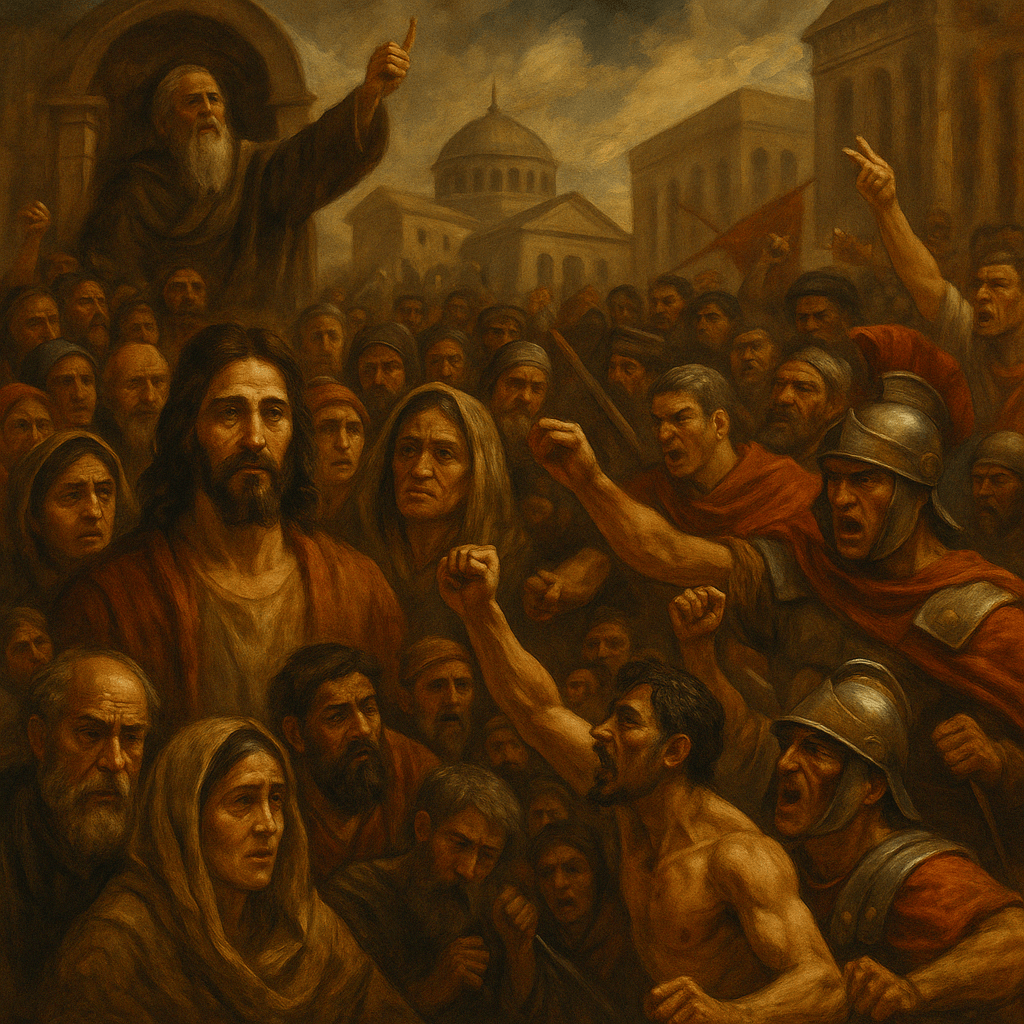
Christianity thrived in the underbelly of Roman society: among slaves, laborers, prisoners, and women. Roman authorities saw Christianity as dangerous—not for its doctrine, but its defiance of Caesar and refusal to participate in imperial cults. Persecutions under Nero, Domitian, Decius, Diocletian, etc. were less about belief and more about control.
Class struggle defined the early church. The wealthy classes in Rome began adopting Christianity in limited forms—but without the redistribution, without the communal sharing. This is where the rot begins.
II. The Rise of Regional Churches and Theological Factions
As the movement spread, so did theological divergence. Christianity was not a monolith—it was a mosaic.
The Church in North Africa
Figures like Tertullian and Cyprian emphasized martyrdom, strict discipline, and communal purity.
The Alexandrian Church
Thinkers such as Origen and Clement focused on philosophical theology, allegorical readings, and attempts to harmonize with Greek thought.
The Syrian Churches
These communities emphasized mysticism and asceticism, sometimes bordering on radical poverty and anti-state ideology.
The Roman Church
With an administrative focus, the Roman Church developed a legalistic structure, slowly aligning with imperial institutions.
These churches were not just divided theologically—they were divided socially. Some retained the revolutionary memory. Others began adapting to wealth and power.
III. The Montanists, Donatists, and Other Rebellions from Within
Not all Christians welcomed this drift toward moderation.
Montanists (2nd century)
A grassroots, ecstatic movement that rejected clerical authority and embraced prophetic visions and female leadership.
Donatists (4th century)
A revolutionary North African movement that refused to forgive church leaders who had cooperated with imperial persecution. They insisted on a church of the poor, uncontaminated by empire.
These were not “heretics”—they were the last echoes of the radical church before the Constantinian flood.
IV. Institutionalization from Within: Bishops, Creeds, and Clerical Control
As persecution waned and Christianity gained followers across social classes, bishops began organizing more hierarchical systems. The rise of episcopal authority mirrored Roman administration: regions became dioceses, bishops became governors of souls.
Early creeds (Apostles’ Creed, Rule of Faith) were not just statements of belief—they were tools of standardization and control. The church was beginning to look more like a Roman institution than a revolutionary assembly.
V. Theology of Survival or Theology of Surrender?
To survive, many Christians argued, the church had to make peace with the empire. Martyrdom gave way to moralism. Prophecy gave way to priestcraft. Communal life gave way to Sunday ritual. The gospel of liberation became a gospel of endurance—waiting for heaven, not fighting for justice.
VI. Constantine’s Opportunity: Empire Needs a New Myth
By the early 300s, the Roman Empire was in crisis—economically, militarily, and ideologically. Constantine saw what the emperors before him had feared: Christianity could no longer be destroyed. So he turned it into something else.
The groundwork had already been laid. All Constantine had to do was bless the bishops, stage a council, and swap out Caesar’s robes for Christ’s. What emerged was not a new Christianity—but an old empire in a new disguise.
Conclusion: The Counterrevolution Within the Church
This wasn’t just a cooptation—it was a class counterrevolution inside the body of the church. The memory of Jesus was sanitized. The poor were told to obey. The rich were told they were chosen. The empire survived—now with a halo.
Part 5 will pick up here: when Constantine baptizes the empire and the revolution becomes a religion of conquest.
 Weaponized Information
Leave a comment