From Jungle Resistance to Multipolar Revolution, the Struggle of Bolivia’s Indigenous Left Lives On
By Prince Kapone | Weaponized Information | May 2025
Born from Túpac Amaru
“They thought they killed Túpac Amaru. But we are his children. We are the rebellion he left behind.” — Evo Morales
Before Evo Morales was a president, before he was a union leader or an exile, he was something older—something the empire has tried and failed to destroy for over five centuries. He was the living breath of Túpac Amaru, the great Andean rebel who led an Indigenous insurrection against Spanish rule in 1780 and was torn limb from limb in the plaza of Cuzco as a warning to all who would rise. But warnings fade. And rebellions return.
Morales was born in 1959 in Isallavi, a speck of a village nestled in the dusty highlands of Bolivia’s Oruro department. His people were Aymara—descendants of the ones the Spanish never quite conquered, only caged. His childhood was not marked by ideologies or slogans, but by hunger. His family herded llamas, made bricks, and migrated for work to Argentina, scraping by at the outer edges of an economy that never intended to include them. Evo didn’t grow up reading Marx. He grew up living class war.
The state called his people backward. The cities called them dirty. The rich called them superfluous. But Morales learned early that what they called poverty was actually a system. One that extracted from the land, erased its stewards, and then punished them for surviving.
In the 1980s, when neoliberalism swept through Bolivia like a second conquest, the government began enforcing U.S.-mandated coca eradication programs in the name of the “War on Drugs.” But the real war wasn’t on drugs—it was on Indigenous autonomy. Coca wasn’t just a crop. It was medicine, ceremony, livelihood, identity. And so the cocaleros resisted.
Evo Morales emerged not from think tanks or faculty lounges, but from union assemblies under tin roofs, where farmers debated strategy with calloused hands and dust on their boots. His rise in the Chapare coca-growing region was not about charisma—it was about trust. He slept where they slept, marched when they marched, and bled when they were beaten. He didn’t need to speak for the people—he was them.
The cocalero struggle became a school of political warfare. They faced police raids, U.S.-funded paramilitaries, assassinations, aerial fumigation, and disinformation campaigns. The U.S. Embassy called Morales “an obstacle to stability.” Washington tried to ban him from parliament. But the more they attacked, the more the movement grew.
Morales began to speak not only as a unionist, but as a tribune of the colonized. He invoked not only wages, but sovereignty. Not only rights, but memory. “They fear us because we have memory,” he once said. “Because we remember the rebellions they buried.” For Morales, Túpac Amaru was not a martyr in a textbook—he was unfinished business.
By the late 1990s, Bolivia was boiling. The Water War in Cochabamba had revealed how far the elites would go to privatize life itself. The Gas War exposed how foreign companies looted national resources while the people froze. Amid this growing fire, the cocaleros moved from resistance to construction. A political instrument was forged: the Movimiento al Socialismo—MAS.
It was not a party. It was a weapon. A coalition of peasants, Indigenous nations, workers, miners, students, and street vendors. A political structure born from centuries of exclusion—and suddenly poised to take the reins of the state itself.
When Morales declared his candidacy for president, the oligarchy laughed. The press mocked his accent. The U.S. embassy issued warnings. But the people remembered. The mountains remembered. The seeds planted by Túpac Amaru were blooming again. And this time, they wore a blue cap, chewed coca, and refused to bow.
Building Power from Below
When Evo Morales rose, it wasn’t on a campaign platform—it was on the shoulders of the poor. Not just the rural poor or the urban poor, but the historically looted, racially despised, colonially governed poor. The poor with memory. The ones who remembered when water was a right, when land was communal, when the mountains spoke in Quechua and Aymara before Spanish tongues ever carved the earth into property. Morales didn’t offer hope. He offered revenge through construction.
The 1990s were a neoliberal fever dream. IMF technocrats strutted across La Paz like colonial viceroys. Water was sold to Bechtel. Gas was sold to multinationals. The state shrank, the oligarchs swelled, and U.S. military advisors quietly trained Bolivian special forces in “drug interdiction”—code for counterinsurgency against the cocaleros and Indigenous unions.
But the people fought back. In 2000, the people of Cochabamba rose up against the privatization of water in what would become known as the Water War. Entire communities marched, clashed with police, blocked roads, and shut down the city until the foreign corporations fled. This wasn’t just a protest—it was a rupture. Bolivia’s poor had discovered something dangerous: their collective power.
Then came the Gas War in 2003. The U.S.-backed president, Gonzalo Sánchez de Lozada—nicknamed “Goni”—announced plans to export Bolivia’s gas through Chile, bypassing Bolivians entirely while enriching foreign investors. That was the final straw. Miners, campesinos, cocaleros, and students poured into the streets. Over 60 were massacred. But Goni fell. Forced to flee to Miami, he left behind a government in flames and a people on fire.
Out of this crucible came MAS—the Movimiento al Socialismo. But MAS was never just a political party. It was a vessel for a rebellion centuries in the making. Built from the coca growers’ unions, the Indigenous councils, the miners’ federations, the market vendors, and the students—MAS became a political insurgency with electoral teeth.
Evo Morales was not their messiah. He was their delegate. He didn’t speak for the people. He was the people—sent into enemy terrain to seize the machinery of the state and reroute its purpose. His candidacy in 2005 was not just a campaign—it was a declaration of counter-hegemony. The colonized were coming for the republic that had never recognized them.
The U.S. Embassy knew it. Leaked cables show how they tried to isolate Morales, warned of his “authoritarian tendencies,” and pressured opposition parties to unite against him. USAID funded parallel NGOs. The DEA built intelligence networks. And Washington’s think tanks wrung their hands about “regional instability.”
But it didn’t matter. The people didn’t want Washington’s stability. They wanted sovereignty. And in December 2005, they got it. Evo Morales won the presidency with over 53% of the vote—the first Indigenous person to hold power in a country where Indigenous people were always the majority but never the rulers.
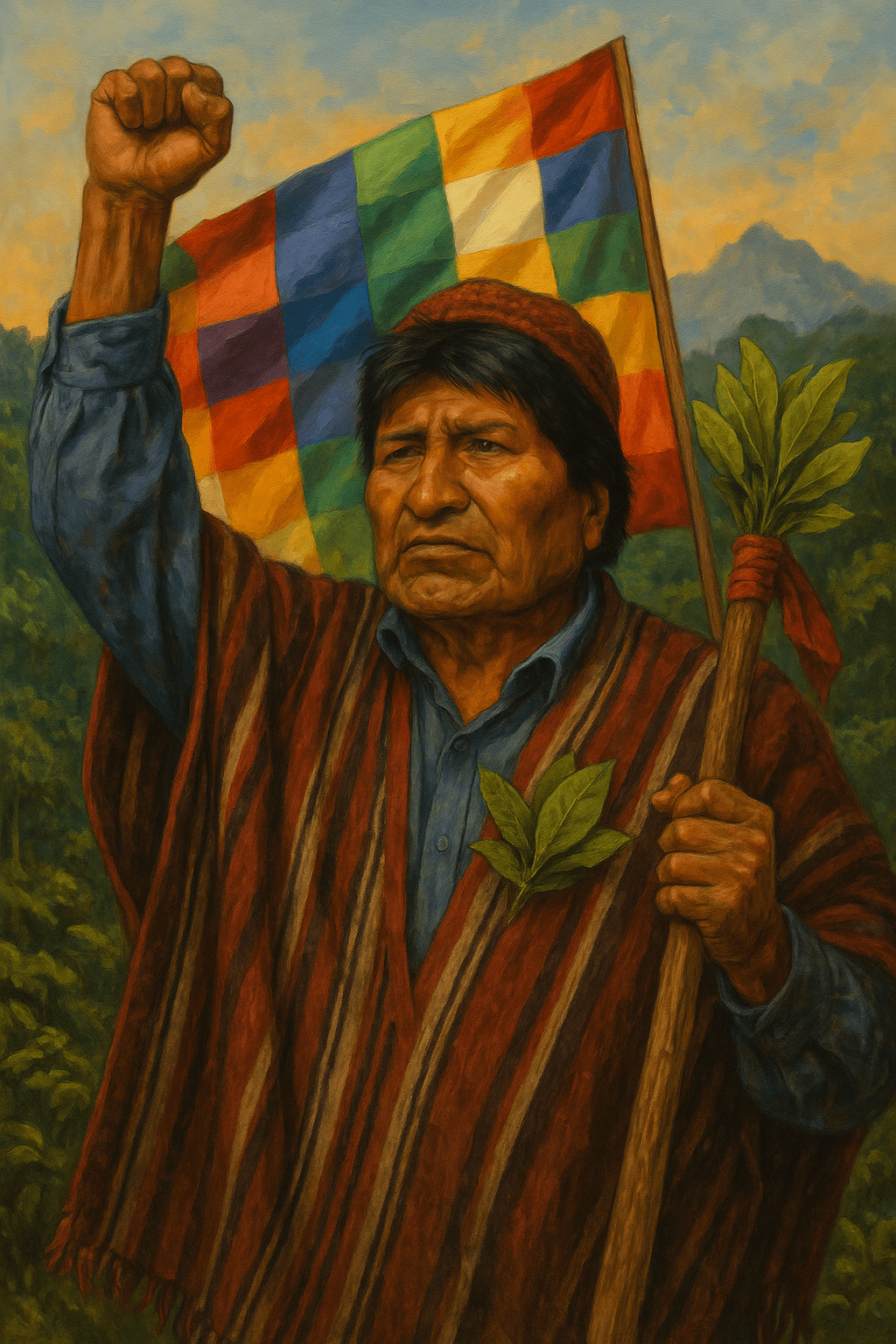
At his inauguration, Morales didn’t just speak to diplomats. He held a separate ceremony at Tiwanaku, the pre-Columbian sacred site of the Aymara. Dressed in traditional poncho and whipala flag raised high, he declared not just a political shift—but a civilizational correction.
“We are not here to govern for the elites,” he said. “We are here to govern with the people who have always been governed.” It wasn’t rhetoric. It was the unfinished revolution of Túpac Amaru walking into the palace.
Decolonizing the State
“We decided… to end this dark history of domination, of humiliation, of oppression—and especially of the looting of our natural resources, like our historical ancestors Túpac Katari, Túpac Amaru.” — Evo Morales
The day Evo Morales walked into the presidency was the day Bolivia declared its second independence. Not from Spain this time, but from the creole oligarchy, from the World Bank, from the IMF, from the white masks who ruled in the name of Washington and called it democracy. From the moment he took office, Morales made clear: the state would no longer be a colonial machine. It would be broken down, reassembled, and returned to the people who had been buried beneath it for 500 years.
The first act of this transformation came in 2006, when Morales moved to nationalize Bolivia’s gas and hydrocarbon industry. Executives from Shell, Repsol, and Total scrambled. The U.S. embassy fumed. But the workers and farmers celebrated. For the first time in living memory, the riches of the land were no longer being siphoned into offshore bank accounts—they were funding schools, roads, clinics, and pensions. The gas beneath Bolivia’s soil no longer belonged to empire. It belonged to the people who walked upon it.
But Evo understood that nationalization alone was not enough. You cannot decolonize a country if the constitution still speaks in the voice of the colonizer. And so in 2009, Bolivia held a national referendum to ratify a new foundational document—the first in its history that recognized Indigenous nations not as folklore, but as sovereign. The Plurinational Constitution declared Bolivia to be a federation of Indigenous peoples, each with their own languages, territories, and self-governance. It made Pachamama—Mother Earth—a subject of rights. It rewrote the definition of citizenship itself.
The document was not just legal—it was spiritual. It spoke of ama sua, ama llulla, ama qhilla: do not steal, do not lie, do not be lazy. These were not slogans. They were Andean ethics inscribed into the state’s DNA. The constitution was ratified with 61% of the national vote. For the oligarchy, it was heresy. For the people, it was salvation.
Under Morales, Bolivia underwent one of the most successful redistributive programs in the Global South. Extreme poverty was cut by more than half. Public investment in infrastructure, healthcare, and education surged. A universal pension was established. Indigenous students entered universities in record numbers. Women, especially Indigenous women, gained unprecedented political representation.
But Morales didn’t do this by submitting to capitalist metrics. He used the tools of the state to defy them. Bolivia rejected IMF loans. It paid off existing debts. It expanded public control over strategic industries—telecommunications, electricity, transportation. It refused to obey the austerity gospel preached by the North. Instead, it grew—on its own terms.
Internationally, Morales aligned Bolivia with the anti-imperialist bloc of the 21st century. He joined ALBA alongside Cuba and Venezuela. He built ties with Iran, China, and Russia. He condemned Zionist aggression in Palestine, imperial wars in Libya and Iraq, and U.S. meddling across the continent. When Evo spoke at the United Nations, he didn’t mince words. He called capitalism “the worst enemy of humanity.” He called water and air basic human rights. And he reminded the so-called developed world that its wealth was born from colonial plunder.
For the first time since the conquest, Bolivia had a government that governed from below. The people weren’t merely represented—they were present. In councils. In cooperatives. In grassroots assemblies. The state no longer spoke in the voice of the colonizer. It spoke Quechua. It spoke Aymara. It spoke back.
This was not utopia. There were contradictions. Tensions. Internal critiques. But even those critiques happened in a different language now—in the language of sovereignty. The process was never about Evo as an individual. It was about a people reclaiming their future with their own hands. And empire never forgave him for that.
The Coup and the New Conquest
“They didn’t just want to remove me. They wanted to destroy our process.” — Evo Morales
What empire cannot co-opt, it will kill. By 2019, Bolivia had become a dangerous example: a small, landlocked Indigenous nation that defied U.S. hegemony, nationalized its natural wealth, slashed poverty, and stood shoulder to shoulder with the so-called “pariahs” of the multipolar world—Cuba, Venezuela, Iran, China, and Russia. That kind of defiance is not forgiven. So they moved in—not with tanks, but with lies, lawfare, and lithium contracts.
The excuse was an election. In October 2019, Morales won re-election with 47.1% of the vote, beating his closest rival by over 10 points. That alone, under Bolivian law, was a legitimate first-round victory. But the Organization of American States (OAS)—the same Washington-backed entity that had whitewashed right-wing coups across the region—declared without evidence that the results were suspicious. Corporate media repeated it. CNN, The New York Times, Reuters—all echoed the OAS claims. The lie metastasized into truth.
What followed was a textbook hybrid coup. Police mutinied. Military leaders “suggested” Morales resign. Right-wing mobs torched the homes of MAS leaders, assaulted Indigenous women, and burned the Wiphala—the flag of the Andean peoples. Morales was forced into exile, first in Mexico, then Argentina. And into the vacuum walked Jeanine Áñez: a white, evangelical senator from the oligarchy’s underbelly who declared herself president with a Bible in one hand and a fascist smirk on her face.
Her regime wasted no time. Indigenous protesters were massacred in Sacaba and Senkata—gunned down for daring to resist. At least 36 were killed, hundreds injured. Áñez gave the military immunity in advance. The press looked away. Washington applauded. The “interim” government began rapidly reversing MAS reforms, initiating privatization plans, and reaching out to multinationals eager to re-enter the Bolivian lithium market.
And here lies the mineral beneath the rhetoric. Bolivia’s lithium reserves are among the largest in the world—essential for electric car batteries and high-tech weaponry. Under Morales, Bolivia had refused to hand lithium over to U.S. or European firms. Instead, he had struck deals with China and pursued state-controlled processing facilities. Tesla CEO Elon Musk would later tweet—half-joking, half-confessing—“We will coup whoever we want. Deal with it.” Bolivia wasn’t destabilized because of voter fraud. It was destabilized because Morales refused to surrender his country’s strategic resources.
Meanwhile, the international liberal order did what it always does: it looked the other way. The OAS, under Secretary Luis Almagro, refused to acknowledge its role in legitimizing the coup. The EU and U.S. recognized the Áñez regime as “transitional.” Western journalists moved on to the next scandal. And the Indigenous bodies buried in mass graves were never counted on the front page.
In exile, Morales warned that the coup wasn’t just about him. It was about reversing centuries of progress. About breaking the spine of a people who had dared to govern themselves. He was right. The repression intensified. Former MAS officials were hunted. Journalists were threatened. COVID response collapsed. Foreign debt skyrocketed.
But the empire made a critical miscalculation. They assumed that Morales was the revolution. They didn’t understand that he was only one expression of a movement rooted in every mountain, every barrio, every trade union and water cooperative across the land. You can exile a president. You can assassinate a leader. But you cannot disappear a people that has learned to see itself as sovereign.
Return from Exile, Survival in the Jungle
“If they could, they would have me killed. But they fear the people more than they fear me.” — Evo Morales
The empire assumed it had crushed the Bolivian revolution. It miscalculated. The MAS wasn’t dead—it was reorganizing. In October 2020, just one year after the coup, the Bolivian masses returned to the polls—not because the system had been repaired, but because they overwhelmed it. Luis Arce, Morales’s former finance minister and architect of Bolivia’s sovereign economic model, won in a landslide. The fascists were humiliated. The Áñez regime crumbled. And the message was unmistakable: the people were not finished.
When Evo Morales returned to Bolivia in November 2020, it was not as a savior—but as a symbol. He stepped back onto Bolivian soil after a year in exile, greeted not by bodyguards but by a million campesinos, miners, students, and elders who flooded the roads from the Argentine border to Cochabamba. It was a caravan of memory. A procession of unfinished rebellion. “I was never alone,” he said. “The people protected me.”
But as Arce took the reins of government, contradictions began to emerge. Within MAS itself, fractures widened. The Arce administration sought to distance itself from Morales, emphasizing pragmatism, technocracy, and international diplomacy. Morales, meanwhile, returned to the Chapare—his stronghold in the tropical lowlands—and began organizing again. Old tensions resurfaced. Was MAS a movement or a party? Was the process about institutions—or insurrection?
Soon, the knives came out. The right accused Evo of “destabilizing” the new government. The liberal media once again painted him as power-hungry. Inside the state apparatus, a soft purge began—Morales loyalists were sidelined, investigated, silenced. Lawfare returned through the back door. And then came the threats.
Morales revealed in 2023 that multiple assassination plots had been uncovered. Intelligence reports suggested coordination between foreign operatives, former police officials, and regional elites. The jungle, once again, became his shield. He withdrew deeper into the Chapare, organizing from the margins, staying mobile, refusing to be caged by security protocols or political scripts. “If they want to kill me,” he said, “they will have to come find me among my people.”
And still, he fights. In 2024, Morales announced his intention to run for president again in the upcoming elections—if he survives. The Arce government pushed back. Legal roadblocks were raised. MAS began to fracture into formal wings: one loyal to Morales, the other to Arce. The bourgeois press salivated over the “civil war” within the left. But what they couldn’t see—what they never understand—is that Evo’s fight is not about a seat. It’s about the soul of a revolution that refuses to die.
While elites debate legality, Morales remains in the jungle—meeting with coca growers, hosting assemblies, speaking not to donors or diplomats, but to villagers and students. He’s not hiding. He’s preparing. Because in Bolivia, the revolution has always lived outside the capital.
He’s walking the path of resistance once again—only now, he’s no longer the head of state. He’s what he always was: a cocalero, a union man, an Indigenous rebel in the Andes with the entire weight of empire still chasing him.
Morales, the Living Symbol
“We are not just resisting—we are governing as Indigenous people, for the first time in 500 years.” — Evo Morales
Evo Morales is no longer just a name. He is a terrain. A contested site of memory, strategy, contradiction, and hope. He is not simply a politician in exile or a presidential candidate on the run—he is a cipher for everything empire fears and everything the people remember. He is the physical embodiment of what it looks like when a colonized people refuses to stay in their assigned place.
For the ruling class—white, wealthy, Western-aligned—Evo is a threat not because he’s perfect, but because he proved that another kind of power is possible. He proved that the son of a llama herder could govern better than a Harvard graduate. That an Indigenous farmer could lead a nation without kissing the ring of capital. That sovereignty is not a fantasy—it is a fight, and a winnable one.
He showed that water, gas, lithium, and life itself didn’t have to be sold. That the state could serve the people. That dignity didn’t have to be begged for in Washington. For that, he was exiled. For that, he was targeted. For that, he is still being hunted.
But Morales is more dangerous now than ever before—because now he is a living symbol of the unfinished revolution. Like Sankara, who refused the trappings of power. Like Chávez, who dared to speak the language of the poor in international halls. Like Túpac Katari, who said “I will return, and I will be millions.” Morales did return—and he is millions.
In his survival, we see possibility. In his persecution, we see the violence of the system laid bare. In his refusal to disappear, we see the insurgency of memory. For the poor and dispossessed, Evo is not a messiah. He is proof. Proof that we are not crazy to dream. Proof that we are not alone when we resist. Proof that we can govern—not as a ruling class, but as a people with our feet in the earth and our eyes on justice.
The empire keeps trying to reduce him to a headline, a scandal, a footnote. But Morales remains rooted. Like coca. Like resistance. Like the Andes themselves. And as long as he breathes—wherever he may be—the question remains alive: what happens when the colonized no longer ask permission?
Evo Morales is not nostalgia. He is instruction. He is a crack in the colonial mirror. A fugitive of empire. A survivor of coups. A stubborn reminder that the revolution is not over—it is simply regrouping.
The Struggle Continues in the Mountains and Valleys
“I am not going to stop struggling, because the people will never stop.” — Evo Morales
Evo Morales’ story doesn’t end in exile, nor does it end with his return to the Chapare jungle. It doesn’t end with the defeat of the coup or the partial victory of 2020. The struggle never ends—it adapts. It grows. It becomes something else entirely. Evo’s journey is not a personal one. It is the story of Bolivia and the broader resistance of the Indigenous and working-class peoples who will never stop fighting until the last vestiges of empire are expelled.
Bolivia’s people remember that the revolution isn’t just a political shift—it is a cultural rebirth. The plurinational state is not just a legal framework—it is an embodiment of Indigenous liberation and autonomy that cuts through centuries of oppression. Morales’ rise was never about one man. It was about a people reclaiming what was always theirs: their land, their labor, their resources, their right to govern themselves without the boot of empire on their necks.
Evo’s return is a challenge, not just to the elites of Bolivia, but to the global order. The empire thought it had snuffed out his movement with a coup. But in that very moment, the people learned how to fight back. In exile, Morales continued to build alliances across the hemisphere—with Indigenous groups, with peasant unions, with environmental movements. The people never let go of the fight. And now, the world has learned a bitter lesson: you can destroy the man, but you cannot destroy the movement.
The imperialists have tried every tactic in their arsenal—lawfare, assassination, media manipulation, electoral fraud—and they’ve failed at every turn. But they won’t stop trying. And that’s why Evo’s struggle is still a mirror for every anti-colonial movement around the world. Because this isn’t just about Bolivia—it’s about the continued war for sovereignty, dignity, and self-determination of the Global South. Morales’ fight is our fight. His survival is our survival.
Evo Morales may not be president again—he may never return to the seat of power. But his ideas, his revolutionary spirit, and his commitment to the people will live on in the struggle that never stops. He is the resistance. He is the rebellion. He is the people’s eternal leader—not because he holds office, but because he never stopped fighting for the people, no matter the cost.
For every revolutionary, for every Indigenous fighter, for every worker on strike, for every campesino tilling the soil—the memory of Evo Morales is alive. It’s alive in the mountains, in the valleys, in the jungles where he still organizes, and in the hearts of those who refuse to give in. The revolution continues, in Bolivia and across the world.
Morales’ legacy is not a static monument. It is a challenge that echoes through every protest, every grassroots movement, every act of defiance. It says: “They can never fully crush us. They can only force us to adapt. We are not going anywhere.” And as long as there is a people to carry his struggle, the empire will never truly rest.
 Weaponized Information
Leave a comment