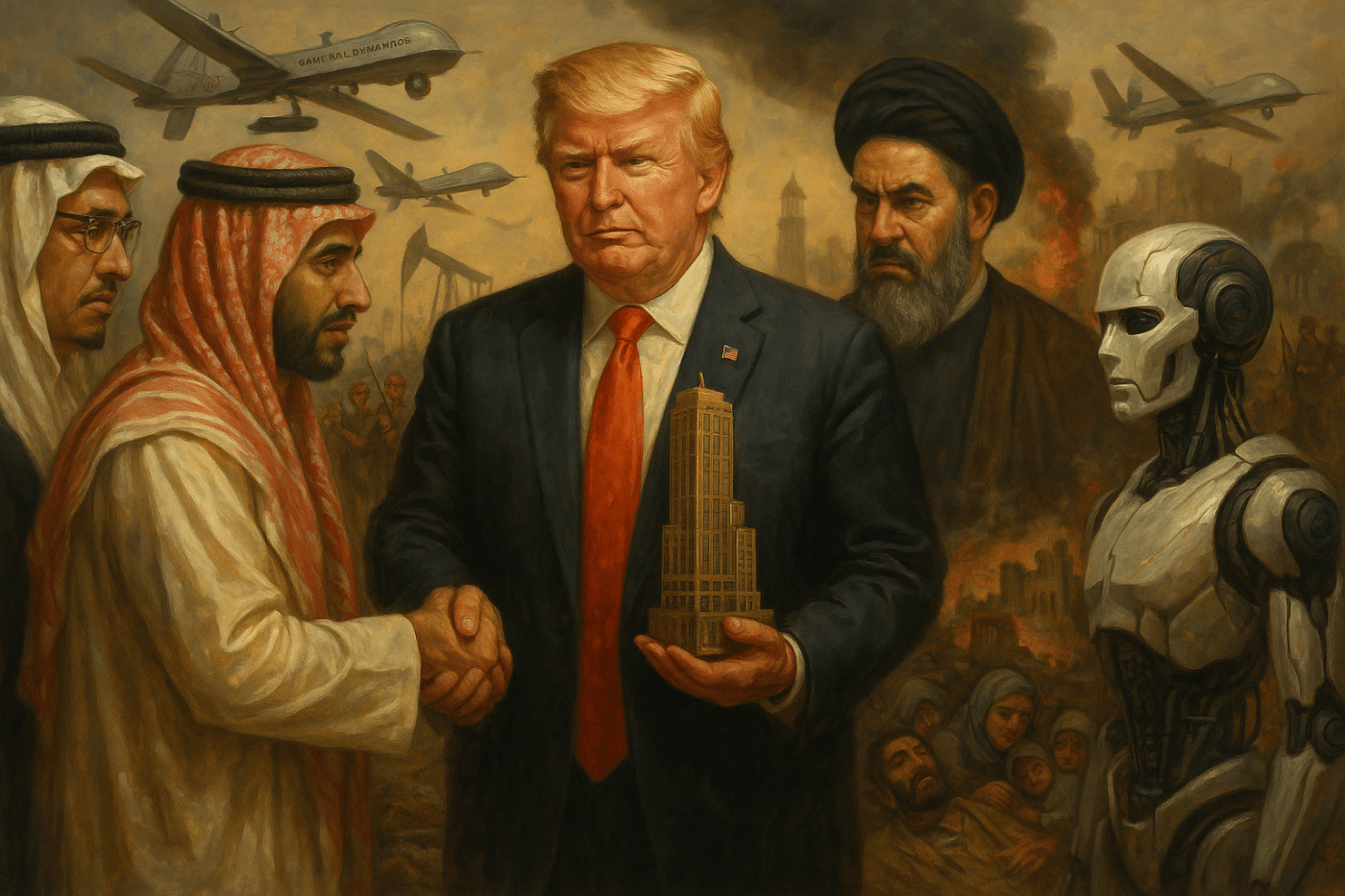
The empire returns not to make peace, but to make profit—and to break resistance.
By Prince Kapone | Weaponized Information | May 14, 2025
What Empire Lifts, It Owns
The lifting of sanctions on Syria wasn’t mercy—it was a hostile corporate acquisition. Trump has rebranded imperialism as economic “normalization,” where rebel-turned-technocrats like Ahmed al-Sharaa govern in exchange for Western investment and political obedience. The U.S. installs a proxy in Damascus and demands he sign the Abraham Accords, signaling not peace, but submission. This is recolonization disguised as diplomacy.
The Petrodollar Gets an Upgrade
Trump’s deals with Saudi Arabia—$600 billion in investments, $142 billion in arms, and AI contracts for companies like Nvidia—aren’t just economic coups. They’re the foundation of a new Middle Eastern comprador bloc, re-centered around Riyadh. The goal is to create a Gulf-led regional order that absorbs Zionist interests, marginalizes Iran, and binds the region to U.S. capital through oil, surveillance, and military dependency. This is the birth of a technofascist OPEC+, designed to counter BRICS and protect dollar hegemony.
The Axis Under Siege
Trump’s proposed nuclear deal with Iran comes with a loaded pistol: abandon Hezbollah, Ansar Allah, the PMF, and Hamas—or face total isolation. This isn’t denuclearization—it’s strategic decapitation. The U.S. wants Iran stripped of its alliances, weakened in its deterrence, and collapsed in its regional credibility. Meanwhile, a ceasefire with the Houthis seeks to fragment the Axis of Resistance from within—offering “peace” to some while threatening others. It’s divide-and-dominate, dressed up in Doha diplomacy.
Gaza: A Case Study in Imperial Real Estate
Trump’s grotesque proposal to “redevelop” Gaza—removing 2 million Palestinians and replacing them with resorts and ports—wasn’t just a Zionist fantasy. It was a vision of empire’s future: turn war zones into privatized export hubs, run by compradors, defended by tech, sanitized of resistance. This is settler-colonial urban planning on an imperial scale. And it’s coming, unless it’s stopped.
Ceasefires and Chains: The False Peace of Imperial Recolonization
Let’s keep it real. For the United States to devastate the Middle East for a quarter century—flattening Fallujah, starving Gaza, sanctioning medicine in Iran, unleashing CIA-trained jihadists on Libya and Syria—and then return as a supposed architect of peace is not a triumph of diplomacy. It is a crime syndicate laundering its blood money through the language of stability.
Millions are dead. An entire generation of Arabs, Kurds, Persians, and Pashtuns raised amid rubble and drones. Water systems bombed. Hospitals cut off. Nations dismembered, dignity denied. And now, after the killing fields have cooled, the empire comes knocking with real estate contracts, surveillance tech, and AI integration. The same empire. The same Wall Street backers. The same State Department ghouls. Different branding.
Trump’s Middle East recalibration isn’t peace—it’s pacification. It’s recolonization by contract. It’s the transformation of sovereign resistance into subcontracted servitude. Syria gets a puppet president. Saudi Arabia gets investment clout. Iran is told to abandon its allies. Gaza is offered to developers like beachfront real estate. And all the while, U.S. empire consolidates a new comprador alliance to block China, isolate Russia, and contain multipolarity.
But don’t mistake recalibration for resurrection. This is not imperial confidence—it’s imperial crisis management. A desperate attempt to revive an order that’s bleeding legitimacy and overextended militarily. The U.S. isn’t rising. It’s betting the house on a new colonial front. It needs the Gulf. It needs Syria. It needs cheap oil, obedient regimes, and geopolitical leverage against BRICS.
And yet, despite everything, the resistance still breathes. Yemen didn’t fall. Hezbollah didn’t surrender. Iran didn’t collapse. Palestine refuses to die. The global South grows bolder, and the empire knows it. That’s why it returns—not out of strength, but fear.
This is the contradiction of the moment: U.S. imperialism may “reenter” the Middle East, but it does so on weakening foundations. Its victories are pyrrhic. Its alliances are transactional. Its economic model is parasitic. And its people? Disillusioned, broke, angry. Technofascism may give it breath—but it cannot give it legitimacy.
So yes, comrade, the moment is demoralizing. But that’s only because we are seeing clearly. And clarity is the prerequisite for strategy. Now is not the time to retreat—it’s the time to sharpen our weapons. Not of violence, but of truth. History. Class analysis. Revolutionary internationalism.
Trump may offer ceasefires. But what the world needs are revolutionary ruptures. Let the false peace burn. Let the real struggle begin.
 Weaponized Information
Leave a comment