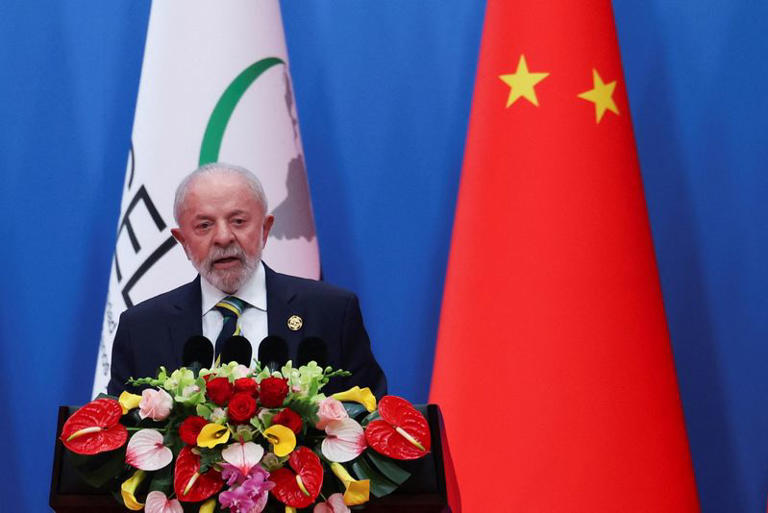
Speech by President Lula at the Opening of the IV CELAC-China Forum
H.E. Mr. Xi Jinping, President of the People’s Republic of China;
H.E. Comrade Gabriel Boric, President of the Republic of Chile, through whom I greet the entire Chilean delegation;
My dear Gustavo Petro, President of the Republic of Colombia, through whom I greet the entire Colombian delegation;
My dear comrade Dilma Rousseff, President of the New Development Bank, also known as the BRICS Bank;
My dear Mauro Vieira, Minister of Foreign Affairs, through whom I greet the entire Brazilian delegation;
My beloved comrade Janja;
Comrade ministers, ambassadors, parliamentarians present at this fourth CELAC-China summit:
I thank you for the invitation to participate in this meeting, which crowns the efforts of the Honduran presidency and marks an auspicious beginning for the Colombian presidency.
As many have recalled today, the CELAC-China Forum celebrates its tenth anniversary this year. Over the past decade, ties between Latin America and the Caribbean and China have grown stronger. China is now CELAC’s second-largest trading partner and one of the region’s most important sources of foreign direct investment. Funds from Chinese financial institutions surpass the loans offered by the World Bank or the Inter-American Development Bank. Partnership with China has become a dynamic force in the regional economy.
Chinese demand was one of the driving forces behind the growth we experienced at the beginning of the century. We made significant advances in reducing poverty and inequality. It was during this time that we finally looked around us and united to create UNASUR and CELAC.
During the COVID-19 pandemic, Chinese vaccines and medical supplies helped us protect our populations. Only through greater coordination among ourselves can we fully harness the potential of Sino–Latin American and Caribbean cooperation.
This is especially evident in infrastructure. Chinese support is decisive for moving forward with highways, railways, ports, and transmission lines. But the economic viability of these projects depends on our ability to coordinate as a region and give these initiatives regional scale.
The disarticulation of UNASUR—which we are now trying to reverse—left a huge gap in joint planning. We do not only need export corridors, but routes that are also vectors of development and integration. For centuries, resources extracted from Latin America and the Caribbean enriched other parts of the world. We now have a chance to do things differently.
The recent commodity cycle helped elevate our region’s position in the global economy. But times of crisis have shown that long-term prosperity requires balanced trade and diversified economies.
Distortions in international trade have always existed, especially in the exchange of agricultural goods, which has never been treated fairly within the WTO. The imposition of arbitrary tariffs only worsens this situation.
To build a shared future, we must reduce asymmetries between nations. The collaboration between CELAC and China must strengthen industrial capacity and innovation in our region.
The digital revolution must not become a new technological abyss between nations. The development of artificial intelligence should not be a privilege for the few. A just transition to a low-carbon economy also requires broad access to clean energy technologies.
Latin America, the Caribbean, and China can show the world that it is possible to fight climate change without sacrificing economic growth and social justice. COP30, to be held in Belém, in the state of Pará, at the heart of the Amazon, aspires to be a turning point in the implementation of climate commitments and in building trust in collective solutions.
The solution to the crisis of multilateralism is not to abandon it, but to improve it.
Latin America and the Caribbean can contribute by electing the first woman Secretary-General of the United Nations—thus honoring the legacy of the Beijing Conference on Women’s Rights.
Global governance no longer reflects the diversity of humanity. This anachronism has prevented the fulfillment of the UN Charter’s purpose to avoid the scourge of war.
Our region does not want to be a stage for hegemonic disputes. Over a decade ago, CELAC declared Latin America and the Caribbean a zone of peace. We do not want to replay history and stage a new Cold War.
Our vocation is to be one of the pillars of a multipolar order in which the Global South is duly represented. The CELAC-China Forum was the first mechanism for Latin America and the Caribbean to establish dialogue with a developing country. I hope we continue forging new paths with the same spirit of pioneering for the next ten years.
My friends, before I conclude, I want to issue a call to all comrades of Latin America:
The future of Latin America depends on our own conduct—on a fair analysis of what happened in the 20th century, where we advanced, and where we regressed—so we may finally understand this:
There is no way out for any country on its own.
We have 500 years of history that prove this. Either we unite among ourselves and seek partners willing to build a shared world with us, or Latin America will remain a region synonymous with poverty in today’s world.
We must understand this. It depends on no one else. It doesn’t depend on President Xi Jinping. It doesn’t depend on the United States. It doesn’t depend on the European Union. It depends solely and simply on whether we want to be great—or whether we choose to remain small.
Thank you.
 Weaponized Information
Leave a comment