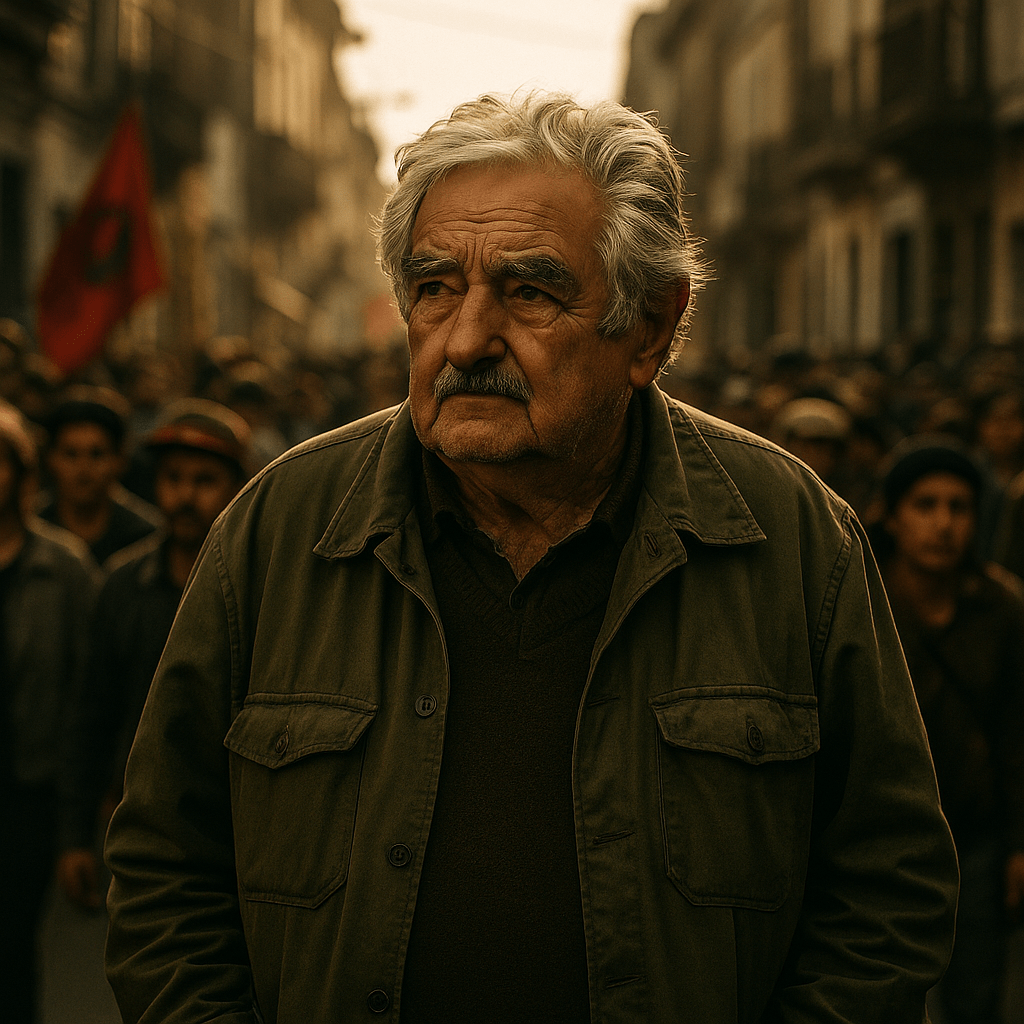
Born of the Land, Forged in Struggle
“I’m not poor. Poor are those who need too much.” — José “Pepe” Mujica
Pepe Mujica came from the soil—not the palaces, not the parliaments, but the hard land and harder times of Montevideo’s outskirts. Born in 1935 to a farming family that lost almost everything, he knew early what it meant to live with less and still walk with pride. His father died when he was six. His mother worked to keep the house standing. They didn’t talk about ideology at the table—they talked about how to get through the month. That was his first lesson in class struggle: the kind you live before you name.
In the 1950s, Uruguay was dressed up like a little European republic—progressive on the outside, but rotten underneath. The banks were foreign, the land was concentrated, and the workers were disposable. Washington smiled on it all, of course. Stability, they called it. But across the continent, the poor were waking up. The Cuban Revolution hit like a thunderclap. Mujica, like many young Latin Americans, stopped believing in slow reforms and started studying rifles. He didn’t want a better seat at the table—he wanted to flip the damn table over.
That’s how the Tupamaros were born. The Movimiento de Liberación Nacional wasn’t playing pretend—they were robbing banks, redistributing wealth, blowing up power lines, and making the rich remember they were vulnerable. This wasn’t chaos. This was strategy. This was a movement born from the belief that imperialism couldn’t be voted away, that the people had the right to fight back. Mujica wasn’t looking for glory—he was looking for justice. And sometimes, justice means putting your body on the line.
The Uruguayan state—propped up by Yankee money and local oligarchs—responded with what all empires do: terror. The Tupamaros were hunted. Mujica was captured. They didn’t give him a fair trial—they gave him a hole in the ground. Thirteen years of imprisonment. Most of it in solitary. They tried to erase him. Deprived of sunlight, books, contact, dignity—he should’ve come out a ghost. But he didn’t.
Something happened in that darkness. Mujica didn’t emerge obsessed with revenge. He came out with something rarer: clarity. He’d seen power up close—its brutality, its pettiness, its illusions. And he came to understand that revolution isn’t just about winning. It’s about not becoming what you set out to destroy.
Mujica’s greatest weapon wasn’t a gun. It was his refusal to be seduced by power. He didn’t wear simplicity like a costume—he lived it like a politics. When he said “I’m not poor,” he meant it. Because poverty isn’t about having little—it’s about being owned by your needs. Capitalism needs us to want everything, to chase the latest, to worship accumulation. Mujica walked away from all that. That made him dangerous.
The world teaches us to climb. Mujica dug in. While others polished their résumés for the system, he built his character in the ruins. Before he was president, before he was called “the world’s humblest leader,” he was a freedom fighter who slept on cement floors and came out unbent.
And that’s where the story really begins. Not in the Senate. Not in the palace. But in the silence of a jail cell, where one man refused to let the system take his soul—and came out ready to fight in a different way.
Revolution, Repression, and Return
The 1960s turned into the 70s with blood in the soil and bullets in the air. Across Latin America, the smoke of revolution rose—and with it, the boot came down. Washington called it “containment.” We called it what it was: counterinsurgency. They trained the torturers in the School of the Americas, branded liberation as terrorism, and stitched juntas together like Frankenstein’s monsters across the continent. Uruguay was no exception. It was a laboratory of repression—a test site where Yankee empire and local comprador elites perfected the science of fear.
The Tupamaros had stirred something powerful—working-class rage, peasant defiance, urban rebellion. They’d taken the fight to the banks, the corporations, the corrupt politicians. And so the state came with its full arsenal. By 1972, the MLN-T was crushed. Mujica was in chains. His comrades were dead or disappeared. The dictatorship turned the entire country into an open-air prison, and Mujica into a political hostage.
But they made a mistake. They thought they were burying him. They didn’t know he was a seed.
After 13 years of steel doors and psychological warfare, Mujica emerged in 1985 with the return of bourgeois democracy. Amnesty was granted, but not justice. The torturers walked free. The oligarchs kept their land. The U.S. embassy kept its grip. Mujica, however, didn’t come out looking for revenge. He came out with a longer view.
That’s when the so-called moderates started whispering: had he mellowed? Had the Tupamaro traded in his revolution for a seat in parliament? But they misunderstood him. Mujica hadn’t changed sides—he’d changed tactics. The rifle gave way to the microphone, not out of submission, but strategy. The street fighter moved to the Senate floor, but he never took off his boots.
Together with fellow ex-militants and working-class organizers, Mujica helped build the Movimiento de Participación Popular (MPP), a party that held fast to its Tupamaro roots and anchored itself in the struggles of the dispossessed. The MPP joined the Frente Amplio, a broad left coalition forged in the fires of dictatorship. Mujica didn’t demand ideological purity—he demanded class commitment. He understood that revolution was a marathon, not a spectacle.
This wasn’t reformism—it was revolutionary patience. While neoliberals sold off national industries and celebrated the market like it was God, Mujica and his comrades quietly built power. They knocked on doors. They organized co-ops. They supported unions. They didn’t tweet—because the poor weren’t online. They weren’t clout-chasing—they were class-building.
And the people remembered. They remembered the man who shared his food in prison. The man who never betrayed his principles for applause. The man who’d been locked away for loving justice too much. Mujica didn’t need to remind them who he was. His scars did the talking.
By the time he ran for president, he wasn’t running as a politician. He was running as a survivor of imperial violence, a messenger from the underside of the system. And when they laughed at the thought of a guerrillero leading the country, he smiled and said, “Let’s see what the people think.”
The Reluctant President and His Radical Modesty
They didn’t expect him to win. Not the bankers, not the pundits, not the polished liberals in tailored suits who thought politics belonged to the educated and elite. But in 2009, the people of Uruguay made their decision. They elected José “Pepe” Mujica—the Tupamaro guerrillero who once robbed banks and planted bombs—as their president. And just like that, the state had to make room for a man it once tried to disappear.
But Mujica didn’t come into power the way others do. He didn’t arrive draped in ego, flanked by consultants, or obsessed with legacy. He didn’t care about marble halls or international summits. He refused to move into the presidential palace, calling it “too grand.” He stayed on his one-story flower farm, where he and his wife, Senator Lucía Topolansky, grew chrysanthemums for local markets and fed three-legged dogs off tin plates. He kept his rusty Volkswagen Beetle, turned down luxury cars, and gave away 90% of his salary to public housing projects and community organizations.
In an era of million-dollar campaigns and billion-dollar candidates, Mujica made frugality into revolution. He exposed how much waste and self-worship are stitched into the fabric of bourgeois politics. While technocrats measured success in GDP and stock prices, Mujica asked: are the workers eating? Are they housed? Can they live with dignity?
His government wasn’t perfect—but it was bold. He legalized same-sex marriage and abortion. He made Uruguay the first country on Earth to legalize and regulate marijuana, not because he was a libertarian, but because he understood the war on drugs was a war on the poor. He pushed renewable energy, expanded labor protections, and improved access to health care and education. All while the IMF and World Bank lurked in the shadows, whispering caution. Mujica wasn’t reckless. He just didn’t ask permission from empire.
But he also never romanticized the state. Mujica knew bureaucracy was a hungry beast, and that power, even in the hands of the well-intentioned, can rot from the inside. He constantly warned against the cult of professionalism, the logic of technocracy, the slow death of politics through process. He reminded his own coalition: “We came to serve—not to get comfortable.”
They called him the “world’s humblest president.” But that misses the point. Mujica’s humility wasn’t a personal quirk—it was an ideological position. A rejection of capitalist narcissism. A slap in the face to the rich who confuse consumption with character. He didn’t dress simply to win praise—he dressed simply because nothing about liberation should require a necktie.
Mujica’s presidency was a contradiction—and that was the point. A former urban guerrilla running a nation-state. A prisoner of empire now negotiating with its emissaries. But instead of being swallowed by power, he held his line. Not perfectly. Not always loudly. But always with dignity.
In a time when most leftists get lost in conferences, NGOs, or career paths, Mujica showed what it meant to remain rooted. He never stopped being Tupamaro. He just changed his terrain—from the cell block to the cabinet room. And he never forgot which side of history he came from.
The Theory Behind the Simplicity
The world mistook Mujica’s lifestyle for eccentricity. They saw a man in worn clothes, a beat-up Beetle, a president with dirt under his fingernails—and they called him quirky. But this wasn’t a personality tic. It was political theory. It was class war, dressed in humility. A living rebuke to the ruling class, a standing indictment of capitalist values. Mujica didn’t just live simply—he lived in defiance of everything the empire tells us we should want.
His critique of capitalism wasn’t buried in academic jargon. It was plain, sharp, and devastating:
“We invented a mountain of superfluous needs. You buy and buy… and when you can’t, you carry frustration. You feel inferior. You feel a failure. We are trapped by consumerism. It is a paradox: we talk of saving the environment, but we push consumption to the limit.”
Mujica saw capitalism not just as a system of economic exploitation, but as a form of spiritual colonization—a machinery of desire that teaches people to hate themselves unless they’re consuming. He understood that the war isn’t only for our labor—it’s for our souls. For our sense of what life is and what it should be. And against that, he built a quiet insurgency of enough.
His ideological roots ran deep. He drew from anarcho-syndicalist traditions, from the anti-colonial philosophy of Uruguay’s national hero José Artigas, and from the socialist internationalism of Bolívar and Martí. He called himself a “libertarian socialist”—but not in the western, boutique sense. His was the socialism of the campo, of co-ops and collectives, of campesinos and ex-guerrilleros still organizing neighborhood assemblies. His politics were never abstract. They were grown in the soil, passed through struggle, and tested in steel.
Mujica’s anti-consumerism wasn’t about guilt or moralism. It wasn’t Instagram minimalism or eco-chic virtue signaling. It was collective ethics. He believed a society shouldn’t be judged by how fast it grows, but by how well it shares. And more importantly, by whether people could live lives of dignity without selling their souls for survival.
His vision of the state was equally radical—precisely because it was modest. He didn’t believe the state should micromanage every part of life, nor abandon it to the market. He believed the state should support, not smother; protect, not dominate. The state, in his eyes, was a tool—nothing more. And if it lost its usefulness to the people, it deserved to be broken.
Mujica often said that power changes people—but he worked every day to make sure it didn’t change him. He treated ideology not as a religion, but as a compass. He never claimed to have all the answers. He claimed to have one obligation: to never forget where he came from. And to never stop walking toward a world where no one is disposable.
“Revolution,” he said, “is not about hating the rich. It’s about loving the poor.” But love, for Mujica, was never soft. It was organized. It was militant. It was a lifelong commitment to destroy the conditions that make poverty possible.
Internationalism, Multipolarity, and Post-Colonial Humility
Mujica never mistook Uruguay for the center of the world—but he also never allowed it to be its periphery. His internationalism wasn’t stagecraft; it was conviction. Born of the Latin American tradition of resistance—from Bolívar to Sandino, from Che to Chávez—Mujica carried the torch of anti-imperialism with quiet force. He didn’t posture. He didn’t grandstand. But when he spoke on the global stage, you could hear the weight of every campesino, every factory worker, every disappeared comrade in his voice.
He rejected Cold War binaries. He refused to bow before the Washington Consensus or play errand boy for NATO. He didn’t glorify the East either. He stood firm in what he called “strategic dignity”—a politics of non-alignment that refused to be a pawn in anyone’s game. Mujica understood that the Global South needed unity, not subordination; sovereignty, not servitude.
He condemned the U.S. blockade on Cuba. He stood with Venezuela, even when it cost him favor in European capitals. He offered real solidarity to Bolivia under Evo. And when Colombia was bleeding from decades of war, Mujica’s Uruguay became the unlikely host of peace talks between the FARC and the Colombian government. He didn’t do it for photo ops. He did it because that’s what internationalism means: not statements, but struggle. Not hashtags, but help.
He took the same stance on Palestine. While the so-called “free world” flooded Tel Aviv with arms and silence, Mujica broke ranks. He condemned the occupation, called out Israeli apartheid, and defended the dignity of the Palestinian people when it was neither convenient nor popular. For Mujica, empire was empire—whether it flew the stars and stripes or the Star of David.
But he never turned that internationalism into arrogance. He didn’t romanticize his role or pretend to be a global savior. Mujica knew the damage Latin America had suffered at the hands of colonialism, and he refused to mirror that violence in his diplomacy. He didn’t lecture the Global South—he listened. He understood that humility is not weakness. It is strength. Especially when facing the temptations of technocracy, the traps of geopolitical flattery, and the soft coercion of Western “development aid.”
In an age of NGO imperialism and Beltway think tanks selling neoliberal “solutions” to the world’s poor, Mujica said no. No to extractivist treaties dressed up as progress. No to privatized infrastructure wrapped in the flag of foreign investment. No to debt as a chain and austerity as a leash. He wasn’t anti-modernity—he was anti-mimicry. He didn’t want Uruguay to become a cheap copy of the North. He wanted it to become a dignified version of itself.
Multipolarity, for Mujica, wasn’t about trading one master for another. It was about building a world where no one had to kneel. A world where sovereignty wasn’t conditional. Where development wasn’t code for extraction. Where people could dream without permission.
And for all his critiques of empire, Mujica never lost his sense of planetary responsibility. He spoke often about the climate crisis—not as a branding opportunity, but as a death sentence for the poor. He saw ecological survival as a class issue, and demanded a new ethic: one rooted in cooperation, restraint, and solidarity between nations, not competition.
His message was clear: if we are to build a new world, it will not come from the North. It will come from below. From the villages, the barrios, the jungles, and the ruins—where dignity still breathes, and where the fight for freedom has never ended.
Death, Legacy, and the Lessons of Revolutionary Humility
Comrade Mujica left us the same way he lived: without spectacle, without vanity, and without apology. In April of 2024, he was diagnosed with esophageal cancer. By January 2025, he refused further treatment. “I’m dying,” he said. “A warrior has the right to rest.” On May 13, 2025, at the age of 89, he took his final breath at his flower farm in Rincón del Cerro—surrounded by his compañera Lucía, the birds he fed, and the soil he never stopped tending. Uruguay declared three days of mourning. Latin America mourned longer. The poor and struggling around the world—those who recognized in him a rare kind of honesty—mourn still.
The tributes poured in, from presidents and prisoners alike. Not because Mujica was a saint—he wasn’t. And he didn’t want to be. He was a man forged in contradiction: a guerrilla who sat in office, a radical who believed in institutions, a socialist who distrusted ideology when it lost touch with life. Some accused him of selling out. Others accused him of being too stubborn, too impractical, too poor. But Mujica never answered to them. He answered to the people who carried him.
His death raised the same questions his life had: Was he too pragmatic, or not pragmatic enough? Too radical for the liberal class, too compromising for the militant sects. But Mujica never fit cleanly into categories because he never worshipped them. He believed in struggle, not purity. In process, not posture. In liberation, not branding. That made him dangerous—because it made him ungovernable by capital’s logic.
The system couldn’t buy him. It couldn’t scare him. And perhaps most threatening of all—it couldn’t make him need it. Mujica didn’t emerge from struggle to climb. He emerged to build. And when the state was no longer a site of possibility, he simply walked away. Lighter than he entered. Unimpressed by applause.
His legacy isn’t in statues. It’s in soil and smoke, in union halls and prison scars, in the quiet defiance of a people who’ve learned to organize themselves. It’s in the idea that revolution doesn’t require ego—it requires ethics. That leadership isn’t about charisma—it’s about character. And that if we ever hope to destroy empire, we must first destroy the empire in ourselves.
Mujica didn’t teach us how to be saviors. He taught us how to be servants. He reminded us that the revolution is not a moment, or a meme—it is a commitment. One that survives defeat, adapts to terrain, and speaks softly when the shouting is done.
“You can’t change the world,” he said, “if you can’t change yourself.” That was no self-help slogan. It was a challenge. Because the system trains us to accumulate, to conquer, to dominate. Mujica trained himself to let go. To live with less. To serve the people, and then step aside.
From Che to Sankara, from Berta to Chávez, from Cabral to Mujica—there is a thread: revolutionary humility. Not submission, but clarity. Not meekness, but discipline. Not martyrdom, but meaning. We do not build socialism for glory. We build it for each other.
The Rebel Who Gave Everything Back
In a world where power corrupts, accumulates, and devours, José “Pepe” Mujica lived a life that gave it all back. He didn’t enrich himself in office. He didn’t chase global prestige. He didn’t hoard power, land, or titles. And when his time came, he left not with wealth—but with the love of a people, and the respect of a world tired of liars.
This was not charity. It was class fidelity. Mujica didn’t “resist temptation”—he had already buried the urge. He showed that revolutionary leadership is not about holding power longer than your enemies. It’s about refusing to become them. He left the presidency the same way he left prison: upright, unbought, and unbroken.
His flower farm never became a museum. His Beetle never became a monument. And that, comrade, is the legacy. He didn’t ask to be remembered. He asked us to continue. His life wasn’t a statue—it was a map. A compass pointing to what is still possible: politics without greed, struggle without ego, victory without betrayal.
In a time when the technocrats govern by algorithm, when fascists govern by fear, and when too many leftists govern by compromise, Mujica governed by conscience. And when he walked away, he left behind no vacuum, no scandal, no palace intrigue. Just a legacy measured not in terms of power seized—but in power refused.
For the colonized, for the landless, for the imprisoned and the exploited—Mujica’s life is a reminder that dignity is not abstract. It is lived. It is protected. It is defended. And above all, it is shared.
“He walked out of power lighter than he walked in.”
Let the world say of us what they said of him: they lived with the people, and died with dignity. And may we, like Mujica, leave behind no monuments—only movements.
 Weaponized Information
Leave a comment