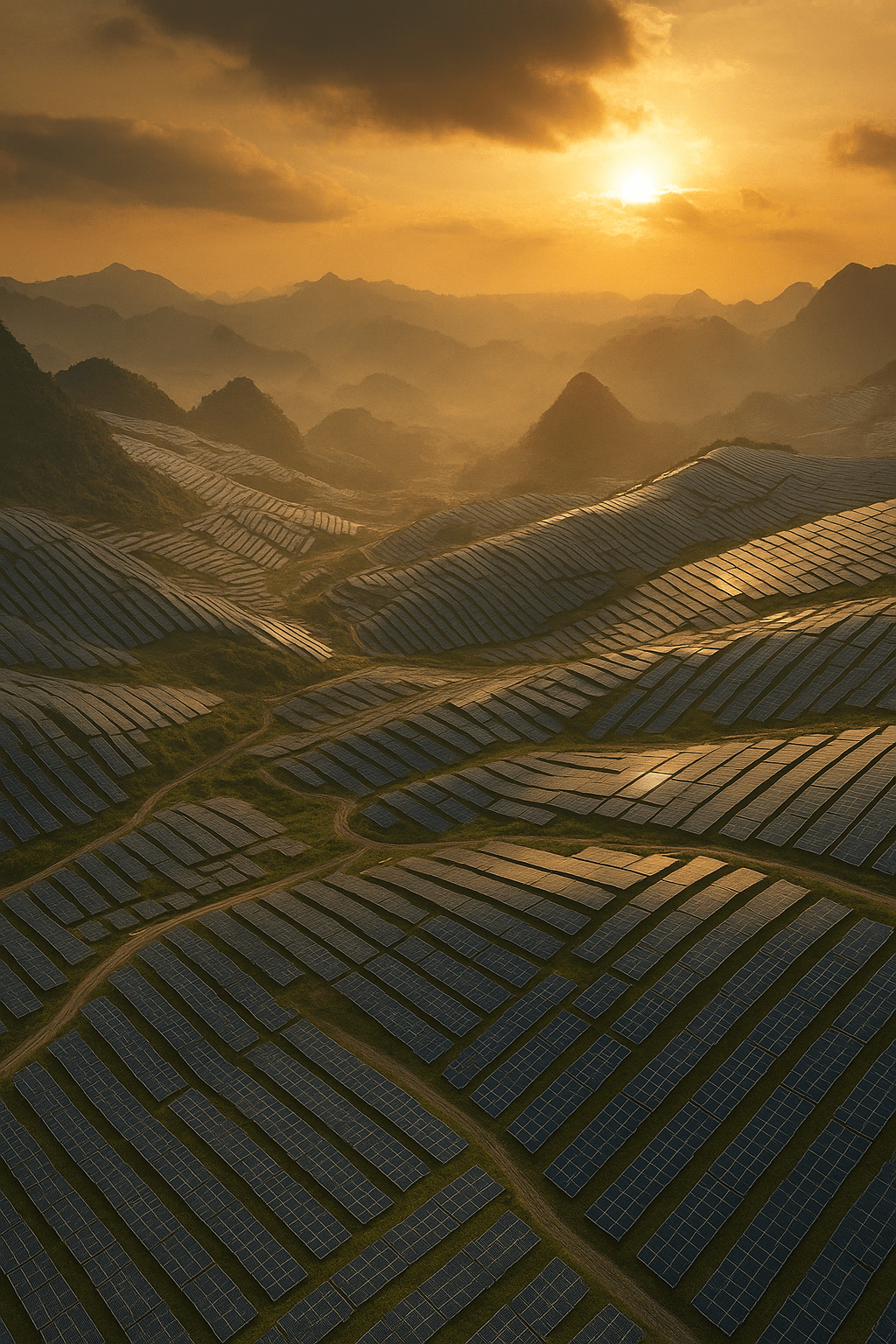
What the West calls clickbait is actually a revolution in energy planning. Guizhou’s solar fields aren’t just panels—they’re proof that the Global South is done waiting.
By Prince Kapone | Weaponized Information | May 12, 2025
I. When the Empire Accidentally Tells the Truth: A Solar Glitch in the Matrix
There’s no byline here—just Yahoo News, one of the many algorithmic content mills of late-stage U.S. media, repackaging wire service blurbs for clicks and ad revenue. Normally, Yahoo plays its role in the imperialist media apparatus quietly—blunting contradictions, flattening insurgent infrastructure into apolitical spectacle. But sometimes, even empire stumbles. Sometimes, reality bursts through the firewall of memes and metrics. This article is one such rupture. It doesn’t smear China. It doesn’t lie. It doesn’t even really editorialize. Instead, it stares, momentarily stunned, at a solar revolution it can’t explain—and accidentally admits that the West is losing the future.
The article opens with an image: “a viral drone video shows mountains in China’s Guizhou province blanketed in solar panels.” Right away, we’re told what this is supposed to be: not infrastructure, not sovereignty, but “clickbait.” That word is doing a lot of ideological work. It trivializes the footage before the reader can think. It tries to reduce a planetary-scale transformation into just another moment in the attention economy. This is the first line of defense: deflection by novelty. The message is clear—don’t study this, don’t take it seriously, don’t ask what it means. Just marvel. Then scroll.
But then the article glitches. It admits, almost in passing: “Behind the drone footage is something far more serious: real infrastructure, built at scale, in service of a national plan.” This sentence doesn’t belong in Yahoo’s ideological script. It contradicts the premise. It tells the truth. China isn’t just building—it’s planning. Coordinating. Developing. Not through carbon markets or celebrity offsets or ESG portfolios, but through the state. The same Guizhou province once dismissed as “too remote” by Western development economists is now anchoring a solar grid the size of a small country. The terrain hasn’t changed. The system has.
That truth can’t stand on its own for long, so the article retreats. It says: “China isn’t perfect.” That’s not analysis—it’s ritual. A reflexive gesture toward moral equivalence, inserted whenever a Western outlet gets too close to acknowledging multipolar superiority. The U.S. can bomb pipelines and fund dictators and still be called “imperfect.” But China? China must always be footnoted, caveated, restrained. Even when it’s building the sun.
Still, the cracks keep widening. The article goes on to say: “This is what planned development looks like when it isn’t hijacked by hedge funds or greenwashed by NGOs.” That sentence doesn’t come from Yahoo’s editorial handbook. It reads like something out of *Monthly Review* or the Tricontinental. The writer doesn’t name the hedge funds or NGOs—but we know them: BlackRock, Brookfield, Breakthrough, Bezos Earth Fund. The whole Western climate grift machine. The entire infrastructure of green capitalism built to extract value from a burning world while blaming poor people for using plastic straws. The sentence slips in like a confession. They didn’t mean to say it. But they did. And we heard it.
So what is this article, really? It’s not propaganda in the classic sense—there’s no enemy portrait, no Cold War framing, no caricature of Chinese repression. But it’s not fraternal either. It doesn’t stand in solidarity with the Chinese people or acknowledge the anti-colonial dimensions of national planning. What we have here is a contradiction in motion. A transmission glitch from inside the imperial matrix. The spectacle escaped containment. The drone showed something it wasn’t supposed to show. And the editor—blinking, unsure—hit publish anyway.
We take it not as gospel, but as evidence. That even the organs of empire cannot completely suppress the facts anymore. That the ground is shifting. That the future isn’t being built in Silicon Valley—it’s being wired into the mountains of Guizhou, where the sky now reflects panels, not poverty. That is the truth they cannot unsee. And that’s the truth we will weaponize.
II. From Remote Province to Energy Vanguard: Reading Guizhou Beyond the Drone
The facts, such as they are, are buried like roots beneath the viral canopy. The article tells us that in Guizhou—a historically poor and mountainous province in southwestern China—a massive solar installation now blankets entire ranges. It tells us the video went viral. That China is laying down “terawatts of concrete and silicon.” That this is infrastructure, scaled and real, serving a national plan. These are admissions, not arguments. But even fragmented truth, when pried from the hands of empire, can become revolutionary material.
Guizhou was long considered economically “backward” by Western economists—a province of steep hills, rural poverty, and limited agricultural potential. For decades, development was uneven, stunted by geography, colonial debt cycles, and central planning policies that prioritized the coast. But in the past ten years, that changed. Through a deliberate strategy of westward investment, poverty alleviation campaigns, and renewable infrastructure deployment, Guizhou was transformed from a forgotten hinterland into a linchpin of China’s solar grid. This wasn’t accidental. It was dialectical development—rooted in the contradictions of uneven growth and resolved not by market magic, but by central coordination, public ownership, and state engineering capacity.
What the article doesn’t say is just as important. It doesn’t mention that China leads the world in solar panel manufacturing, grid-scale battery deployment, and renewable integration. It doesn’t mention that by 2023, China had more installed solar capacity than the next ten countries combined. It doesn’t mention that Guizhou’s development is part of a Five-Year Plan coordinated through the National Energy Administration and executed by state-owned enterprises like China Huaneng and State Grid Corporation. It doesn’t mention that China has poured over a trillion dollars into green infrastructure while the U.S. state apparatus has pivoted entirely back to fossil capital. The drone gives us pixels. The dialectic gives us context.
Meanwhile, what is the U.S. model? Fossil fuel expansion dressed up as “energy independence.” Climate policy gutted by executive order and replaced with corporate capture. Under Trump 2.0, even the hollow gestures of green capitalism have been scrapped. Environmental protections have been rolled back, federal agencies like the EPA and DOE have been placed under fossil fuel loyalists, and solar tariffs have been reimposed in the name of “national security.” The Department of Energy no longer plans for a green transition—it auctions drilling permits and rewrites grid regulations for ExxonMobil. Instead of planned energy, we get petro-populism. Instead of terawatts, we get TikTok influencers telling us to recycle while the Gulf Coast sinks beneath rising tides.
Even in the Global South, Western-backed NGOs have undermined sovereign energy development—pushing “community solar” schemes that fracture public utilities, delaying grid integration in favor of small-scale, donor-dependent projects. In contrast, China’s model is flawed, yes—but material. It builds. It connects. It replaces. It organizes energy not as a commodity, but as a geopolitical lever and civilizational task. Guizhou isn’t an anomaly—it’s an index of a system operating on fundamentally different logics than the decaying core of hyper-imperialism.
That’s what makes the Yahoo article so unintentionally revealing. In trying to trivialize the footage, it confirms its threat. In trying to contain the spectacle, it registers its scale. And in trying to hedge its praise, it shows us something deeper: that energy is no longer just about megawatts or emissions. It’s about sovereignty. About who gets to survive the 21st century. And who gets to decide how.
III. Building the Sun: Solar Sovereignty as Anti-Imperialist Infrastructure
What Guizhou offers us is not just wattage—it’s a glimpse of what sovereignty looks like when it’s wired into silicon and steel. It is the political economy of light. These solar fields aren’t just panels. They are declarations. Not of utopia, but of rupture—of what becomes possible when a nation organizes its productive forces not around hedge fund appetites or NGO grants, but around collective survival. When a province once discarded as peripheral becomes central—not to spectacle, but to strategy. This is what multipolarity looks like from the ground up.
It is no accident that the West sees Guizhou’s solar revolution as a meme. That’s how empire processes trauma: by laughing at what it cannot control. A solar field the size of a mountain isn’t supposed to exist without Elon Musk’s name on it. Power at this scale is only considered legitimate when it flows from Wall Street’s portfolio, not from a national plan forged by engineers, workers, and elected local bodies in a socialist-oriented state. That’s why even Yahoo, in its glitching moment of honesty, had to shroud the revelation in a veil of irony. To admit the reality would be to accept the decline of Western energy hegemony—and the emergence of a rival logic that doesn’t beg for venture capital approval before laying a power line.
While the West cycles through dead-end elections and greenwashing NGOs, China organizes energy through the state and its mass democratic institutions—from local People’s Congresses to village committees and consultative mechanisms like the CPPCC. These are not liberal spectacles. They are organs of participatory governance structured by democratic centralism, enabling feedback from below and implementation from above. They do not negate contradiction—but they contain it, channel it, and resolve it through policy, not punditry. Guizhou’s transformation is not just technological. It is political.
The Western model promises climate virtue but delivers pipelines and carbon credits. The Chinese model delivers contradictions, yes—but also megawatts. It delivers transition not as lifestyle branding, but as geopolitical necessity. Because unlike the West, China isn’t just preparing for rising seas or trade wars—it’s preparing to survive them. Guizhou’s solar grid isn’t a flex. It’s a shield. A platform for continuity in a century that will be defined by disruption. And that, more than anything, is what terrifies Washington, Brussels, and the liberal climate elite: the idea that climate resilience doesn’t require capitalism at all.
We don’t reframe Guizhou’s solar fields as utopia. We reframe them as evidence: that another path exists. That empire’s collapse is not the end of the world, but the end of its monopoly on the means to power it. That the Global South is not waiting for permission to survive. It’s already building the sun.
IV. From Energy Spectacle to Eco-Socialist Struggle: Mobilizing in Defense of Solar Sovereignty
Guizhou’s solar fields are not just a national asset. They are a front line in the global struggle for ecological survival against hyper-imperial sabotage. And like all front lines, they require material solidarity—not applause, not analysis, but active defense. China’s energy transition has never been separate from its anti-colonial project. From damming rivers in Yunnan to desert-greening in Inner Mongolia, the ecological arm of socialist development has always been inseparable from sovereignty. The West calls this centralization. We call it coordination in service of survival.
There is precedent for solidarity. When the U.S. and EU tried to cripple China’s solar industry with tariffs and WTO rulings in the 2010s, international networks of scientists, engineers, and anti-sanctions advocates exposed the hypocrisy. When the Trump administration demonized Huawei’s green infrastructure development in the Global South, African and Latin American leaders publicly affirmed China’s investment in sustainable growth. When the West accused China of “overcapacity” in solar panel production, it was Chinese factories—state-directed and labor-powered—that kept panels affordable for dozens of Global South nations. This is not charity. It is multipolar mutual aid.
Today, material solidarity means rejecting the imperialist climate narrative at its root. It means organizing against the greenwashing apparatus that smears Chinese development while defending Wall Street’s carbon offsets. It means exposing Western “eco-NGOs” that pressure the Global South to adopt austerity and “community energy” while blocking public grids and sovereign electrification. And it means building class consciousness in the imperial core that connects fossil fascism abroad to technofascism at home.
Revolutionaries inside the U.S. must move from commentary to construction. Some concrete tactical pathways include:
- Launch public campaigns exposing the fossil capital lobby’s role in attacking China’s renewable exports—naming companies, banks, and front groups operating through “climate” channels.
- Develop bilingual political education materials highlighting China’s eco-socialist infrastructure for communities of color, labor unions, and youth organizers in the U.S.
- Forge principled alliances with diaspora-led environmental justice coalitions resisting the U.S. war drive against China and promoting climate cooperation over Cold War.
- Disrupt local, state, and federal subsidies for fossil fuel giants using China’s clean energy scale as a counterexample in public hearings, op-eds, and actions.
- Build dual and contending power through energy co-ops, tenant associations, and labor formations that articulate a vision of public, decommodified energy rooted in socialist planning—not market-based decarbonization.
This is not about mimicking China’s model—it’s about drawing inspiration from its refusal to obey the laws of imperialism. The West insists that no state can lead an ecological transition without first serving private capital. China proves otherwise. Our task is not to universalize China’s path, but to clear space for it to continue—and to build our own revolutionary route alongside it. Guizhou shows us what’s possible. The rest is on us.
 Weaponized Information
Leave a comment