Self-Sufficient and Sovereign: Why the West Feared an Independent China
(Part 2 of the Series: The Roots of Western Hostility Toward China)
By Prince Kapone | Weaponized Information | May 11, 2025
Part 1: Stolen Foundations: How the West Pirated China’s Knowledge and Technologies
There was once a land that needed no one.
It grew its own food, wove its own cloth, smelted its own iron, charted its own stars.
It had perfected the art of survival long before the cities of Europe crawled out of their muddy infancy.
It did not seek colonies, did not dream of conquest across oceans, did not believe that salvation lay in the domination of others.
This land was called China. And it stood, for centuries, as an unbroken wall against the rising tide of Western capital, a stubborn testament to the idea that a people could be sovereign, self-sufficient, and whole.
And that — not communism, not authoritarianism, not some imagined dragon’s ambition — is why China earned the permanent enmity of the West.
Harmony Over Conquest: The Chinese Model of Civilization
In the time when Europe tore itself apart with feudal wars and religious fanaticism, China cultivated something else entirely: the steady hand of bureaucratic governance.
The Mandate of Heaven was no divine right of kings; it was a practical contract between ruler and ruled, broken when emperors grew corrupt, renewed when they governed with virtue.
Agriculture thrived through massive public works — irrigation canals, levees, terraced hillsides — so that the majority of the Chinese population could feed itself with relative stability.
Urban life blossomed not as isolated city-states warring for supremacy, but as extensions of a unified civilization that stretched from the Yellow River to the South China Sea.
Technological innovations — paper, printing, compasses, gunpowder — were treated as common goods to improve human life, not as commodities to be privatized and militarized.
As Needham reminds us in Science and Civilisation in China, China’s greatness was not built on the subjugation of others, but on the steady cultivation of its own potential. It was a civilization secure enough not to need the world — a dangerous affront to the emerging Western gospel that life itself must be reduced to a marketplace.
When the Seas Were Theirs — And They Walked Away
In the fifteenth century, China could have conquered the world.
Admiral Zheng He, commanding fleets so large they dwarfed anything Europe could conceive, sailed as far as East Africa. His treasure ships — some the length of football fields — carried silk, porcelain, and spices, not soldiers.
He brought gifts to the rulers he met, not gunboats and demands for tribute.
And then, just as suddenly, the voyages ended.
The Ming emperors — believing that their civilization needed no foreign entanglements — turned inward. The great shipyards were shuttered. The dragon returned to its mountain.
This decision, detailed in Louise Levathes’ When China Ruled the Seas, remains incomprehensible to the Western mind. Why, having glimpsed the world, would a power choose not to seize it?
Because conquest was not at the center of China’s political imagination. Stability was. Harmony was. Sovereignty was.
The West, raised on a diet of predatory accumulation, could neither understand nor forgive this choice.
The Unbalanced Ledger: Europe’s Growing Obsession
By the eighteenth century, Europe was hooked on Chinese goods.
Silk fluttered in aristocratic courts, porcelain adorned the tables of kings, tea became the morning ritual of entire empires.
Yet China wanted nothing from Europe in return.
No Scottish wool, no French wines, no British clocks could tempt the Chinese court.
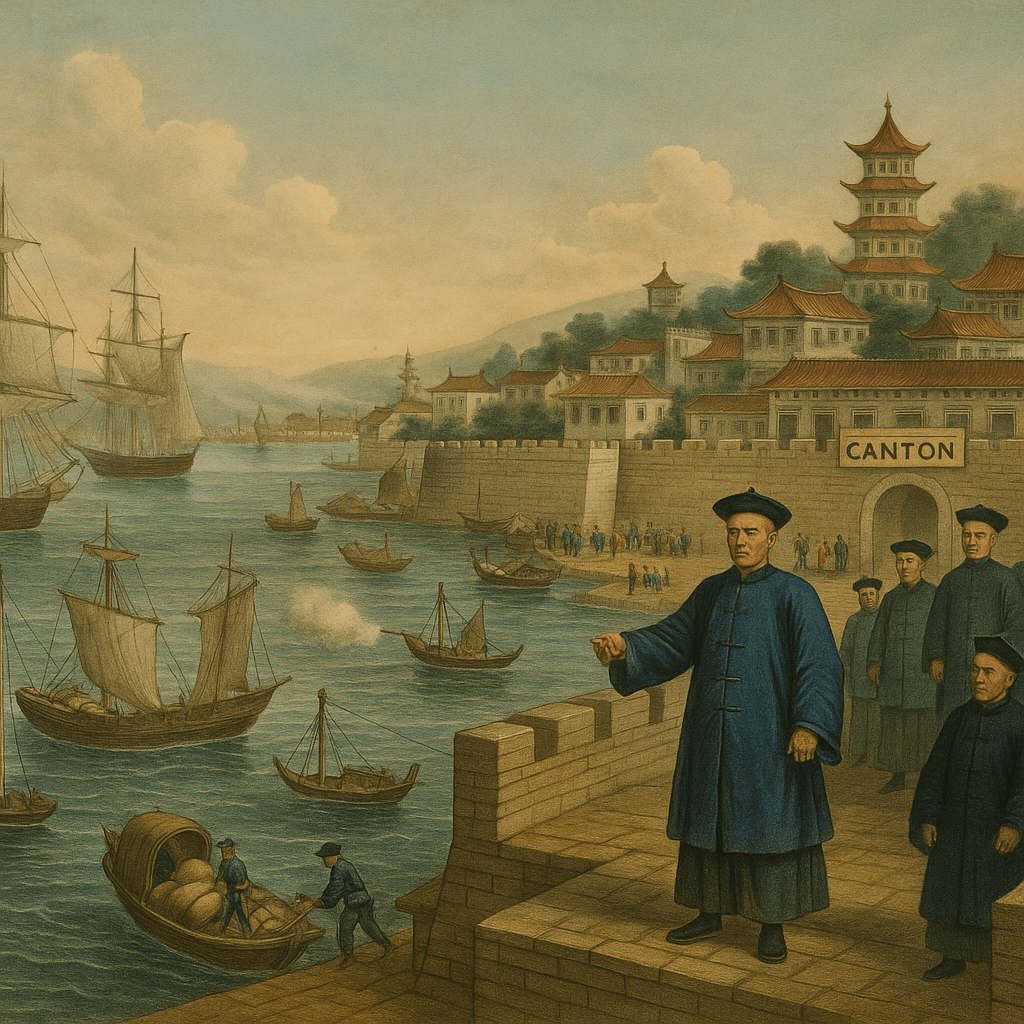
In Guangzhou, under the Canton System, Western merchants were permitted to trade — but only under strict Chinese terms, limited to a single port, a single district, a single intermediary class of traders known as the Cohong.
The trade deficit ballooned. Silver drained from European treasuries into China like a river reversing course.
As chronicled in the Historical Journal, Britain’s panic grew palpable. China’s self-sufficiency was no longer a curiosity — it was an existential threat to the mercantilist dreams of empire.
The Economic Necessity of Opium and War
Capitalism, facing a wall it could not climb or buy its way over, reached for its oldest and ugliest tool: narcotic violence.
Britain flooded China with Indian-grown opium.
A century’s worth of careful Confucian order began to corrode from within. Addiction hollowed out communities; silver hemorrhaged from Chinese coffers back into British banks.
This was no small-time operation. Some of America’s most “respectable” ruling families built their fortunes smuggling opium into Chinese ports: the Delano family (ancestors of Franklin Delano Roosevelt), the Astor family (who became America’s first multi-millionaires), and the Forbes family (whose descendants would later move in the highest corridors of U.S. political and economic power).
Opium profits did not simply pad private fortunes. They were laundered into banks, insurance houses, shipping empires — laying down the brick and mortar of Western capitalist expansion.
The drugging of China’s people became the foundation for Wall Street, for Boston Brahmin dynasties, for the transatlantic networks that would bankroll industrial revolutions in the West.
This wasn’t free trade. It was chemical warfare for capital accumulation — the hidden scaffolding of the world order the West dares to call civilized.
When the Qing government tried to resist, confiscating and destroying opium shipments, Britain cried foul — and responded with gunboats.
The Opium Wars (1839–1842; 1856–1860) were not about “freedom of commerce.”
They were about smashing China’s sovereignty and forcibly integrating it into a world economy built for Europe’s benefit.
Julia Lovell’s The Opium War leaves no doubt: it was economic terrorism, pure and simple.
Inventing the Backward China
Yet even after the treaties were signed, the ports opened, the warships docked in Chinese harbors —
the West still faced a dilemma.
It needed not only to break China’s material power, but to destroy China’s moral authority as well.
And so the narrative shifted.
China was no longer a self-sufficient civilization to be respected. It was now “the Sick Man of Asia” — decadent, stagnant, and ripe for colonization.
As Edward Said’s Orientalism explains, the colonizer must create the colonized as inferior — backward not merely technologically, but existentially.
Mobo Gao’s Constructing China sharpens the point further:
this was not simply a 19th-century slander. It is a living ideological warfare that persists to this day, where China’s victories must be recast as threats, and its sovereignty painted as tyranny.
The Price of Refusal
China’s crime — the crime that cannot be forgiven — was refusing to become a permanent appendage of Western capitalism.
Not then, not now.
When China rejected Christianity, it was deemed godless.
When China rejected capitalism, it was deemed communist.
When China today refuses to collapse into neoliberal subjugation, it is deemed a “threat to the rules-based international order.”
But the rules were written by the thieves.
And China, even battered, bloodied, and humiliated over the centuries, never fully accepted those terms.
Conclusion: A War Older Than Memory
The hostility directed at China today is not about democracy, or freedom, or human rights.
It is about the unfinished business of empire — the need to discipline, fragment, and dominate any civilization that dares to walk its own path.
China’s greatest sin in Western eyes was not expansionism, but independence.
Not belligerence, but self-reliance.
Today’s New Cold War is simply an old war, repackaged in modern slogans — a war against the stubborn existence of a people who once taught the world to sail, to print, to chart the heavens, and who now refuse to kneel before the crumbling thrones of the West.
And this time, they are not alone.
 Weaponized Information
Leave a comment