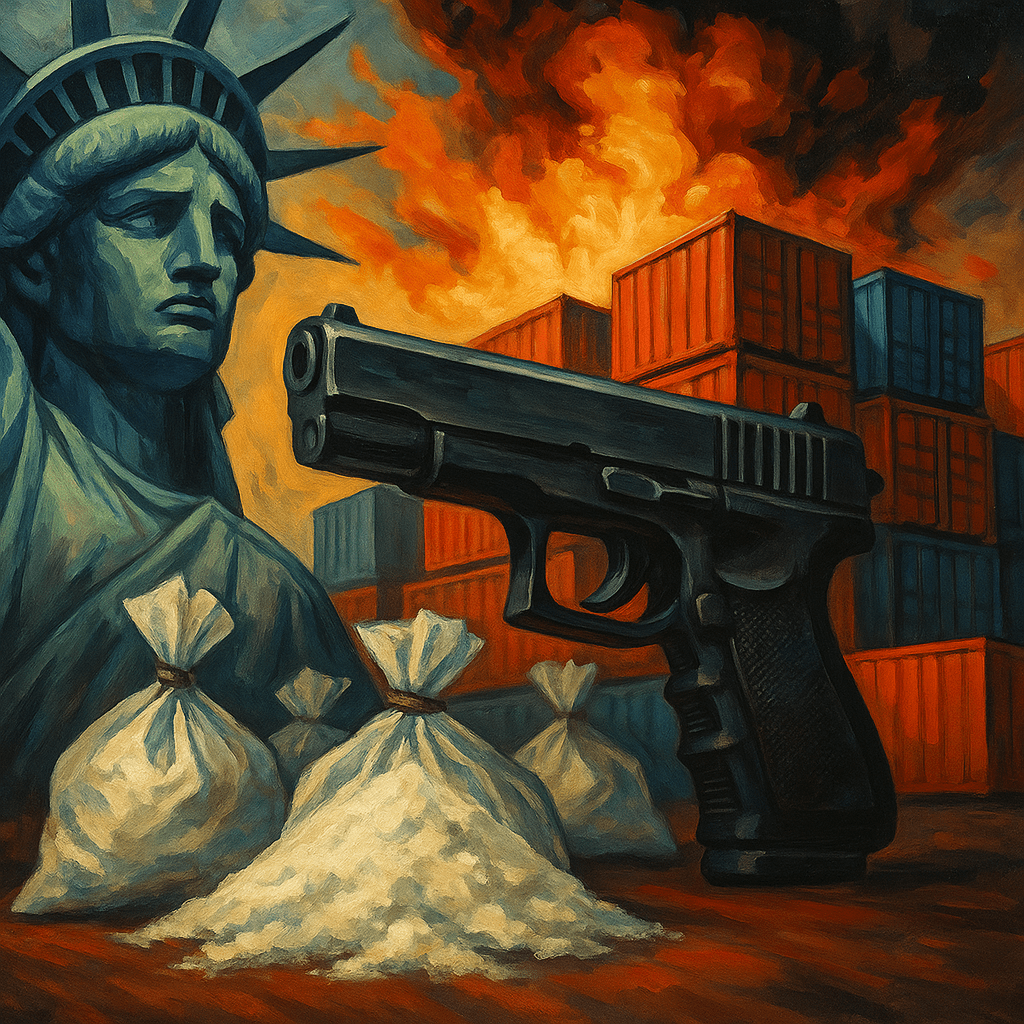
Behind every overdose is a system—not a border. The fentanyl flood isn’t foreign sabotage. It’s imperial fallout, laundered through propaganda, protected by profit, and enforced through death.
By Prince Kapone | Weaponized Information | May 10, 2025
The Real Cartel: How Empire Launders Death Through Propaganda
Every empire needs a scapegoat. For Rome, it was the Christians. For Hitler, the communists and the Jews. For the United States in the technofascist era, it’s China and Mexico—branded as the chemical arms dealers of global narcotics death. From Fox News to The New York Times, the propaganda machine has been relentless: Chinese labs and Mexican cartels are “flooding” America with fentanyl, killing white youth, and destabilizing the republic. But like all imperial narratives, this one hides far more than it reveals—and what it hides is blood on the hands of U.S. capital itself.
Let’s start with the messengers. From Senate hearings chaired by men like Tom Cotton and Marco Rubio to DEA press conferences, the narrative is recited with bipartisan unity: fentanyl is a foreign invasion. These figures speak not for the working class or victims of addiction, but for a white ruling class that needs fear, surveillance, and war to hold its empire together. Behind them, the media repeats the lie. Politico runs front-page exposés on “Chinese chemical flows.” Fox blames “open borders.” All of them omit the one truth that shatters the story: the U.S. government and corporate elite are not victims of the drug trade—they are its architects, protectors, and primary beneficiaries.
The real fentanyl empire was born in the boardrooms of Purdue Pharma, Johnson & Johnson, Mallinckrodt, and McKesson Corporation—pharmaceutical and logistics giants who, for decades, flooded U.S. towns with opioids under government protection. Purdue alone pumped over 70 billion milligrams of oxycodone into working-class communities, bribing doctors, falsifying studies, and dodging accountability through bankruptcy courts. Mallinckrodt, one of the largest opioid manufacturers, shipped nearly 2.5 billion pills between 2006 and 2012. McKesson, the logistics backbone of Big Pharma, shipped those pills with impunity—and profited all the way to the bank.
When the “legal” opioid market reached saturation and public outrage became uncontainable, the pharmaceutical class pivoted. As states cracked down on prescriptions, they created an artificial vacuum—one quickly filled by illicit synthetics. Fentanyl wasn’t an accident. It was the logical mutation of a system that treats human pain as a profit opportunity. When Purdue executives were finally “punished,” they weren’t jailed. They were fined—billions made, a few billion lost. The Sackler family kept their wealth. Capitalism absorbed the scandal and moved on.
Today’s fentanyl pipeline is not operated by “Mexican gangs” in the abstract—it runs through chemical precursor brokers in China, Mexican processing operations, and U.S.-based distribution networks, all shaped by global trade patterns built by empire. The Chinese precursors flow through Hong Kong shell firms and legal gray zones, not in defiance of the system but because of it. Many of these firms are linked to global shipping and logistics conglomerates, including UPS, FedEx, and DHL—all of whom have transported precursor chemicals and pill presses across borders. This is not just crime—it is commerce.
Meanwhile, U.S. intelligence and law enforcement—agencies with a century-long history of trafficking heroin, cocaine, and meth—look the other way or play dumb. The CIA’s use of drug money to fund covert operations is well-documented: Southeast Asia in the 1960s, Colombia and Nicaragua in the ’80s, Afghanistan in the 2000s. Narco-capital has always been useful to the empire. What has changed is who the empire blames. And who it targets.
This is the ideological sleight of hand: as capitalism manufactures addiction and distributes death, it externalizes the crisis, blaming it on “foreigners” and “open borders.” But the real traffickers wear suits, not ski masks. The real cartel is not based in Sinaloa or Wuhan—it’s headquartered in Wall Street, Silicon Valley, and Washington D.C.
Empire’s Needle: Mapping the Political Economy of the Fentanyl Trade
When stripped of patriotic panic and Sinophobic spin, the data tells a different story. Over 90% of illicit fentanyl that enters the U.S. does so through legal ports of entry, not “wide open” deserts or “invisible borders.” It’s often trafficked in small quantities, easily concealable, and sometimes hidden inside packages sent through commercial shipping giants like FedEx and UPS. Most of the chemical precursors come from China, yes—but they are legal products, exported under World Trade Organization rules and routed through a global logistics network managed largely by Western firms. The final synthesis happens mostly in Mexico—because NAFTA gutted the Mexican countryside, destroyed rural economies, and handed whole territories to cartels as parallel states.
The U.S. opioid crisis was not created by Chinese labs or Mexican smugglers—it was manufactured domestically. From 1999 to 2010, deaths from prescription opioids quadrupled. Purdue Pharma alone pumped over 100 million prescriptions into the country, marketing OxyContin as “non-addictive.” Doctors were incentivized to overprescribe, pharmacies were financially tied to wholesalers like AmerisourceBergen and Cardinal Health, and regulators looked the other way. The FDA—tasked with public protection—approved Purdue’s fraudulent marketing claims. The DEA—supposedly the nation’s drug police—approved shipments of billions of pills, even when pharmacy orders exceeded the local population’s needs tenfold.
But when the prescription pill market became politically volatile, the system pivoted. Federal and state crackdowns reduced legal opioid availability for working-class addicts, many of whom had become dependent through medical channels. Into that vacuum came fentanyl—cheaper, stronger, easier to traffic, and disconnected from the pharmacy counter. Far from ending the crisis, the crackdown just shifted the supply chain from the white coat to the black market. And that market still runs on capitalist logic: lowest cost, highest potency, biggest profit.
China’s role? Real, but not what it’s made out to be. Chinese firms do manufacture fentanyl precursors—but they also supply precursor chemicals for countless legal products consumed globally. What’s rarely mentioned is that these sales were encouraged during the height of “free trade”—when U.S. and Western pharmaceutical companies outsourced manufacturing to Asia to cut costs. And China, unlike the U.S., has actually implemented multiple regulatory crackdowns on fentanyl production since 2019. U.S. media barely mentions that because it interrupts the Cold War hysteria.
Mexico’s role? Also real—but inseparable from its status as a neocolony. The drug trade in Mexico exploded in tandem with U.S. economic domination. NAFTA wiped out millions of peasant farmers, flooding the country with subsidized U.S. corn. In the wake of rural collapse, cartels stepped in—offering cash where the state offered nothing. The Mexican government, heavily infiltrated by both cartel money and U.S. intelligence, has often functioned as an enabler. The U.S. response? Send weapons through “Fast and Furious,” then militarize the border and sell it as “security.” Classic counterinsurgency dressed as anti-drug policy.
At the deepest level, this is a system crisis. A declining empire, losing wars abroad and collapsing socially at home, manages its internal decay with a chemical fix. It uses legal drugs to sedate the middle class, criminalized drugs to pacify the poor, and border theatrics to externalize blame. The U.S. doesn’t want to end the fentanyl trade—it wants to control it. Dominate the flow. Regulate the dosage. Decide who lives, who dies, and who gets locked up.
Narco-Imperialism: When Empire Profits from the Poison It Pretends to Fight
The United States isn’t under attack from fentanyl. It is fentanyl—its empire built on exploitation, its profits soaked in blood, and its crises managed with a needle. What the ruling class calls an “opioid epidemic” is better understood as a byproduct of imperial decay. The mass death of working-class Americans—rural and urban, Black, Brown, and white—isn’t collateral damage. It’s system maintenance. It’s how a declining empire disciplines its poor, manages its surplus population, and keeps rebellion sedated.
Fentanyl is not a Chinese bioweapon or a Mexican conspiracy. It is a chemical symptom of a dying empire that can no longer promise stability, jobs, or meaning—only pills and punishment. In this system, grief is a market, pain is a business model, and addiction is profitable. When Big Pharma was the dealer, it was called “healthcare.” When the pharmacy closed, the same system outsourced the kill switch to cartels. This is not a failure of policy—it’s the logic of profit.
The U.S. blames China to justify its Cold War against multipolarity. It blames Mexico to militarize the border and criminalize the desperate. It blames the drug, not the system that manufactures dependency. But the truth is this: the U.S. doesn’t want to stop the trade. It wants to own it. The DEA, the CIA, Wall Street—they’ve all been players in narco-capitalism for decades. The goal has never been to eradicate drugs. The goal is to regulate death and extract profit from misery.
What we are witnessing is not a drug war. It is a war by drugs—deployed by empire to control, to confuse, to kill. It is the perfect weapon: deniable, profitable, and endlessly renewable. The overdose epidemic is not a tragedy. It is a tactic. And it has a class character. Working-class and colonized communities are the targets. The state’s response—more jails, more surveillance, more border walls—is not protection. It is counterinsurgency.
This is what we call narco-imperialism: a system where the empire exports financial collapse, imports chemical pacification, blames the colonized, and militarizes the fallout. The fentanyl crisis is not a crime—it is a business model, perfected in boardrooms, protected by bureaucrats, and sold to the public as “security.” But no empire can sedate its contradictions forever. And no people can be drugged into silence without consequence.
Revolutionary Detox: Organizing Against Narco-Imperialism
We do not mourn quietly while empire kills our class with synthetic poison. We fight. The fentanyl crisis is not just an epidemic—it is a battlefield. And like all battlegrounds, it demands clarity, organization, and revolutionary resolve. The U.S. ruling class wants to confuse us, to turn our pain into panic, and to turn that panic into patriotism. But we see through it. We see that addiction is not weakness. It is a scar inflicted by capitalism. And every overdose is a comrade fallen to empire’s chemical warfare.
We declare our solidarity with the working-class and colonized communities across the U.S. devastated by this crisis—not as victims, but as front-line survivors. We unite with the people of Mexico, whose lives and lands have been turned into staging grounds for cartel-capitalism and U.S.-sponsored militarism. We stand with the Chinese people, whose factories are scapegoated while the real traffickers operate in plain sight from Wall Street to Langley. And we honor those organizing harm reduction, mutual aid, and community defense against the death machine.
We must organize campaigns that expose the role of U.S. pharmaceutical companies, logistics firms, and intelligence agencies in constructing the architecture of addiction. We must shut down the border militarization racket, reject Sinophobic war propaganda, and oppose all calls to escalate conflict with China under the pretext of fentanyl hysteria. We must demand reparations for the families destroyed by legal and illegal drug empires—reparations from the Sacklers, the McKessons, the state itself.
In our neighborhoods, we build networks of care and resistance. Support harm reduction centers, underground detox programs, and prisoner-led rehabilitation efforts. Oppose punitive drug laws and racist prosecutions. Connect the struggle against overdose to the broader war against imperialism, capitalism, and carceral control. Turn grief into education. Turn pain into power. Turn withdrawal into uprising.
Because the only true antidote to fentanyl is revolution. Not the reformist lie of “public health with policing.” But the abolition of the system that profits from our death. We fight not just for clean veins, but for free lives. For land, bread, dignity—and a future no longer sedated by empire’s poison.
Let the needle break. Let the border fall. Let the system rot. The people will rise.
 Weaponized Information
Leave a comment