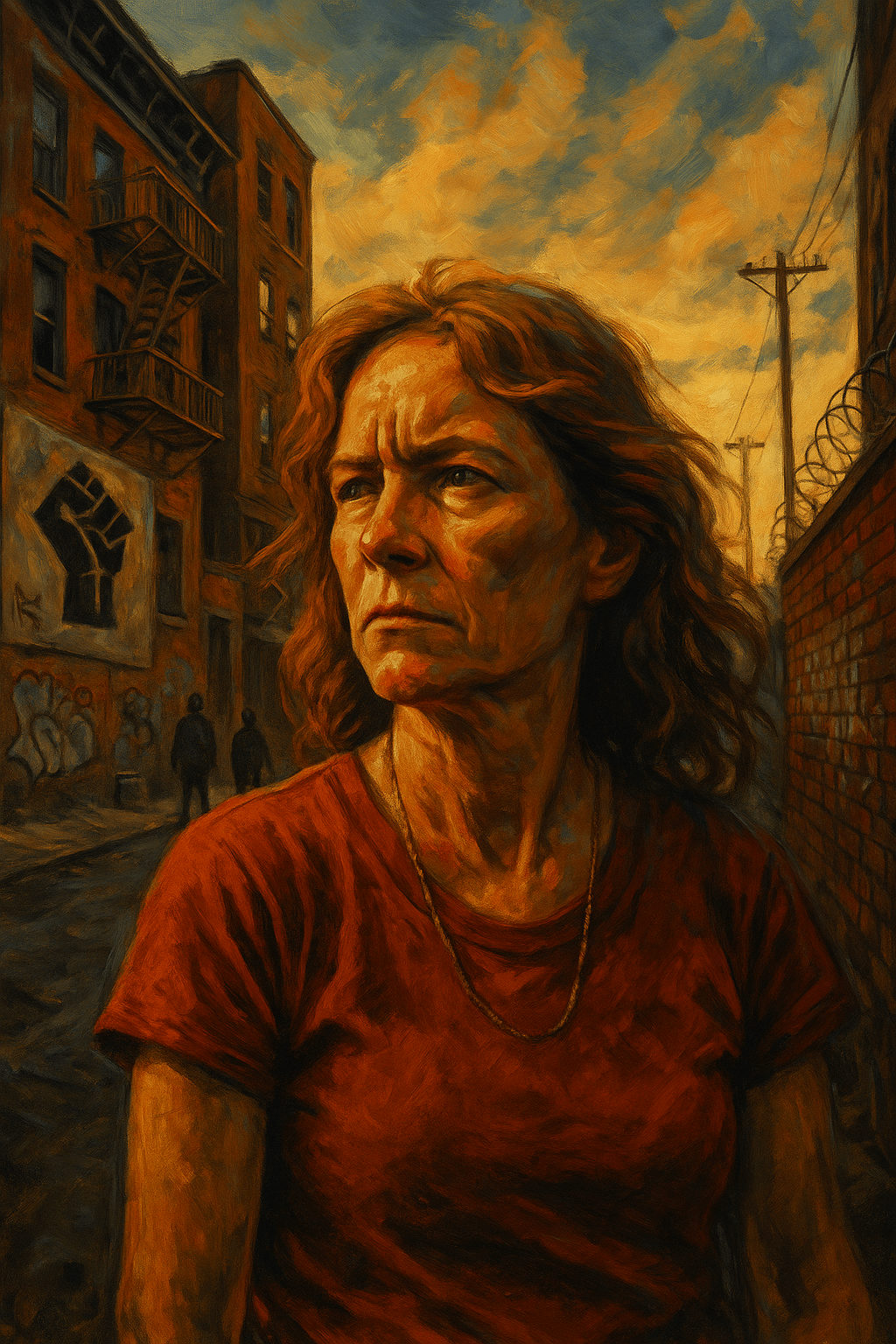
“I did not join the movement to become a martyr, but to become a revolutionary.” — Marilyn Buck
Part I: From Settler Innocence to Revolutionary Betrayal
Marilyn Buck was born on December 13, 1947, in Temple, Texas—a place where the lines of American mythology ran deep: Southern heritage, liberal civility, Cold War patriotism. Her father was a minister and university chaplain who taught theology and anti-racist values. But for all its surface-level decency, the world she inherited was still the American South—a land of lynch law, patriarchal quietism, and settler self-deception. It was not until she left Texas that she began to understand: liberalism was just a softer mask for empire.
At the University of California, Marilyn became active in anti-war protests and civil rights organizing. But while most white students flirted with rebellion before returning to careers, Marilyn kept moving forward. She joined Students for a Democratic Society (SDS), gravitated toward Marxist anti-imperialism, and began to see that protest alone could not defeat the structures she opposed. U.S. capitalism, white supremacy, and global domination were not corruptions—they were the foundation. To be white in America was not neutral—it was participation in empire.
This realization wasn’t academic. It was existential. Marilyn didn’t just “support” Black liberation—she saw that white people like herself had a duty to materially oppose the system that enriched them. Not with sympathy, but with sabotage. She left the realm of symbolic dissent and entered the realm of revolutionary betrayal. In the early 1970s, she began working with the Black Liberation Army (BLA) and later the May 19th Communist Organization (M19CO)—two clandestine formations rooted in Black liberation, anti-colonial struggle, and armed resistance to U.S. empire.
To do so meant disappearing. Cutting ties. Surrendering safety. She didn’t ask to lead. She didn’t demand to be centered. She subordinated herself to the liberation of colonized people. That is what made her dangerous—and that is what made her revolutionary. Marilyn Buck was not just another white radical. She was a daughter of the empire who chose to burn her inheritance and fight with the damned.
Part II: The Underground Years — Armed Struggle and Revolutionary Discipline
“Solidarity is not a gesture—it is a weapon. And it must be forged through action.” — Marilyn Buck
Marilyn Buck didn’t just talk revolution—she lived it from the inside. In the early 1970s, she went underground, aligning herself with two of the most disciplined anti-imperialist formations operating in the U.S. at the time: the Black Liberation Army and the May 19th Communist Organization. Together, these clandestine networks formed a multi-racial revolutionary front grounded in Black liberation, anti-colonial struggle, and anti-capitalist expropriation. Their operations were not rhetorical—they were material.
Marilyn’s role was crucial, though rarely centered. She provided safe houses, organized logistics, printed documents, transported weapons, and maintained the underground infrastructure necessary to sustain political fugitives and coordinate action. One of her most consequential contributions was her involvement in the 1979 liberation of Assata Shakur from Clinton Correctional Facility. That operation—bold, precise, and successful—was not the product of idealism, but of revolutionary preparation. Assata walked free because people like Marilyn risked everything to make it so.
She also participated in a number of political expropriations—bank robberies and armed actions that aimed not at enrichment, but at redistributing wealth from imperial institutions to the movement. These operations helped fund underground networks, prisoner support, and revolutionary organizations inside and outside U.S. borders. She was later connected to the infamous 1981 Brinks expropriation in which two officers and a guard were killed. Though she was not present at the scene, her alleged involvement became central to her eventual indictment.
Her work was grounded in revolutionary discipline—not romanticism, not adventure. She subordinated her identity as a white woman to the collective needs of the liberation struggle. She understood that “allyship” was meaningless if it wasn’t backed by risk, accountability, and material contribution. She moved in silence, took direction from colonized leadership, and never once betrayed her comrades under interrogation or during her trial.
The U.S. state called it conspiracy. But Marilyn called it duty. And when she was captured in 1985 after nearly a decade underground, she was unrepentant. She refused to denounce the movement, refused to beg for leniency, refused to play the liberal’s game of “good intentions gone too far.” She stood trial as a revolutionary—and she took her sentence like a soldier.
For the empire, she was a traitor. For the movement, she was something rarer: a white defector from the settler regime who didn’t ask for praise, didn’t seek the spotlight, and never came back to the comfort she abandoned. She burned her return ticket. And she kept walking.
Part III: Captivity and Resistance — Poetry, Prison, and Political Clarity
“I am caught in the belly of the beast, with fear as my only companion. I will not submit. I will not forget. I will write.” — Marilyn Buck
Marilyn Buck entered prison in 1985 with a life sentence and a code she refused to renounce. She was convicted under federal conspiracy laws—charged with armed actions, expropriations, and the liberation of Assata Shakur. But captivity never broke her. Inside the prison walls, she became what she had always been outside: a revolutionary organizer, a political educator, and a cultural worker wielding poetry like a blade.
At the Federal Correctional Institution for Women in Dublin, California, Marilyn resisted not just the prison regime, but the erasure that the U.S. reserves for white revolutionaries who betray their class and their race. She wrote essays, translated radical texts, taught literacy, and organized reading groups. But it was through poetry that she exposed the psychic violence of incarceration and linked the personal to the political.
Her work—featured in Inside/Out and posthumously in Collected Poems of Marilyn Buck—was raw, militant, and unflinching. She documented the spiritual war waged by prison walls, the gendered violence of confinement, and the daily resistance of women who refused to be broken. Her pen moved like her politics—with precision, clarity, and revolutionary love. For Marilyn, writing was not therapy. It was counterinsurgency against the silence imposed by empire.
She also contributed ideological analysis from inside, engaging in sustained correspondence with outside organizers and comrades. She remained committed to anti-imperialist feminism, constantly interrogating how class, race, and gender shaped struggle—not as identity categories, but as material relations. She warned against liberal co-optation of feminism, urged white women to confront their complicity, and insisted that real solidarity with Black and colonized women meant fighting the structures that exploited them—not simply performing awareness.
Her political sharpness never dulled. She remained grounded in the revolutionary nationalism of the 1970s but critically engaged with its shortcomings. She saw clearly how counterinsurgency had shifted—from direct repression to cultural absorption, from bullets to NGOs. She refused both defeatism and nostalgia. She kept thinking. She kept learning. She kept resisting.
Prison didn’t silence Marilyn Buck. It clarified her voice. Her body was caged, but her words escaped the walls—and they struck like smuggled weapons into the hands of a new generation. She reminded us that revolution is not a moment. It’s a life. And sometimes that life is lived under lock and key—but never under submission.
Part IV: Final Years — Release, Illness, and Revolutionary Legacy
“To change the world, we must first understand it. To understand it, we must never stop struggling inside and out. Even in a cage, I was still at war with empire.” — Marilyn Buck
In 2010, after serving 25 years of an 80-year sentence, Marilyn Buck was released from federal prison under a compassionate release clause. Her body was failing—ravaged by cancer that had gone undiagnosed and untreated for years inside the U.S. prison system. She was dying. But even in her final weeks, she remained unshaken. She died on August 3, 2010, surrounded by comrades, loved ones, and the revolutionary community that never abandoned her.
Her death was not marked by the state. There were no flags lowered. No front-page obituaries. To the empire, she was a terrorist, a traitor, a criminal. But to us, she was a militant, a poet, a daughter of empire who chose to defect and never looked back.
Marilyn Buck’s legacy is not defined by the time she served—it’s defined by how she served the people. She never asked for applause. She never made her whiteness into a brand. She used her position to undermine, sabotage, and dismantle the very structures that raised her. In an age when most white radicals seek affirmation, Marilyn sought accountability. She gave everything. Not for guilt. But for justice.
She is part of a revolutionary lineage that includes not only Assata and Mutulu Shakur, but also John Brown, Kathy Boudin, David Gilbert, Laura Whitehorn, and Susan Rosenberg—white people who took sides in the colonial war and never turned back. Marilyn made it clear: real solidarity costs something. If it doesn’t risk your life, your freedom, or your position—then it’s not solidarity. It’s performance.
She taught us that liberation is not a slogan. It’s a discipline. It’s betrayal of comfort. It’s sacrifice. It’s clarity. And sometimes, it’s dying in freedom after a life spent underground, imprisoned, or both. Her poetry, her essays, her actions—they remain. They speak to the young white rebels of today who are asking: what does it mean to defect? Marilyn answered not with words, but with her life.
Marilyn Buck lives. In memory. In discipline. In revolt.
 Weaponized Information
Leave a comment