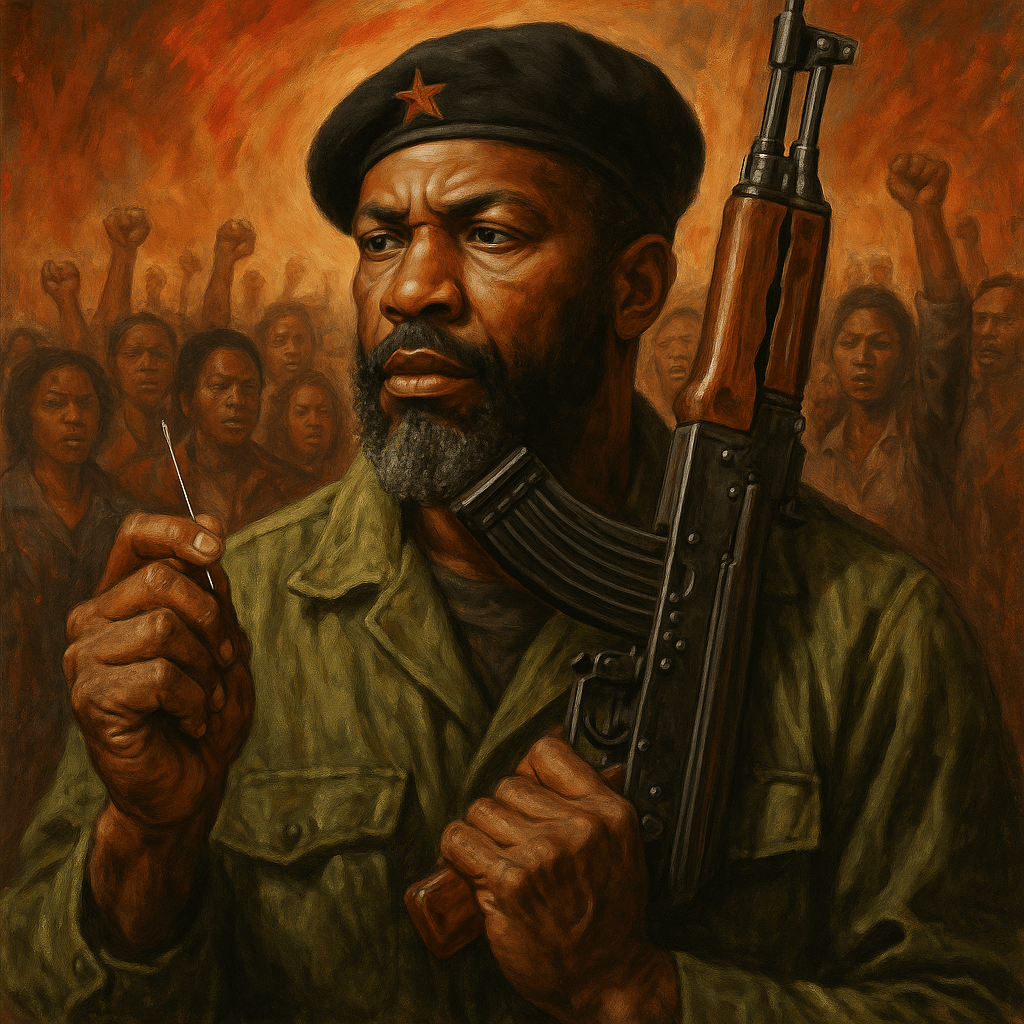
“You have to be concerned about the soul, the spirit, and the body. Healing is political when the people are being made sick by oppression.” — Mutulu Shakur
Part I: Roots of a Revolutionary – From Harlem to the Republic of New Afrika
Mutulu Shakur was born Jeral Wayne Williams on August 8, 1950, in Baltimore, and raised in the war-torn heart of the South Bronx—a landscape disfigured by redlining, chemical warfare, police occupation, and poverty engineered by white settler governance. He came of age in the shadow of urban decay and Black radical awakening. The 1960s were not an era of peace and love—they were a battlefield of ideas, bullets, and betrayals. And Mutulu chose his side early.
As a teenager, he was radicalized by the teachings of Malcolm X, the uprisings in Harlem and Watts, and the international wave of anti-colonial revolutions. By the time he was 19, he had immersed himself in the Republic of New Afrika (RNA)—a revolutionary Black nationalist formation that rejected U.S. citizenship and demanded land, sovereignty, and reparations. RNA militants understood the U.S. not as a flawed democracy, but as an occupying settler regime holding African people captive. Mutulu didn’t join the RNA as a symbolic gesture. He joined it to build an alternative nation, by any means necessary.
At the same time, he began working with the Lincoln Detox Center in the South Bronx—a revolutionary medical clinic run by members of the Black Panther Party, Young Lords, and radical health workers. Lincoln wasn’t just a clinic. It was a political institution. They treated heroin addiction not as a disease, but as a weapon of counterinsurgency deliberately deployed by the U.S. government to destroy the Black revolutionary movement. Mutulu trained in acupuncture, Eastern medicine, and collective therapy—not as a retreat from struggle, but as a form of resistance: to heal the people was to arm the people.
He became an expert in holistic treatment, a visionary of revolutionary medicine. His work helped thousands detox from heroin without pharmaceutical dependency. More than that, he used the clinic as a site of political education—where treatment was fused with consciousness, and healing was tied to struggle. At a time when the state offered methadone, prisons, or death, Mutulu offered liberation. For the empire, that made him dangerous.
His early revolutionary practice reveals something the state never understood: that health is not neutral. That medicine, like education, like policing, like housing, is a front in the class and colonial war. Mutulu Shakur was not just a healer. He was a political organizer of pain, recovery, and resistance. And the state was already watching.
Part II: Revolutionary Medicine and the Science of Anti-Imperialist Healing
“Healing must be political when oppression is what’s making people sick.” — Mutulu Shakur
By the early 1970s, Mutulu Shakur had fully committed to transforming health care into a weapon of resistance. The Lincoln Detox Center, housed inside a crumbling wing of Lincoln Hospital in the South Bronx, became a revolutionary command post—not only for treating addiction, but for diagnosing the political sickness of the American empire itself.
Heroin had flooded Black communities in the aftermath of the urban uprisings of the late 1960s. It wasn’t just self-destruction—it was chemical counterinsurgency. Just as the state used COINTELPRO to jail and kill movement leaders, it used heroin to sedate, fragment, and neutralize the base of Black rebellion. The Lincoln Detox Center refused to play along.
Mutulu and his comrades—many of them from the Young Lords and Black Panther Party—rejected the government’s “solution” of methadone, which replaced heroin with state-sanctioned dependency. Instead, they turned to acupuncture, community healing circles, political education, and radical therapy grounded in the lived experience of colonized people. Their goal wasn’t just sobriety—it was liberation through health autonomy.
Mutulu trained with Chinese and Korean revolutionary doctors, traveled to Asia and Africa to study anti-colonial models of medicine, and became one of the foremost acupuncture educators in the country. He helped establish the National Black Acupuncture Association and trained a new generation of community health workers to treat the people outside the grip of capitalist medicine. To the state, that was subversion. To the people, it was survival.
At Lincoln, healing and struggle were one. Posters of Mao, Lumumba, and Fanon lined the walls. Patients were taught that their addictions were not moral failings, but symptoms of systemic warfare. Treatment was free. Decisions were collective. Police were not allowed. In its brief life, Lincoln Detox became the most effective addiction recovery program in New York—and perhaps the most dangerous to the status quo.
The city eventually shut it down, citing “security risks.” But the real risk was that it worked. That it treated Black people as human. That it politicized pain. That it organized care. And that Mutulu Shakur—an unlicensed, self-taught acupuncturist trained by revolution—was healing the very people the state had written off as casualties.
Mutulu’s revolutionary medicine was more than practice—it was theory. He understood that health care under capitalism is triage for labor. That Black suffering is structured, not accidental. That hospitals, like prisons and schools, reproduce inequality by design. And that healing cannot be separated from struggle. To serve the people is to treat the people. And to treat the people, you have to fight the system that’s killing them.
Part III: Armed Struggle, Underground Life, and the Brinks Expropriation
“This government has no right to call us criminals when it is the most criminal enterprise in the world.” — Mutulu Shakur
Mutulu Shakur’s turn toward underground armed struggle was not a departure from his politics—it was a logical continuation. The same system that shut down the Lincoln Detox Center was waging open war on Black communities. COINTELPRO had dismantled the Panthers. Heroin had devastated the ghettos. The prisons were swelling. And every attempt at nonviolent, community-based resistance had been met with bullets, indictments, and erasure.
In this context, Mutulu joined the ranks of the Black Liberation Army (BLA) and began working closely with other clandestine formations like the May 19th Communist Organization, a multiracial group of white anti-imperialists committed to supporting Black and Puerto Rican revolutionaries through direct action and infrastructure.
For the state, this was criminal conspiracy. For Mutulu, it was revolutionary duty: to materially support the forces fighting for the liberation of the oppressed. That support took many forms—safe houses, transportation, medical care, and, in some cases, direct participation in armed expropriations to fund underground work and prisoner liberation efforts.
On October 20, 1981, a unit composed of members from the BLA, the M19CO, and other formations carried out a tactical expropriation of a Brinks armored truck in Nanuet, New York. The operation was meant to seize funds—not for personal gain, but for the continuation of the struggle. It ended in tragedy. Two police officers and a security guard were killed in a shootout. Several were arrested. Others, including Mutulu, went underground.
For the next five years, he evaded one of the largest manhunts in U.S. history. He was ultimately captured in 1986, labeled the “mastermind” of the Brinks operation and linked to other underground activities. He was indicted under the RICO Act—a legal tool originally designed for organized crime, now weaponized against revolutionaries. In a trial stripped of political context, he was sentenced to sixty years in federal prison.
The state called it justice. But the movement called it what it was: retribution against a man who healed, organized, fought, and refused to kneel. Mutulu’s real crime wasn’t Brinks. It was building an infrastructure of resistance inside the empire. It was proving that revolutionary solidarity could be disciplined, multiracial, and operational.
His trial, like those of Assata Shakur, Sundiata Acoli, and the Panther 21, wasn’t about individual guilt. It was about deterring future rebellion. And yet even in prison, Mutulu continued the struggle—organizing healing circles, mentoring younger prisoners, and refusing to be broken. He remained what he had always been: a revolutionary doctor in a diseased society. A people’s soldier behind enemy lines.
Part IV: Political Prisoner, Prison Healer, and Revolutionary Cultural Worker
“Even in the belly of the beast, we must build institutions that serve the people. Struggle doesn’t end at the prison gate—it sharpens.” — Mutulu Shakur
From 1986 until his compassionate release in 2022, Dr. Mutulu Shakur spent over 36 years behind bars in the U.S. federal prison system. But he was never “just” an inmate—he remained a political prisoner, an elder of the movement, and a revolutionary physician committed to healing and organizing under the most repressive conditions imaginable.
Inside, Mutulu didn’t retreat. He launched literacy programs, peer counseling initiatives, and healing circles for incarcerated people struggling with trauma, addiction, and isolation. He continued to teach acupuncture and wellness techniques to fellow prisoners. He became a source of stability, mentorship, and revolutionary clarity for multiple generations of incarcerated Black men—many of whom had been criminalized for surviving the very conditions of abandonment and warfare Mutulu had spent his life fighting.
But his influence stretched beyond prison walls. In the 1990s, amid the rapid expansion of the prison-industrial complex and the rise of hyper-commercialized gangsta rap, Mutulu took on a new political front: the politicization of the Black lumpenproletariat through hip hop.
Working closely with his stepson Tupac Amaru Shakur, Mutulu helped shape a radical framework that sought to redirect the energies of gang-affiliated youth toward revolutionary consciousness and social discipline. Together, they helped draft the Code of THUGLIFE—a set of principles intended to govern street organizations, limit harm to the community, and create unity among gangs grounded in political education and mutual respect. THUGLIFE wasn’t a slogan—it was a theory of survival under occupation.
Mutulu and Tupac envisioned a reawakening of Black militancy through cultural expression. They saw that the post-Panther generation had been criminalized, atomized, and submerged in a war of all against all. The state had succeeded in isolating the revolutionary vanguard. But hip hop, with all its contradictions, had become a mass platform—and they believed it could become a political vehicle for rebellion.
In their hands, rap wasn’t just music. It was insurgency. It was pedagogy. It was street-level psychological warfare against empire. Mutulu’s impact on Tupac ran deep—from political study to tactical conversations on organizing street forces. Tupac’s contradictions were many, but his revolutionary instincts were sharpened by the political education imparted by his mother Afeni, his godmother Assata, and his stepfather Mutulu, among others
Even as he languished in prison—denied parole over and over again despite clean disciplinary records, a cancer diagnosis, and support from global activists—Mutulu remained a force. His teachings traveled through mixtapes, prison letters, and whispers across cell blocks. He refused parole deals that demanded he renounce the movement. He refused to beg for freedom. He remained a prisoner of war in the empire’s dungeon—never a criminal, never a slave.
His carceral captivity was not an end. It was another phase in the same war. And even behind bars, Mutulu Shakur was healing the wounded, training new soldiers, and planting seeds the state could never see bloom.
Part V: Revolutionary Memory and the Struggle Beyond the Grave
“I’m a prisoner of war. I do not seek forgiveness from the system I’ve spent my life fighting. I seek freedom for my people.” — Mutulu Shakur
Dr. Mutulu Shakur was released from prison in December 2022—dying of terminal cancer after serving over 36 years in federal captivity. His release came not from justice, but from pressure. It came too late for his body to heal, but not too late for his spirit to return home. He passed in July 2023 surrounded by loved ones, comrades, and the generation of fighters he helped raise—even if most never met him in person.
But Mutulu Shakur never really left the struggle. He remains woven into the fabric of revolutionary memory. He lives in every prison literacy circle. In every gang truce turned peace treaty. In every healing clinic run out of a storefront. In every political education workshop in a halfway house. In every beat that samples truth and rage. In every young rebel who learns that survival alone is not freedom—and that service to the people is the only path to liberation.
His legacy cuts across all contradictions. He was a healer and a soldier. A teacher and a fugitive. A father and a comrade. A nationalist who embraced internationalism. A revolutionary who believed that the fight for Black liberation required not just courage—but care, clarity, and infrastructure.
He taught us that addiction, trauma, and illness are not signs of weakness—but battlegrounds. That the state uses pain as a weapon. That counterinsurgency doesn’t just kill—it makes the people sick, distracted, disconnected. And that revolution must treat the wound, not just swing the hammer.
Dr. Mutulu Shakur is gone in the physical. But his praxis remains: revolutionary medicine, revolutionary love, and revolutionary discipline. He left behind a model of resistance forged in the dialectic between care and combat. A blueprint for building power among the abandoned. A lesson for the white left, for the non-profit crowd, for the culture industry: if you’re not healing the people, organizing the people, and defending the people, you’re not in the struggle. You’re just spectating it.
So mourn him with fire, not tears. Read his writings. Share his teachings. Build his institutions. Carry the Code. Free the prisoners. Heal the people. And finish the war he never stopped fighting.
Mutulu Shakur lives. In memory. In discipline. In rebellion.
 Weaponized Information
Leave a comment