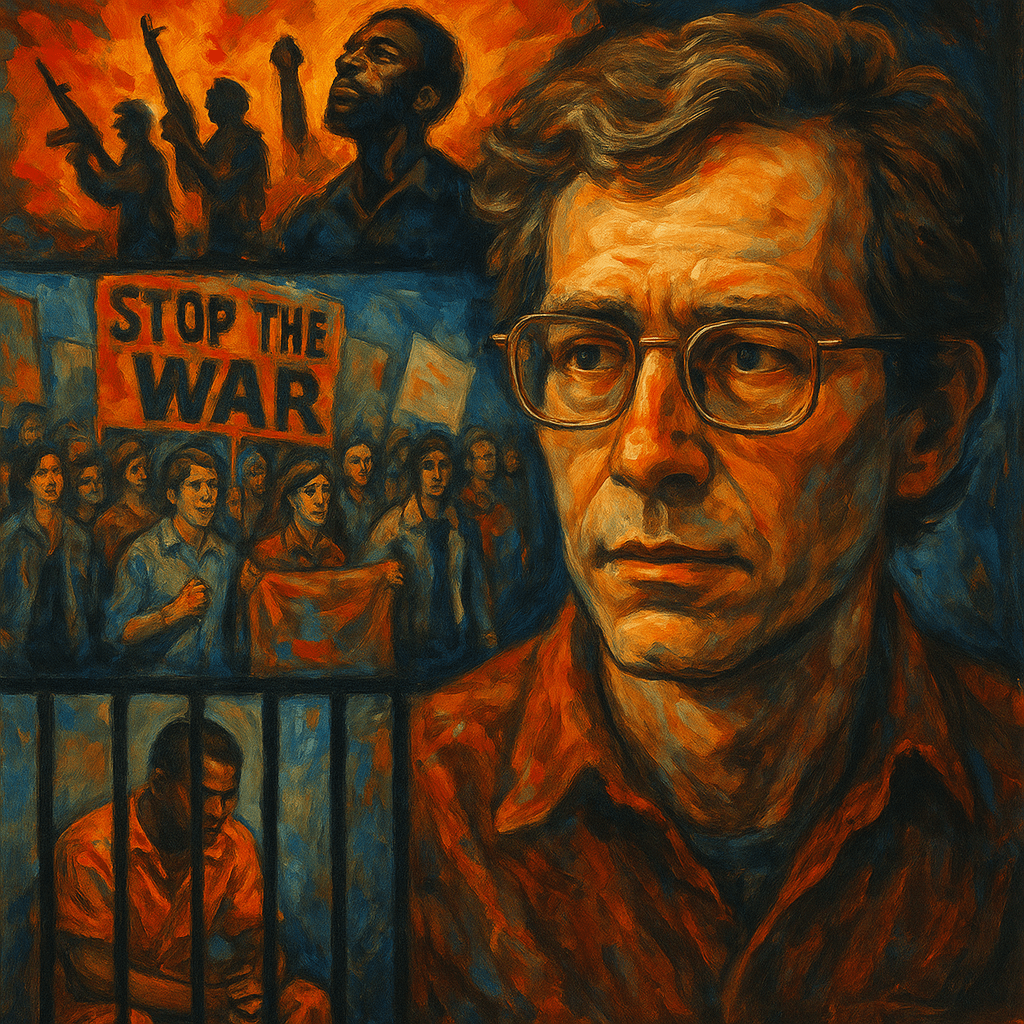
“I came to understand that solidarity with oppressed peoples had to be more than sentiment—it had to be struggle. It meant giving up the privileges I had as a white person in an imperialist empire.” — David Gilbert
Part I: From Suburb to Struggle
David Gilbert was born in 1944 in Boston, raised in the comfort of a white, middle-class suburban family—a world insulated from the brutal realities of Jim Crow, colonial war, and racial capitalism. Like many children of postwar liberalism, he was taught ideals of fairness, equality, and democracy, yet surrounded by a society structured on anti-Black racism and imperial plunder. Gilbert’s early life reflected the contradictions of white liberalism: a belief in universal human rights coexisting with silent complicity in white supremacy.
At Columbia University in the early 1960s, those contradictions began to rupture. Gilbert’s exposure to the civil rights movement, anti-Vietnam war protests, and Black liberation struggles forced a reckoning. The sanitized narratives of U.S. democracy collided with televised images of Southern cops beating Black demonstrators, and with the draft notices sending poor and Black youth to kill and die in Vietnam. He joined Students for a Democratic Society (SDS), initially driven by a liberal humanitarian desire to “help” the oppressed.
But as Gilbert deepened his engagement, he began to see that solidarity wasn’t about charity—it was about confronting the system of oppression itself. The polite reformism of SDS’s early years proved inadequate in the face of escalating imperial aggression abroad and police repression at home. Radicalized by the Black Panther Party, the Cuban Revolution, and anti-colonial movements sweeping Africa and Asia, Gilbert came to see that imperialism was not a flaw in the system—it was the system. And whiteness wasn’t simply a skin color—it was a political allegiance to the structures of colonial domination.
Part II: Radicalization, Weatherman, and Breaking with Whiteness
By 1969, the contradictions inside SDS exploded into a split, with the Weather faction—later Weather Underground—arguing for militant anti-imperialist struggle, direct solidarity with national liberation movements, and the need to “bring the war home.” David Gilbert became a core figure in this trajectory, moving from campus activism to clandestine organizing, embracing a revolutionary commitment to oppose U.S. imperialism not only with words, but with action.
Gilbert’s decision to join Weatherman wasn’t an adventurist thrill—it was an ideological rupture. He understood that for a white person born into settler privilege, “solidarity” required a betrayal of whiteness as a political identity. It meant disavowing the safety, legality, and moral superiority conferred by white citizenship in a colonial empire. It meant siding materially with the colonized and oppressed, even at the cost of illegality, surveillance, and repression.
Weather Underground’s transition to armed propaganda was shaped by a deep admiration for the Black Panther Party, the Young Lords, and the Vietnamese liberation struggle. Gilbert and others sought to position white radicals not as leaders, but as accomplices, striking blows against the empire from inside its heart. Yet even as they escalated militancy, Gilbert maintained an acute awareness of the limits and dangers of substituting symbolic action for mass movement. His later reflections from prison would critically assess Weather’s failure to build deeper connections with working-class and colonized communities, recognizing that underground struggle without mass organizing risks isolation.
In breaking with whiteness, Gilbert wasn’t claiming to “become” Black or colonized. Rather, he was committing to use his position inside the oppressor nation to materially sabotage imperialism, to support national liberation, and to confront the enemy within. His journey posed a sharp question to every white leftist: solidarity is not a posture—it is a line in the sand between empire and revolution. Which side are you on?
Part III: Armed Struggle, Revolutionary Solidarity, and Its Contradictions
“Our task was never to ‘lead’ Black liberation—it was to weaken the empire that stood in its way.” — David Gilbert
By the early 1970s, David Gilbert had fully embraced clandestine life as part of the Weather Underground Organization (WUO). The group’s bombings of U.S. military, government, and corporate targets were designed as armed propaganda—symbolic actions intended to expose imperial violence and express solidarity with revolutionary movements at home and abroad. For Gilbert, each action was a political statement: that white people inside the empire could no longer stand aside, could no longer claim innocence through silence.
But Gilbert’s commitment to armed struggle was not blind heroism. It emerged from a sober assessment: that the U.S. state was waging a counterinsurgency war against Black, Puerto Rican, and Indigenous movements. The murder of Fred Hampton, the COINTELPRO campaign, the imprisonment of hundreds of political prisoners, the suppression of urban uprisings—all pointed to the reality that reformist avenues were foreclosed. The state had declared war on Black liberation, and any genuine solidarity required confronting the state’s violence head-on.
In 1981, Gilbert deepened this solidarity by participating in a joint action with the Black Liberation Army (BLA) and members of the Republic of New Afrika—a Brinks armored car expropriation intended to fund the revolutionary struggle. Though unarmed during the action, Gilbert served as a getaway driver. The operation ended in tragedy: a shootout with police left two officers and a guard dead. Gilbert was captured, tried, and sentenced to 75 years to life.
For the empire, Gilbert was a terrorist. For the movement, he was a white revolutionary who had crossed the Rubicon—who had placed his body, his liberty, his very life on the side of the colonized. His imprisonment reflected a deeper truth: that solidarity with Black liberation was not a matter of slogans or statements, but a material practice that challenged the very foundations of settler-colonial order.
Yet Gilbert himself remained critical of the limits of Weather’s approach. In *Love and Struggle*, he reflected on how WUO failed to build sustainable mass support, how its underground isolation hindered political growth, and how its strategy sometimes mistook symbolic militancy for structural challenge. He recognized that while armed struggle may be necessary, it could not substitute for mass organizing and long-term institution building. True solidarity required not just acts of defiance, but **embedding revolutionary politics within working-class, oppressed, and colonized communities**.
Still, Gilbert’s participation in armed struggle wasn’t a detour—it was part of a continuum of revolutionary praxis. His life raises uncomfortable, necessary questions: What does it mean for white radicals to materially oppose the empire? How far are we willing to go? How do we balance militancy with mass work? And above all, are we prepared to betray whiteness—not as a matter of guilt, but as a revolutionary necessity?
Part IV: Captivity, Reflection, and the Prison as a Front of Struggle
“Prison is a frontline of struggle. The walls are meant to isolate us—but solidarity turns them into bridges.” — David Gilbert
Sentenced to 75 years to life, David Gilbert entered prison not as a defeated militant, but as a revolutionary determined to continue the struggle from inside the belly of the beast. For Gilbert, captivity was not the end of praxis—it was a new theater of political work. He immersed himself in study, writing, and building solidarity across prison walls, forging connections with other political prisoners, especially those from the Black Liberation Army and Puerto Rican independence movement.
Behind bars, Gilbert deepened his analysis of white supremacy as structural glue for settler-colonial capitalism. In *Love and Struggle* and his numerous essays, he explored how whiteness operates not just as individual prejudice, but as a system of political and material privilege that must be actively betrayed for solidarity with the oppressed to be real. “There is no middle ground,” he wrote. “To side with the oppressed means to oppose, materially, the privileges of whiteness.”
Gilbert became a mentor to younger activists, an intellectual link between generations of revolutionaries, and a chronicler of the U.S. state’s counterinsurgency war against the Black liberation movement. His writings detailed the state’s strategy of criminalizing Black self-determination, erasing political prisoners from public memory, and normalizing mass incarceration as a continuation of colonial domination under neoliberalism. Gilbert situated the prison-industrial complex as not merely punitive, but counterinsurgent infrastructure designed to neutralize rebellion from colonized peoples and oppressed classes.
In prison, Gilbert modeled an unwavering commitment to collective struggle. He participated in hunger strikes, educational programs, AIDS peer counseling, and solidarity campaigns for other imprisoned revolutionaries. His life behind bars embodied the ethic that solidarity is a practice, not a posture—a daily commitment to serving the people, even in the most repressive conditions.
Gilbert’s reflections challenge white radicals today to confront the stakes of solidarity. Prison, he showed, is not simply a site of individual suffering—it is a battlefield in the war between empire and liberation. His life asks: are we willing to resist empire at the level where it imprisons, kills, and neutralizes? Are we willing to struggle beyond the safe terrain of legality and social respectability? Or will we retreat to the comforts of whiteness when the cost of solidarity demands more than words?
Part V: David Gilbert’s Challenge to White Leftists Today
“The main task for white radicals in the heart of empire is to materially oppose white supremacy and imperialism—not to claim leadership, but to undermine the empire from within.” — David Gilbert
David Gilbert’s life is not a tale of martyrdom or romantic rebellion. It is a revolutionary indictment of whiteness—not merely as a racial identity, but as a political allegiance to settler colonialism, capitalism, and empire. His journey from suburban liberal to revolutionary militant, from SDS to underground, from prison cells to revolutionary reflection, poses a stark challenge to every white leftist in the imperial core: what does solidarity really mean?
Gilbert’s life teaches that solidarity cannot be a spectator sport, a symbolic gesture, or a moral performance. Solidarity demands rupture: a betrayal of white privilege, a refusal of settler innocence, a willingness to confront the material structures that uphold oppression. It demands risking comfort, legality, and personal safety to stand with the oppressed not as an ally above, but as an accomplice beside and under their leadership.
His writings dismantle the myth that white radicals can “lead” or “save” struggles for liberation. He showed that white anti-imperialists must subordinate themselves to the leadership of colonized peoples, offering material support, sabotage of imperial machinery, and commitment to collective transformation without seeking authority or recognition. In a world where whiteness buys safety, Gilbert chose danger. Where whiteness offered silence, he chose voice. Where whiteness demanded complicity, he chose betrayal.
Today, as technofascism consolidates, as settler colonialism deepens its extraction, as counterinsurgency targets Black, Indigenous, and Global South struggles, Gilbert’s legacy raises urgent questions: Will white leftists once again retreat to reformism, electoralism, or performative solidarity? Or will they follow Gilbert’s example—not necessarily by replicating armed struggle, but by taking up the harder task of destroying whiteness as a political project from inside the heart of empire?
David Gilbert never claimed to have all the answers. But his life offers a roadmap marked by struggle, humility, critique, and unwavering commitment to liberation. His challenge endures: Solidarity must cost you something. Solidarity must rupture your place in the empire. Solidarity must betray whiteness, or it will betray the oppressed.
And in that betrayal of whiteness lies the possibility of a new humanity.
 Weaponized Information
Leave a comment