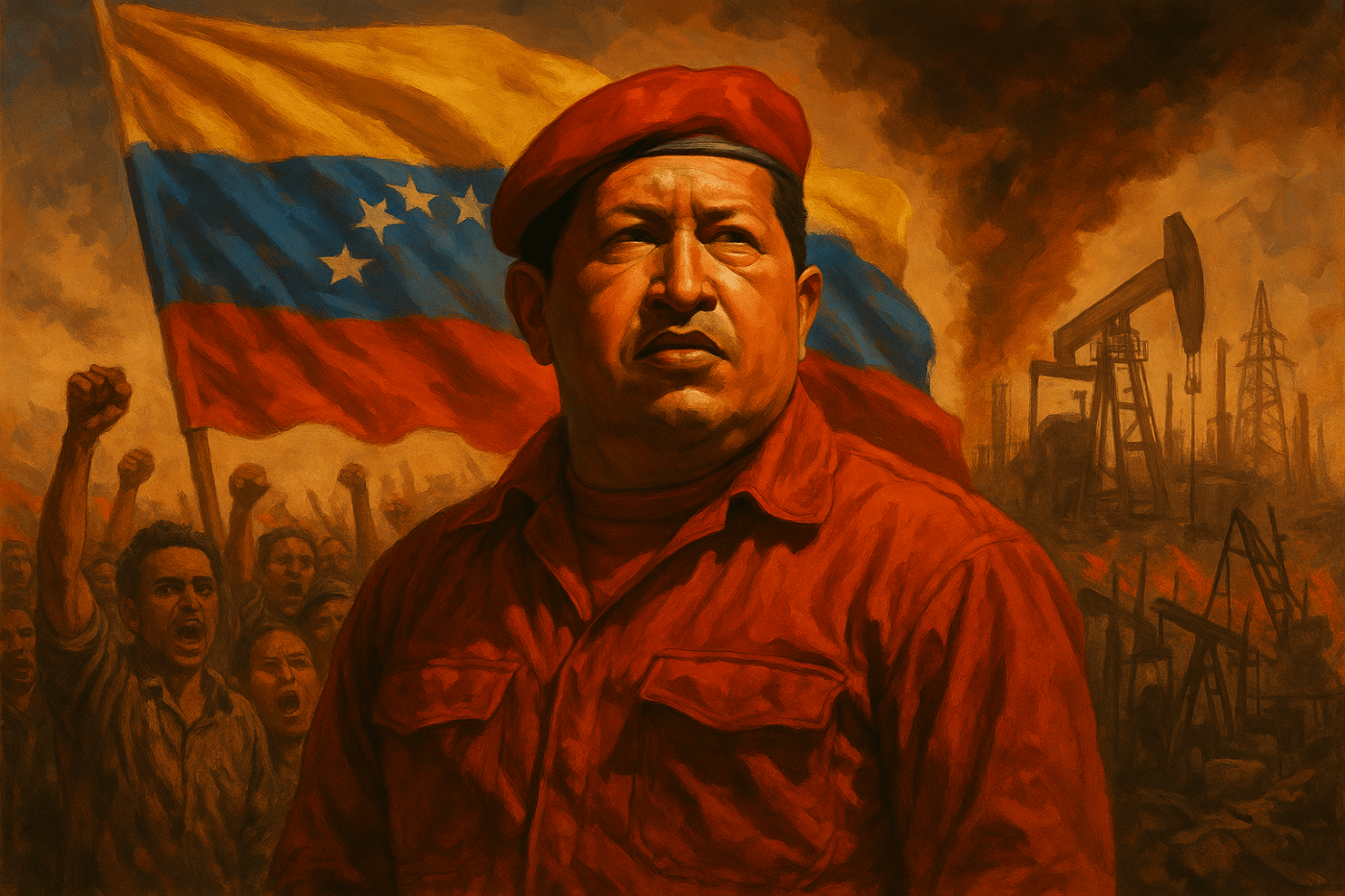
How a Soldier Became a Socialist, a President Became a Protagonist, and a People Became a Power
By Prince Kapone | Weaponized Information
Part I: From the Plains of Sabaneta to the Barracks
“I am from the people, and I owe myself to the people.” — Hugo Chávez
Hugo Chávez was born on July 28, 1954, in Sabaneta, a small town in Venezuela’s western plains. His family were schoolteachers, scraping by in the harsh conditions of Venezuela’s rural interior. Chávez grew up in a mud-walled house, selling homemade candies on the streets to supplement the household income. His early life was marked not by privilege, but by proximity to the hunger, landlessness, and humiliation of Venezuela’s poor majority—the peasantry and the urban informal workers excluded from the oil wealth flowing to Caracas and foreign capitals.
But it wasn’t just poverty that shaped Chávez—it was memory. From an early age, he was captivated by the stories of Simón Bolívar, Ezequiel Zamora, and the Llanero rebels who fought in Venezuela’s wars of independence and civil wars. These names weren’t dead heroes; they were living symbols of unfinished liberation. Bolívar’s dream of a united, sovereign Latin America had been betrayed by oligarchies and foreign powers. Zamora’s cry of “free land and free men!” had been silenced by elite landlords and comprador armies. Chávez inhaled these legacies like oxygen. He didn’t see history as past—he saw it as a battlefield he was born into.
At 17, Chávez entered the Venezuelan Military Academy—not as a careerist seeking status, but as a son of the plains seeking a path out of poverty, and perhaps, a way to serve the people. The military, for Chávez, was a contradictory institution: both instrument of oligarchic control and reservoir of popular sons who carried the memory of rebellion in their blood. He discovered in the barracks comrades from similar humble backgrounds, and mentors who secretly read Marx, Lenin, and Mao alongside Bolívar and Zamora. It was in the academy that Chávez began to see the military not as a neutral apparatus, but as a terrain of struggle—one that could either uphold the status quo or ally with the poor in a new civil-military alliance.
In those years, Chávez founded the clandestine Movimiento Bolivariano Revolucionario 200 (MBR-200), named for Bolívar’s 200th birthday. It wasn’t a traditional military clique—it was an embryonic revolutionary cell, rooted in a fusion of nationalist, anti-imperialist, and popular democratic ideals. The seeds of the Bolivarian Revolution were already germinating in the shadows of Venezuela’s corrupt Fourth Republic, inside a young officer who saw his rifle not as a tool of repression, but as a weapon to one day turn against the oligarchy that starved the nation’s children while oil profits flowed abroad.
Chávez’s early life reveals a core contradiction: born within the people’s suffering, yet educated within an institution built to defend the ruling class. But rather than sever him from his roots, this contradiction deepened his resolve. The military gave him organization, discipline, and strategic vision—but his loyalty remained below, to the barrio, the llano, the campesino, and the forgotten Venezuela whose hopes had long been betrayed. This dialectic—between civilian and soldier, between popular memory and institutional discipline—would shape Chávez’s revolutionary strategy for the rest of his life.
Part II: February 4, 1992: A Soldier’s Uprising
“For now, the objectives were not achieved.” — Hugo Chávez, February 4, 1992
By the late 1980s, Venezuela’s so-called democracy had imploded under the weight of its contradictions. The country’s oil wealth enriched a narrow elite while austerity, privatizations, and IMF-imposed structural adjustment programs devastated the poor. In 1989, the people exploded in rebellion—the Caracazo, a mass uprising against bus fare hikes and neoliberal reforms, met with bullets. Hundreds, possibly thousands, were massacred in the streets by the state. Chávez, still an officer in the army, watched the regime’s true face revealed: beneath the democratic facade stood a repressive bourgeois state willing to drown the people’s demands in blood.
It was in the wake of this massacre that Chávez and his clandestine movement decided to act. On February 4, 1992, Chávez led a military rebellion aimed at overthrowing the corrupt oligarchic government of Carlos Andrés Pérez. The uprising aimed to spark a broader popular insurrection, to fulfill Bolívar’s promise not in rhetoric but in revolutionary rupture. But the uprising failed militarily—communications were cut, key cities didn’t fall, comrades were arrested or isolated. Facing defeat, Chávez surrendered to avoid further bloodshed. Yet in his brief televised statement, he uttered the words that electrified a nation: “For now, the objectives were not achieved.”
It was a simple phrase, but it carried the weight of unfinished struggle. In that moment, Chávez ceased being a marginal conspirator and became the living embodiment of Venezuela’s betrayed hopes. In barrios, factories, and villages, the people heard not a defeated soldier, but a promise deferred. Chávez had spoken a truth that generations of demagogues had evaded: that the oligarchic state was irredeemable, that liberation required rupture, and that the people’s turn to power would come—not immediately, but inevitably.
Imprisoned for two years after the failed uprising, Chávez became a symbol—a prisoner of conscience for the poor, a “new Bolívar” for the disillusioned. His prison cell became a revolutionary classroom. There, he deepened his study of Marx, Gramsci, Mariátegui, Mao, Bolívar, and Zamora. He engaged with the works of István Mészáros, whose analysis of global capitalism’s structural crisis would shape Chávez’s later shift toward socialism. Far from silencing him, prison forged Chávez’s ideological clarity: the Bolivarian Revolution could not be a mere nationalist modernization project; it had to be anti-capitalist, anti-imperialist, and rooted in the protagonistic participation of the poor majority.
February 4 wasn’t an end. It was a rupture. A new historical subject had stepped onto Venezuela’s stage: not the oligarchic political parties, not the comprador generals, but a revolutionary soldier bearing the dreams of the llano, the barrio, and the shack-dweller. The “for now” wasn’t resignation—it was a promise. And the promise would live in the people’s memory, waiting for the next insurrection—not from tanks, but from ballots, barrios, and the rising tide of class struggle.
Part III: The Prison Years: From Rebel to Revolutionary Thinker
“I read, and I read, and I read… there, I became convinced that we had to make a revolution.” — Hugo Chávez
Behind bars, Hugo Chávez found liberation in study. His prison cell became a school of revolutionary theory, a crucible where defeat was transformed into deeper political clarity. He immersed himself in the writings of Simón Bolívar and Ezequiel Zamora—not merely as nationalist icons, but as incomplete revolutionaries whose dreams of sovereignty and social justice had been betrayed by oligarchic elites. Chávez read Marx, Lenin, Mao, Che, and Mariátegui, seeking to understand why revolutions succeed or fail, why popular hopes are so often crushed under the weight of capital and empire.
In these years, Chávez’s vision sharpened. He realized that the old dream of a “cleaner” military or a patriotic bourgeoisie redeeming Venezuela was a fantasy. The problem wasn’t just corruption—it was class power. The oligarchic state wasn’t malfunctioning; it was functioning exactly as designed: to defend the privileges of capital against the demands of the poor. Revolution could not mean simply replacing one set of rulers with another; it had to transform the relations of power, property, and production at their root.
Chávez emerged from prison not merely as a rebellious officer, but as a revolutionary thinker committed to building a mass movement. He broke with traditional military conspiracies and turned to the people. While some comrades still dreamed of another coup, Chávez saw that the people’s protagonism was the key to victory. “Without the people, nothing is possible,” he declared. His project shifted from clandestine barracks to open political organizing, channeling the hopes awakened by February 4 into a national movement: the Fifth Republic Movement (MVR).
In 1998, against the united forces of the political establishment, the media oligarchy, and international finance, Chávez won the presidency with a landslide. His victory wasn’t merely electoral; it was an insurgency at the ballot box, a popular uprising through democratic means. The poor, long excluded from the political arena, flooded the voting booths. His election marked the return of Venezuela’s silenced majority to the political stage—not as clients of patronage, but as protagonists demanding transformation.
Yet Chávez knew that winning office was not winning power. The state apparatus remained infested with bureaucrats loyal to the old order. The oligarchy still controlled the economy, the media, and key institutions. Imperialism watched from the north, ready to intervene. Chávez’s challenge wasn’t simply to govern—it was to lay the foundation for a revolutionary process that could survive sabotage, coup attempts, and imperial destabilization. The Bolivarian Revolution had entered a new phase: one that would test the dialectic between state power and popular power, between the limits of electoral democracy and the possibilities of building a participatory, protagonistic democracy rooted in the masses themselves.
Part IV: Winning Power, Building the Bolivarian Process
“The people are not spectators; they must be the leading actors of their own liberation.” — Hugo Chávez
From the moment Chávez took office in 1999, he declared that Venezuela’s revolution would not be carried out for the people, but with the people. His first major initiative was to convene a Constituent Assembly, a body not composed of elites and technocrats but of teachers, workers, community leaders, and grassroots activists. This assembly drafted a new constitution rooted in participatory democracy, enshrining rights to healthcare, education, indigenous recognition, and popular sovereignty. It renamed the country the Bolivarian Republic of Venezuela—a symbolic rupture with the oligarchic republics of the past.
But Chávez’s vision extended beyond legal reform. He saw the need to embed power in the people themselves. He promoted the creation of consejos comunales (communal councils), grassroots assemblies where neighbors deliberated, planned, and implemented projects using state resources directly controlled by the community. It was here that Chávez’s rejection of bourgeois democracy became clearest. For him, voting every few years wasn’t democracy—it was pacification. True democracy was participatory, protagonistic, daily. It was the people making decisions, not delegating power to politicians who governed in their name but against their interests.
This political deepening unfolded alongside economic transformation. Chávez nationalized key sectors: oil, electricity, telecommunications. He redirected oil revenues toward social missions that slashed illiteracy, expanded healthcare, and reduced poverty. Between 1999 and 2012, millions were lifted out of extreme poverty. But Chávez knew poverty reduction wasn’t enough. He wasn’t content to manage capitalism more humanely; he aimed to transition toward socialism—a socialism born not from abstract blueprints, but from the living struggle of the Venezuelan people.
In 2005, he declared: “We have to transcend capitalism by way of socialism, with equality and justice.” But this wasn’t a return to Soviet models. Chávez envisioned a socialism rooted in popular power, communal ownership, and democratic planning—a socialism not imposed from above but woven from below. He warned that socialism required not just economic measures, but a cultural revolution: a transformation of values, consciousness, and relationships of solidarity over individualism.
Chávez’s challenge was immense. Every step toward deeper transformation provoked new forms of resistance: an attempted coup in 2002, a bosses’ strike in 2002–2003, sabotage, U.S. intervention, and media war. Yet with each assault, the revolutionary process radicalized. The coup failed because the people mobilized in the streets, confronting tanks and reclaiming the presidential palace. The oil sabotage failed because workers seized the installations and kept production running. It wasn’t the state apparatus that saved the revolution—it was the people themselves, armed with consciousness and commitment.
Through it all, Chávez’s fundamental belief remained unwavering: that the revolution’s engine wasn’t the executive office, but the organized people. “I’m not the revolution,” he insisted. “The people are the revolution.” His task was to open spaces, dismantle old structures, and catalyze the formation of a new power rising from the depths of Venezuelan society. The Bolivarian Process was not a finished model—it was an experiment in insurgent democracy, a dialectical movement still unfolding, still struggling, still unfinished.
Part V: From the Third Way to 21st-Century Socialism
“Without socialism, without a socialist path, it’s impossible to defeat poverty, exploitation, and inequality.” — Hugo Chávez
In the early years of his presidency, Chávez navigated between competing pressures. He spoke of a “third way,” seeking an alternative to both neoliberalism and Soviet-style statism. But as the oligarchy sabotaged reforms, as imperialism tightened its grip, and as the people demanded deeper change, Chávez’s own political compass shifted leftward. By 2005, he named the horizon explicitly: Socialismo del siglo XXI—21st-Century Socialism.
But what did this socialism mean? It wasn’t a copy of Cuba or China, nor a nostalgic return to old formulas. It was, in Chávez’s words, an attempt to “invent it as we walk.” And at the heart of his theorizing lay a key contribution: the Triangle of Socialism, a synthesis of three interlocking principles he saw as essential for building socialist society: political education, social ownership of the means of production, and social production led by the associated producers.
“We cannot have socialism,” Chávez explained, “if the workers do not control production; if the people are not protagonists in politics; if the collective consciousness is not developed alongside material transformation.” The Triangle wasn’t an abstract model—it was a practical guide. Factories nationalized without worker control would fall to bureaucracy. Political reforms without education would lapse into populist demobilization. Social ownership without participatory management would degenerate into state capitalism. For Chávez, socialism had to be participatory, democratic, and protagonistic—or it would not be socialism at all.
This vision wasn’t limited to economic restructuring. Chávez articulated a profound dialectical unity between civilian and soldier in the Bolivarian Revolution. Drawing from the example of Mao’s people’s war and Latin America’s own insurgent traditions, he argued that the armed forces could not remain a caste above society. They had to “merge with the people,” to become defenders of popular sovereignty, not guardians of oligarchic privilege. Under Chávez, soldiers worked alongside communities in building infrastructure, distributing food, and defending the revolution against imperialist subversion. The military was to be deprofessionalized—not in skill, but in social character—becoming part of a broader revolutionary people in arms.
At every turn, Chávez emphasized that bourgeois democracy was not democracy. Voting every few years while capital controlled the media, the economy, and state institutions wasn’t democracy—it was domination with a human face. True democracy, he insisted, had to be participatory, protagonistic, insurgent. It had to be built from below, through communal councils, workers’ assemblies, popular militias, and collective deliberation over resources and policy. “Democracy is socialism,” he declared, “and socialism is democracy.” For Chávez, the struggle wasn’t between dictatorship and democracy, but between bourgeois democracy and popular, revolutionary democracy.
These ideas were not idle theory. They were forged in struggle—against coups, sabotage, electoral warfare, and imperialist aggression. Each attempted rollback radicalized the process further. Chávez’s legacy here is profound: he demonstrated that electoral paths to power do not negate class struggle; they initiate new fronts of it. The revolutionary process required a constant dialectic between state action and popular mobilization, between institutional transformation and grassroots protagonism. Chávez didn’t see the state as an end—but as a trench, a platform, a temporary instrument in a longer war against capital and empire.
Part VI: The Commune is the Key: Internationalism, Anti-Imperialism, and the Unfinished Revolution
“The commune must be the space where socialism is born. Without the commune, socialism will never arrive.” — Hugo Chávez
In his final years, as imperial siege intensified and contradictions sharpened, Chávez made a decisive turn in the Bolivarian Revolution’s strategy: he declared that **the commune was the key to socialism**. Beyond electoral victories, beyond state reforms, Chávez placed his hope in a revolutionary transformation driven by the organized, empowered people—building power from below, constructing alternative structures of governance, production, and social life in defiance of the bourgeois state.
The communes—networks of communal councils federated into larger collective bodies—were not mere local governments. They were intended as embryonic institutions of popular power, capable of transcending capitalist relations of production, dismantling bureaucratic mediation, and forging new socialist relations rooted in direct democracy and collective ownership. Chávez envisioned a future where the old bourgeois state would be progressively eclipsed by a new communal state, rising organically from the people’s protagonism.
“The commune is the point of arrival of the revolution, but also its point of departure,” Chávez explained. The struggle to build socialism was not a distant goal to be decreed from above, but a daily process of constructing new power in concrete territory—deciding budgets, managing enterprises, controlling land, resolving disputes, producing collectively. Every commune was a school of socialism, a trench of anti-capitalist resistance, a living laboratory of new social relations.
This turn toward the commune was not a retreat from state power, but an effort to deepen and radicalize the revolution by anchoring it in the people themselves. Chávez saw clearly: without new power rising from below, the revolution risked being captured by bureaucracy, coopted by reformists, or suffocated by imperial siege. Only the organized, conscious people, exercising sovereignty over their own lives, could sustain the long struggle against capital and empire.
Alongside this strategic shift, Chávez continued his internationalist campaign. Through ALBA, Petrocaribe, and solidarity with Cuba, Bolivia, Nicaragua, Palestine, and beyond, he linked Venezuela’s fate to the broader anti-imperialist struggle. “The empire has no borders,” he warned, “so our resistance must also be global.” His anti-imperialism was not isolationist—it was a call for a multipolar world anchored in solidarity among oppressed peoples, not domination by imperial finance and military might.
When Chávez’s health declined, he left the people with his clearest political testament: “Commune or nothing.” This was not a slogan—it was a revolutionary imperative. He knew that the revolution’s survival depended not on his charisma, nor on state ministries, but on the people’s organized power, multiplying communes, defending gains, deepening the socialist path even in his absence.
After his passing in 2013, the Bolivarian Revolution entered new storms: sanctions, sabotage, destabilization, counter-revolution. Yet in every commune that still resists, in every cooperative that still produces, in every barrio assembly that still deliberates, Chávez’s vision lives on. The commune is not a utopian project; it is a terrain of struggle, a seed of future power fighting to grow in hostile soil.
Chávez’s legacy is not a finished model—it is an unfinished process, a revolutionary wager. He showed that socialism cannot be decreed; it must be built by the hands of the people themselves, in every neighborhood, every workplace, every council, every commune. His life’s work was not to complete the revolution, but to place its instruments into the people’s hands, to ignite a process whose ultimate outcome would depend not on leaders, but on the organized masses willing to carry it forward.
And in that ongoing struggle—against empire, against capital, against bureaucratic inertia—Chávez lives.
 Weaponized Information
Leave a comment