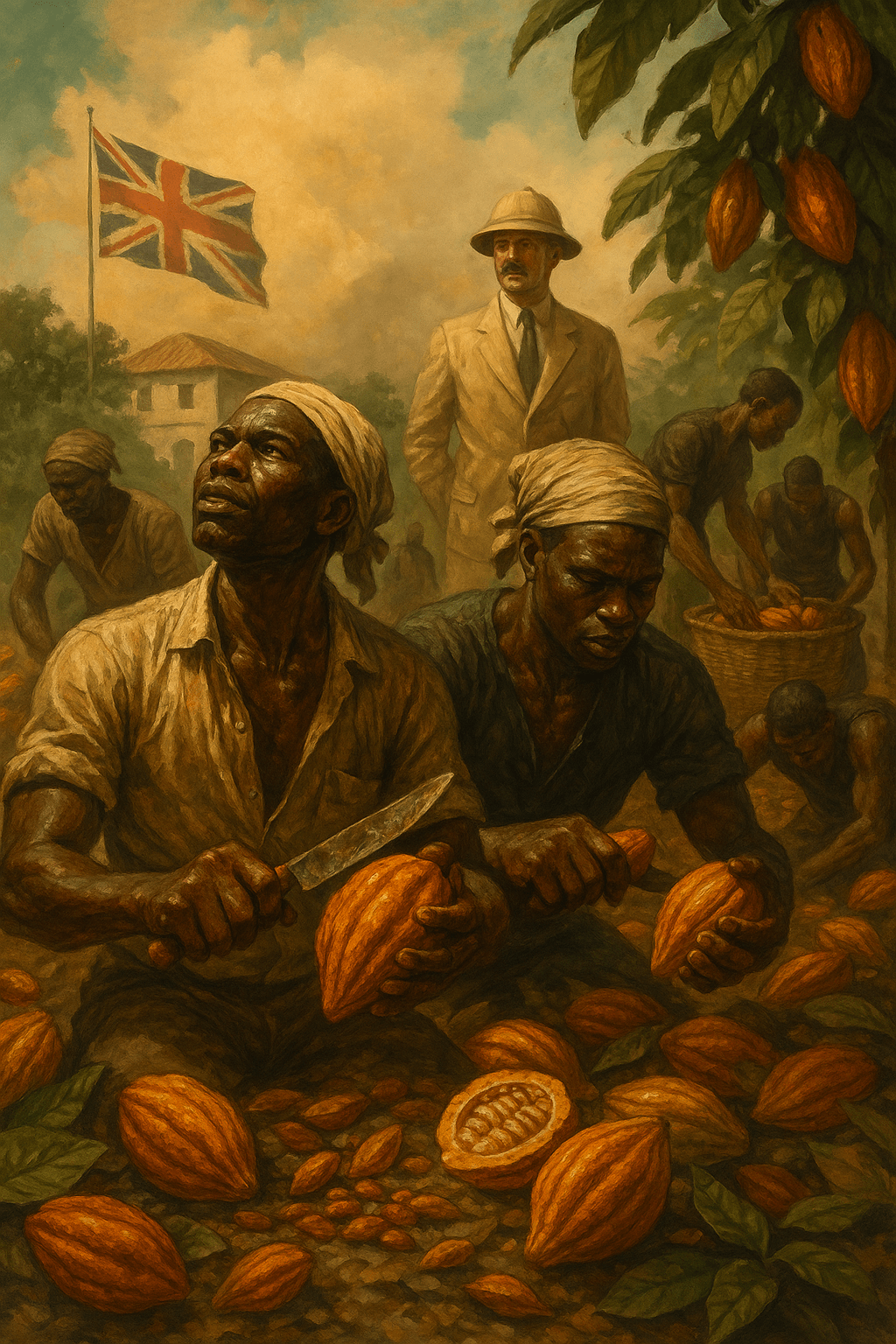
Excavating Reuters’ propaganda, exposing the imperialist cocoa supply chain, and reframing Nigeria’s cocoa “revival” as colonial extraction.
By Prince Kapone | Weaponized Information | May 7, 2025
I. Excavating the Cocoa Boys: Reuters, Propaganda, and the Plantation Revival Myth
On May 4, 2025, Reuters published a glowing feature on Nigeria’s so-called “Cocoa Boys,” casting them as heroic young entrepreneurs reviving the country’s cocoa industry. Behind the photo-ops and feel-good framing lies something far more sinister: imperial propaganda masquerading as economic reporting, designed to launder a neocolonial export model under the banner of “growth.” This is not journalism. It’s narrative management for agribusiness, foreign capital, and global commodity markets.
Reuters, a central node in the imperial media apparatus, serves here as the producer of this ideological line. The individual journalist’s byline is ultimately subordinate to the institutional function: to protect the international value chain, to normalize raw export dependency, and to romanticize a plantation economy dressed in local colors. The amplifier is the very platform of Reuters itself—a trusted voice for investors, Western policy elites, and financial markets. The beneficiaries are the usual suspects: multinational chocolate giants like Nestlé, Mondelez, and Mars; European commodity traders; speculative hedge funds; and comprador intermediaries within Nigeria who broker access to cheap cocoa for imperial supply chains.
The article presents the “Cocoa Boys” as visionary disruptors revitalizing a proud national industry. But look closer: every metric of success is tied to export volume, foreign demand, investor confidence. Their goal? “Return Nigeria to its place among the world’s top cocoa exporters.” Not a word about food sovereignty, domestic processing, or value addition. Not a whisper about the structural traps that make Nigeria a price-taker in a rigged global market. Not a line about the cocoa farmers laboring at the bottom of the chain while corporate profits flow upward to Zurich and New York.
Reuters deploys a familiar script: local faces front a system designed to extract. The article’s language evokes nostalgia for “the golden days” of Nigerian cocoa, conveniently skipping the colonial foundations of those “glory days”—when British colonial administrators enforced cocoa monoculture, expropriated land, and relied on coerced labor to feed European industries. By centering entrepreneurial figures like the “Cocoa Boys,” Reuters obscures the system they’re plugged into: a global value chain still dominated by colonial hierarchies in everything but name.
The story omits any mention of the WTO rules that prevent Nigeria from protecting its domestic chocolate industry. It ignores the IMF-imposed dismantling of marketing boards that once buffered farmers from price shocks. It buries the role of speculative finance in manipulating global cocoa prices. And it erases the environmental toll of intensified cocoa expansion: deforestation, soil exhaustion, and displacement of food crops as farmland is redirected toward cash crops for export.
In short, Reuters’ article is a propaganda piece for agribusiness imperialism. It frames Nigeria’s deepening integration into neocolonial commodity circuits as “progress.” It invites Nigerians to celebrate their role as producers of cheap raw materials for Western luxury markets. And it dares to call this “development”—while the real profits are siphoned off by chocolate conglomerates who never set foot in a cocoa grove.
The Cocoa Boys may wear local faces. But the system they serve wears an imperial mask. And Reuters is here to polish that mask, sell it to global investors, and ensure the plantation economy lives on under the illusion of African entrepreneurship. The plantation may have new managers. But the master still sits in the same old house.
Planted in Chains: The Cocoa Commodity Trap Beneath the Hype
Let’s strip the varnish off Reuters’ narrative and pull out the bare facts they buried beneath PR gloss. According to the article, Nigeria’s so-called “Cocoa Boys” are leading a revival of the country’s cocoa sector, aiming to restore Nigeria’s place among the world’s top cocoa producers. We’re told that 70% of West Africa’s cocoa is exported to Europe and the U.S., and that Nigerian farmers are being directly courted by foreign chocolate giants eager for more supply. The piece cheers this as entrepreneurial dynamism, as if these farmers are reclaiming agency and global market share.
But here’s what Reuters won’t contextualize: Nigeria’s cocoa economy was built by the British colonial state as a monoculture export machine, enforced through forced labor, land dispossession, and food crop displacement. It wasn’t cocoa “development.” It was cocoa servitude. When independence came, Nigeria inherited a structurally distorted agricultural system locked into commodity exports. The brief postcolonial attempts at regulating and stabilizing the sector—via marketing boards, minimum pricing, and state supports—were crushed under the boot of IMF and World Bank structural adjustment in the 1980s. Marketing boards dismantled. Subsidies slashed. Protective tariffs banned. The farmers thrown naked into global commodity markets rigged by the very imperial powers that once ruled their soil.
Reuters mentions none of this. It pretends today’s cocoa “revival” is an organic, Nigerian-led renaissance. But beneath the surface, it’s recolonization through trade. Under WTO rules and neoliberal “free market” dogma, Nigeria is prohibited from levying export taxes on raw cocoa or subsidizing domestic processors to move up the value chain. Instead, the lion’s share of cocoa profits flow to Europe and the U.S.—to Nestlé, Mars, Mondelez, Barry Callebaut—who process, refine, brand, and sell chocolate at many times the price of the raw beans. Nigeria remains the raw material supplier. The cocoa is still extracted from African soil, but the real wealth is extracted into foreign bank accounts.
Even worse, increased production today comes at an ecological and social cost. Smallholder farmers expand cocoa acreage by clearing forests, depleting soils, and displacing food crops essential for local food security. Land grabs intensify as foreign firms and local elites scramble to cash in. Meanwhile, global commodity speculation ensures that despite producing more, Nigerian farmers remain price-takers in a rigged game—subject to the whims of futures traders in London and New York who manipulate prices far above the farmers’ heads.
In this context, the Cocoa Boys aren’t grassroots revolutionaries. They’re the local compradors facilitating a new round of imperial extraction. The “revival” Reuters lauds is not a rebirth of national strength, but a tightening of Nigeria’s chains within a global commodity trap engineered by imperial finance, enforced by WTO diktats, and cheered on by the corporate press. Every ton of cocoa exported unprocessed is a ton of value stolen from Nigerian hands. Every hectare converted from food to export cocoa is another nail in the coffin of national food sovereignty. The “success” is an illusion—a plantation success, not a people’s success.
Not a Revival, But a Plantation Restoration: Reframing the Cocoa Boys
Let’s tear off the mask: the Cocoa Boys aren’t national heroes—they’re the middle managers of a plantation economy repackaged for the 21st century. Reuters calls it a “revival.” But revival for whom? It’s not a revival of Nigerian sovereignty. It’s a restoration of Nigeria’s structural role as raw material supplier for foreign capital. This isn’t a national project. It’s a comprador project, a class of local intermediaries greasing the gears of imperial extraction while posing as modern entrepreneurs.
The cocoa export model Reuters celebrates is the same model that underdeveloped Nigeria in the first place: a monoculture economy built to serve European markets, maintained by the suppression of food sovereignty, locked into dependency by unequal trade terms enforced through WTO and IMF dictates. There’s no sovereignty in being a plantation colony for chocolate conglomerates. There’s no empowerment in remaining a price-taker at the bottom of the global value chain while Nestlé and Mondelez reap windfall profits selling finished chocolate back to the world at 10, 20, 30 times the price of raw cocoa.
True sovereignty doesn’t lie in exporting more raw beans. It lies in breaking free from raw export dependency. It lies in building domestic processing capacity, in imposing export tariffs to keep value onshore, in rejecting WTO’s anti-development rules that forbid such measures. It lies in using cocoa not as a colonial export crop, but as a lever for integrated national development—supporting food sovereignty, industrialization, ecological sustainability, and working-class livelihoods.
The contradiction is glaring: Reuters praises cocoa export earnings while Nigeria’s poor face skyrocketing food inflation, imported food dependence, and chronic rural poverty. The export boom doesn’t feed Nigerians. It feeds global agribusiness. Every cocoa shipment cheered in foreign press is another shipment of calories, nutrients, and ecological resources drained from Nigerian soil. This isn’t progress. It’s the same extraction, wrapped in neoliberal PR.
We must situate cocoa within the broader imperial agricultural chokepoint: an imperialist global supply chain that forces the Global South to export raw goods while importing processed commodities at inflated prices; that bans protective policies under “free trade” dogma; that uses financial leverage to dictate crop choices and trade flows. Reuters doesn’t just omit this system—it actively launders it. It makes the chains look like opportunity. It makes recolonization sound like empowerment.
This is imperialist recalibration, not liberation. It’s hyper-imperialism adapting to the era of multipolar resistance by tightening agricultural chokepoints, re-entrenching raw export dependency, and neutralizing sovereignty with comprador frontmen. The Cocoa Boys are not leading a revolution. They’re helping paint the plantation walls a prettier color. And the longer Nigeria stays trapped in this model, the deeper the chains will cut.
Break the Chains: From Cocoa Colonies to Sovereign Soil
We know the enemy now. Reuters isn’t just reporting—it’s laundering the ideology of empire, normalizing a colonial export model dressed up as “revival.” It’s giving imperial agriculture a friendly face, erasing the structural violence beneath every shipment of raw cocoa that leaves Nigerian soil. This is ideological warfare, and it demands ideological resistance.
We must name the beneficiaries clearly: Nestlé, Mondelez, Mars—global chocolate conglomerates fattening themselves on Nigerian cocoa while exporting processed products back at predatory markups. These are not neutral market actors. They are direct agents of imperial extraction, their profits built on the continued underdevelopment of cocoa-producing nations. Every chocolate bar sold in Europe or the U.S. is a testament to the theft of value from African labor and land.
The fight begins with unmasking the Cocoa Boys for what they are: not nationalist heroes, but comprador intermediaries facilitating imperial agribusiness’s grip on Nigerian agriculture. They don’t represent sovereignty—they represent a domestic elite aligned with foreign capital, trading national development for personal gain. Their success is not a national success. It’s a local victory for global capital.
The path forward is clear. We must demand:
- Debt cancellation to free Nigeria from IMF and World Bank chains strangling agricultural sovereignty;
- Nationalization or strategic state control of key agro-export sectors to reclaim control over trade and production;
- Tariffs and protective measures to build domestic cocoa processing industries and stop the export of raw value;
- Land reform to block agribusiness land grabs and prioritize food sovereignty, agroecology, and peasant livelihoods over export monoculture;
- Support for farmers’ cooperatives and unions resisting corporate capture of rural land and production chains;
- International solidarity with Global South movements fighting WTO agricultural regimes and imperialist food systems.
This struggle is bigger than cocoa. Cocoa is a frontline in a broader war over land, food, labor, and sovereignty in the imperial world system. Every cocoa bean exported under colonial trade terms tightens the empire’s grip on Nigeria’s future. Every processed chocolate bar imported back deepens dependency. We are not just fighting for higher prices. We are fighting to dismantle the imperialist chokepoint that keeps Nigeria—and the Global South—locked in structural subordination.
Reuters’ propaganda must be met with revolutionary clarity. Their narrative must be flipped. Their beneficiaries must be named. Their agenda must be exposed. And their system must be broken. The cocoa struggle is not a nostalgic return to glory. It is a call to break from the plantation past—and to build a future rooted in sovereignty, solidarity, and socialist transformation.
The time for begging is over. The time for bargaining is over. The only path forward is revolutionary rupture. And the cocoa struggle is our frontline. Let’s break the chains. Let’s reclaim the soil. Let’s build the new world.
 Weaponized Information
Leave a comment