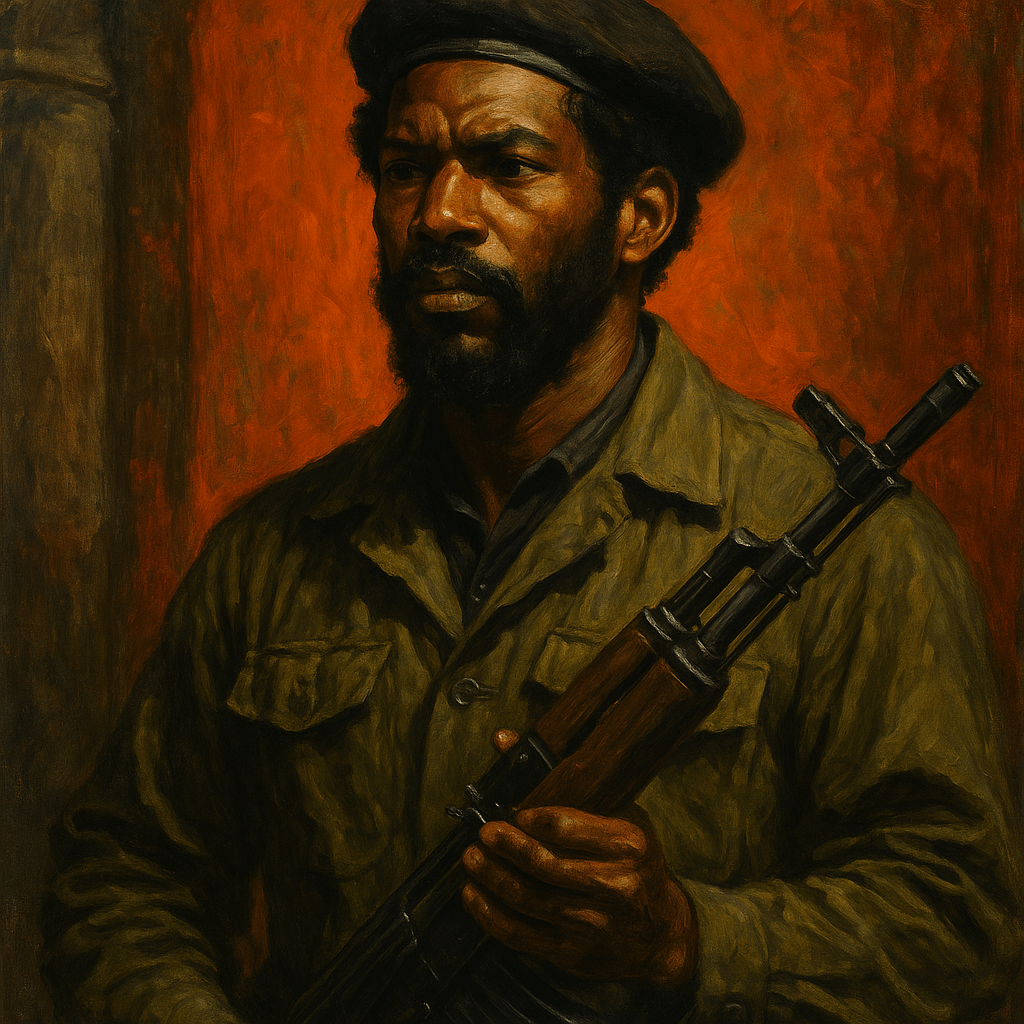
Part I: From the Ghetto to the Vanguard—The Birth of a Revolutionary
Before he was Dhoruba Bin Wahad, he was Richard Earl Moore—born in the belly of the beast, Harlem 1944, raised in the volatile and segregated cauldron of the South Bronx. His youth unfolded amidst state violence, poverty, racial containment, and the heroin that flooded Black neighborhoods like a colonial army in liquid form. But Moore didn’t drown—he radicalized. His story was not an individual awakening, but a reflection of the social storm engulfing Black America in the 1950s and ’60s. Appropriately, he would later rename himself Dhoruba, meaning “the storm” in Swahili.
As a young man, Dhoruba joined the U.S. military—not out of patriotism, but desperation. He encountered white supremacy in uniform and fascism cloaked in bureaucracy. Like Malcolm before him, he entered the military disillusioned and left politicized. In the late ’60s, as uprisings spread across the country—from Watts to Detroit—he gravitated toward the Black Panther Party. Not just as a symbol, but as an organized force grounded in theory and revolutionary practice.
He joined the New York chapter of the Panthers, where he was quickly recognized for his discipline, strategic mind, and oratorical fire. He studied the writings of George Jackson, Mao Zedong, Frantz Fanon, and Kwame Nkrumah—not in an academic vacuum, but while living the very contradictions they diagnosed. He became a field marshal in the underground resistance, operating at the intersection of theory and armed defense.
In 1969, Dhoruba was arrested alongside 20 others in the infamous Panther 21 case. The government sought to destroy the BPP’s New York base with trumped-up charges and COINTELPRO sabotage. But Dhoruba was chosen by his comrades to be released on bail—not to hide, but to speak. He toured the country defending the Panthers and exposing the fascist nature of U.S. courts. That’s when he became a serious threat to the state. The FBI placed him on the COINTELPRO “neutralize list,” targeting him for silencing by any means necessary.
Soon after, Dhoruba went underground and joined the Black Liberation Army (BLA)—a continuation, not a break, from the Panthers. Where the BPP had focused on political education, community programs, and self-defense patrols, the BLA embraced clandestine guerrilla tactics. Dhoruba and others carried out armed campaigns not as adventurists, but as part of a broader revolutionary strategy to confront the white supremacist, imperialist state on its own terms.
In 1971, he was captured and accused of killing two NYPD officers in Harlem. The charges were fabricated—built on coerced testimony, forged evidence, and FBI tampering. He spent 19 years behind bars for a crime he didn’t commit. But in prison, he didn’t break. He studied harder. He wrote sharper. He organized fellow prisoners into political study groups and resistance cells. When his legal team finally forced the FBI to release over 300,000 pages of COINTELPRO files, the case unraveled. The documents revealed a campaign of systematic political persecution, confirming what Black revolutionaries had long known: the U.S. was not a democracy—it was a counterinsurgency state.
Dhoruba walked free in 1990, unapologetic and still stormborn.
Part II: Revolutionary Theory, Political Clarity, and Global Consciousness
Dhoruba Bin Wahad wasn’t just a foot soldier in the Black Liberation struggle—he was and remains one of its most uncompromising political theorists. While the state tried to bury him for two decades, he sharpened his thought behind bars. And when he emerged, he came out not reformed—but refined. His revolutionary clarity today reflects not just lived experience, but a dialectical method rooted in collective liberation and ruthless criticism of all that exists.
Dhoruba argued that the U.S. prison system is not a site of reform, but a domestic war zone. He called prisons the “plantation of the 21st century,” and insisted that incarceration in the empire is a direct extension of counterinsurgency against the Black colony. This is not metaphor. It is the logical outcome of a settler state seeking to neutralize its most potentially insurgent populations.
He also rejected the liberal politics of representation. Dhoruba had no illusions that placing Black faces in high places would deliver justice to the masses. Long before Obama or Kamala, he warned that the national bourgeoisie would serve as buffers, not liberators. “Their function is to legitimize the colonial apparatus,” he said, “not to dismantle it.” His critique wasn’t personal—it was systemic. He understood that Black mayors, judges, and prosecutors would only inherit the institutions of oppression unless they were overthrown and reconstituted by the people themselves.
Internationally, Dhoruba built ties with revolutionaries from Palestine to South Africa. He saw the Palestinian liberation struggle as an extension of the anti-colonial fight and was one of the earliest Black revolutionaries to publicly support the PLO and denounce Zionism as settler-colonialism. He connected the dots between the Bronx and Gaza, between Angola and Attica. Wherever imperialism operated, Dhoruba trained his eye and raised his voice.
In his writings and speeches, Dhoruba articulated a vision of revolutionary justice that transcended retribution. He wasn’t interested in revenge—he was interested in transformation. He demanded reparations not as a moral plea, but as a strategic necessity. He demanded liberation not as a rhetorical slogan, but as a material process led by the people themselves.
Dhoruba has also been a relentless critic of the non-profit industrial complex, which he sees as the new face of colonial pacification. “They don’t need to shoot us anymore,” he once said. “Now they just fund us out of existence.” He exposed how NGOs, foundations, and liberal institutions use money as a weapon to neutralize Black radicalism, turning struggle into service, rebellion into reformism.
Today, in his 70s, Dhoruba Bin Wahad remains a living archive of insurgent knowledge—a man who did not just read Fanon or Malcolm, but lived their lessons through fire and steel. His revolutionary legacy reminds us that freedom is not a dream deferred—it is a weapon seized.
Part III: Post-Prison Struggle and Living Legacy
Dhoruba Bin Wahad didn’t leave the struggle when he left prison. If anything, he returned to it with greater precision and purpose. After his release in 1990, he immediately began speaking, organizing, and educating—offering analysis that was unfiltered, unbought, and unbroken. He didn’t chase book deals or bourgeois accolades. He built movement.
One of his key contributions post-release has been his relentless critique of the criminal justice system—not just as an institution, but as a mechanism of counterinsurgency. Dhoruba exposed how every level of the legal system, from the police precinct to the courtroom to the prison block, is structured to contain, pacify, and disappear the colonized subject. For Dhoruba, prison abolition is not a slogan—it’s a revolutionary imperative.
He worked with formerly incarcerated revolutionaries and younger radicals to build intergenerational continuity. He didn’t believe in romanticizing the past or gatekeeping the struggle. He believed in training the next generation. Through his writings, workshops, and raw speeches, Dhoruba challenged emerging organizers to move beyond activism and toward revolutionary strategy.
In the wake of the post-Ferguson Black uprisings, as a new wave of radicals emerged, many rediscovered Dhoruba’s legacy. His critiques of nonprofit reformism, state co-optation, and liberal spectacle found renewed resonance in an era of Black Lives Matter press conferences and state-sanctioned protests. His essays became required reading for those who understood that freedom would not come through body cameras, police commissions, or progressive prosecutors.
Dhoruba has also contributed to international forums, Pan-Africanist summits, and global conferences on political imprisonment and colonial repression. His presence has helped unite struggles across borders—connecting imprisoned revolutionaries in the U.S. with Palestinian detainees, Indigenous land defenders, and anti-imperialist fighters in Latin America.
But perhaps Dhoruba’s greatest legacy lies in what he embodies: the refusal to be broken by empire. He is a reminder that we are not victims—we are enemies of a system that must be destroyed. He didn’t ask for justice. He demanded power. And he continues to teach that unless we do the same, we will never be free.
In a moment when so many radicals seek validation from the very institutions we should be dismantling, Dhoruba Bin Wahad stands as a living indictment of liberalism, a living memory of the Black liberation struggle, and a living blueprint for revolutionary strategy.
Conclusion: Stormborn Still
Dhoruba Bin Wahad’s story isn’t over—it’s unfolding in the very streets, prisons, and radical spaces that continue to resist the settler-colonial empire of the United States. His life has been forged in the crucible of counterinsurgency, but also in the struggle of the people to reclaim their dignity, their history, and their power. His legacy is not a museum piece—it’s a toolkit. A weapon. A living archive of revolutionary science born from lived contradiction.
In an era of digital pacification, liberal branding, and algorithmic repression, Dhoruba reminds us what it means to be uncompromising. He didn’t ask for justice—he demanded liberation. He didn’t ask to be understood—he demanded to be heard. And he didn’t wait for permission—he took power.
From Harlem to Palestine, from Attica to Soweto, from the trenches of the BLA to the lecture halls of a new radical generation, the name Dhoruba Bin Wahad means resistance. Not the aesthetic of revolution—but the labor, the suffering, the organization, the fire.
He is the storm. And the storm hasn’t passed—it’s just begun.
 Weaponized Information
Leave a comment