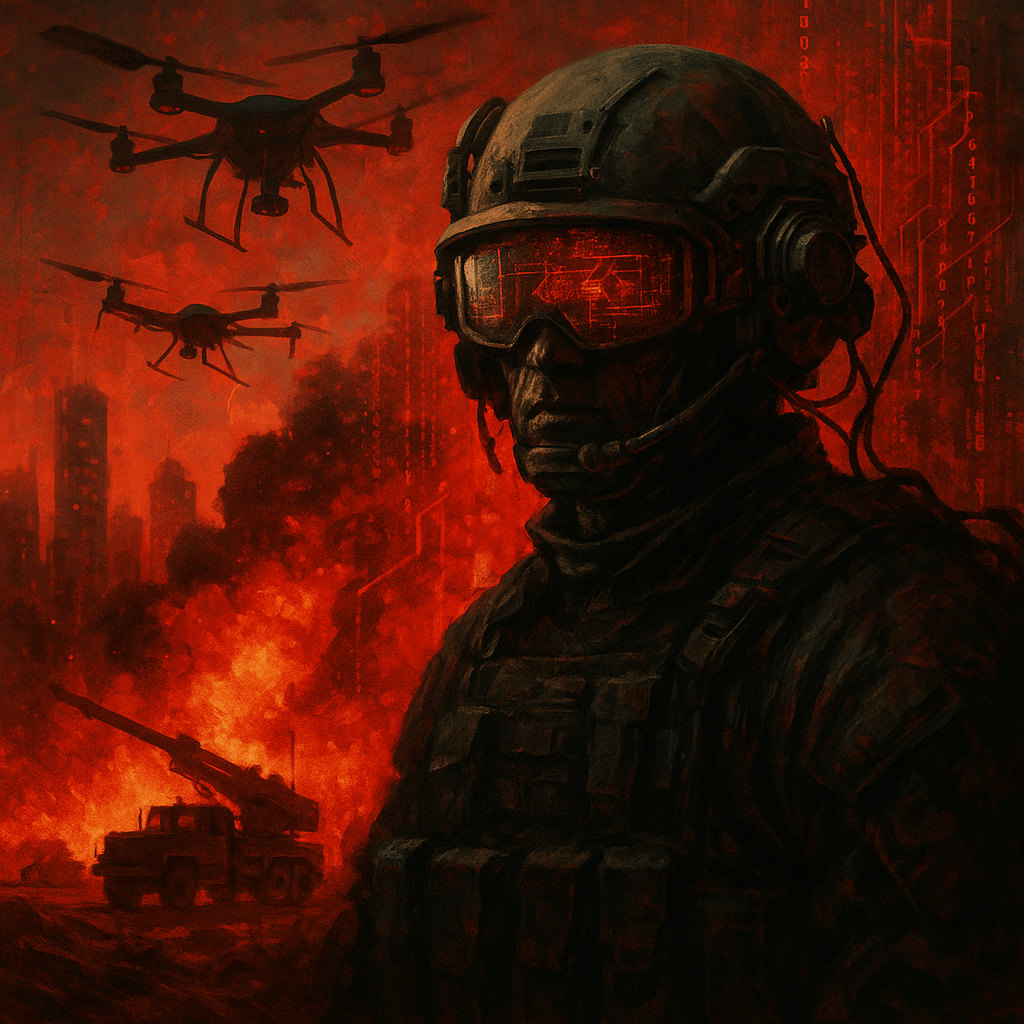
The Army Transformation Memo and the Technofascist Military: Empire’s New Arsenal
By Prince Kapone | Weaponized Information | May 4, 2025
I. A Blueprint for Empire’s Technofascist Recalibration
The leaked Army Transformation memo, authored under the stewardship of Secretary of Defense Pete Hegseth, is not a mere policy adjustment. It is a declaration of imperialist recalibration, a technofascist blueprint for reorganizing military power amid the empire’s accelerating decline. The memo does not propose war replaced by algorithms—it codifies war automated by algorithms, integrating monopoly-finance capital, corporate killware, and the militarized state into a fused operational matrix. Every paragraph reads like a corporate-military blood pact: proprietary software turned into artillery, data streams hardened into battle plans, the cloud transformed into the empire’s digital armory.
At its core, the memo attempts to retrofit U.S. imperialism for the era of multipolarity and global defiance. Faced with rising anti-imperialist sovereignty, BRICS+ coordination, and crumbling unipolar legitimacy, the Pentagon’s answer is not diplomacy or retreat—it is logistical acceleration, digital integration, and the compression of imperial time through networked warfare. But beneath the jargon of “multi-domain operations” and “modular readiness,” the material essence of the military remains: the deployment of violent force to sustain global looting.
II. Hegseth’s Domestic Counterinsurgency: From Classroom to Combat Zone
Pete Hegseth’s personal trajectory—soldier, propagandist, privatization lobbyist, Fox News warmonger—is the ideological foundation for this memo. His long-standing advocacy for mandatory JROTC programs in public schools, presented as “discipline and patriotism,” reveals a strategy of militarizing civil society from the classroom outward. This is not civic education—it is settler-colonial pacification by pedagogical militarization, planting the seeds of counterinsurgency into the very structure of youth identity.
During the George Floyd uprisings, Hegseth infamously demanded “order by any means necessary,” urging military deployment against Black-led rebellion. This posture echoes the colonial contradiction at the empire’s heart: dissent inside the metropole is treated as insurgency from an internal colony. The memo’s domestic provisions—expanding surveillance under “critical infrastructure protection,” embedding the military in emergency response, and cultivating “resilience partnerships”—are the operational scaffolding for repressing the colony within. It is COINTELPRO reloaded, but this time driven by algorithmic governance, biometric profiling, and cloud-native police command systems.
III. Historical Continuities: Empire’s Laboratories of Counterinsurgency
The memo’s innovations are not new; they are refinements of imperial violence honed across colonial laboratories. The U.S. military’s experiments in Vietnam, Iraq, and Afghanistan perfected the fusion of surveillance, assassination, and psychological warfare under the banner of “stability.” The Israeli occupation of Palestine pioneered algorithmic governance through tools like the Habsora AI system and the Lavender kill list, automating the selection of Palestinian bodies for liquidation. These experiments feed back into U.S. doctrine, as the memo’s embrace of “predictive battlespace management” shows: the algorithm is a weapon, not a neutral tool.
Just as COINTELPRO criminalized Black revolutionary movements under the guise of “national security,” algorithmic counterinsurgency now criminalizes Palestinian TikTok posts as “terrorist content.” Every dataset is pre-criminalized; every dissident body pre-targeted. The memo’s integration of data streams from social media, telecom networks, and biometric databases is not innovation—it is the formalization of empire’s long-standing imperative: to map, monitor, and neutralize insurgent life.
IV. The Material Core: Weapons, Contractors, and War Profits
Beneath the memo’s digital sophistication lies an unbroken material foundation: the weapons themselves. The Army’s $1.2 billion contract with Palantir to “optimize” drone strike targeting in Yemen exemplifies the marriage of cloud-native operations and imperialist violence. Every line of code maps to a warhead; every software upgrade is a weapons upgrade. The memo’s call for “distributed lethality” is not a metaphor—it is the logistical scaffolding for making death mobile, scalable, and profitable.
Lockheed Martin, Raytheon, Boeing: the military-industrial core remains intact, with new profit lines opened through cyber-command contracts, hypersonic missile integration, and space militarization. The memo’s procurement annex lists autonomous drone swarms, AI targeting systems, and sensor-fusion helmets—not as future projections, but as current acquisitions. Technofascism here is not an abstraction: it is embedded in each contract, where software licensing, killware deployment, and data sovereignty converge under corporate monopoly control.
V. Suppression Without Occupation: The Logic of Distributed Empire
The Army Transformation memo’s emphasis on “non-linear battlespaces” and “asymmetric force projection” signals a strategic shift: from direct occupation to distributed suppression. The U.S. empire has learned—through Vietnam, Somalia, Iraq, Afghanistan—that occupation breeds insurgency faster than it quells it. The memo’s solution is “distributed lethality”: replacing bases with networks, garrisons with drones, armies with algorithms. Where colonial empires once planted flags, technofascist imperialism deploys orbital satellites, autonomous drones, and deniable special operations. Sovereignty is not seized; it is surveilled, sabotaged, preempted.
This model depends on the proliferation of private military contractors (PMCs) and outsourced mercenary forces. Firms like Wagner, Blackwater (Constellis), and G4S are not deviations from state power—they are privatized extensions of it, enabling empire to act beyond legal and public scrutiny. The memo’s annex exposes the architecture behind this suppression: private drone fleets in Djibouti, modular airstrips in the Sahel, leased cyberwarfare platforms embedded in telecom networks. The empire doesn’t leave—it hides in proxies and platforms.
Technofascism fuses logistical control, technological domination, and privatized force into a decentralized coercion machine. Military theorists call it “mosaic warfare”—a patchwork of interoperable nodes assembling lethal force across land, sea, air, cyber, and space. DARPA’s Mosaic Warfare Initiative envisions battlefields where assets are plug-and-play, software dictates tactics in real time, and human oversight is a bottleneck. This is not speculative; it is codified in the memo’s roadmap for “adaptive force deployment.”
Historically, the empire’s distributed violence echoes past models: British gunboats along colonial rivers, Roman frontier forts, Spanish sea raids. But today’s empire no longer needs governors or viceroys; it needs orbital satellites, cyber units, privatized kill teams. The suppression of sovereignty has been modularized.
At its core, this distributed empire targets infrastructure itself. Oil pipelines, data cables, railways, rare earth mines, semiconductor fabs—these arteries of 21st-century extraction are the new frontlines. The memo’s emphasis on “critical infrastructure protection” and “strategic denial” reveals a doctrine treating every anti-imperialist project—from China’s Belt and Road to Iran’s oil terminals—as a node to sabotage, sanction, or seize.
This is imperialism without colonies in name but colonies in function: an empire that controls not by occupation but by embedding violence into the very infrastructure sustaining sovereignty. The new empire does not plant flags; it plants switches, cables, contracts, bombs. And wherever that control is resisted, the memo promises defense by a globalized logistics of suppression—invisible yet omnipresent, decentralized yet coordinated, privatized yet imperial.
VI. Imperialist Recalibration and the Crisis of Hegemony
The Army Transformation memo must be understood as a symptom of imperialism in crisis—a desperate recalibration to sustain U.S. global dominance as its economic foundation erodes. Beneath its jargon of “network-centric rapid response” and “multi-front preemption” lies an empire that can no longer afford long wars or permanent occupations, yet cannot relinquish control over the arteries of global accumulation. The memo’s urgency is not a strategy for victory; it is a strategy for delay, sabotage, and disruption—a technofascist attempt to weaponize time itself against the forces of multipolarity and anti-imperialist sovereignty.
This recalibration reflects the empire’s material predicament. The global south’s push toward economic independence—from BRICS+ currency frameworks to African sovereign wealth funds—threatens the infrastructure of U.S. dollar hegemony. Every oil transaction settled outside the petrodollar, every semiconductor supply chain bypassing U.S. sanctions, every Belt and Road port inaugurated beyond Western finance represents a crack in imperial control. The memo’s military acceleration is an attempt to close those cracks by force, to harden imperial bottlenecks through militarized logistics, cyber disruption, and sabotage masquerading as “stabilization operations.”
What emerges is not simply militarism—it is a new form of military Keynesianism, where state violence becomes the principal stabilizer of an otherwise unsustainable economic order. As U.S. manufacturing declines and productive investment falters, the military-industrial complex serves as a sink for surplus capital, a guarantor of monopoly contracts, and a driver of technological innovation that remains monopolized by the imperial core. Every drone contract, every cloud-computing war room, every AI targeting platform is not just an instrument of repression—it is a subsidy to monopoly capital, a mechanism for fusing economic stagnation with militarized extraction.
This is the political economy of technofascism: monopoly-finance capital cannot resolve its contradictions through expansion, so it doubles down on militarized coercion. The memo reflects a structural dependency: the empire’s military supremacy has become the last pillar sustaining the illusion of hegemony. Yet this pillar grows more brittle with every deployment. The Romans stretched their frontiers thin; the British Empire turned to punitive raids and blockades; the Spanish crown relied on privateers and piracy as its colonial reach faltered. The U.S. empire is following the same trajectory—not toward stability, but toward accelerated decline masked by accelerated violence.
This violence is not merely external. As the memo signals, the military’s role in “critical infrastructure protection” and “resilience partnerships” domesticates counterinsurgency, embedding military logic into the fabric of civilian governance. The metropole itself becomes a battlespace, as austerity, ecological collapse, and racialized rebellion expose the fragility of settler-colonial order. Pete Hegseth’s vision of militarized classrooms and algorithmic emergency management is not an anomaly—it is the logical extension of an empire that treats domestic dissent as insurgency, and public life as a soft target for counterinsurgent control.
The memo’s strategy is thus not designed to restore hegemony—it is designed to manage collapse, to delay defeat, to sabotage sovereignty wherever it emerges. But every act of sabotage accelerates delegitimization; every attempt at disruption deepens systemic instability. The empire fights not for a future it can build, but for a present it cannot sustain. And in this fight, the old weapons—military bases, aircraft carriers, sanctions—are increasingly supplanted by a digital arsenal of surveillance, cyberwarfare, and algorithmic suppression. It is imperialism retreating into the network, militarizing every domain of life as it loses its grip on the material foundations of global rule.
VII. The Corporate-Military Nexus: Technofascism’s Infrastructure
The Army Transformation memo exposes not just a military doctrine, but an infrastructure of empire—a corporate-military nexus so deeply embedded in daily life that war and peace have become indistinguishable. As Nick Turse reveals in The Complex, the U.S. military has spent decades infiltrating the civilian economy, privatizing military functions while militarizing civilian institutions. From university research labs to video game companies, from Hollywood studios to logistics firms, the boundaries between defense and commerce have collapsed into a single war economy. The memo’s “public-private innovation ecosystems” are not partnerships—they are the formalization of this merger, an open declaration that war is the organizing principle of capitalist production in the imperial core.
The cloud contracts with Microsoft and Amazon, the AI battlefield platforms developed by Google’s DeepMind alumni, Palantir’s predictive policing tools deployed both abroad and in U.S. cities—these are not neutral technologies. They are instruments of technofascism, fusing monopoly-finance capital with algorithmic repression, embedding empire’s operational logic into the very platforms we are told are “disruptive” or “innovative.” Every corporate logo hides a military contractor; every app is a node in the surveillance-industrial complex. As Turse notes, even McDonald’s partners with the Pentagon to streamline food logistics for troop deployments. There is no outside.
This corporate-military merger is not an accidental consequence of privatization; it is a deliberate strategy to insulate empire from democratic accountability. Private military contractors, corporate cyberwarfare teams, and university research funded by DARPA operate beneath public oversight, behind proprietary algorithms and intellectual property protections. The memo’s procurement annex is a corporate catalog: Lockheed Martin’s hypersonic missile systems, Raytheon’s drone swarms, Northrop Grumman’s orbital battle management software, Palantir’s battlefield analytics. Technofascism is not a metaphor—it is a balance sheet, a patent portfolio, a contract ledger where militarized extraction, digital enclosures, and algorithmic governance converge.
At the ideological level, the corporate-military nexus sustains itself through a culture of militarized innovation. From Silicon Valley’s libertarian techno-optimism to the gamification of drone strikes, empire’s violence is aestheticized as progress, its monopolies framed as efficiency, its extraction sanitized as data management. The memo’s language of “innovation ecosystems” and “modular readiness” reflects this ideological laundering, wrapping empire’s machinery in the gloss of entrepreneurial disruption. But behind the marketing lies the same colonial imperative: the automation of repression, the acceleration of extraction, the consolidation of monopoly power.
Drawing from Turse’s analysis, we must understand the corporate-military merger not as a corruption of civilian life, but as the logical extension of settler-colonial capitalism itself. The empire has always required a fusion of private profiteering and militarized coercion; what has changed is the scale, speed, and digital saturation of that fusion. The memo codifies a technofascist infrastructure where every data stream is a target, every platform a weapon, every contract a battlefield acquisition. And as long as monopoly capital rules, this merger will deepen—not to secure a sustainable order, but to sustain a decaying one through algorithmic force.
VIII. Global Implications: Multipolar Resistance and Imperial Desperation
The Army Transformation memo is not confined to domestic or regional warfighting; it is an operational doctrine for global imperial preservation. Every page reflects a military designed not for expansion, but for sabotage—targeting the very arteries of multipolarity that threaten U.S. imperial control. From Venezuela’s oil terminals to China’s Belt and Road corridors, from Iran’s nuclear infrastructure to Russia’s energy pipelines, the memo’s readiness for “gray zone warfare” translates to a readiness for disruption, coercion, and undeclared war across every domain where sovereignty resists imperial extraction.
Each new node of multipolar resistance becomes a target: the Iranian port of Chabahar, a BRICS+ currency clearinghouse, a Sudanese gold mine aligned with Russian interests, a fiber-optic cable circumventing Western telecom monopolies. These are not neutral infrastructures; they are contestations of imperial order. The memo’s focus on “critical infrastructure protection” abroad is a euphemism for preemptive strikes, sabotage operations, and proxy warfare designed to deny these projects material viability. It is imperialism’s piracy reborn: a 21st-century doctrine of hijacking, blockade, and destruction masquerading as “security operations.”
The operational blueprint mirrors historical precedents. As the British empire turned to blockades and covert destabilization during its decline, as the Spanish empire empowered privateers and mercenaries to plunder rivals, so too does U.S. imperialism turn to hybrid war and clandestine disruption. The memo institutionalizes this trajectory, coding piracy into policy, outsourcing sabotage through privatized cyberwarfare teams, and embedding digital kill-switches into the global infrastructure of finance, energy, and communication.
Yet this desperate strategy breeds its own contradictions. Every drone strike against a sovereign engineer, every cyberattack on a non-aligned port, every attempt to sabotage a semiconductor supply chain deepens the resolve of multipolar actors to build autonomy, redundancy, and collective security mechanisms. Iran develops domestic missile production under sanctions. Venezuela restores power grids amid U.S. sabotage. China invests in alternative payment systems precisely because of dollar weaponization. The empire’s attempt to disrupt only accelerates decoupling.
Technofascist imperialism thus fights not for expansion, but for deceleration—fighting to delay its own irrelevance by obstructing the future it cannot control. The memo’s militarization of infrastructure, data, and supply chains is an effort to weaponize the very networks that sustain global economic life. Yet every attack confirms the necessity of sovereignty, every sabotage legitimates counter-hegemonic blocs, every act of imperial violence fertilizes the ground for deeper international solidarity.
In this sense, the memo is not merely a military document—it is an obituary written in advance, a roadmap of imperial decline tracing its own unraveling. Each tactical innovation reflects strategic desperation; each technological upgrade masks geopolitical retreat. And for the global south, for the colonized, for the builders of multipolar futures, the memo offers a lesson: that empire, faced with the limits of its own reproduction, will destroy rather than relinquish, will sabotage rather than surrender, will burn rather than share. But in burning, it exposes its engines; in sabotage, it reveals its vulnerabilities. And in doing so, it prepares the very conditions for its defeat.
IX. Revolutionary Counter-Analysis
The Army Transformation memo is not an anomaly—it is the predictable evolution of militarized imperialism under technofascist crisis management. It reflects an empire incapable of reform, doubling down on militarized extraction, surveillance, and algorithmic pacification to compensate for its political and economic decay. It is not a roadmap to strength; it is a map of desperation.
Our response cannot be confined to policy critique or appeals to civilian oversight. The technofascist military must be confronted by building dual and contending power: revolutionary institutions of counter-hegemonic sovereignty capable of contesting empire’s machinery of death at every level. As theorized by Omali Yeshitela, this means creating autonomous people’s courts, liberated educational spaces, and community defense structures that prefigure revolutionary rupture. The struggle against Hegseth’s Army is not a struggle for inclusion—it is a struggle for abolition.
In this moment, the memo offers us not only a window into imperialist strategy but a mirror reflecting the necessity of revolutionary praxis. Every drone overhead, every algorithmic checkpoint, every militarized classroom underscores the same lesson: empire will not collapse on its own—it must be dismantled. And the dismantling begins wherever we build power outside its command, wherever we disarm its violence through solidarity, organization, and revolutionary will. The old world is dying. Let us hasten its end.
 Weaponized Information
Leave a comment