Epigraph:
“If one day they carry me out of here dead, know that I will die for justice, for peace, for a better life for all Haitians.”
— Jean-Bertrand Aristide
Part I: From the Parish of the Poor
Jean-Bertrand Aristide was born on July 15, 1953, in Port-Salut, a small town in southern Haiti. Orphaned as an infant, he was raised by his mother and the Salesian Catholic order. Bright and deeply committed to justice from a young age, Aristide pursued studies in philosophy, psychology, and theology in Haiti and later in Canada and Israel. But his true education came not in the seminaries, but in the slums of Port-au-Prince, where he served as a priest in La Saline and led the parish of St. Jean Bosco.
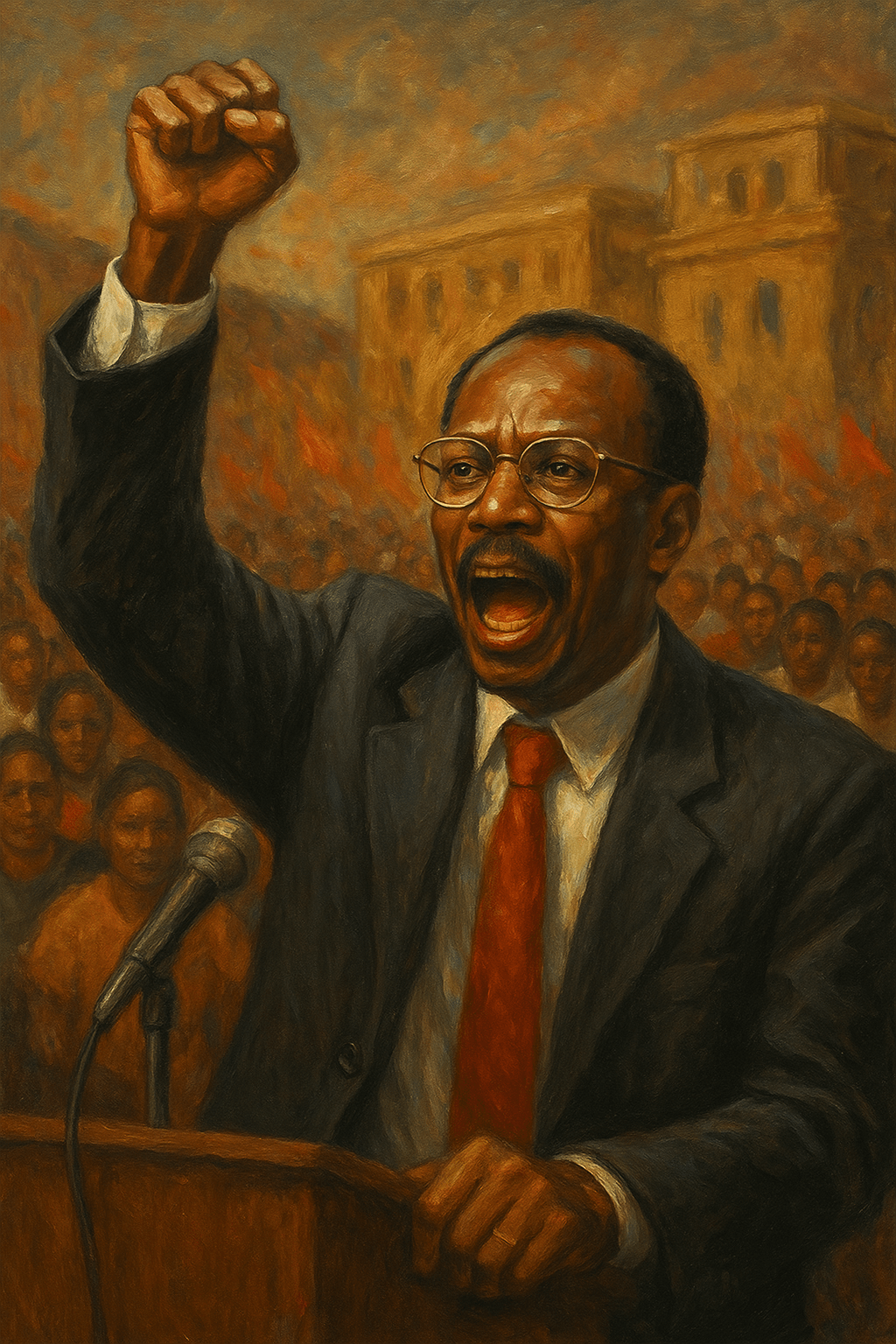
Aristide was a key figure in the “Ti Legliz” (Little Church) movement—Haiti’s liberation theology current, which broke with the Vatican’s conservatism and aligned itself with the poor, the oppressed, and the revolutionary currents sweeping Latin America. As a priest, he did not only preach the Gospel—he politicized it. In fiery Creole sermons, Aristide condemned the Duvalier dictatorship, denounced U.S. imperialism, and called for the people to rise up. His words electrified the masses and painted a target on his back. But he never flinched. He declared: “You cannot kill the truth.”
In 1988, death squads torched his church and massacred at least 13 parishioners. Aristide narrowly escaped with his life. But the attack only deepened his moral authority. Haiti’s poor saw him as the people’s priest. A prophet of justice. And when the dictatorship finally crumbled in 1990, they propelled him to the presidency with 67% of the vote—the first democratic election in Haiti’s history. It was the slum-dwellers and market women, the peasants and barefoot children, who carried him to power. Lavalas—meaning “flood”—was their movement, and Aristide was its symbol.
But the oligarchy and their patrons in Washington saw a threat. A priest who became president. A man of the poor who nationalized utilities, raised the minimum wage, launched literacy and food programs, and dared to ask France for $21 billion in reparations for slavery. Aristide declared: “We moved from misery to poverty with dignity.” That was unacceptable. And in 1991, after just seven months in office, he was overthrown in a CIA-backed military coup. Thousands were killed. Aristide was exiled. And the terror returned.
Yet Aristide was not finished. The poor still stood by him. The flood had not receded. It would rise again. In exile, he traveled the world, building support. He testified before Congress. He exposed the coup. And under massive international pressure, the Clinton administration restored him to power in 1994—though only for the remaining 18 months of his term, and under strict neoliberal conditions. Still, he abolished the army, created a new civilian police force, and launched new popular programs. He never forgot who he served.
Part II: The Second Lavalas Revolution and U.S. Subversion
In 2000, Aristide was reelected in a landslide. The Lavalas movement returned to power on the backs of the poor, and this time, he came with renewed focus. He deepened social programs: subsidized school lunches, increased literacy campaigns, expanded public health outreach, and accelerated efforts to build infrastructure in the countryside. He pursued land reform and launched an ambitious initiative to provide universal access to education in Haitian Creole. Once again, he made demands for reparations—this time more forcefully, calling on France to repay the ransom it had extracted from Haiti following its independence.
These were not just populist policies. They were revolutionary gestures—rooted in the belief that the Haitian people, the descendants of those who overthrew slavery and French rule, had the right to govern themselves without foreign domination. Aristide called it “mental decolonization,” and he saw it as essential to Haiti’s political and spiritual rebirth.
But the forces of empire struck again. In 2004, on the bicentennial of the Haitian Revolution, Aristide was kidnapped by U.S. and French military operatives and flown into forced exile in Africa. The coup was dressed in the language of humanitarian intervention and “democratic transition,” but the facts made it clear: the U.S., France, and Canada had conspired with elite Haitian opposition forces to remove a popular, elected president and roll back the gains of the poor.
In exile once more, Aristide remained unbowed. He wrote, taught, and organized from abroad. He remained a symbol of Haiti’s dignity and resistance. And when he returned in 2011, thousands flooded the streets in celebration. The man who had been twice overthrown, twice exiled, and relentlessly demonized by Western media, remained beloved by Haiti’s majority—the poor, the dispossessed, the barefoot children of the Revolution.
Part III: Decolonizing the Mind, Building the Future
Jean-Bertrand Aristide was not simply a populist or a charismatic priest turned president—he was a political theorist of the oppressed. His philosophy, expressed through texts like Haiti-Haitii: Philosophical Reflections for Mental Decolonization and In the Parish of the Poor, emphasized that true liberation could not be reduced to electoral victories or piecemeal reforms. It required a profound transformation of consciousness. Colonization, he argued, was not merely physical—it was spiritual and psychological. It trained the poor to believe they were inferior, to accept suffering, and to internalize defeat. Aristide’s revolution, therefore, began with truth-telling, Creole-speaking, and reclaiming Haiti’s historical dignity.
Aristide challenged the false binary between religion and revolution. Drawing on liberation theology, he placed love, solidarity, and justice at the center of radical politics. He believed that a political movement must not only denounce imperialism, but also embody the values of care, mutual aid, and moral courage. For him, the Beatitudes were revolutionary slogans: Blessed are the poor. Blessed are the peacemakers. Blessed are those who hunger for righteousness.
His notion of “mental decolonization” called for a cultural revolution that would reverse centuries of elite mimicry and colonial dependence. He promoted Haitian Creole as the national language of instruction and state policy. He prioritized local knowledge, grassroots democracy, and economic self-reliance. For Aristide, the greatest danger to Haiti’s future was not simply neoliberalism—but the alienation of the Haitian soul by those who viewed themselves as Westerners in Black skin.
Aristide’s legacy remains contested by the elite and the imperialist press, but among Haiti’s masses, his impact endures. Lavalas is not just a party—it is a memory, a hope, and a movement. And for those of us committed to decolonization and global liberation, Aristide offers not just inspiration, but instruction. He showed what it means to wield state power without surrendering revolutionary principles, to serve the people without selling out, and to fight empire without apology.
In an age of NGO pacification, neoliberal coups, and proxy imperialism, the example of Aristide stands as a revolutionary warning: you cannot serve the poor without confronting the rich. You cannot uplift the people without tearing down the systems that oppress them. And you cannot decolonize the nation unless you also decolonize the mind.
 Weaponized Information
Leave a comment