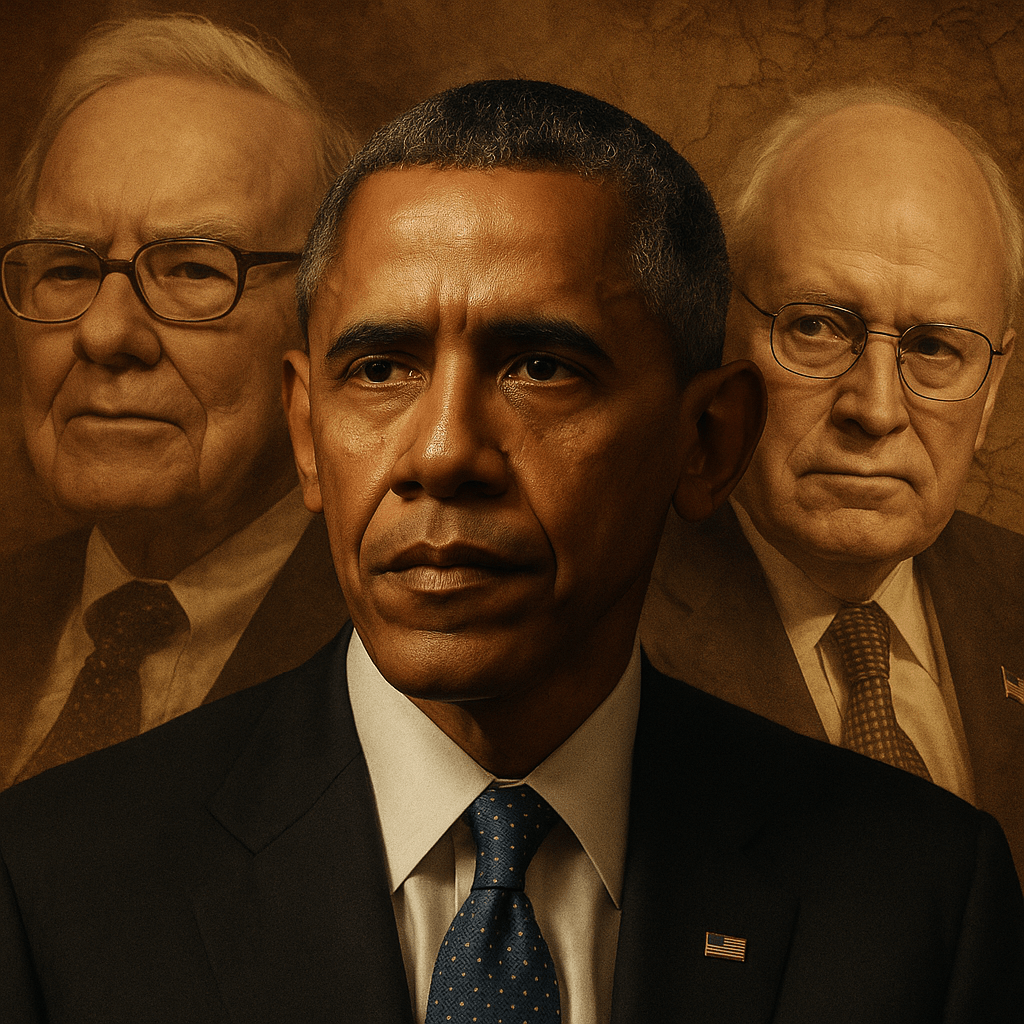
The strange case of Barack Obama and the unbroken chain of colonial domination
By Prince Kapone | Weaponized Information | May 3, 2025
The Face of Change, the Blood of Continuity
When Barack Obama stood on that stage in Chicago in 2008, the crowd roared like they were witnessing history. And in a way, they were. A Black man, elected president of the United States—the very empire built on slavery, genocide, and stolen land. People called it a new era. They called it “post-racial.” They said, “See? America really is the land of opportunity.”
But if you looked beneath the slogans, if you listened past the chants of “yes we can,” you’d find an old story hiding under the new. A story older than America itself.
Because here’s the thing they won’t tell you on CNN: Barack Obama, Dick Cheney, and Warren Buffett are all distant cousins. That’s right. The liberal president, the Republican vice president, and the billionaire investor—they all come from the same colonial bloodline. They’re all descended from a man named Moreen Duvall, a French Huguenot who landed in Maryland in the 1600s, got rich off land theft and slavery, and planted his family deep in the soil of settler colonial America.
Let that sink in. The “first Black president” is literally the blood relative of one of America’s original enslavers.
This isn’t some quirky genealogical trivia. This is the whole system laid bare. This is the dirty family secret of the empire.
Obama wasn’t the end of the white ruling class. He was its most clever move. By putting a Black face on the empire, they managed to renew its legitimacy without giving up its power. By calling him “progress,” they managed to keep the system of exploitation and domination intact while making it look like things had changed.
The fact that Obama shares blood with Cheney and Buffett tells us something deeper about race and class in America. It tells us that “whiteness” isn’t just about skin color—it’s about your position in a system built on colonial plunder. It’s about what side of the plantation you’re on, no matter what you look like.
This essay is about the strange case of Barack Obama. Not the myth, not the hope, not the PR package they sold us. But the real Obama: a man who inherited not just a presidency, but an empire; not just a family tree, but a colonial legacy.
We’re going to trace that legacy. We’re going to follow the bloodline back to its roots. And along the way, we’ll see how race and class, far from being separate forces, were born together in the belly of the colonial beast—and continue to work together to keep the empire standing.
Obama wasn’t a break from history. He was its latest chapter. The face of change, yes—but under that face? The same old blood.
Moreen Duvall — The Colonial Ancestor
Before we talk about Barack Obama’s inheritance, we have to talk about the man who started it: Moreen Duvall. You’ve probably never heard of him. That’s not an accident. The system doesn’t want us to know the names of the men who laid the foundations of this empire. But Duvall’s story tells us everything we need to know about how whiteness, wealth, and power were built in America.
Moreen Duvall wasn’t born into whiteness. He was born in France, a Huguenot—a Protestant minority chased out by Catholic persecution. In Europe, he was an outsider. But when he crossed the Atlantic in the 1650s and landed in Maryland, he didn’t come looking for freedom. He came looking for land. For power. For a piece of the colonial project.
And he got it. Fast.
Duvall became a wealthy planter. He snatched up thousands of acres of Indigenous land. He bought and enslaved African people to work it. He married into other settler families, forging alliances with the rising colonial elite. By the time he died, he wasn’t an outsider anymore. He was a man fully incorporated into the settler ruling class.
How did that happen? Simple: he earned his whiteness. Not by skin color alone, but by proving his loyalty to the colonial order—by participating in genocide, slavery, and land theft. Whiteness wasn’t just a birthright; it was a political position you had to claim through domination.
Moreen Duvall didn’t just pass down property. He passed down a position inside the system of racial capitalism. He passed down an inheritance of domination, a claim to the colonial spoils. His descendants would carry that inheritance forward, century after century, even as the political parties changed, even as the faces of empire shifted.
Obama, Cheney, Buffett—they all carry that inheritance. Different brands, same bloodline. Different factions, same class. They didn’t all look the same, didn’t all talk the same, didn’t all play the same role—but they were all born into the same system, tracing their power back to the same colonial roots.
The story of Moreen Duvall shows us that whiteness, under settler colonialism, is not a simple question of skin—it’s a structure of power, a position inside the machinery of empire. And once you’re in, you don’t have to stay white in appearance to keep your place. The empire’s logic is flexible. It knows how to diversify the face while keeping the plantation intact.
Obama wasn’t the exception to the rule. He was the rule’s latest form. His presidency wasn’t a rupture—it was the Duvall legacy adapting itself for the 21st century.
Obama’s Genealogy — Blackness and the Blood of Whiteness
Here’s where the story gets strange. Or maybe, if you understand how empire works, it’s not strange at all.
Barack Obama, the son of a Black Kenyan man and a white woman from Kansas, was held up as proof that the United States had turned a corner. A mixed-race child rising to the highest office in the land—what could be more American, they said, than that?
But dig beneath the official biography, and you find that Obama’s mother, Stanley Ann Dunham, wasn’t just some Kansas liberal. Her family tree stretches back into the heart of colonial America. And one of the names sitting on those branches is Moreen Duvall—the French settler who enslaved Africans and grabbed up Indigenous land.
Think about what that means: Obama is a direct descendant of the white settler colonial elite. He carries the blood of a man who bought and sold Black people, who made his fortune off the violence that built this country.
So what happens when a man who is racialized as Black in his body also carries the genealogical inheritance of a white colonial master? What does it mean when the blood of the oppressor and the blood of the oppressed flow in the same veins?
It means we have to stop thinking about race as a question of skin alone. It means race, under this system, is a political position inside a colonial order. It’s not biology. It’s power. It’s where you stand in relation to the empire.
Obama’s ascent didn’t happen in spite of this inheritance—it happened because of it. He wasn’t a break from the white ruling class. He was its cleverest adaptation. By elevating a man with Black skin but colonial blood, the system could extend the appearance of progress while keeping the same old power structure intact.
Obama didn’t inherit the plantation from the outside. He inherited it from within. He stepped into the role that his ancestor Moreen Duvall helped carve out: a position inside the machinery of racial capitalism, inside the empire built on conquest, slavery, and land theft.
His presidency wasn’t the abolition of that system. It was its diversification. Its upgrade. Its mask.
This is the racial alchemy of empire: the ability to mix bloodlines, absorb difference, and still keep the plantation standing. A Black face sitting atop the empire doesn’t mean the empire has changed. It means the empire has learned to wear a new mask.
Obama’s genealogy reveals the truth: whiteness is not skin—it’s the structural position of domination inside a settler colonial system. And Blackness, under this system, is not just biology—it’s the structural position of colonized labor, of exploited life.
Obama’s body carries both. But in 2008, only one of those positions walked onto that stage in Chicago. And it wasn’t the colonized one.
Obama’s Presidency — Managing the Colonial Contradiction
Barack Obama didn’t just inherit a family tree. He inherited a role. And that role wasn’t to dismantle the empire—it was to manage it. To smooth its cracks. To sell its wars with a better smile. To make the machine of domination run more efficiently, more softly, without losing an ounce of its power.
That’s what his presidency was. Not a rupture, but a repair job.
When Obama walked into the White House, the empire was in crisis. Wall Street had just looted the economy and crashed it. Two imperial wars were bleeding out in Iraq and Afghanistan. Black and Brown communities were suffocating under debt, foreclosure, unemployment, mass incarceration. The legitimacy of the system was cracking.
And so they gave it a new face. A Black face. A Duvall descendant with the skin of the oppressed but the pedigree of the ruling class. A man who could make imperialism feel like progress, who could bomb children with drones while lecturing the world about peace.
He bailed out the banks. He let the war criminals walk free. He expanded the surveillance state. He deported more immigrants than any president before him. He flooded Black communities with police and austerity while telling them to “work harder” and “stop making excuses.”
Obama’s presidency didn’t challenge the white ruling class. It stabilized it. It saved it.
And yet the spectacle kept working. “Look,” they said, “a Black man is president! The system works!” They put his portrait up next to Dr. King’s. They played his speeches over grainy footage of the civil rights movement. They sold him to us as the culmination of struggle, when really, he was its neutralizer.
This is what the empire does. It knows how to co-opt. It knows how to diversify its face while keeping the same plantation standing. It knows how to turn the descendants of the oppressed into the managers of oppression.
Obama wasn’t outside the contradiction. He was the contradiction. A Black man, descended from a colonial enslaver, sitting in the seat of empire, tasked with keeping the machine of racial capitalism running.
He was both the product of the system and its defense mechanism. A living embodiment of how race and class are fused under settler colonialism—not separate axes, but a single project of domination wearing many masks.
Under Obama, the empire didn’t die. It learned to speak in the language of hope and change while dropping bombs and writing bailout checks. It learned to kill you softly, with a Harvard accent, with a drone that whispered “justice” as it vaporized a wedding.
Obama’s presidency wasn’t a deviation from Moreen Duvall’s legacy. It was its latest, most sophisticated chapter.
The Genealogy of the White Ruling Class
When we talk about the “white ruling class,” we’re not just talking about people who look white, who check a box on a census form. We’re talking about a structure. A position inside a system built on colonial plunder, slavery, and global theft. A class that reproduces itself not just through money, but through blood, through marriage, through political loyalty, through institutional control.
That’s why the story of Moreen Duvall matters. He wasn’t just a man who grabbed some land and owned some slaves. He was a node in the creation of a colonial dynasty—a settler elite who used violence and property to carve out a permanent position inside the machinery of empire.
And his descendants? They didn’t just scatter. They inherited more than a name. They inherited a seat at the table of power.
Look at them: Warren Buffett, master of finance capital, steward of monopoly wealth. Dick Cheney, architect of endless war, defender of oil and empire. Barack Obama, manager of imperial legitimacy, smoother of contradictions. Three faces, three brands, one lineage. One class.
This is what the ruling class really looks like. It’s not just the boardrooms or the war rooms. It’s the family trees. The genealogies. The hidden bloodlines that tie together the bankers, the generals, the presidents. The way property and power pass hand to hand, generation after generation, across political parties, across skin colors, across the myths of “opportunity” and “merit.”
And don’t get it twisted—this isn’t some conspiracy of secret cousins meeting in a candlelit room. It’s the logic of settler colonialism playing out over centuries. The logic that says: the land, the wealth, the power belong to those who protect the plantation, no matter what they look like on the surface.
Obama’s bloodline doesn’t make him unique. It makes him typical. It shows that the white ruling class isn’t a closed racial club, but a flexible political project. A class that can absorb difference when it serves its interests, that can grant partial entry to new faces so long as the core machinery of domination stays untouched.
That’s why whiteness, under this system, is not just an identity—it’s a position of power inside a colonial hierarchy. You don’t have to be white-skinned to occupy it. You just have to serve its logic, protect its spoils, manage its contradictions.
And that’s why the story of Obama, Cheney, and Buffett tracing their lineage back to Moreen Duvall isn’t a strange historical coincidence. It’s a map of how the white ruling class reproduces itself: not just through capital, but through kinship; not just through elections, but through inheritance; not just through ideology, but through blood.
The empire doesn’t just reproduce its structures. It reproduces itself.
Race and Class — A Colonial Relation of Power
If there’s one thing this story teaches us, it’s that race and class under settler colonialism are not two separate systems stacked side by side. They are born together. They grow together. They move as one.
Look at Moreen Duvall. His “whiteness” wasn’t guaranteed when he stepped off that boat. He was a French Huguenot—a refugee, an outsider, a man fleeing persecution. In Europe, he wasn’t at the top of the food chain. But in Maryland? On stolen land, with enslaved Africans in chains? That’s where he earned his place. He became white through participation in colonial domination.
Whiteness wasn’t a skin tone—it was a political position. A membership card in the settler ruling class, stamped with land deeds and ownership papers, baptized in blood.
Fast forward 350 years, and Barack Obama walks onto that stage in 2008. The blood of Duvall in his veins. The same colonial inheritance, dressed up in a different skin, wearing a different story.
And here’s the twist: the empire didn’t reject him for having Black skin—it embraced him, because his politics, his class position, his loyalty were already aligned with the needs of the system.
This is what we mean when we say race is a class project under settler colonialism. Whiteness isn’t just phenotype—it’s a position of dominator inside a global racial hierarchy. Blackness isn’t just phenotype—it’s a position of the dominated, the exploited, the surplus, the disposable.
Obama’s body carried both contradictions at once. But in 2008, it wasn’t the colonized position that took power. It was the Duvall inheritance stepping forward, wearing the mask of progress, managing the contradictions of an empire in crisis.
That’s why his presidency couldn’t deliver liberation. Because the system doesn’t elevate individuals to overthrow it—it elevates individuals to protect it. To patch the cracks, to extend its legitimacy, to give the appearance of rupture without touching the foundation.
This is the racial alchemy of empire: the ability to absorb the face of the oppressed while maintaining the structure of oppression. To say “look, we’ve changed” while the drone strikes keep falling, while the police budgets keep rising, while the wealth keeps flowing upward.
Obama wasn’t outside the contradiction. He embodied it. He was the living synthesis of race and class under settler colonialism—proof that the color of the manager can change without ever changing the color of the plantation.
And that’s why our struggle can’t be about representation alone. It has to be about dismantling the entire system that makes representation a substitute for liberation. It has to be about breaking the chains of both race and class, because under colonial capitalism, they are the same chain.
Obama’s Inheritance and the Unbroken Chain of Empire
When Barack Obama stood before the world and declared that “change has come to America,” it wasn’t a lie in the usual sense. Change had come—but not the kind they sang about in the streets. The change was not a breaking of the chain, but its tightening. Not a rupture from the past, but a seamless continuation wearing a different face.
Obama inherited more than a presidency. He inherited an empire. An empire his ancestor Moreen Duvall helped build with stolen land and enslaved labor. An empire maintained through centuries of racial capitalism, passed down from settler to settler, from generation to generation, from bloodline to bloodline.
In that inheritance, we see the true face of the white ruling class. Not just a collection of white-skinned people, but a structure of domination that reproduces itself biologically, politically, economically, ideologically. A class that knows how to diversify its managers without ever giving up its power. A class that can put a Black face in the White House without ever changing the color of power itself.
Obama’s presidency wasn’t the abolition of white ruling-class rule—it was its adaptation. Its most sophisticated pivot. Its most seductive mask. A Black man managing the empire, descended from a white colonial master, holding together a system whose foundation remained untouched: settler colonialism, racial capitalism, imperial domination.
This is why we cannot mistake representation for liberation. The elevation of a single body does not liberate the masses still chained to the plantation. A Black overseer is still an overseer. A diversified boardroom is still an instrument of exploitation. A drone strike with a Nobel Peace Prize is still imperial murder.
Obama’s story, his bloodline, his presidency—all of it teaches us that the white ruling class is not simply a race but a relationship to power, a position inside the machinery of global domination. And until that machinery is dismantled—until the empire is broken—the inheritance will continue. The chain will remain unbroken.
Our task is not to beg for more inclusion inside that chain. Our task is to break it. To overthrow the system that ties race to class, exploitation to domination, whiteness to empire. To fight not for a new manager, but for no more plantation.
Because the face of change, if it leaves the structure standing, is no change at all.
And the blood of continuity will keep flowing, until we stop the bleeding at its source.
 Weaponized Information
Leave a comment