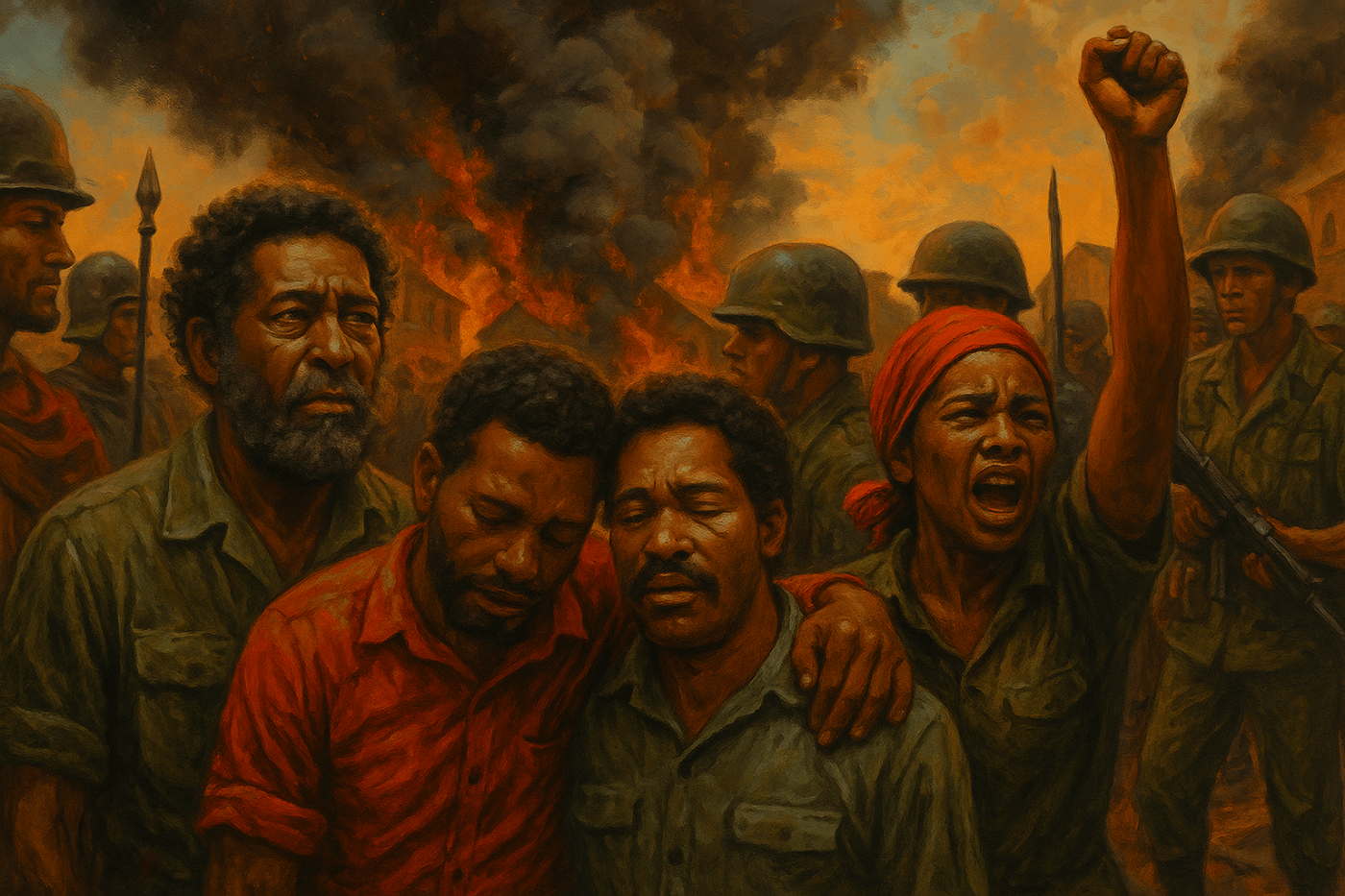
Maurice Bishop: The People’s Prime Minister of the Caribbean
Prologue: A Revolutionary Cut Down, A Flame That Never Died
In 1983, a Black socialist leader named Maurice Bishop was lined up against a wall by a U.S.-backed faction and gunned down. He was unarmed. He was beloved. And he had just begun building what many called “the most promising socialist experiment in the Western Hemisphere.”
Bishop was not a dictator. He was not a puppet. He was not a client. He was a revolutionary Caribbean man who walked the path of Fanon, Nkrumah, and Fidel—turning the tiny island of Grenada into a beacon of dignity, justice, and anti-imperialist transformation.
“It is better to die fighting on our feet than to live forever on our knees.”
— Maurice Bishop
I. The Making of a Revolutionary
Maurice Bishop was born in Aruba in 1944 to working-class Grenadian parents. He returned to Grenada as a boy and later studied law in London, where he was radicalized by the anti-colonial, Black Power, and Marxist movements erupting across Africa and the Caribbean diaspora.
Bishop returned home in the late 1960s to a Grenada ruled by Eric Gairy, a U.S.-backed strongman whose regime was infamous for repression, corruption, and the use of hired gangs known as the “Mongoose Gang” to silence dissent.
Bishop formed the Movement for Assemblies of the People (MAP), which would merge with the Joint Endeavor for Welfare, Education and Liberation (JEWEL) to form the New Jewel Movement (NJM) in 1973.
NJM was a Marxist-Leninist party committed to revolutionary democracy, mass education, self-reliance, and regional anti-imperialist solidarity. It was not a dogmatic party—it was pragmatic, people-centered, and deeply rooted in the material needs of Grenada’s workers and farmers.
“We are not building socialism from a textbook. We are building it with our people, brick by brick, mind by mind.”
— Bishop, 1980
On March 13, 1979, the NJM launched a bloodless armed insurrection. With the support of the people and elements of the military, Gairy’s regime was overthrown. The People’s Revolutionary Government (PRG) was formed, with Bishop as Prime Minister.
Grenada—small, Black, colonized, and proud—had just declared war on underdevelopment.
II. A Revolution in Action: Education, Health, Land, and Dignity
The People’s Revolutionary Government wasn’t just rhetoric—it was results. In four years, Maurice Bishop’s government transformed Grenada into a living example of what socialism from below could achieve, even on a small island with few natural resources and under constant threat.
1. Literacy and Education for All
Grenada’s adult literacy rate had been hovering around 60% under the colonial and neocolonial regimes. Bishop declared that ignorance was colonialism’s most potent weapon—and launched a mass literacy campaign that brought the rate above 90% in just a few years.
Free primary and secondary education was guaranteed. School enrollment jumped. Thousands of Grenadian youth were sent abroad—especially to Cuba—to study medicine, engineering, and pedagogy. Education was reoriented to serve development and liberation, not dependency.
“We are not educating our people to be servants in hotels. We are educating them to build a nation.”
— Bishop, 1981
2. Free Healthcare and Cuban Solidarity
For the first time in Grenadian history, healthcare was declared a human right. Clinics were built in rural areas. Preventive care and vaccination campaigns became standard. Infant mortality dropped. The number of trained doctors and nurses soared.
Cuba sent over 500 technicians, doctors, teachers, and construction workers to support the PRG’s development plans—including the construction of a new international airport to open Grenada to non-Western trade and tourism.
The U.S. would later claim this was a “Soviet military base.” In truth, it was an act of Afro-Caribbean solidarity built with bulldozers, not bombs.
3. Women’s Power and Legal Equality
Under Bishop’s leadership, the PRG passed laws ensuring equal pay for equal work, maternity leave, childcare support, and protections against sexual exploitation. Women were encouraged to participate fully in the revolutionary process—not just as helpers, but as leaders.
The National Women’s Organization mobilized tens of thousands of women across the island. They helped organize literacy drives, agricultural cooperatives, and neighborhood defense units.
4. Workers, Land, and Democratic Assemblies
Wages rose. Unemployment dropped. Workers gained the right to organize. Several abandoned estates were turned into agricultural cooperatives, boosting food security and reducing reliance on imperial markets.
The PRG established People’s Assemblies and Zonal Councils—direct democratic structures to allow mass participation in governance. Bishop called them “organs of people’s power.” They were messy. They were grassroots. They were revolutionary.
“Democracy is not about casting a vote every five years and being ignored. Democracy is about building power every day.”
— Maurice Bishop
5. Internationalism from Below
Grenada established formal alliances with Cuba, Nicaragua, Angola, the Soviet Union, and the Non-Aligned Movement. It supported anti-apartheid forces in South Africa, backed the PLO in Palestine, and condemned U.S. interventionism in Latin America.
And it terrified Washington.
Why? Because here was a small, Black, English-speaking island nation defying colonial dependency and winning. Bishop called it the “New Jewel”—and for the oppressed, it shined like one.
III. The Empire Strikes: The Murder of Bishop and the Invasion of Grenada
By 1983, the Grenadian Revolution was gaining momentum—but so were its internal contradictions. Tensions emerged within the New Jewel Movement between Bishop’s mass line, people-centered vision, and a more rigid Marxist-Leninist faction led by Deputy Prime Minister Bernard Coard.
The conflict wasn’t just ideological. It was about strategy, power, and the pace of the revolution. Coard and his allies believed Bishop was too soft—too willing to negotiate with sectors of society. Bishop believed in deepening mass participation before pushing more aggressive state restructuring.
In October 1983, a faction of the NJM placed Bishop under house arrest in a party coup. The people rose up. Tens of thousands took to the streets and freed him. Bishop returned to Fort Rupert—now the People’s Headquarters—where crowds gathered to defend the revolution and demand unity.
That same day, the army, still under Coard’s influence, stormed the fort. Bishop and seven of his closest comrades—including three cabinet members and union leaders—were captured. They were lined up against a wall and executed by firing squad.
“They didn’t just kill Bishop. They tried to kill the hope he represented.”
— Grenadian Worker, 1983
Within 48 hours, the U.S. launched Operation Urgent Fury. Over 7,000 U.S. Marines and Special Forces invaded Grenada on October 25, 1983—claiming to protect American medical students and prevent “a Cuban-Soviet beachhead in the Caribbean.”
In truth, it was a Cold War counterrevolution: a brutal act of imperialist revenge against an independent Black government that dared to build socialism in the Western Hemisphere.
The Legacy They Tried to Erase
The U.S. destroyed the People’s Revolutionary Government, disbanded the People’s Militia, and installed a puppet regime. Hundreds were arrested. Revolutionary infrastructure was dismantled. The literacy campaign was defunded. The airport was renamed.
Bishop’s name was removed from textbooks. But it was not removed from the people’s memory.
“They say Maurice Bishop is dead. But Maurice Bishop lives wherever people fight for bread, land, education, and power.”
— Walter Rodney Memorial Lecture, 1984
The Grenadian Revolution lasted just four years. But in that short time, it proved that even a small, poor nation—if armed with clarity, dignity, and revolutionary love—could stand upright in a crooked world.
 Weaponized Information
Leave a comment