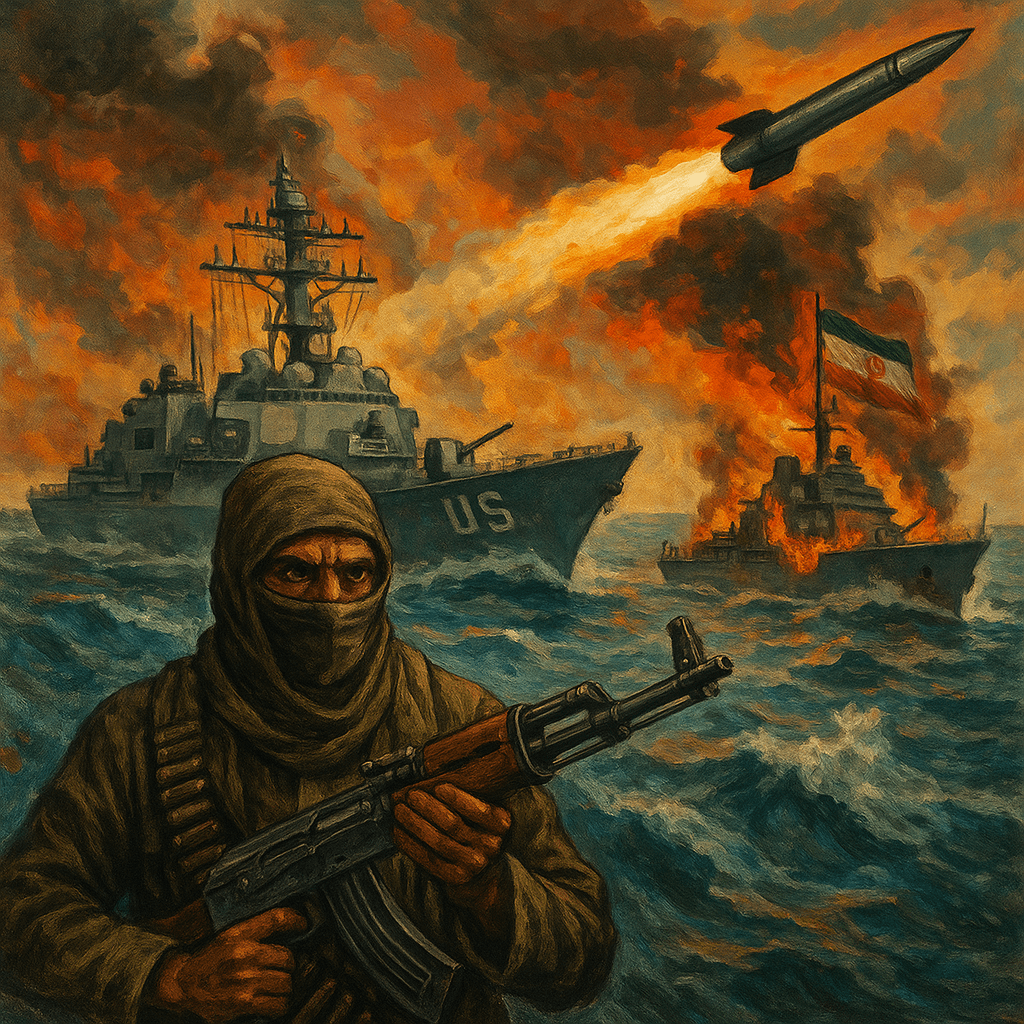
Excavating, dismantling, and reframing imperial propaganda in service of Yemen’s right to sovereignty, self-defense, and survival.
By Prince Kapone | Weaponized Information
May 2, 2025
I. The Script of Empire: How a Headline Manufactures Consent
The Jerusalem Post’s headline—“US forces intercept shipment of Iranian weapons smuggled to Houthis”—is doing ideological work from the very first word. Every term is carefully calibrated to fit the narrative of empire: that Yemen’s resistance is illegitimate, that Iran is a shadowy manipulator, and that U.S. military aggression is normal, necessary, protective. This is not journalism. This is narrative warfare.
Let’s start with the name: “Houthis.” The article never once refers to Yemen’s resistance by its chosen name: Ansarallah (أنصار الله, “Supporters of God”). The imperial lexicon reduces them to a sectarian slur, erasing their political and national identity, painting them as a tribal militia rather than a mass political movement leading Yemen’s defense against foreign aggression. This rhetorical reduction parallels the media’s refusal to name liberation movements across the Global South on their own terms—a familiar tactic deployed against Hezbollah, Hamas, and other anti-colonial forces labeled only by outsider-imposed designations.
Next comes the phrase “Iranian weapons.” No evidence is presented—no photographs, no serial numbers, no intercept logs. The sole attribution is “US sources” passed through Al Arabiya, Saudi Arabia’s state propaganda network. The article cites no independent investigation, no UN verification, no shipping records. Yet the claim is stated as fact. This phrase is meant to trigger the imperial narrative that Ansarallah is merely an Iranian proxy, a puppet rather than an autonomous revolutionary movement. It conditions readers to view any arming of Yemeni resistance as foreign interference, while erasing the reality of U.S.-supplied weapons raining down on Yemeni civilians for nearly a decade.
Finally, we come to “intercept.” The article frames U.S. military piracy as law enforcement. A U.S. warship seizing cargo in international waters is not an act of neutral security—it’s a textbook case of imperialist blockade and illegal maritime enforcement. But the headline sanitizes this aggression, normalizing an imperial “right” to control Red Sea shipping lanes, as if Washington is the natural arbiter of Yemeni borders and trade.
But the ideological work of this propaganda piece doesn’t stop at loaded language. The chain of sourcing itself is a propaganda mechanism: U.S. government sources leak to Saudi state media, which reports it through Al Arabiya, which is then picked up by Israeli media via The Jerusalem Post, from which it will circulate globally through wire services. At no point is independent verification inserted into the information chain. At every point, imperial-aligned regimes control the narrative flow. Each step adds the appearance of “journalistic distance” while reinforcing the same imperial story: Iran bad, Ansarallah illegitimate, U.S. military action justified.
Equally powerful is the article’s propaganda by omission. Missing entirely is any mention of the Saudi-led coalition’s bombing of Yemeni ports, schools, hospitals, and grain silos. Not a word is spared for the blockade-induced famine killing tens of thousands. No context is provided for why Ansarallah might seek weapons under conditions of siege and foreign occupation. The article mentions neither the United States’ role in refueling Saudi jets, providing targeting intelligence, or blocking peace negotiations. The silence is not incidental. It is ideological.
Let’s say it plainly: this article is not an isolated act of misinformation. It is part of an integrated imperial propaganda system designed to obscure U.S.-Saudi-Israeli aggression, delegitimize Yemen’s national liberation movement, and manufacture public consent for continued siege and war. Its headline is not just misleading—it is a weaponized narrative, firing ideological bullets in the service of empire.
II. Digging for Truth in a Minefield of Lies
The Jerusalem Post article offers no evidence, no verifiable facts, no documentation—only anonymous “US sources” funneled through Saudi state propaganda. And yet the claim is circulated as objective truth. To excavate what’s actually happening, we must peel away the propaganda and situate this story within the material reality of Yemen’s war and resistance.
First, let’s be clear: Ansarallah is not a foreign proxy. Ansarallah is a national liberation movement rooted in the Zaidi Shia communities of northern Yemen, emerging in the early 2000s in response to growing Saudi and U.S. interference in Yemeni affairs. They have fought not just against Saudi military aggression but against the imposition of neoliberal economic policies, foreign-backed puppet regimes, and cultural domination imposed by Wahhabi ideology from Riyadh. Their political program combines defense of Yemeni sovereignty, opposition to U.S. imperialism, and anti-Zionist solidarity with Palestine.
The framing of Ansarallah as a mere “Iranian proxy” functions ideologically to erase their grassroots legitimacy and political agency. It echoes the imperial playbook used against every anti-colonial resistance force in the region—from Hezbollah in Lebanon to Hamas in Gaza to the Iraqi Popular Mobilization Forces—painting them not as autonomous actors defending their homelands, but as pawns in a sectarian chessboard manipulated by Tehran. This narrative delegitimizes their struggle and seeks to justify foreign military intervention under the guise of “countering Iranian influence.”
Meanwhile, the article offers zero context about who is actually arming whom. While it wrings its hands over alleged Iranian weapons shipments, it says nothing of the billions in U.S. weapons sold to Saudi Arabia and the UAE, the bombs stamped “Made in USA” that have flattened Yemeni hospitals, schools, and marketplaces. It ignores the Pentagon’s role in refueling Saudi jets mid-air, providing targeting intelligence, and enforcing the naval blockade that has strangled Yemen’s economy and pushed millions to the brink of famine. By omission, the article constructs a narrative where the aggressors appear as victims and the besieged appear as criminals.
Even the alleged “intercept” must be contextualized. U.S. naval patrols in the Red Sea are not neutral law enforcement. They are the military enforcement arm of a genocidal siege against an entire population. The U.S. Navy operates as a de facto extension of Saudi Arabia’s blockade, cutting off Yemen’s access to food, fuel, medicine, and basic imports. By policing these waters under the banner of “intercepting Iranian arms,” the U.S. justifies its illegal maritime aggression under international law while reinforcing its imperial chokepoint strategy over the Bab al-Mandeb Strait.
Far from being a neutral act of arms control, such intercepts are part of a broader campaign of economic strangulation and military coercion designed to break Yemen’s resistance by any means necessary. And even if a shipment of weapons were seized, international law recognizes the right of occupied and besieged peoples to acquire arms in self-defense. The real illegality is not the weapons Ansarallah might seek—it is the war being waged against Yemen by foreign powers seeking to crush its sovereignty.
In this context, the Jerusalem Post article functions not as journalism, but as an ideological smokescreen. It shifts the focus away from the aggressors, absolving the U.S. and Saudi Arabia of their crimes, and redirects attention onto Yemen’s resistance, framing them as the sole threat to “stability.” It conceals the reality of imperial warfare under the fog of selective outrage and false neutrality. And by framing Ansarallah solely through an “Iran proxy” lens, it denies the Yemeni people’s right to resist occupation and blockade on their own terms.
III. Reframe: The Struggle for Sovereignty and the Lie of Iranian Puppetry
Strip away the propaganda, and what remains is a simple truth: Yemen is under siege because it dared to chart an independent course. The Jerusalem Post’s narrative, echoed through U.S. and Saudi media, is designed to obscure this reality. It reduces Ansarallah—a complex, indigenous political movement—into nothing more than a puppet dancing on Tehran’s strings. But Ansarallah’s roots stretch far deeper than any alliance with Iran, and its struggle is not a proxy war but a battle for Yemen’s sovereignty, dignity, and survival.
Ansarallah was born not in the halls of a foreign ministry, but in the mountains and villages of northern Yemen, where generations of political exclusion, economic marginalization, and Saudi-backed cultural domination laid the foundation for rebellion. From its earliest days, the movement articulated demands that were unmistakably Yemeni: the right to political participation, the end of foreign interference, the preservation of Zaydi religious and cultural identity, and the restoration of national sovereignty. To call this a mere Iranian export is not just inaccurate—it is an insult to the lived experience of millions of Yemenis who rallied behind its banners long before any foreign weapons crossed a border.
Yet the “Iranian proxy” narrative persists because it serves empire’s needs. If Ansarallah is framed as a foreign implant, then the war waged against them can be cast as a war of regional containment, not colonial domination. It transforms a war of aggression into a necessary act of defense. It erases the agency of the Yemeni people and transforms them into pawns to be moved, removed, or sacrificed depending on imperial interests. This is not a new rhetorical trick—it is the same script used to delegitimize every anti-colonial struggle from Algeria to Vietnam to Palestine. To recognize Ansarallah as a legitimate Yemeni force would be to admit that Yemen’s war is a war against sovereignty itself, a war of recolonization waged through bombs, blockades, and diplomatic siege.
The imperial narrative also pivots attention away from the real arms pipeline flooding the region. While headlines scream of alleged Iranian smuggling, they remain silent about the tens of billions in U.S. and European weapons that have armed Saudi Arabia, the UAE, and their coalition partners. They do not mention the U.S.-manufactured bombs that have reduced schools, hospitals, marketplaces, and water treatment plants to rubble. They do not mention the targeting intelligence, mid-air refueling, and logistical support provided by Washington to ensure the smooth execution of Saudi airstrikes. This silence is no accident—it is an erasure of complicity. In this narrative, imperial violence disappears, while the resistance to that violence is criminalized and foreignized.
But the hypocrisy runs even deeper. The same empire that claims Ansarallah has no right to acquire arms is the empire that has militarized every aspect of the Yemeni conflict. The same naval blockade that chokes Yemen’s ports is enforced by U.S. warships under the banner of “interdicting Iranian weapons.” The same military-industrial complex profiting from the siege condemns the besieged for seeking any means of defense. In reality, it is not Ansarallah’s arming that is illegal—it is the war being waged against them. Under international law, occupied and blockaded peoples have the right to resist, by any means necessary. Yemen’s right to self-defense did not evaporate because Washington or Riyadh declared it inconvenient.
Reframing this narrative requires restoring the dignity and political subjectivity of the Yemeni people to the center of the story. Ansarallah is not a puppet; it is an expression of national resistance that emerged in response to decades of betrayal by foreign-backed regimes, economic plunder, and cultural humiliation. Its war is not a war for Iran—it is a war for Yemen’s ability to determine its own destiny, free from Saudi tutelage and U.S. control. And every attempt to delegitimize that struggle by reducing it to a sectarian or geopolitical proxy fight serves only to obscure the colonial contradiction at the heart of the conflict: that Yemen’s sovereignty remains intolerable to empire precisely because it stands in defiance of imperial order.
In this light, the intercepted weapons narrative dissolves into what it always was: an ideological diversion, a manufactured scandal to justify ongoing siege and aggression. The real scandal is not that Ansarallah might seek arms to defend their homeland—it is that they are forced to resist an imperial war machine backed by some of the world’s most powerful military and economic forces. The real scandal is that Yemen has been subjected to a genocidal blockade designed to starve its population into submission. And the real threat, in the eyes of empire, is not Iranian influence—it is Yemeni independence.
IV. Mobilize: From Exposure to Action—The Global Task of Solidarity
We cannot stop at deconstructing imperial lies. We must convert that clarity into revolutionary commitment. To read the Jerusalem Post’s propaganda and merely scoff is not enough. The task before us is to build material solidarity with Yemen’s struggle, to expose the complicity of our own governments, and to amplify the Yemeni people’s right to resist by any means necessary.
Ansarallah’s fight is not isolated. It is tied to every struggle against imperialism’s chokeholds—whether those chokeholds take the form of bombs, blockades, debt traps, or digital warfare. Yemen is not a footnote in U.S. foreign policy; it is a frontline in the global war against sovereignty. And as such, it demands a global front of resistance.
Our first responsibility is to shatter the media silence that cloaks this war. Every newsroom that parroted U.S. and Saudi claims without evidence, every headline that framed Yemen’s resistance as terrorism, every think tank that called for more sanctions and more siege—these are not neutral actors. They are amplifiers of empire’s war. We must confront them with facts, with organized disruption of their narrative control, and with a militant refusal to let their lies go unchallenged.
But propaganda does not operate in a vacuum. Behind every lie is a material interest. Every time a newspaper repeats “Iranian proxy,” a weapons manufacturer in the imperial core makes another sale. Every time the narrative demonizes Ansarallah, the blockade deepens, the bombs keep falling, and the profits keep flowing. We must not only attack the ideological infrastructure—we must expose and target the economic relationships that sustain this war. That means identifying the arms dealers, the shipping companies, the logistics firms, the diplomatic enablers, and organizing campaigns to disrupt and delegitimize their operations.
We must also learn from the resistance. Yemenis have shown a resilience that defies imperial expectation. Their survival under siege is not just a humanitarian miracle—it is a political statement: that even in the face of overwhelming force, a people can refuse to surrender. Their struggle belongs to the lineage of every colonized people who fought blockades with ingenuity, every besieged community that found ways to survive and fight back when the empire tried to starve them into submission. We have a duty to study their methods, uplift their voices, and draw strategic lessons for our own conditions.
Finally, we must internationalize the Yemeni struggle within a broader anti-imperialist movement. Yemen’s fate is intertwined with the fate of Palestine, of Syria, of Iran, of Venezuela, of every nation targeted by sanctions, military aggression, and financial warfare. The same drones that fly over Saada fly over Gaza and Baghdad. The same naval blockades enforced against Yemen patrol the waters of the Caribbean and the Persian Gulf. We must build connections across these theaters of struggle, forging solidarity not as charity, but as co-resistance against a shared enemy.
In the face of propaganda, our answer is clarity. In the face of blockade, our answer is material solidarity. In the face of imperial siege, our answer is organized, uncompromising, revolutionary struggle. Yemen’s cry for sovereignty echoes far beyond its borders. It is a cry that calls to all who still believe in the right of peoples to determine their own destiny. Our task is to answer that call—not with words alone, but with action.
 Weaponized Information
Leave a comment