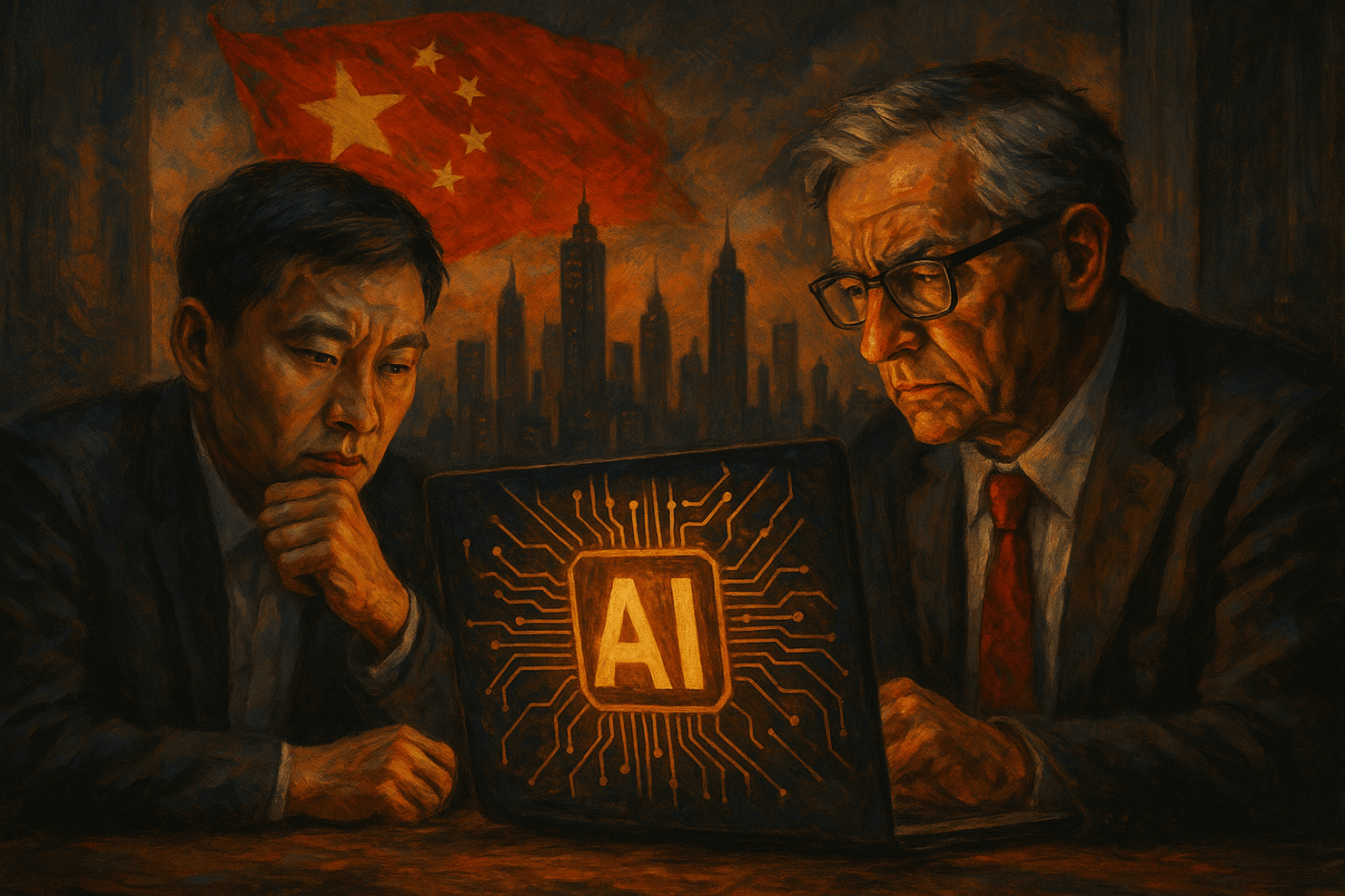
Dissecting the ideological work of empire’s tech war propaganda: how a book review becomes a weapon against sovereignty
By Prince Kapone | Weaponized Information | May 2, 2025
I. The Pen of Empire: How a Book Review Becomes a Weapon
Kyle Chan’s review of Eva Dou’s House of Huawei in Phenomenal World isn’t just a book review—it’s an instrument of imperial propaganda, dressed in academic prose. Every sentence functions like a quiet ideological incision: sliding suspicion beneath admiration, embedding doubt within description, normalizing U.S. aggression as a defensive posture. This isn’t scholarship—it’s narrative warfare.
The framing begins with the title itself: “Huawei the Hydra.” The hydra isn’t a neutral image. It conjures mythological menace, a monster whose heads regrow when cut, evoking chaos, danger, and an enemy too sprawling to contain. It primes the reader to view Huawei’s rise as unnatural, threatening, invasive. From the first headline, Huawei is coded not as a firm, but as a beast—a creature whose very existence justifies containment, decapitation, eradication. That metaphor isn’t analytical. It’s ideological work, laying the narrative groundwork for sanctions, blacklists, and tech warfare to be read as necessary acts of self-defense.
Throughout the review, Chan meticulously chronicles Huawei’s achievements—its transformation from a phone switch supplier to a global telecom giant; its role in China’s Digital Silk Road; its production of AI chips and 5G infrastructure. But every achievement is paired with a footnote of suspicion. Every milestone is shadowed by Western anxieties: accusations of intellectual property theft, reminders of surveillance claims, invocations of Huawei’s contracts in “countries viewed warily by the West.” The review doesn’t openly indict Huawei—it simply never allows its victories to stand uncontested by doubt.
This is a subtle but powerful ideological mechanism. Rather than denounce Huawei outright, the review embeds imperial narratives as framing devices. It describes Huawei’s R&D breakthroughs while pairing them with disclaimers about espionage. It recounts Huawei’s global market share gains while interjecting reminders of national security risks. It cites Huawei’s domestic industrial policy support while portraying it as the mobilization of state power outside imperial norms. In this way, the review teaches readers not to celebrate Huawei’s rise as sovereign technological development, but to view it as a problem, a red flag, a sign of something suspect beneath the surface.
And that’s the heart of its ideological function: to make empire’s aggression appear reasonable. To make U.S. sanctions seem like regrettable but necessary protections. To render the imperial project invisible, while casting sovereign development outside imperial control as inherently suspicious. It’s propaganda by omission, by tone, by framing. And Phenomenal World—by platforming Eva Dou’s framing through Chan’s review—acts here as an unwitting amplifier of this ideological apparatus, smuggling imperial discourses beneath the veneer of heterodox critique.
Make no mistake: this review isn’t neutral. It doesn’t simply report facts. It organizes facts around an imperial lens, curating which stories to elevate, which histories to omit, and which interpretations to naturalize. And in doing so, it performs the ideological work of empire: teaching readers to doubt multipolar sovereignty, to view Chinese technological breakthroughs as destabilizing, and to accept U.S. tech war escalation as inevitable governance. That is its propaganda function. And that is why it must be exposed, dismantled, and rejected.
II. Huawei’s Rise: The Facts the Empire Fears
Strip away the imperial framing, and the facts tell a different story. Huawei’s ascent is no accident. It is the product of decades of Chinese industrial policy, sovereign state planning, and relentless technological capacity-building. From the 863 Science and Technology Program to Made in China 2025, China has systematically worked to overcome technological dependency imposed by imperialist monopolies. Huawei’s trajectory—from a telephone switch supplier in 1987 to a global telecom giant, AI hardware producer, and 5G leader—is a testament to sovereign development under socialism with Chinese characteristics.
The review acknowledges this history in passing, but never centers it. Instead, it dilutes the meaning of Huawei’s breakthroughs by embedding them in a narrative of suspicion: the company’s international expansion is framed through its deals with “countries viewed warily by the West”; its R&D partnerships are shadowed by accusations of intellectual property theft; its success is punctuated by reminders of surveillance claims, sanctions, and Western bans. Every achievement is paired with a footnote of distrust, every milestone shadowed by imperial paranoia.
But let’s be clear: Huawei’s global expansion was not a covert plot. It was the result of superior products, sovereign financing (via China Development Bank’s $10 billion line), and a strategic commitment to breaking Western telecom monopolies. Its partnerships with universities, its development of undersea cables connecting continents, its AI chip production in defiance of U.S. embargoes—these are not signs of criminality. They are signs of multipolar sovereignty asserting itself in the digital infrastructure of the world.
And that’s what empire fears. Not theft. Not infiltration. Sovereignty. The possibility that a nation outside imperial control can build, connect, and lead without asking permission from Washington or Brussels. That’s the real “threat” Huawei represents to the imperial order.
III. The Real Hydra: Empire’s Chokepoint Strategy
The review’s title, “Huawei the Hydra,” is an ideological sleight of hand. It projects monstrosity onto Huawei while ignoring the real hydra in the room: U.S. imperialism’s sprawling apparatus of digital domination. From the NSA’s global hacking operations (including its infiltration of Huawei servers, exposed by Edward Snowden), to the weaponization of semiconductor embargoes, to the militarization of undersea cables and satellite networks, it is the U.S. that deploys a hydra-headed system of surveillance, sabotage, and coercion to preserve its decaying monopoly over global infrastructure.
Huawei’s rise is not an aberration—it is a rupture in this imperial chokehold. That’s why empire struck back. Trump’s 2019 Entity List designation wasn’t a defense of “security”—it was an act of economic warfare. The ban on TSMC supplying chips to Huawei wasn’t about “risk mitigation”—it was an imperialist recalibration to block sovereign tech development. Every sanction, blacklist, and export control is a node in the imperial chokepoint strategy, weaponizing control over semiconductors, AI hardware, telecom systems, and digital infrastructure to coerce rivals and suppress multipolarity.
Yet the review never names this strategy. It never questions the legitimacy of the sanctions. It never interrogates the imperial prerogative to dictate who may or may not develop core technologies. Instead, it treats U.S. aggression as a given, a neutral backdrop, a regrettable necessity. That silence is complicity. That omission is ideology. That’s the function of enemy propaganda: to narrate imperial war as inevitable governance.
IV. The Task Before Us: Tell the Truth, Fight the Lie
We won’t be seduced by liberal prose or academic neutrality. We see the lie for what it is. The U.S. tech war against Huawei is not a conflict between equals. It is an imperialist assault on sovereign technological development. It is part of the broader war against multipolar sovereignty, a front in the struggle between empire and emancipation. Huawei is not perfect, nor without contradiction—no state-owned firm is. But its breakthroughs are not crimes. Its rise is not theft. Its success is not a scandal. It is a product of sovereign industrial development in a world still dominated by imperial monopoly and coercion.
We stand with sovereignty. We stand with multipolarity. We stand with every struggle to break the imperial stranglehold over technology, resources, and development. And we reject every narrative that cloaks imperial aggression in the language of “security” and “trust.” Kyle Chan’s review, Eva Dou’s framing, the Washington Post’s reporting, the Western policy elite’s drumbeat of suspicion—this is enemy propaganda, designed to manufacture consent for economic warfare, tech blockades, and imperial sabotage. We name it. We expose it. We dismantle it.
The real hydra is empire. And it is empire, not Huawei, that must be slain.
 Weaponized Information
Leave a comment