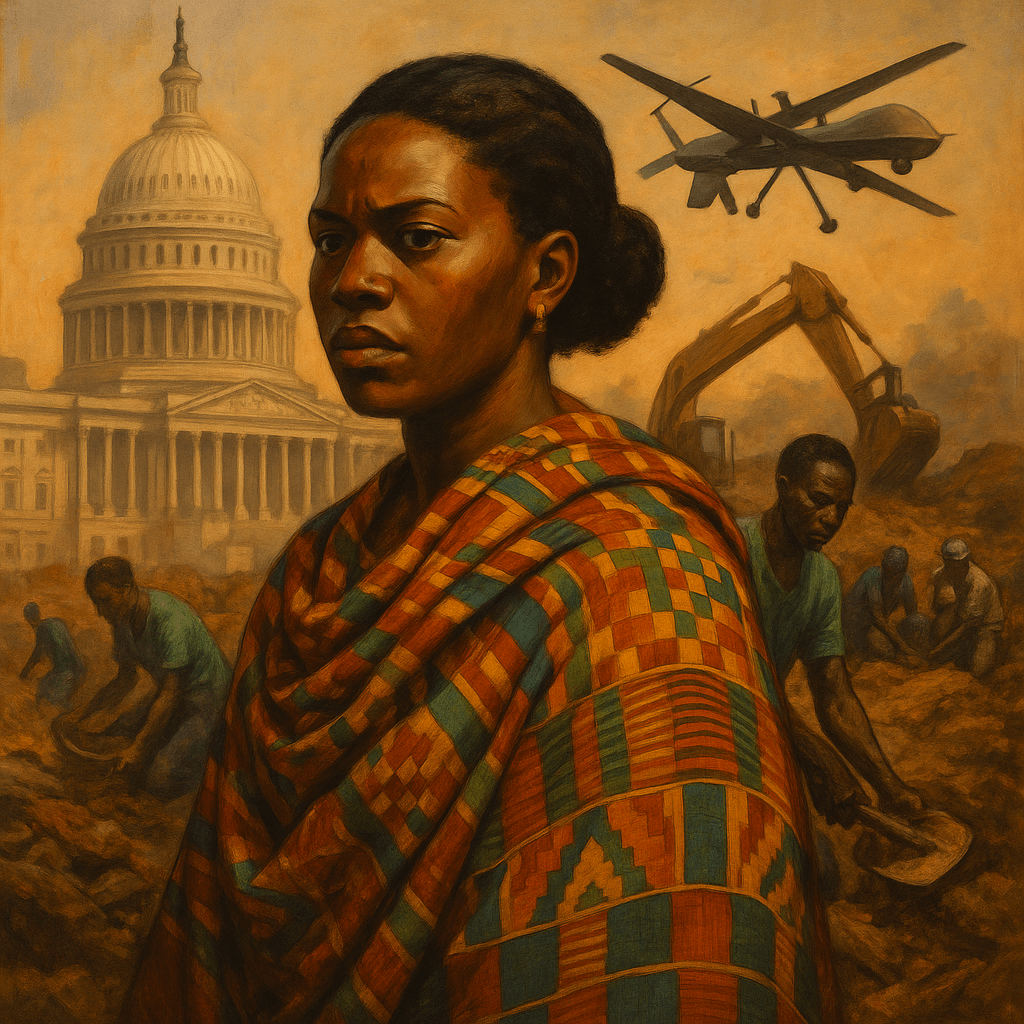
How the Atlantic Council’s “diaspora engagement” strategy extends technofascist imperialism through culture, business, and identity politics
Prince Kapone, Weaponized Information | May 2, 2025
I. Digging Up the Empire’s New Script
The Atlantic Council wants us to believe it’s discovered a new path to U.S.-Africa “engagement.” In a recent article by Kirstie Kwarteng, they pitch a plan that sounds empowering on the surface: mobilize the African diaspora to forge deeper economic and cultural ties with the continent. Words like “identity,” “entrepreneurship,” “mutual growth” dance across the page, cloaked in liberal optimism. But if you’ve been paying attention, you know better. This isn’t a fresh start—it’s a new mask for the same empire we exposed in Rubio’s Africa Blueprint: A Technofascist Upgrade.
Back then, we showed how Trump’s blunt-force dismantling of diplomacy gave way to Rubio’s more sophisticated model: embedding U.S. military, intelligence, and economic control into every fiber of African governance. This article isn’t separate from that project—it’s the soft-power front, offering culture and commerce where Rubio offered bases and supply chains. Together, they form a single imperial recalibration: one hand outstretched with a handshake, the other clinched in a fist.
The Atlantic Council is no neutral observer. It’s an imperial think tank, funded by weapons contractors, banks, oil giants—the same names profiting off war, extraction, and destabilization. By platforming Kwarteng’s proposal, they aren’t amplifying an innocent academic—they’re using her to wrap empire in kente cloth. The beneficiaries aren’t African communities or diasporic solidarity networks. The beneficiaries are U.S. capital, Wall Street investors, AFRICOM planners, and every corporate boardroom salivating over Africa’s natural resources and markets.
Look at the article’s framing. Diaspora businesses are cast as saviors: stepping in where remittances decline, where aid dries up, where traditional U.S. influence wanes. But notice what’s missing: no mention of African sovereignty, no acknowledgment of the role U.S. policy has played in underdeveloping the continent, no critique of the global capitalist structures that created these crises in the first place. Instead, the diaspora is offered up as a friendly middleman—an intermediary class to manage U.S. influence under the guise of “cultural connection.”
It’s a clever move. The article celebrates diaspora consumption—of music, fashion, tourism—as inherently empowering. But consumption without struggle is a dead end. Streaming Afrobeats isn’t the same as building Pan-African solidarity. Booking a culinary tour isn’t the same as confronting AFRICOM. By collapsing solidarity into spending, and belonging into branding, the article turns diasporic identity into an economic pipeline flowing back into empire’s hands. And every “opportunity” offered comes stamped with a U.S. trade deal, a Chamber of Commerce contract, a foreign direct investment clause. This is not partnership—it’s recolonization with better PR.
II. Pulling the Mask Off: What’s Really Going On
Kwarteng’s proposal orbits what she calls the “digital identity economy.” Translation: using apps, festivals, fashion, and platforms to connect diasporans to Africa through business and culture. It sounds harmless, even hopeful. But every example she cites—language apps, fashion brands, culinary tours, music festivals—points to the same pattern: funneling diasporic pride into controlled markets, platforms, and investment streams aligned with U.S. capitalist interests.
The policy recommendations make it plain. The U.S. should recognize diaspora investment as foreign direct investment. It should create post-AGOA trade policies centered on diaspora entrepreneurs. It should mobilize U.S. Chambers of Commerce to “connect” diaspora businesses with Africa’s economy. This isn’t about helping African economies stand on their own—it’s about embedding diaspora businesses into U.S.-mediated trade frameworks, making sure every dollar, every contract, every partnership flows through Washington-approved channels. It’s imperial plumbing with cultural wallpaper.
This isn’t new. We’ve seen it before. During the Cold War, the U.S. used scholarships, fellowships, and NGO funding to cultivate a pro-Western elite class across Africa. Now, facing a rising China, an expanding BRICS+, and growing multipolar defiance, the empire is pivoting again. Hard power remains—AFRICOM’s bases aren’t going anywhere—but it needs soft power to finish the job. Diaspora engagement becomes the velvet glove covering the iron fist.
In this light, Kwarteng’s article isn’t a benign cultural proposal. It’s the ideological wing of technofascist imperial recalibration. Just as Rubio’s Africa blueprint fused military, economic, and digital control, the Atlantic Council’s diaspora plan fuses identity, business, and culture into empire’s circuits. It doesn’t challenge imperialism—it integrates the diaspora into it, recruiting identity itself as an instrument of imperial maintenance.
III. Telling It Straight: This Ain’t Liberation
From the side of Africa’s working classes, peasants, and revolutionary forces, this isn’t empowerment. It’s recruitment. The “digital identity economy” is not a neutral playground for cultural pride. It’s a market designed to transform diasporic longing into commodities, diasporic culture into branded exports, and diasporic entrepreneurs into compliant brokers for imperial capital. Every festival, every tour, every brand name lauded in the article is an ideological checkpoint, redirecting diasporic energy away from solidarity and into consumption pipelines managed by empire.
This is technofascism’s soft power apparatus at work: empire embedding itself not through occupation but through curated playlists, fashion logos, and networking events hosted by U.S. embassies. It’s the ideological counterpart to the militarized blueprint we analyzed under Rubio: a hybrid control system where culture, capital, and coercion work hand in hand. And at its center is a class contradiction the article never names: diaspora elites are not automatically allies of Africa’s oppressed. Their proximity to capital, to policy circles, to U.S.-aligned trade makes them vulnerable to co-optation. A diaspora aligned with empire won’t free Africa—it’ll decorate its chains.
True diaspora solidarity can’t be routed through U.S. think tanks or Atlantic Council strategy sessions. It must stand with the oppressed, not the oppressors. It must build horizontal networks of struggle, not vertical chains of investment. It must treat diaspora culture not as a product to sell, but as a weapon to wield in the fight for liberation.
IV. The Real Task: Weaponizing the Diaspora for Liberation
We’ve seen a different kind of diaspora before. The kind that refused to serve empire’s interests. Malcolm X</strong forged Pan-African connections that bypassed U.S. diplomacy. Kwame Ture</strong carried Black Power beyond borders. Claudia Jones</strong built solidarity from the Caribbean to London’s working class. George Padmore</strong organized anti-colonial forces across continents. Their diaspora didn’t ask permission from Washington. It stood shoulder to shoulder with Africa’s freedom fighters, not its financiers.
That’s the lineage we honor. And that’s the side we choose. Diaspora solidarity must reject imperial recruitment pipelines: Atlantic Council fellowships, U.S.-backed diaspora councils, neoliberal entrepreneurship incubators. We must expose these initiatives for what they are: instruments of ideological capture, designed to embed diaspora elites into empire’s infrastructure. Instead, we need revolutionary diasporic networks committed to anti-imperialism, to solidarity with Africa’s popular struggles, to material support for grassroots movements resisting militarization, extraction, and recolonization.
The Atlantic Council wants a diaspora that serves as empire’s smiling mask. We say: absolutely not. The diaspora must be weaponized for Africa’s liberation—not empire’s recalibration. Every imperial blueprint must be met with a people’s blueprint: sovereignty, socialism, and solidarity across the South. Empire’s plan is clear. Ours must be clearer. And the time to act is now.
 Weaponized Information
Leave a comment