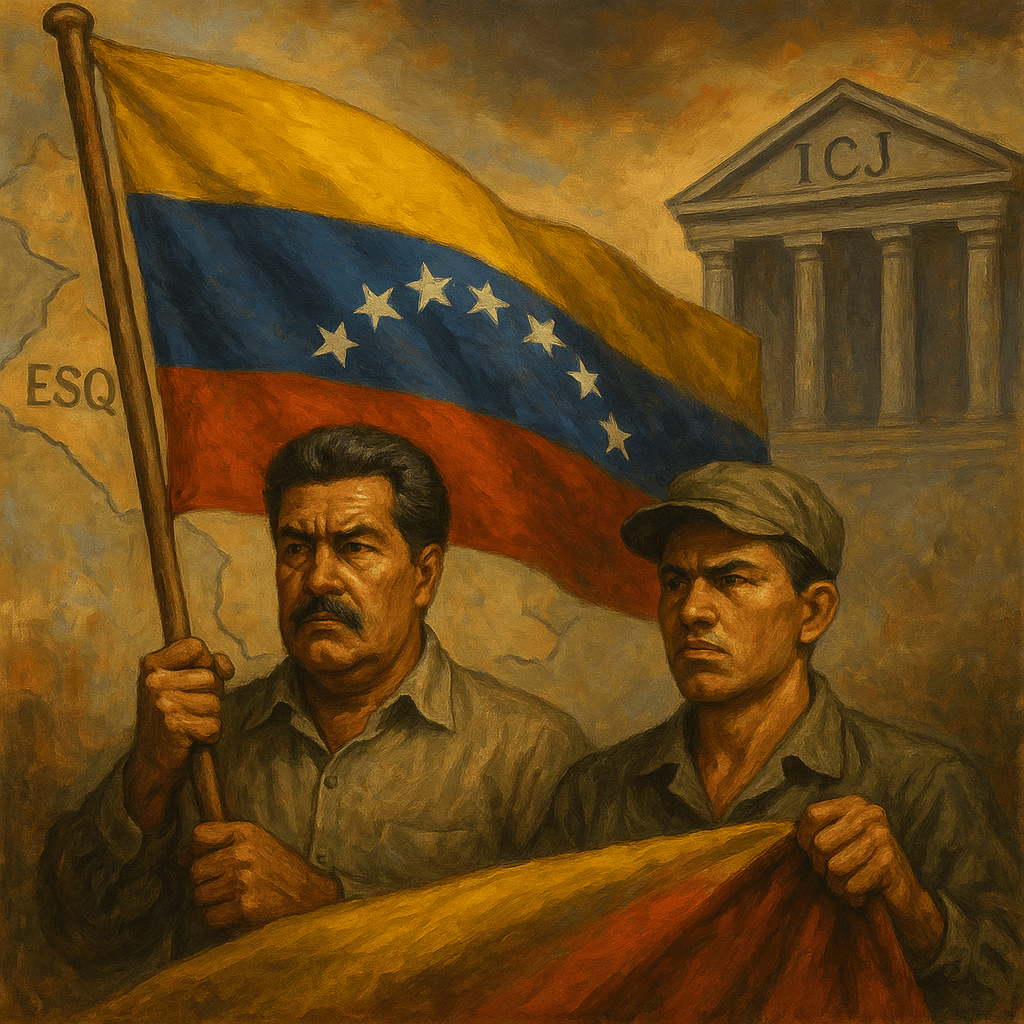
Deconstructing the Associated Press narrative and reframing Venezuela’s sovereignty struggle through the lens of revolutionary solidarity
By Prince Kapone | Weaponized Information | May 2, 2025
Excavating the Empire’s Narrative: The AP’s Framing and the Unspoken Hypocrisy
Read the Associated Press story and you’ll catch the quiet hum of empire’s propaganda machine, humming along as if it’s just the neutral sound of “objective” reporting. A few words here—“rejects,” “annex,” “disputed,” “illegal”—and already the battle lines are drawn. Venezuela isn’t a sovereign nation standing up for its historic claim; it’s an unruly trespasser refusing to obey the rules of the so-called international community. And the “international community”? That’s a euphemism for the very imperial powers that robbed the world blind and now pretend to referee the disputes they created.
The AP article does its work with surgical omission. It tells you Venezuela “rejected” the International Court of Justice ruling but won’t tell you why. It won’t tell you that Venezuela’s claim to the Essequibo predates ExxonMobil’s oil rigs or that the 1899 arbitration awarding the territory to Britain was a colonial swindle rubber-stamped without Venezuela’s consent. It won’t tell you about the 1966 Geneva Agreement, where both Venezuela and newly-independent Guyana agreed to resolve the dispute bilaterally—no third-party court empowered to decide. It certainly won’t tell you that ExxonMobil is practically governing Guyana’s oil policy like a colonial viceroy with a Chevron logo.
But most damningly, the AP won’t tell you that the United States itself rejects the jurisdiction of the ICJ over its own sovereignty. When the ICJ ruled in 1986 that Washington had violated international law by mining Nicaragua’s harbors and funding the Contras, the U.S. responded by withdrawing from the court’s compulsory jurisdiction. To this day, the U.S. refuses ICJ rulings that touch its empire’s crimes. Yet here it stands, wagging its finger at Venezuela for doing exactly what it does: defending sovereignty against an imperial tribunal rigged in favor of the powerful. The hypocrisy isn’t a glitch—it’s the imperial playbook, printed in the same ink as every U.S. military base and every IMF loan document.
This omission isn’t journalistic sloppiness—it’s narrative warfare. Because to explain Venezuela’s legal position, its referendum, its invocation of popular sovereignty, would be to admit that the Bolivarian Revolution still holds a flame of anti-colonial defiance in a region long strangled by U.S. hegemony. It would mean recognizing that Venezuela isn’t trying to expand its borders like some cartoonish aggressor, but is upholding a historic claim embedded in the anti-colonial struggle of Latin America itself. The AP won’t tell you that, because that would mean questioning the very rules of the imperial game—and if you question those, you might start questioning who the referees really serve.
Extracting the Material Truth: Oil, Empire, and the Battle for Essequibo
To understand what’s really at stake in Essequibo, we have to rip off the polite veil of “territorial dispute” and expose the raw material interest pulsing beneath. This isn’t about a strip of jungle or a colonial map gathering dust in a European archive. It’s about oil. It’s about resources. It’s about ExxonMobil sinking its steel fangs into Guyana’s offshore fields while the U.S. military hovers nearby, ready to enforce corporate extraction under the banner of “regional security.”
Since ExxonMobil’s discovery of massive oil reserves off the Essequibo coast in 2015, Guyana has been transformed from a poor, peripheral state into the latest outpost of petrodollar imperialism. Contracts signed in secrecy. Royalties skewed to favor the corporation. Environmental risks buried under PR. And looming behind it all, the quiet collusion of Washington, ensuring that Guyana becomes Exxon’s gas station and America’s geopolitical pawn in South America’s northern arc. The AP article won’t tell you that, of course. Instead, it parrots the narrative of “international law” and “territorial integrity” while the oil rigs multiply like colonial fortresses in contested waters.
Venezuela’s claim to Essequibo is older than Exxon’s stock ticker, older than Guyana’s independence, older than the very tribunal that handed Britain the territory in 1899. The Bolivarian government isn’t inventing a pretext for expansion—it’s holding onto a historic grievance rooted in colonial theft. And when Venezuela held its December 3 referendum—asking the people themselves whether to affirm sovereignty over Essequibo—it wasn’t a military provocation. It was participatory democracy wielded as a shield against imperial oil interests. Ten million Venezuelans voted. That’s more democratic input than most U.S. citizens ever get on where the Pentagon stations its troops or where Exxon drills its wells.
The AP article erases this democratic mandate. It treats the referendum as a threat, not an affirmation. It ignores the fact that the U.S., Britain, and Exxon have all rejected Venezuela’s diplomatic overtures, ignored the 1966 Geneva Agreement, and pushed the dispute into international courts stacked by the same colonial powers who drew the original map with imperial pens. And while the AP frames the ICJ as a neutral arbiter, it says nothing of how the same court has routinely shielded the crimes of imperial states—whether ignoring Israeli occupation or failing to enforce rulings against U.S. aggression.
This isn’t a border dispute between equals. It’s a battle between a besieged revolution and a corporate-military alliance using lawfare, narrative warfare, and military intimidation to enforce capitalist plunder. Essequibo is not just a map—it’s a resource node in the machinery of imperialist recalibration, a chokepoint in the empire’s hemispheric strategy to reassert control over Latin America’s energy future. Venezuela’s struggle here is part of the same war being waged against Bolivia’s lithium, against Cuba’s sovereignty, against Nicaragua’s independence. The same war, the same playbook, different front lines.
By stripping away the propaganda, by situating Essequibo within the history of colonial theft and capitalist extraction, we see the truth the AP cannot report: Venezuela’s fight is not an act of aggression—it’s a defense of sovereignty in the face of imperial siege. And every headline that frames it otherwise is an ideological bullet aimed at softening the world for the next Exxon-backed military maneuver, the next IMF pressure tactic, the next diplomatic isolation scheme. This isn’t about international law. It’s about who gets to write the law—and who gets to break it with impunity.
Reframing the Narrative: Sovereignty, Self-Determination, and the Siege of Venezuela
Let’s call it what it is: Venezuela is not the aggressor here—it is the besieged. While Western headlines conjure images of a reckless, expansionist state trying to “annex” Guyana, the truth is that Venezuela is defending a historical claim rooted in anti-colonial struggle, not empire-building. What the empire cannot tolerate is not Venezuela’s borders—it’s Venezuela’s stubborn refusal to submit. The referendum wasn’t an act of war; it was an act of popular sovereignty. And that is precisely what makes it dangerous to the imperial order.
Imagine, if you will, a world where ordinary people are allowed to vote—not just on politicians or ballot measures, but on the very land they walk, the resources beneath their soil, the future of their communities. That’s what the Venezuelan referendum represents: not a bureaucratic maneuver, but a mass assertion that sovereignty doesn’t belong to technocrats in The Hague or oil executives in Houston—it belongs to the people. And the empire knows that if that idea spreads, it threatens the entire neoliberal project, where borders are open for capital but closed for self-determination.
The Associated Press won’t tell you that. It can’t. Because to tell that story would mean admitting that Venezuela, despite sanctions, sabotage, and siege, is still practicing a form of participatory democracy that puts most Western liberal states to shame. It would mean admitting that ExxonMobil’s drilling isn’t development—it’s plunder. That the ICJ’s jurisdiction isn’t neutral arbitration—it’s lawfare dressed in colonial robes. That the U.S. military presence in Guyana isn’t about defending sovereignty—it’s about securing oil for Wall Street and Washington’s war machine.
What the AP offers instead is a script recycled from every imperial playbook: criminalize the resistance, sanctify the client state, erase the corporation, sanctify the court, and bury the people’s voice under a mountain of diplomatic euphemisms. But here’s the revolutionary truth: Venezuela’s sovereignty is not a threat to peace—it’s a challenge to imperial peace, the “peace” of corporate plunder enforced by gunboats, courts, and press releases. And that peace was never meant for the Global South. It was meant for capital.
We’ve seen this script before. We saw it in Palestine, where the ICJ’s rulings against occupation were ignored while bulldozers flattened homes. We saw it in Iraq, where oil contracts were signed in Washington long before the first bomb dropped. We saw it in Haiti, where every elected leader who challenged foreign control was met with coups, sanctions, and assassinations. Venezuela’s struggle over Essequibo is cut from the same cloth. And the empire’s panic is not about maps—it’s about sovereignty escaping their control.
So let’s be clear: when Venezuela rejects the ICJ’s jurisdiction, it is not rejecting international law—it is rejecting the weaponization of international law by the very powers who themselves refuse to be bound by it. The United States, after all, does not recognize ICJ rulings against its own crimes. Why should Venezuela be forced to obey rulings from a court stacked by the same empires that once drew the borders with blood and ink?
And when Venezuela affirms its claim to Essequibo, it is not launching an invasion—it is defending its history, its resources, and its right to self-determination. To stand with Venezuela is not to endorse militarism. It is to stand against Exxon’s extractive imperialism. It is to stand against U.S. militarization of Latin America. It is to stand with a besieged people demanding the right to decide their own future without the bayonets of empire pressed against their necks.
In the end, the struggle for Essequibo is bigger than a border. It is a struggle over who gets to control land, labor, resources, and sovereignty in a world still haunted by colonial theft. Venezuela’s stand is a reminder: sovereignty is not a gift from the imperial core. It is a fight. And every headline trying to convince us otherwise is part of the siege. But the siege is not destiny. The people have already spoken. And that is something no court, no oil company, and no empire can silence forever.
Instead, you get the headlines about “annexation,” the framing of Maduro as an expansionist strongman, the elevation of Guyana as the innocent underdog—never mind ExxonMobil’s fingerprints on every oil well in Essequibo, never mind the Pentagon’s quiet maneuvers alongside the Guyanese military, never mind the U.S. Southern Command salivating at a pretext to militarize another corner of Latin America. The AP’s story reads clean and calm, but it’s a weaponized narrative, every sentence an ideological bullet aimed at delegitimizing Venezuela’s sovereignty while laundering Exxon’s corporate plunder as lawful enterprise.
Mobilizing Solidarity: From Essequibo to Everywhere
We’ve dug up the lie. We’ve pulled the imperial narrative up by its roots. Now comes the most important question: what are we going to do about it?
The struggle over Essequibo is not a remote border dispute—it is a frontline in the global war against imperialism. It is a site where extractive capital, corporate media, colonial courts, and military muscle converge to discipline a sovereign state daring to assert control over its own resources. And if we fail to stand with Venezuela today, we concede the battle not just for Essequibo, but for every oil field, every mine, every river, every inch of land the Global South has fought to reclaim from the claws of empire.
Let’s be clear: solidarity with Venezuela is not charity—it’s revolutionary necessity. It’s recognizing that the same imperial machine waging war on Venezuela is the one extracting lithium from Bolivia, cobalt from the Congo, gas from Mozambique, and water from Palestine. It’s the same machine evicting tenants, busting unions, criminalizing protest, and feeding the prison-industrial complex right here in the heart of the imperial core. To stand with Venezuela is to stand against the entire architecture of exploitation that governs this world.
And that solidarity cannot be passive. It must be organized, deliberate, and materially grounded. It looks like pressuring our legislators to denounce U.S. military deployments in Guyana. It looks like calling out corporate media outlets—like the Associated Press—for laundering imperial propaganda while silencing Venezuela’s democratic processes. It looks like forging alliances with Latin American diaspora organizations, Black and Indigenous liberation groups, antiwar coalitions, and workers’ movements fighting the same enemy in different arenas.
It also looks like challenging the ideological battlefield. Every time someone parrots the line about “authoritarian Venezuela,” we must bring them the receipts: the referenda, the communal councils, the participatory budgeting, the grassroots planning. Every time someone calls the Essequibo claim “aggression,” we must show them the Exxon concessions, the U.S. military drills, the colonial history buried under legal jargon. Every time someone defends the ICJ as neutral, we must remind them: the same court that lectures Venezuela ignores U.S. war crimes, Israeli apartheid, and the theft of entire nations under colonial rule.
But more than anything, solidarity means learning from Venezuela’s example. Because what’s at stake here is not just a territory—it’s a vision of democracy we’re never supposed to see. A democracy where the people plan, where sovereignty means collective power, and where imperialism’s grip is not inevitable but breakable. The commune, the referendum, the mass mobilization around Essequibo—they are all part of the same revolutionary process: an unfinished, embattled, but living experiment in people’s power.
And if they can build it under sanctions, sabotage, and siege, what excuse do we have not to try? Venezuela’s struggle is not theirs alone—it’s the world’s. It’s ours. And as long as they keep building, as long as they keep fighting, as long as they keep dreaming, the empire will never have the final word.
We close this excavation with a simple truth, one empire fears most: Venezuela is not a pariah. It is not a rogue state. It is a beacon. A flawed, struggling, luminous beacon of what happens when the poor refuse to surrender. And that light will not be extinguished—so long as we carry it forward.
 Weaponized Information
Leave a comment