By Prince Kapone | Weaponized Information | May 1, 2025
I. Smokescreen Journalism: AP’s Imperial Psyop on Iran’s Port Explosion
Let’s get one thing straight from the jump: this Associated Press report isn’t neutral journalism—it’s a weapon. The headline reads like an investigation, but every paragraph is a bullet aimed at Iran’s sovereignty. Jon Gambrell, AP’s Gulf and Iran bureau chief, isn’t some detached observer; he’s the ideological stenographer of empire, translating Langley’s whispers into “breaking news.”
AP’s framing is textbook imperial propaganda. They connect the explosion at Iran’s Shahid Rajaei port to a charitable foundation tied to Supreme Leader Khamenei—but not because they’ve proven a damn thing. Instead, they string together half-facts, allegations from U.S. Treasury reports, and quotes from Washington’s favorite anti-Iran lobbyists to imply that Iran’s entire economy is a criminal front for “terrorism.”
Notice how every actor cited—the U.S. Treasury, “United Against Nuclear Iran,” Western security consultants—is a mouthpiece for U.S. foreign policy. Meanwhile, Iranian denials are buried in hedging language: “Iran says… officials claim… no official explanation offered.” That’s code for: “We don’t believe them.”
Even the chemical compound in question—ammonium perchlorate—is framed as proof of Iran’s missile ambitions, despite zero evidence linking the explosion to weapons production. The report’s sleight of hand: “Iran denies… but experts speculate.” AP doesn’t have proof; they have insinuation. And insinuation, in the propaganda playbook, is more useful than evidence.
They want you to see a mysterious explosion and immediately imagine missile fuel, terrorism, smuggling, and corruption. But what they don’t want you to see is the shadow of sabotage, the hand of empire squeezing Iran’s economy through sanctions, blockades, cyberattacks, and fifth-column subversion.
In this story, AP isn’t covering an explosion—they’re detonating a narrative bomb, meant to justify continued economic war against Iran while masking imperial culpability.
II. Sabotage, Sanctions, and Sovereign Survival
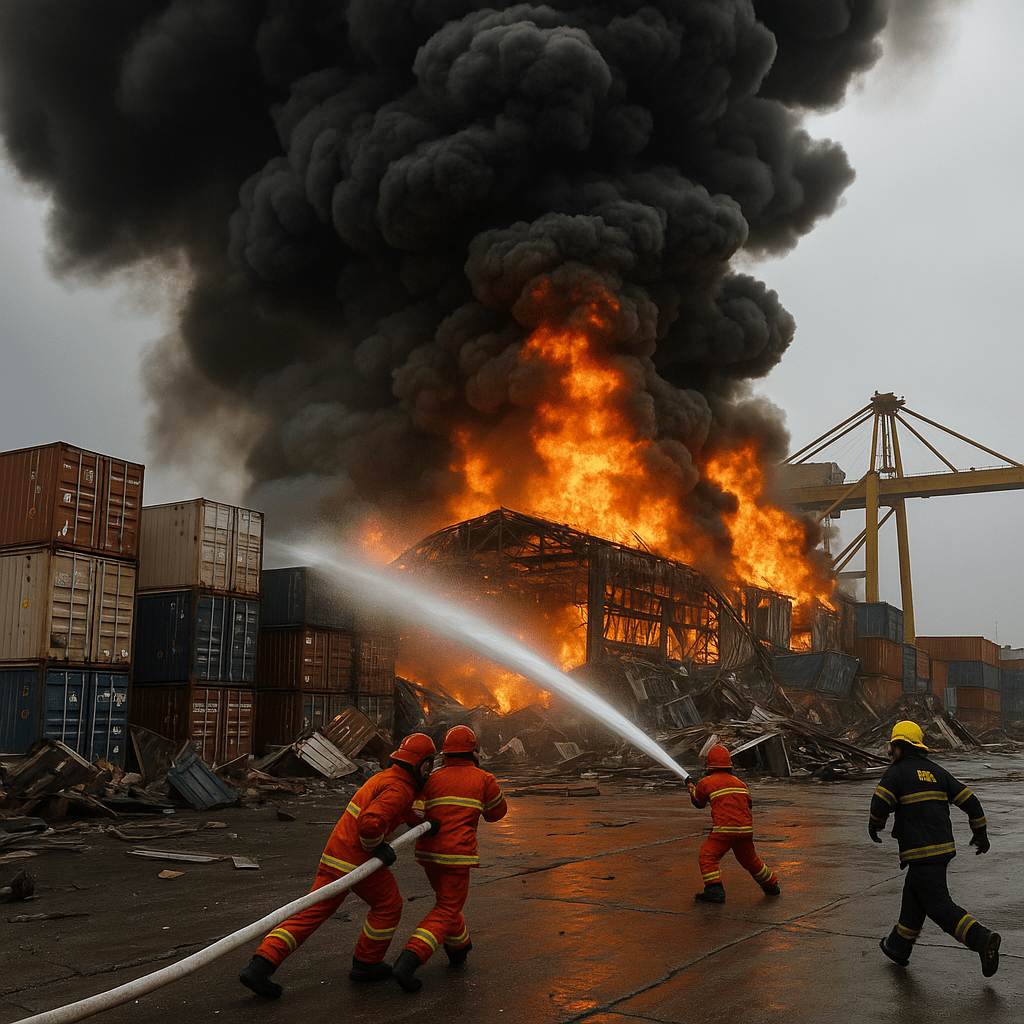
Strip away the AP’s smoke, and what’s left? A critical port in southern Iran—a lifeline for trade under siege—just suffered a catastrophic explosion, killing dozens and injuring over a thousand. The epicenter? A warehouse operated by Sina Port and Marine, a subsidiary of Bonyad Mostazafan: one of Iran’s largest economic foundations.
And here’s the real history: Bonyads like Mostazafan aren’t shady mafias—they’re revolutionary structures born from the ashes of Iran’s anti-colonial uprising. After the 1979 Revolution toppled the U.S.-backed Shah, the Islamic Republic seized the assets of foreign corporations, monarchist cronies, and comprador elites. These assets were reorganized under bonyads to redistribute wealth, fund development, and secure Iran’s independence from Western capital.
That’s what the empire hates. The problem isn’t “corruption”—it’s sovereignty.
The AP’s article conveniently omits the decades-long pattern of imperial sabotage targeting Iran’s economic infrastructure. From Stuxnet’s cyberattack on nuclear facilities to mysterious fires at industrial sites, to assassinations of scientists and engineers, the U.S.-Israel sabotage machine has waged a clandestine war to cripple Iran’s self-sufficiency.
Every explosion in Iran’s industrial heartlands must be read in this context: imperial sabotage cloaked in plausible deniability.
Yet the AP doesn’t even entertain this possibility. Not once. Their silence is loud.
Instead, they frame the explosion as a byproduct of Iranian incompetence, secrecy, or duplicity. They invoke ammonium perchlorate to imply missile fuel storage, then step back—letting the association linger without proof. This is narrative warfare, deploying chemical compounds as ideological weapons.
The bigger picture? The explosion occurs amid tightening U.S. sanctions targeting Iran-China trade, new economic chokepoints imposed by Washington, and escalating hybrid war across West Asia. Shahid Rajaei port is a vital artery in Iran’s logistics under blockade. Damaging that artery—physically or reputationally—serves imperial objectives.
What AP paints as an Iranian failure is more likely the symptom of an empire’s undeclared war.
III. Demonizing Postcolonial Redistribution
Why fixate on Bonyad Mostazafan? Because it represents everything empire fears: a state-controlled economic engine outside the grip of neoliberal finance. A postcolonial institution managing industries, ports, and resources nationalized from imperialist and comprador elites.
The AP—and by extension, Washington—wants you to see Mostazafan as a mafia, Khamenei as a crime boss, and Iran’s economy as a terrorist slush fund. It’s the same colonial trope applied to every anti-imperialist state: “Look at their corruption! Look at their cronyism!” Meanwhile, Wall Street banks launder trillions, Silicon Valley evades taxes, and U.S. defense contractors rob the Treasury blind with impunity.
When the U.S. Treasury sanctions Mostazafan for “funding terrorism,” they’re not targeting criminals—they’re targeting economic sovereignty. They’re punishing Iran for refusing to privatize its public wealth under IMF diktats. They’re punishing a post-revolutionary state for still existing.
And let’s be clear: this demonization isn’t new. Every postcolonial nationalization—whether Egypt’s Suez, Libya’s oil fields, Venezuela’s PDVSA—has been framed as theft, corruption, or dictatorship by the imperial core. It’s the same playbook: delegitimize redistribution, sanction autonomy, and force neoliberal “reform” through pain.
Mostazafan’s links to Iran’s defense sector aren’t evidence of criminality—they’re evidence of a state defending itself under siege. But in the empire’s narrative, any sovereign defense capacity equals terrorism.
AP parrots this framing not because it’s true, but because it serves empire.
IV. Toward Revolutionary Clarity and Solidarity
So what do we do with this propaganda?
First, we disarm it. We call the AP what it is: an ideological arm of imperial war, not a neutral observer. We expose the assumptions beneath its framing: the presumption that Iran’s sovereignty is illegitimate, that its defense is aggression, that its survival is defiance.
Second, we contextualize the explosion as part of the broader chokepoint strategy of hyper-imperialism: a campaign to strangle Iran’s economy by sabotaging infrastructure, sanctioning trade, seizing assets, and weaponizing narrative.
Third, we link this struggle to the broader anti-imperialist front: Venezuela’s blockade, Cuba’s embargo, Palestine’s siege, Yemen’s bombardment. Different terrains, same enemy.
Finally, we mobilize solidarity:
- Demand an end to sanctions and economic warfare against Iran.
- Expose and oppose clandestine sabotage campaigns.
- Amplify Iranian voices challenging imperial narratives.
- Build ideological alliances across the Global South to counter imperial propaganda networks.
Because every port explosion, every industrial fire, every assassination is a battle in a larger war: the empire’s war to reclaim what it lost in 1979. And every lie told by AP is a bullet fired in that war.
But we know the terrain. We know the playbook. And we know this: the empire can sabotage ports, but it can’t kill a revolution that refuses to bow.
 Weaponized Information
Leave a comment