Stolen Foundations: How the West Pirated China’s Knowledge and Technologies
(Part 1 of the Series: The Roots of Western Hostility Toward China)
There’s a myth still whispered in the halls of empire, passed along like gospel in textbooks and television scripts: the idea that “Western civilization” stumbled into greatness through its own God-given ingenuity. They would have you believe that Europe pulled itself out of medieval muck by the sheer power of its exceptional mind.
What they don’t tell you — what they bury deep under a mountain of self-congratulation — is that the foundations of their so-called modernity were stolen. Pirated, borrowed, extracted from civilizations older and more sophisticated than anything London, Paris, or Madrid could dream up in their pestilential infancy. Chief among these civilizations was China — a titan whose scientific brilliance long outshone anything the West could cobble together.
This isn’t just a matter of pride or historical trivia. The theft of Chinese knowledge was the West’s first great looting expedition, a dress rehearsal for the colonial violence that would follow. And today, the same West that once snatched China’s technologies and claimed them as its own now howls in outrage that China stands once again, sovereign and strong, refusing to bow.
The World Before Europe: China at the Pinnacle
Long before the clumsy feudal monarchs of Europe learned to wipe their boots, Chinese artisans had already reshaped the material conditions of human life. Paper, invented during the Han Dynasty in the 2nd century BCE, revolutionized record-keeping, governance, and culture. Printing — both woodblock and movable type — emerged during the Tang and Song Dynasties, centuries before Gutenberg would lay his hands on a press (Britannica).
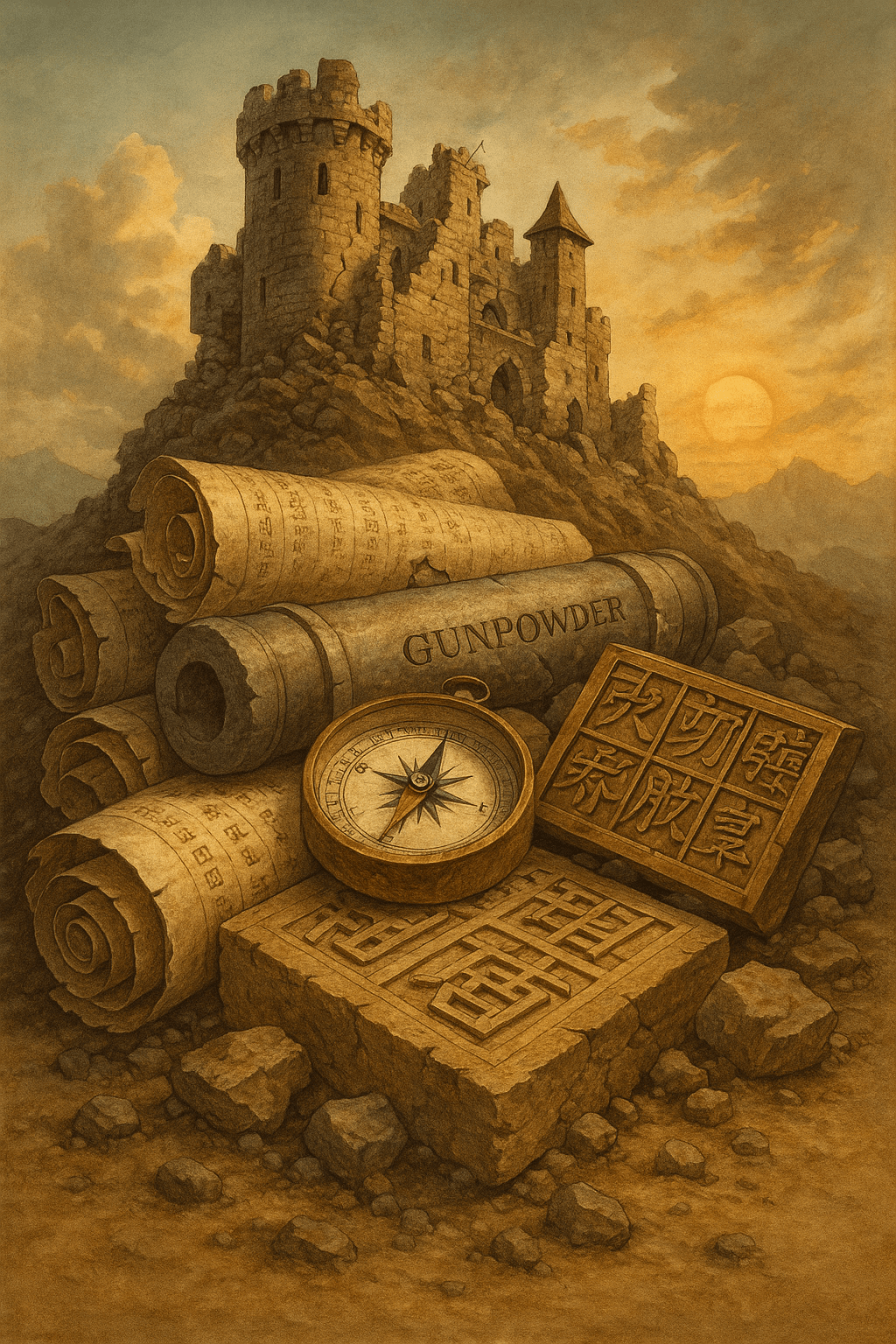
Gunpowder, first a chemist’s experiment, then a military game-changer, burst into existence in 9th century China, later creeping westward where it would upend the feudal strongholds of Europe (Princeton University Press). The compass — that tiny device that would enable Europe’s “Age of Exploration” (read: Age of Plunder) — had already been perfected in Song Dynasty China and used to navigate the monsoon seas.
Civil engineering stood as another monument to Chinese ingenuity. Roads and canals stitched vast territories together; iron suspension bridges swung across valleys when Europeans were still plodding through marshes. Water-driven machinery, trip-hammers, chain pumps — all powered a robust agricultural base that fed the largest cities on Earth. This wasn’t simply technological flair. It was a civilizational choice: to build not for conquest, but for collective sustenance and stability.
As UNESCO documents, the technologies that later made Europe rich — paper, printing, the compass, gunpowder — flowed westward along the arteries of the Silk Road, often through the hands of Arab traders and scholars. Europe, drunk on gold and Crusades, was the unknowing recipient of gifts it neither invented nor understood at the time.
The Silk Road and the Great Transmission
Europe’s encounter with Chinese knowledge was not a meeting of equals. It was more like a desperate mugging carried out across centuries and continents. Through the Silk Road, Chinese inventions seeped westward: paper-making reached Samarkand and Baghdad before finally crawling into Europe. The compass and navigational astronomy trickled into the Mediterranean world via Arab intermediaries, sparking Europe’s maritime expansion. Gunpowder crossed borders in fragments — recipes adapted and altered, misunderstood, weaponized.
The West didn’t create these technologies. It barely understood them. But it seized them, adapted them, and — most importantly — it forgot where they came from.
Myth-Making: How Europe Erased Its Debts
Once the technologies were safely integrated into European hands, a more insidious theft began: the theft of history itself. The compass became a mere footnote in tales of Columbus. Printing was transformed into Gutenberg’s divine revelation. Gunpowder’s bloody transformation of Europe’s feudal order was chalked up to “European innovation” rather than Chinese chemistry (Needham’s Grand Titration).
As Jack Goody and James Blaut reveal, this wasn’t accidental. It was an ideological operation. Europe crafted an entire mythology — “the European Miracle” — that cast Asia as stagnant and backward while crowning itself as the inevitable ruler of the world.
In reality, Europe was the upstart thief, building its castles and cannons atop stolen blueprints, then branding itself the natural master of humankind.
China’s Defensive Stance: A Civilization, Not an Empire
Unlike Europe’s blood-drenched thirst for expansion, China’s trajectory was largely inward. When the Ming Dynasty sent Admiral Zheng He on vast voyages across the Indian Ocean, it wasn’t conquest they sought — it was tribute, trade, and prestige. After those voyages, China chose retreat, turning back toward internal stability. Walls were built — not fleets of plunder. Trade was restricted, not unleashed on the world like a plague of colonizers.
This civilizational choice drove Europe mad with resentment. They coveted China’s goods — silk, porcelain, tea — but China itself desired nothing Europe had to offer.
European frustration fermented into military violence: when China wouldn’t trade freely, Britain flooded it with opium and cannon fire. The Opium Wars weren’t just about trade. They were about forcing a sovereign civilization to kneel before the barbarism of capitalism.
Projection: Yesterday and Today
Today, as the West hurls accusations at China — calling it aggressive, hegemonic, expansionist — it simply projects its own bloody history onto a mirror. China’s record shows no global empire, no genocidal colonial conquest, no plantation economies built on the corpses of millions.
It was London and Paris, not Beijing, that carved up Africa. It was Washington, not Shanghai, that turned Latin America into a permanent semi-colony. It is the Pentagon, not the PLA Navy, that circles the globe with military bases.
The truth cuts deep: the fear of China is not rooted in any real evidence of Chinese aggression. It is rooted in the West’s terror of losing its stolen primacy.
Conclusion: A Theft Unmasked, A World to Win
The so-called “Western miracle” was built on stolen technologies, erased histories, and blood-soaked lies. From the paper that enabled bureaucracy, to the compass that enabled colonization, to the gunpowder that shattered feudal strongholds — the fingerprints of China are all over the Western world, though rarely acknowledged.
Today’s New Cold War against China is not about human rights. It’s about fear — fear that a civilization once robbed and humiliated refuses to stay in its assigned place. Fear that the stolen foundations of the Western empire are crumbling, not under barbarism, but under the steady, sovereign footsteps of the very people once declared “backward.”
The duty of revolutionaries, intellectuals, workers, and the oppressed is clear:
Expose the lies.
Tell the truth.
Tear down the myths that bind the future to the crimes of the past.
History has not yet ended. It has only just begun to be reclaimed.
 Weaponized Information
Leave a comment