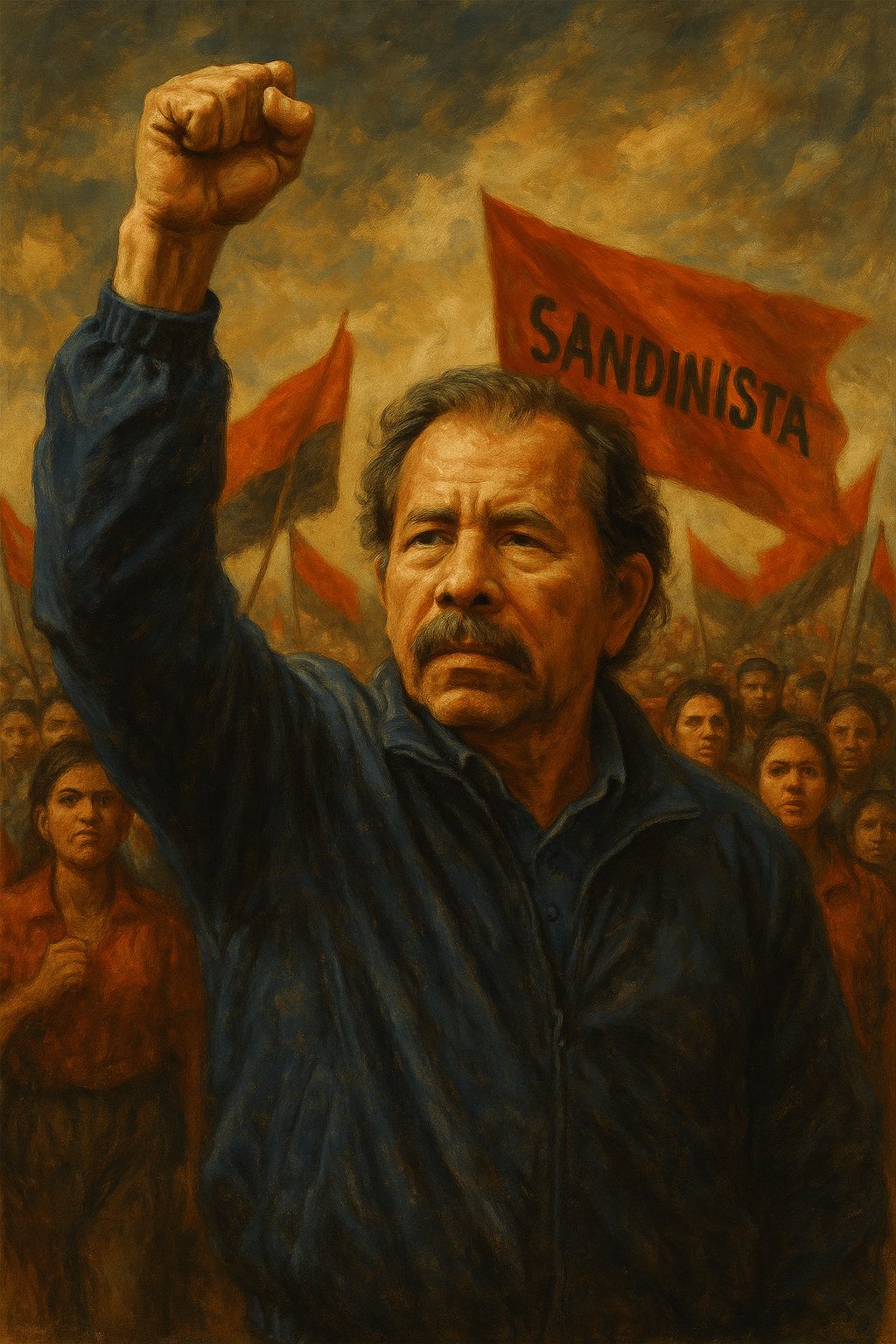
Daniel Ortega: The Man Who Walked With Sandino’s Ghost
Prologue: Sandino Never Died
Augusto César Sandino was executed by the U.S.-backed Somoza regime in 1934, but he never truly died. He lived in the hills of Las Segovias. In the machete songs of the peasantry. In the anti-imperialist speeches smuggled from Havana. In the whispers of campesinos who knew one day, his spirit would rise again in the flesh of a generation that would finish what he started.
Daniel Ortega was born eleven years after Sandino’s assassination. He would spend most of his life trying to avenge it.
The U.S. and the Nicaraguan oligarchy would call him a dictator, a Marxist, a thug, a populist. But they would never say why he endured, decade after decade. The answer is simple: because he never betrayed Sandino. And the people knew it.
“We are not fighting for power. We are fighting to destroy the system that has stolen power from the people for over a century.”
— Daniel Ortega, 1979
I. The Boy Who Would Bury a Dynasty (1945–1979)
Daniel Ortega Saavedra was born in 1945 in the mining town of La Libertad. His father had been jailed for anti-Somoza activism. His mother—a fervent opponent of U.S. occupation—helped organize underground resistance. Ortega grew up in a house where history was not taught—it was lived.
In 1963, at the age of 18, he joined the Frente Sandinista de Liberación Nacional (FSLN), named in honor of the revolutionary general who fought the U.S. Marines to a standstill. The FSLN was not a political party. It was a guerrilla army, a Marxist cell, a revolutionary experiment. Its goal was not reform—it was insurrection.
In 1967, Ortega was captured by Somoza’s National Guard for participating in a bank expropriation to fund the armed struggle. He was tortured, imprisoned for seven years, and finally released in a hostage exchange in 1974. He went into exile, trained in Cuba, and returned with hardened discipline and a revolutionary clarity honed in both isolation and fire.
By the mid-70s, the FSLN was no longer a fringe guerrilla band. It was an insurgent force—rooted in students, workers, farmers, and priests of liberation theology. It understood that to win, it had to become more than a military movement. It had to become a people’s war.
“The rifle alone cannot make a revolution. It must be guided by the consciousness of the oppressed. Otherwise, you only replace one tyrant with another.”
— Ortega, 1976
On July 19, 1979, the FSLN entered Managua. The Somoza dynasty, propped up by the United States for 45 years, was gone. FSLN flags flew from every window. A new people’s government was declared. In the street, Daniel Ortega spoke from the back of a truck: “This is not the end. It is the beginning. We have overthrown a dictator. Now we must overthrow the system that created him.”
II. The First Sandinista Government: Revolution Under Fire (1979–1990)
When the Sandinistas entered Managua in July 1979, Nicaragua was a wounded nation. Nearly 50,000 people had died in the insurrection. A quarter million were displaced. The Somoza family had looted the national treasury. The country’s infrastructure was in ruins. Schools, clinics, and roads had been deliberately neglected for decades.
But the revolution did not wait. In its first year, the new Sandinista government—led by a junta of national reconstruction with Daniel Ortega as one of its key members—launched the most ambitious social transformation in Central American history.
1. The Literacy Campaign
In 1980, Ortega oversaw the National Literacy Crusade. Over 60,000 youth—brigadistas—went into the mountains, jungles, and barrios with chalkboards and flashlights, teaching peasants and workers how to read. Illiteracy dropped from 50% to 12% in just five months.
“The pen was our first weapon. Literacy is the foundation of freedom.”
— Daniel Ortega, 1980
UNESCO declared it a model for the world. It wasn’t just education—it was political empowerment. People who could read could organize. Could fight. Could write new futures.
2. Land and Health for the People
The Sandinistas nationalized land held by the Somoza elite and redistributed over 2.2 million acres to peasants. They established cooperatives, agrarian unions, and credit programs for campesinos. The state bought food at guaranteed prices and subsidized fertilizer and tools.
In health, they built clinics across the country. Infant mortality was cut in half. Polio was eradicated. Over 300 Cuban doctors joined the effort. Vaccination rates jumped from 40% to over 80%.
Nicaragua became a beacon of proletarian internationalism. Brigades from across the world—Argentina, France, Angola, Mozambique, East Germany—came to support the reconstruction effort.
3. Women and the Revolution
The Sandinistas didn’t forget the women who fought and died in the hills. Ortega worked closely with the AMNLAE women’s federation to pass laws outlawing gender discrimination, promoting maternal care, and expanding women’s access to education and work.
While patriarchal traditions remained, the revolution opened new doors: women made up 30% of the FSLN rank and file. Thousands became doctors, teachers, political leaders. The revolution was their victory too.
4. The Empire Strikes Back: Contra Terror and CIA Drug Money
By 1981, the U.S. under Reagan declared Nicaragua a “threat to regional security.” Washington funneled hundreds of millions into the Contras—a CIA-created death squad made up of Somoza loyalists, drug traffickers, and former National Guard officers.
The Contras bombed health clinics, kidnapped teachers, assassinated farmers, raped women, and attacked literacy brigades. The Sandinistas called it low-intensity warfare. The people called it terrorism.
“They say they are fighting communism. But they are fighting books. Doctors. Food. Water. They are trying to turn us back into a plantation.”
— Ortega, 1985
The Contras were funded illegally through arms sales to Iran and through cocaine trafficking operations managed and covered up by the CIA. In the 1990s, journalist Gary Webb exposed how the crack epidemic in Black U.S. communities was directly tied to Contra financing. His series, Dark Alliance, was vilified by the press and led to his mysterious death.
Nicaragua took the U.S. to the International Court of Justice. The court ruled in favor of Nicaragua, ordering the U.S. to pay reparations for the war. The U.S. refused. To this day, Nicaragua has never received a cent.
5. Electoral Defeat, Not Political Defeat
In 1990, after a decade of war, economic sabotage, and internal exhaustion, the FSLN agreed to U.S.-supervised elections. Ortega ran for president but lost to Violeta Chamorro—an opposition candidate backed by $17 million in U.S. funding.
The Western press declared the revolution dead. But Ortega didn’t disappear. He remained head of the FSLN. He traveled the world. He studied the changing terrain. He watched neoliberalism ravage his country—and he waited.
“They beat us at the ballot box with bullets at our back. But history is long. And we are not finished.”
— Daniel Ortega, 1991
III. Return and Reconstruction (2007–Present)
Seventeen years after being forced out by the ballot under the barrel of Contra guns, Daniel Ortega returned. In 2006, he was re-elected President of Nicaragua with 38% of the vote—this time through a broader alliance strategy, using the very electoral system once used against him. But this was not capitulation—it was strategy. And it worked.
Since returning to power in 2007, Ortega has led a quiet but remarkable reconstruction of the Sandinista project. Nicaragua emerged from the ashes of structural adjustment and World Bank dictatorship. Public hospitals were rebuilt. Electricity was nationalized. School fees were eliminated. More than 200,000 homes were constructed for the poor. Roads, bridges, ports, and rural electrification programs expanded rapidly.
Under Ortega, Nicaragua has maintained some of the lowest crime rates in Central America, some of the highest gender equality indicators, and one of the most stable macroeconomic environments in the region.
“We are not going back to the past. The poor will never again be spectators in this country. They are the owners now.”
— Ortega, Inauguration Speech, 2007
1. Defying Empire: The Failed 2018 Coup Attempt
In 2018, the U.S. launched a full-spectrum hybrid war to oust Ortega again—this time via a so-called “color revolution.” Sparked by disinformation around a proposed pension reform, the protests quickly turned into violent riots orchestrated by USAID-funded NGOs, right-wing media, and U.S.-trained opposition cells.
They set fire to health clinics. They looted FSLN offices. Sandinista youth were tortured and filmed. Civilians were burned alive for being suspected government supporters. The empire called them “pro-democracy protesters.” But the people knew the truth.
The Sandinista base, including workers, campesinos, women’s organizations, and neighborhood defense committees, rallied behind Ortega. The coup was defeated. Elections in 2021 reaffirmed Ortega’s leadership with 75% of the vote. The U.S. declared it a sham. But the people declared it a defense of sovereignty.
“They do not want us to govern ourselves. They want us to kneel. But the Nicaraguan people have stood up—and we will not fall again.”
— Ortega, 2019
2. The Empire Can’t Breathe Here: Kicking Out the U.S. Boot
Since 2018, Ortega has expelled over 20 U.S. NGOs and shut down dozens of opposition outlets funded by the National Endowment for Democracy (NED). He stripped oligarchs of their media monopolies and re-nationalized sectors sold off under the neoliberal puppet regimes.
In 2022, Nicaragua broke ties with the Zionist regime of Israel, declaring full solidarity with the Palestinian struggle. Ortega called Zionism “a racist, colonial ideology.” The country has also withdrawn from the Organization of American States (OAS), calling it “a colonial ministry of U.S. regime change.”
3. The Multipolar Pivot: China, BRI, and a New Future
In 2021, Nicaragua re-established full diplomatic relations with the People’s Republic of China, recognizing Beijing as the sole legitimate government of China and cutting ties with Taiwan. This realignment opens the door to infrastructure investment through the Belt and Road Initiative (BRI)—with plans for new ports, logistics hubs, and even a new canal across Central America.
Nicaragua has applied to join BRICS+. It continues to deepen ties with Cuba, Venezuela, Russia, Iran, and other anti-imperialist governments. Ortega has called for “a new global order based on dignity, sovereignty, and respect—not bombs and banks.”
“They fear our independence more than our weapons. They know that a free, dignified people is the greatest threat to empire.”
— Ortega, 2022
In the eyes of Washington, Ortega is once again a “dictator.” But to the working class, to the campesinos, to the women and youth of Nicaragua—he is still the comandante who rose with Sandino’s ghost on his shoulder.
Epilogue: The Long War Isn’t Over — But Neither Are We
The U.S. empire has spent over 40 years trying to destroy Daniel Ortega. They’ve tried bullets, ballots, banks, bombs, and lies. They’ve called him a communist, a populist, a dictator, a criminal. But what they cannot call him is broken.
Because Ortega never bowed. Not to Reagan. Not to Bush. Not to Obama. Not to Trump. And not to Biden.
He took a ruined, war-torn nation and gave it health clinics, paved roads, free education, gender equity, and sovereign dignity.
He did what the empire hates most: he proved another world is possible.
“They want to erase our history. But we are not just resisting—we are rebuilding. And we will continue, with Sandino’s spirit, until the last U.S. boot leaves the last corner of the Global South.”
— Daniel Ortega, 2023
To many in the Western left, Ortega is a controversy. But to the Nicaraguan poor, he is a memory of land reclaimed, of children fed, of dignity restored. His hands bear the calluses of building a revolution—not from theory, but from blood, prison, exile, and war.
He did not come to serve the U.S.-dominated world order. He came to bury it.
And he is not done yet.
 Weaponized Information
Leave a comment