By Prince Kapone | Weaponized Information
May 1, 2025
The Empire’s Smear Campaign Against Traoré
The Associated Press wants you to believe Burkina Faso is teetering on the edge of chaos, that its people are brainwashed into chanting for a military “strongman,” and that its government is hoarding gold while the nation starves. But let’s call this what it is: imperial propaganda—manufactured, curated, and broadcast to serve the same empire that has kept Africa under its boot for centuries.
The AP piece reads like a Langley memo, because it practically is. It amplifies General Michael Langley’s baseless accusations that Captain Ibrahim Traoré is plundering Burkina Faso’s gold for his junta’s gain. No evidence. No audit. No receipts. Just an imperial general—the head of AFRICOM, no less—hurling colonial slander like every imperialist before him. This is the same tired script they used against Sankara, Lumumba, Gaddafi, and every Black leader who dared to seize sovereignty from the white world order: “They’re stealing from their people! They’re corrupt! They’re dangerous!”
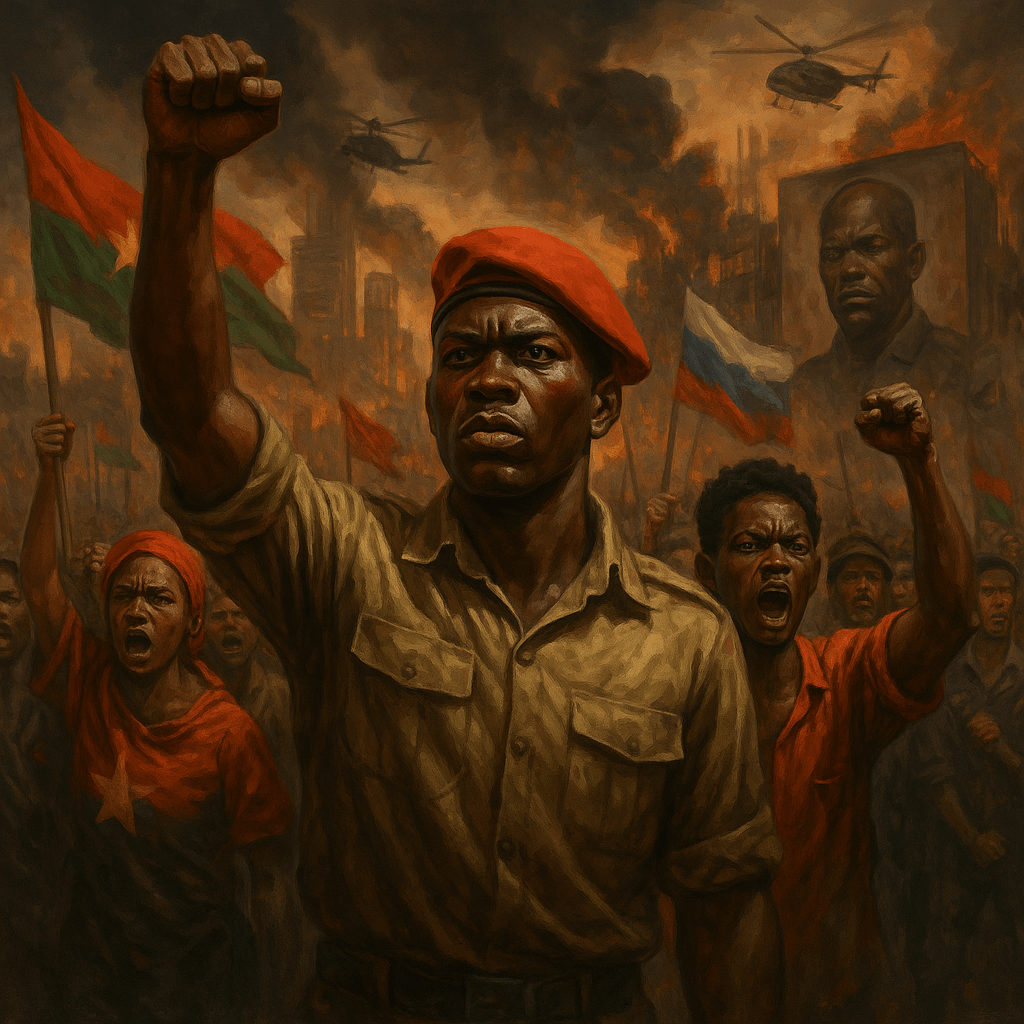
Meanwhile, the article conveniently omits the inconvenient truth: thousands rallied in Ouagadougou, and around the world, not because they’re fooled, but because they know Traoré stands against neocolonial plunder. They waved Russian flags not because they’re dupes, but because Moscow isn’t bombing them or bankrolling coups. They called Langley a “slave” on protest banners because they see clearly what he is: a Black face at the head of a white empire’s military occupation of Africa.
But the AP won’t tell you that. They won’t tell you that solidarity rallies erupted across Africa, in Haiti, in France, in the U.S.—where Black and colonized people saw Traoré not as a tyrant, but as a spark in the long revolutionary fire. They won’t tell you that Burkina Faso, Mali, and Niger formed the Alliance of Sahel States precisely to break free of U.S. and French militarization. Instead, they play the old imperial song: “instability,” “coup plot,” “human rights abuses”—the soft prelude to sanctions, isolation, and regime change.
This isn’t journalism. This is psychological warfare against a liberated Africa. And if we don’t strip it bare, expose it, and reframe it through revolutionary clarity, they’ll keep running the same script until the last revolutionary flag is buried beneath NATO boots.
The Long Shadow of Empire: Coups, Counterinsurgency, and the Colonial Playbook
To understand the empire’s war against Ibrahim Traoré, we have to drag it out of today’s headlines and place it squarely inside the long, bloody history of colonialism and counterinsurgency in Africa. What’s happening in Burkina Faso isn’t some isolated political drama—it’s another battle in the centuries-long struggle between Africa’s right to sovereignty and the West’s insatiable appetite for extraction.
Since the first European flags were planted on African soil, every attempt by African people to control their land, labor, and destiny has been met with military intervention, coup plots, assassinations, sanctions, and puppet regimes. From the British suppression of Mau Mau, to the French assassination of Thomas Sankara, to the CIA’s orchestration of Lumumba’s murder, to NATO’s destruction of Gaddafi’s Libya—every liberated zone has been targeted for elimination.
And what is General Langley’s AFRICOM if not the latest manifestation of that colonial machine? AFRICOM didn’t arrive to “fight terrorism”—it arrived to police African independence, to protect imperial chokepoints, to secure U.S. and EU access to gold, uranium, oil, cobalt, lithium. Langley’s smear of Traoré as a “gold-hoarding dictator” is not just a lie—it’s a projection. The West accuses Traoré of their own crimes. After all, it’s French companies that control much of Burkina Faso’s gold exports. It’s U.S. finance capital that profits from Africa’s extractive industries. The only gold Traoré threatens is the gold they’ve already stolen.
And let’s not forget: Traoré’s real “crime” is breaking military ties with France and the U.S., expelling French troops, and forging new alliances with Russia and other Global South nations. That’s the red line. That’s why AFRICOM wants him gone. That’s why Western media calls him “authoritarian” while celebrating U.S.-backed tyrants elsewhere. A sovereign Burkina Faso, allied with Mali and Niger, forming a united Sahelian front against neocolonialism? That terrifies the empire more than any jihadi insurgency.
The AP article wants us to see a junta clinging to power amid chaos. But the reality is far sharper: Burkina Faso’s people are in the streets, defending a revolution-in-progress. They wave Russian flags not as a naive gesture, but as an act of geopolitical rebellion against France and NATO. They call Langley a “slave” because they know his uniform doesn’t erase his function: to serve the white empire’s command over Black lands.
The imperial playbook hasn’t changed. But neither has Africa’s resolve to throw it into the fire.
Burkina Faso at the Barricades: A Revolutionary Struggle, Not a “Coup Crisis”
Let’s be absolutely clear: what’s happening in Burkina Faso is not the collapse of a state or the tyranny of a “junta,” as Western media want us to believe. It’s the emergence of a revolutionary process—a popular, grassroots movement determined to reclaim sovereignty from the clutches of neocolonialism. Captain Ibrahim Traoré is not some isolated “strongman”—he is the political expression of a rising, youthful, pan-African consciousness fed up with centuries of French domination, IMF strangulation, and U.S. militarization.
The rallies across Ouagadougou are not staged spectacles—they are the living heartbeat of a nation standing up against imperialism. When protesters call Langley a “slave” of empire, they’re not throwing insults—they’re diagnosing a material relationship: a Black man wielding colonial power against Black freedom. When they wave Russian flags, they’re not endorsing Moscow uncritically—they’re signaling their refusal to remain chained to Paris and Washington’s boot.
And the solidarity doesn’t stop at Burkina Faso’s borders. Across Africa and the Global South, solidarity rallies have erupted—in Mali, Niger, Liberia, and beyond. Black revolutionaries, pan-Africanists, anti-imperialists around the world see Traoré’s Burkina Faso as a frontline trench in the wider war for decolonization. This is why the AP, the Pentagon, and the Quai d’Orsay are so terrified: a domino is wobbling, and if it falls, the whole neocolonial architecture might tremble with it.
Let’s expose the ideological trick at play here: the imperial media frame Traoré’s government as “failing” because they measure governance by how well it serves capital and imperial security. But from the perspective of the oppressed, success looks different. It looks like expelling French troops. It looks like reclaiming national resources. It looks like building new alliances that don’t answer to Brussels or DC. It looks like a people rallying around their own sovereignty even in the midst of insecurity and siege.
Yes, Burkina Faso faces deep challenges: insurgencies, displacement, poverty. But these crises were not created by Traoré. They are the inheritances of an imperial order designed to keep the Sahel bleeding, fractured, and dependent. Traoré’s project is not perfect, but it is clear in its orientation: toward rupture, toward sovereignty, toward the possibility of a liberated future. That’s why he must be smeared, sabotaged, and—if possible—overthrown. Empire knows what’s at stake, even if its liberal apologists pretend otherwise.
What’s unfolding is not a “junta crisis.” It’s a revolutionary struggle for power under siege. And every revolutionary struggle will be met with destabilization, counterinsurgency, lies, and sabotage. We know this because we’ve seen it before: from Patrice Lumumba to Thomas Sankara to Muammar Gaddafi. The pattern repeats because the system remains. And until that system falls, every Black leader who refuses the leash will be painted as a tyrant, a looter, or a danger to “stability.”
But the masses know the truth. And the masses are the final authors of history.
From Ouagadougou to the World: Building a Global Front Against Neocolonialism
The struggle in Burkina Faso is not isolated. It is a frontline in a global war against imperial domination. The solidarity rallies in Mali, Niger, Liberia, and diasporic communities across the world are living proof: the dream of Pan-African liberation never died. It has simply waited—quietly, stubbornly—for the next generation to pick up the banner.
But solidarity cannot remain symbolic. The lesson of Sankara’s Burkina Faso, of Lumumba’s Congo, of Nkrumah’s Ghana is that empire will not stand aside. It will mobilize coups, sanctions, mercenaries, propaganda, and assassins to crush any experiment in sovereignty. Every liberated zone must be defended not just militarily, but ideologically. The revolution must be shielded from lies, subversion, and betrayal.
Our task in the imperial core is clear: disrupt the mechanisms of imperial counterinsurgency from within. We must expose and resist the military-industrial networks that supply arms and training to neocolonial proxies. We must campaign for the abolition of AFRICOM and the closure of all U.S. bases on African soil. We must build links between Black, Indigenous, and oppressed communities inside the empire and the revolutionary movements fighting colonialism abroad. We must make the empire’s crises compound, not its domination more efficient.
We must also amplify the voices coming directly from Burkina Faso and the broader Sahel—not the filtered, condescending reports of AP, CNN, or Le Monde. We must translate, circulate, and platform the revolutionary narratives of the people themselves. Because every lie told by imperial media is a weapon pointed at their struggle. And every truth we broadcast in defiance of those lies is an act of solidarity.
Finally, we must learn from their courage. Burkina Faso’s masses are mobilizing despite assassination plots, military encirclement, and economic sabotage. If they can take to the streets in the shadow of empire’s guns, then we—living inside the belly of the beast—have no excuse for silence or passivity. To stand with Burkina Faso is to fight imperialism where you stand.
Because in the end, as the great Frantz Fanon taught us: “Each generation must, out of relative obscurity, discover its mission, fulfill it, or betray it.” Burkina Faso has found its mission. The question is: will we rise to ours?
 Weaponized Information
Leave a comment