I. Introduction: The Blood They Hide
They barely even try to hide it anymore.
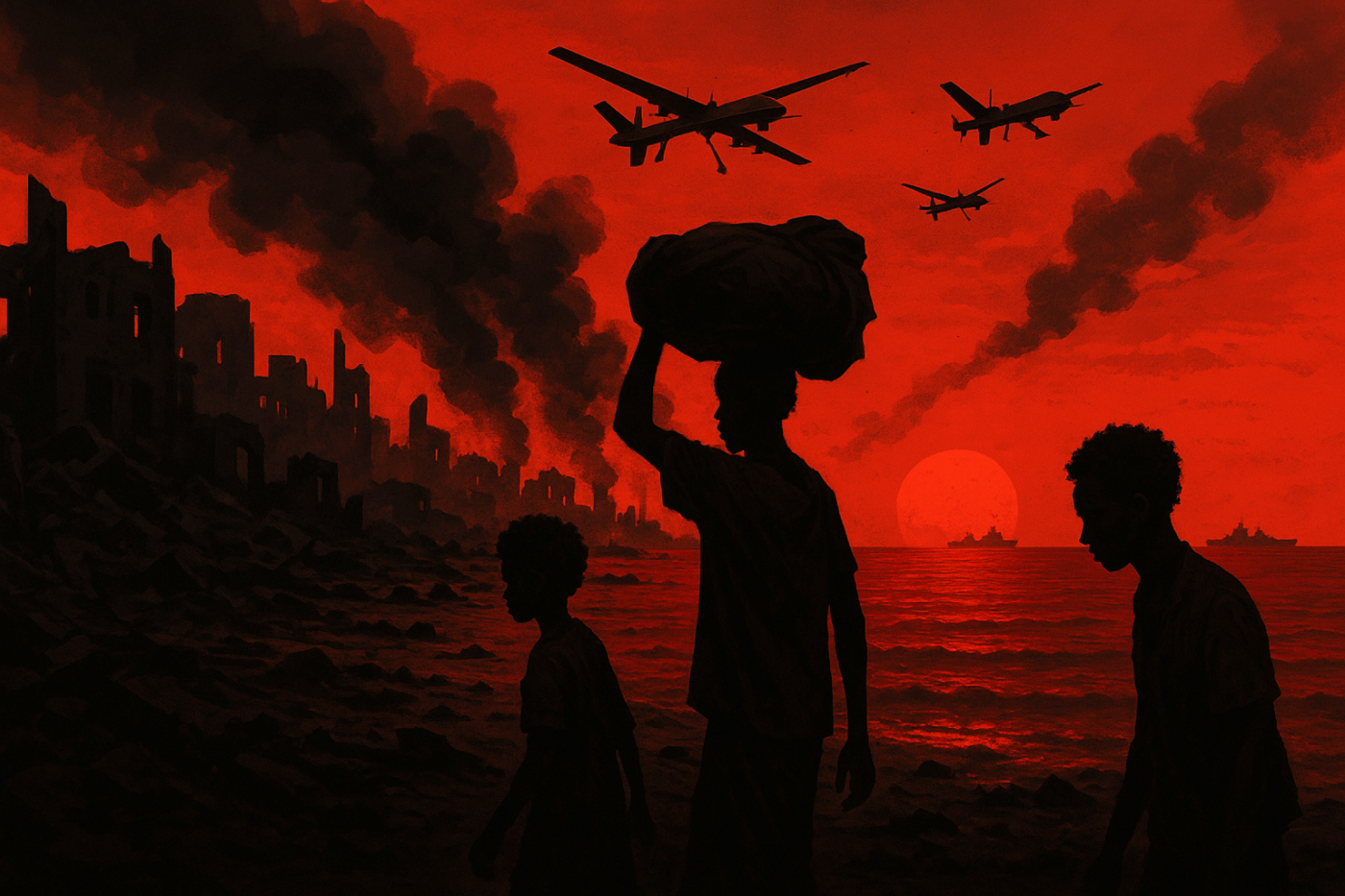
A U.S. drone strike massacres dozens of African migrants in Saada, Yemen — and the corporate media buries the story under sterile language about “precision operations” and “tragic incidents.”
But the reality cuts sharper than their euphemisms:
The United States has once again unleashed direct military terror — not just against Yemen — but against displaced African migrants fleeing the ruins of a world system shattered by imperialism itself.
Saada is not just another “site of conflict.” It is a revolutionary stronghold — the heart of Ansarallah, the Yemeni resistance movement (commonly referred to by the West as the “Houthis” — a colonial mislabeling). Ansarallah has resisted Saudi, U.S., and British imperialism for nearly a decade, defending Yemeni sovereignty against genocidal blockade and occupation.
The blood spilled in Saada is not an accident. It is not a mistake.
It is the logical outcome of an empire bleeding out across the global south, weaponizing counterinsurgency and racialized terror to maintain control over the chokepoints of the world economy.
At the very moment when the Red Sea emerges as a central chokepoint — disrupting imperial shipping lanes, oil flows, and military deployments — the U.S. settler-colonial empire responds the only way it knows how: with bombs, with blood, with brutality masked by bureaucracy.
Weaponized Information digs beneath the lies.
We excavate the facts buried by imperial propaganda.
We arm the oppressed with revolutionary clarity.
This is not a story of “unfortunate incidents.”
This is the story of a dying empire committing mass murder against colonized Africans and Arabs at the frontlines of global imperial collapse.
II. Excavation of the Propaganda
The first operation of empire is always on the narrative front.
Reuters’ original coverage of the U.S. drone strike in Saada, Yemen is a textbook case of imperialist narrative control. Instead of naming the United States as the direct perpetrator of mass murder, Reuters frames the event with passive, sterile, evasive language:
- Describes the massacre as a “strike” without assigning active agency.
- Refers to the victims simply as “people” and later “African migrants,” minimizing their humanity and erasing imperial responsibility for their displacement.
- Frames Ansarallah’s reporting of the deaths as an “allegation” — subtly undermining its credibility — while offering no direct acknowledgment of U.S. military command responsibility.
- Uses bureaucratic language like “an investigation is underway” to imply ambiguity, deflection, and plausible deniability.
- Omits all historical context about Yemen’s long resistance to Saudi-U.S. aggression, the genocidal blockade, or the geopolitical significance of the Red Sea chokepoint.
This is not accidental. It is narrative warfare.
By erasing U.S. agency, Reuters shields the empire from direct accusation.
By minimizing the racial and colonial dimension — African migrants bombed in an occupied Arab nation — it obscures the true continuity of settler-colonial violence.
It is crucial to understand: the primary battlefield is epistemological. If they can control how you think about an event — who the victims are, who the perpetrators are, whether it was “tragedy” or “terrorism” — then they can control how you act in response.
Weaponized Information exposes these lies at the root. We do not allow the empire to define the terms of our understanding.
III. Material Analysis of the Strike
On April 28, 2025, a U.S. drone strike targeted a gathering of African migrants in Saada province, northern Yemen — an area known as the heartland of Ansarallah resistance to Saudi and U.S. imperialist aggression.
According to reports by Ansarallah’s Al-Masirah TV and regional sources, at least 30 bodies were recovered from the rubble, with many more feared missing or wounded. Most victims were Ethiopian migrants attempting to transit through Yemen toward Saudi Arabia and other Gulf states in search of survival, driven by economic devastation, imperialist-imposed underdevelopment, and climate collapse in the Horn of Africa.
The strike occurred near key transport routes connecting Saada to the Red Sea coast — a region under intensified surveillance and militarization by U.S., British, and Israeli forces seeking to break Ansarallah’s naval blockade on Zionist and Western commercial shipping passing through the Bab-el-Mandeb Strait.
U.S. officials provided no immediate confirmation or detailed justification for the strike. Instead, the Pentagon cited “ongoing counterterrorism operations in the region,” a euphemism long used to mask imperialist attacks on civilians resisting occupation and economic strangulation.
The material reality is this:
- The U.S. empire is directly deploying airpower in Yemen — not through proxies, not through intermediaries, but openly.
- The victims are African migrants — among the most exploited and vulnerable strata of the global proletariat, displaced by the same imperialist system that now hunts them across continents.
- The target zone — Saada — is not a random location; it is the symbolic and strategic heart of Yemeni sovereignty, the base of Ansarallah’s resistance infrastructure.
- The context is imperial panic over Red Sea chokepoints — the strategic arteries connecting the Indian Ocean to the Suez Canal, Europe, and global commerce. Yemen’s resistance threatens not just Saudi shipping, but the logistical architecture of hyper-imperialism itself.
This was not a “mistake.”
It was not “collateral damage.”
It was deliberate racialized imperial counterinsurgency — waged at the intersection of logistics, energy, migration, and sovereignty.
The empire’s goal is not merely to kill fighters. It is to terrorize, fragment, and bleed the populations that resist its domination — migrants, workers, the colonized poor — driving them into despair, displacement, or death.
IV. Yemen as a Global Chokepoint
To understand why the U.S. empire is bombing migrants and resisting Ansarallah in Yemen, you must understand geography — and logistics. Yemen sits atop one of the most critical chokepoints in global capitalism: the Bab-el-Mandeb Strait.
The Bab-el-Mandeb (“Gate of Tears”) is a narrow waterway connecting the Red Sea to the Gulf of Aden, linking Europe to Asia via the Suez Canal. Every year, billions of dollars in goods — including oil, gas, weapons, food, and electronics — pass through this artery. Roughly 10 percent of global maritime trade flows through these waters.
Control over the Bab-el-Mandeb means control over a vital vein of the imperialist world economy. It is no coincidence that:
- The U.S. maintains the massive Camp Lemonnier military base in Djibouti, just across the strait.
- British, French, Israeli, and Emirati naval forces constantly patrol the surrounding waters.
- Saudi Arabia has waged nearly a decade of war to crush Yemeni sovereignty and resistance to imperial dominance.
Ansarallah’s emergence as a revolutionary force capable of disrupting shipping lanes, attacking military vessels, and threatening the economic lifelines of empire has thrown hyper-imperialism into crisis. Every ship delayed, every supply line disrupted, every dollar of extra insurance premium ripples through the capitalist system like shockwaves through a dying body.
Yemen’s strategic position gives its resistance disproportionate global leverage. It is a microcosm of the broader multipolar realignment: the formerly colonized, once trampled nations now holding the arteries of empire hostage to their own sovereignty struggles.
This is why the U.S. escalates.
This is why they bomb civilians and migrants alike.
It is not about “terrorism.” It is about chokepoint warfare — about maintaining imperial flows of profit and domination at any human cost.
In the collapsing architecture of hyper-imperialism, Yemen is not a “peripheral battlefield.” It is a strategic epicenter — a frontline where the dying empire confronts the birth pangs of a new, multipolar world.
V. Imperialist Desperation and Technofascist Warfare
When empire collapses, it does not retreat gracefully.
It lashes out with savage, desperate violence — and masks that violence behind the cold technocratic language of “security,” “precision,” and “stability.”
The U.S. settler-colonial empire faces historic decline:
economic rot at home, military overextension abroad, rebellion across the Global South, and the growing strength of multipolar alliances that refuse to kneel.
In response, the empire recalibrates.
It fuses its military, corporate, and technological sectors into a single integrated war machine — a system we call technofascism.
Drone strikes, biometric surveillance, AI-driven targeting, psychological warfare, financial blockades — these are not glitches.
They are the preferred instruments of an empire that can no longer govern through legitimacy and must now govern through terror disguised as efficiency.
Yemen stands at the crossroads of this desperate recalibration:
- Drone assassinations become the normal method of U.S. warfare — remote-controlled murder with no accountability.
- Refugees and migrants are no longer seen as human beings — but as destabilizing “threats” to be eliminated before they disrupt imperial supply chains.
- Resistance movements like Ansarallah are not treated as political actors — but as “terrorist targets” outside the protection of international law.
- Chokepoints like Bab-el-Mandeb are not neutral trade routes — but battlefields for the survival of settler capitalism itself.
Technofascism operates with a core assumption:
that the death of the colonized poor — Africans, Arabs, Asians, Indigenous peoples — can be rendered invisible, mechanical, and morally indifferent through the language of “operations” and “security.”
But no amount of technological camouflage can erase the material reality:
The U.S. empire is engaged in open, racialized, genocidal counterinsurgency to preserve its collapsing system — and Yemen is one of the frontlines where its desperation is laid bare for the world to see.
VI. Yemen’s Resistance in Global Context
The empire’s propaganda insists on framing Yemen as a “failed state,” a “humanitarian crisis,” or an “internal conflict.” But this is deliberate disinformation. Yemen today is not simply a “tragedy” — it is a revolutionary front in the global struggle against imperial domination.
Ansarallah — the Yemeni resistance movement based in Saada — has fought for years under siege, bombardment, blockade, and diplomatic isolation. Yet despite overwhelming U.S., British, Israeli, and Saudi aggression, they have not only survived — they have mounted a sustained military, political, and ideological challenge to imperial hegemony over the Red Sea and Arabian Peninsula.
Their resistance reverberates beyond Yemen’s borders.
It is part of a larger, emerging axis of sovereign forces — Iran, Syria, Iraq’s resistance groups, Lebanon’s Hezbollah, Palestine’s liberation organizations — all challenging the U.S.-Zionist-Saudi order in West Asia.
Globally, Yemen’s defiance mirrors the broader revolutionary tide rising across the colonized world:
- In Africa, nations like Burkina Faso, Mali, and Niger are expelling French and U.S. troops, reclaiming sovereignty.
- In Latin America, the Bolivarian resistance led by Venezuela, Nicaragua, and Cuba continues to withstand imperialist sanctions and sabotage.
- Across Asia, China, Iran, and Russia build new multipolar infrastructure — pipelines, ports, railways — bypassing imperial chokepoints.
Yemen’s struggle is part of the worldwide collapse of the old colonial order.
Every shipping lane disrupted, every drone shot down, every airstrike survived, is a blow against the architecture of settler-colonial hyper-imperialism.
Ansarallah is not isolated. They are not aberrations.
They are partisans in a global war for liberation — a war that stretches from the deserts of Saada to the streets of Gaza, to the favelas of Caracas, to the Sahel, to the Congo, to Standing Rock.
Yemen bleeds today. But Yemen also stands today — as proof that no empire, no matter how technologically advanced or brutally violent, can forever suppress the collective will of the oppressed to rise and reclaim their future.
VII. Revolutionary Clarity
The U.S. drone strike in Saada is not an isolated atrocity.
It is a window into the decaying soul of empire.
When the empire bombs African migrants in a colonized Arab land — at a strategic chokepoint of global commerce — it is revealing the true architecture of its world order: racialized genocide for profit, disguised as “security operations.”
When the media describes mass murder in passive bureaucratic language — “strikes,” “incidents,” “investigations” — it is revealing the ideological machinery designed to sanitize imperial slaughter and shield the settler core from truth.
When Ansarallah withstands a decade of blockade, starvation warfare, cluster bombs, and siege — and still raises the flag of resistance over Saada — it reveals the strength that empire most fears: the refusal of the oppressed to die quietly.
Yemen’s frontline is not a tragedy to mourn.
It is a battlefield to understand — and to take sides on.
Weaponized Information stands with Yemen.
With the displaced African migrants bombed by empire.
With Ansarallah and every force resisting the death cult of imperialism at the gates of the Red Sea and beyond.
We do not accept the vocabulary of empire.
We do not accept its right to narrate, to justify, to sanitize.
We excavate its lies and build revolutionary clarity in their place.
Every bomb dropped in Saada is a sign of weakness, not strength.
Every migrant body buried is a monument to the cruelty of a dying system — and a call to accelerate its collapse.
The blood spilled on the Red Sea will not be forgotten.
It will be weaponized — in memory, in struggle, in history — until settler-colonial capitalism is buried alongside the empires that birthed it.
Stand with Yemen. Stand with the oppressed. Stand against empire — without apology, without compromise, without delay.
 Weaponized Information
Leave a comment