By Prince Kapone | Weaponized Information | April 29, 2025
I. Propaganda as Warfare: Who Built the Narrative and Who Benefits
If empire has a conscience, it’s buried beneath a stack of editorials like the one The Hill just published — sentimental, aesthetically sympathetic, but ideologically poisoned. Mark I. Pinsky’s “A Visit to Cuba Reveals Stasis, Inequality and Desperation” isn’t journalism. It’s soft-power sabotage, wrapped in faux concern and delivered through the polished voice of a well-meaning liberal who still serves empire’s agenda. It doesn’t drop bombs — it drops distortions.
The article is built to feel intimate. Pinsky walks Havana’s cracked streets, quotes noir fiction, notes fading murals and sex workers. He admits the blockade exists — then quickly shrinks it to a footnote. The real cause of Cuba’s hardship, he implies, is the revolution itself: ideology, bureaucracy, stubborn refusal to change. The reader is left not with a critique of U.S. aggression, but with the idea that Cuban socialism is rotting from the inside, that the people are “tired,” and that the time for change has come — not by emancipation, but erosion.
This is not accidental. It’s narrative warfare.
The Anatomy of a Propaganda Piece
- Selective Empathy: The piece centers anecdotal voices — despairing Cubans, nostalgic writers — but never those who understand the blockade as an act of war. It invokes suffering, but not struggle. It quotes resignation, but never resistance. The Cuban people become symbols of fatigue, not fighters.
- Literary Camouflage: The use of Leonardo Padura’s fiction as a framing device subtly reinforces imperial tropes: revolutionary failure, moral ambiguity, the futility of resistance. The fictional detective becomes a stand-in for Cuban society — weary, cynical, spiritually broken. It’s art deployed as ideology.
- False Balance: While acknowledging some revolutionary gains — low infant mortality, free education, universal housing — the piece undermines them with phrases like “the misery is inside the rooms.” Achievements become tragic ironies, not historic victories under siege.
- Structural Erasure: The blockade is mentioned only in passing. Its scale, intent, and daily brutality are nowhere explained. No mention of the 60+ years of unilateral economic warfare, the billions lost, the deliberate sabotage of medicine, fuel, and trade. No reference to Lester Mallory’s genocidal memo stating the goal was to starve the Cuban people into rebellion. No data. No history. Just vibes.
- Strategic Timing: This piece drops as the Trump 2.0 regime escalates its war on Cuba: planning to cut flights, ban remittances, weaponize Guantanamo. Yet the article offers no serious condemnation. Just a soft sigh of disappointment, as if both sides are at fault — as if Cuba deserves this.
Who Benefits?
- U.S. Empire: The narrative helps justify the tightening of the blockade by framing Cuba as economically hopeless, politically exhausted, and internally broken. It manufactures consent for more punishment under the guise of concern.
- The Anti-Cuban Lobby: Figures like Marco Rubio and the Miami comprador elite use stories like this to push regime change agendas — humanitarian intervention cloaked in Cuban misery.
- Western Liberalism: Pinsky’s article speaks to that audience — the college-educated, NPR crowd who want to believe they care, but remain ideologically trapped. It offers them a way to pity Cubans without challenging the empire that strangles them.
- The Global Capitalist Class: Every time Cuban socialism is framed as a failure, it strengthens the ideological hegemony of capitalism. The more hopeless Cuba looks, the more inevitable capitalism appears.
Who Pays the Price?
- The Cuban people — whose reality is distorted and decontextualized.
- The Cuban Revolution — whose history is smeared and whose achievements are erased.
- The Global South — for whom Cuba has long stood as a beacon of resistance, now cast as a failed state rather than a besieged survivor.
In truth, the only thing that’s failed is the empire’s ability to break Cuba. And that’s exactly why they need articles like this.
Because if they can’t defeat Cuba with bombs, they’ll try to defeat it with stories.
II. Extracting the Objective Facts: Stripped from Narrative Fog
Even in propaganda, the truth leaves a trail. Beneath the emotional manipulation and ideological distortions, certain hard facts slip through. But these facts are not contextualized — they are scattered, disconnected, and made to appear self-evident, as if hardship emerged spontaneously from Cuba’s internal contradictions alone. Our task here is to extract these facts, name them clearly, and prepare them for revolutionary contextualization.
- Fact 1: Cuba is enduring extreme economic hardship – which I witnessed myself as far back as 2012 when I did a study abroad there. The article documents blackouts, fuel shortages, food scarcity, rationing, and a collapsing tourism industry. All of that is undeniable.
- Fact 2: Emigration has intensified. In 2022, 250,000 Cubans — out of a population of 11.2 million — left the island, largely for economic survival.
- Fact 3: Cuba’s economy is transitioning in small, controlled ways toward a mixed economy. This includes a “gray market” of private restaurants, boutique hotels, and services — often built on remittances from abroad.
- Fact 4: Despite the economic crisis, certain revolutionary gains remain intact:
– Education through university is still free
– Healthcare is free and effective (e.g. low infant mortality)
– Rent remains free or heavily subsidized
– Homelessness is virtually nonexistent
– Public ownership of basic infrastructure remains the norm - Fact 5: The U.S. embargo — which the article briefly mentions — continues to be enforced. Under Trump 2.0, it is being intensified:
– Plans to ban all commercial and family flights to/from Cuba
– Threats to ban U.S. remittances, which totaled $4B in 2024
– Restrictions on Cuban athletes, doctors, and their families
– Guantanamo to be used to detain up to 30,000 refugees - Fact 6: Class stratification is growing. Some former state officials now profit from tourism, while those without diaspora links or entrepreneurial avenues are left behind.
- Fact 7: Social criticism has become more visible, including via social media. Cubans are increasingly open in their discontent — even while continuing to express pride in revolutionary achievements.
These are the bones of reality — but they mean nothing unless rooted in history and material conditions.
The next step is to do what The Hill won’t: name the blockade for what it is — a siege, a crime, and a war against the poor.
III. Contextualizing Historically and Materially: The Blockade as Counterrevolutionary Warfare
To understand the suffering in Cuba today, you don’t start with failed policies, or broken infrastructure, or even the bureaucratic weight of a 60-year revolution.
You start with war — an undeclared, uninterrupted, full-spectrum economic war imposed by the United States for one purpose: to destroy a revolution that dared to put people over profit.
This is not conjecture. It is confession. In 1960, U.S. State Department official Lester Mallory wrote:
“The majority of Cubans support Castro. There is no effective political opposition… The only foreseeable means of alienating internal support is through disenchantment and disaffection based on economic dissatisfaction and hardship… to decrease monetary and real wages, to bring about hunger, desperation, and overthrow of government.”
That wasn’t Cold War panic. That was policy — still enforced, still evolving, still genocidal.
The blockade — or more accurately, the economic siege — has been designed to strangle Cuba’s ability to survive, much less flourish.
It is not a passive restriction. It is an active, hostile apparatus of sabotage:
- It prevents Cuba from importing medical equipment, even during pandemics.
- It blocks international banks from processing Cuban transactions, even with third-party countries.
- It bans U.S. citizens from traveling, investing, or trading freely — turning the island into an economic prison.
- It punishes foreign companies who dare to engage with Cuba under “secondary sanctions.”
And yet when The Hill laments Cuba’s blackouts or food shortages, it makes no mention of how these conditions were engineered.
Instead, it suggests “stasis” and “regime intransigence.”
But how do you restore power when you can’t buy parts?
How do you feed a population when the market locks you out of global trade?
The answer: you resist. You ration. You adapt. You survive — not despite socialism, but because of it.
The Special Period Was Not a Failure of Socialism — It Was a Victory of Resistance
When the Soviet Union collapsed in 1991, Cuba lost over 80% of its trade overnight. Imperialists predicted the revolution would fall within weeks. Instead, the people endured. Bicycles replaced fuel. Urban gardens replaced food imports. Doctors were exported. Education deepened. Infant mortality dropped.
What other Global South nation — surrounded, besieged, and blockaded — has maintained universal literacy, world-class healthcare, zero homelessness, and dignity in housing?
Name one. We’ll wait.
The Blockade is the Real Cause of Suffering — Not Socialism
Cuba’s economic woes are real. But they are not self-inflicted. They are the logical outcome of external, imperialist strangulation combined with internal contradictions in a resource-starved system.
But this is exactly the outcome Mallory hoped for: to make the Cuban people believe the pain comes from within, so they would destroy their revolution with their own hands.
Yet 65 years later, they have not. And that is the greatest political achievement of the Cuban people.
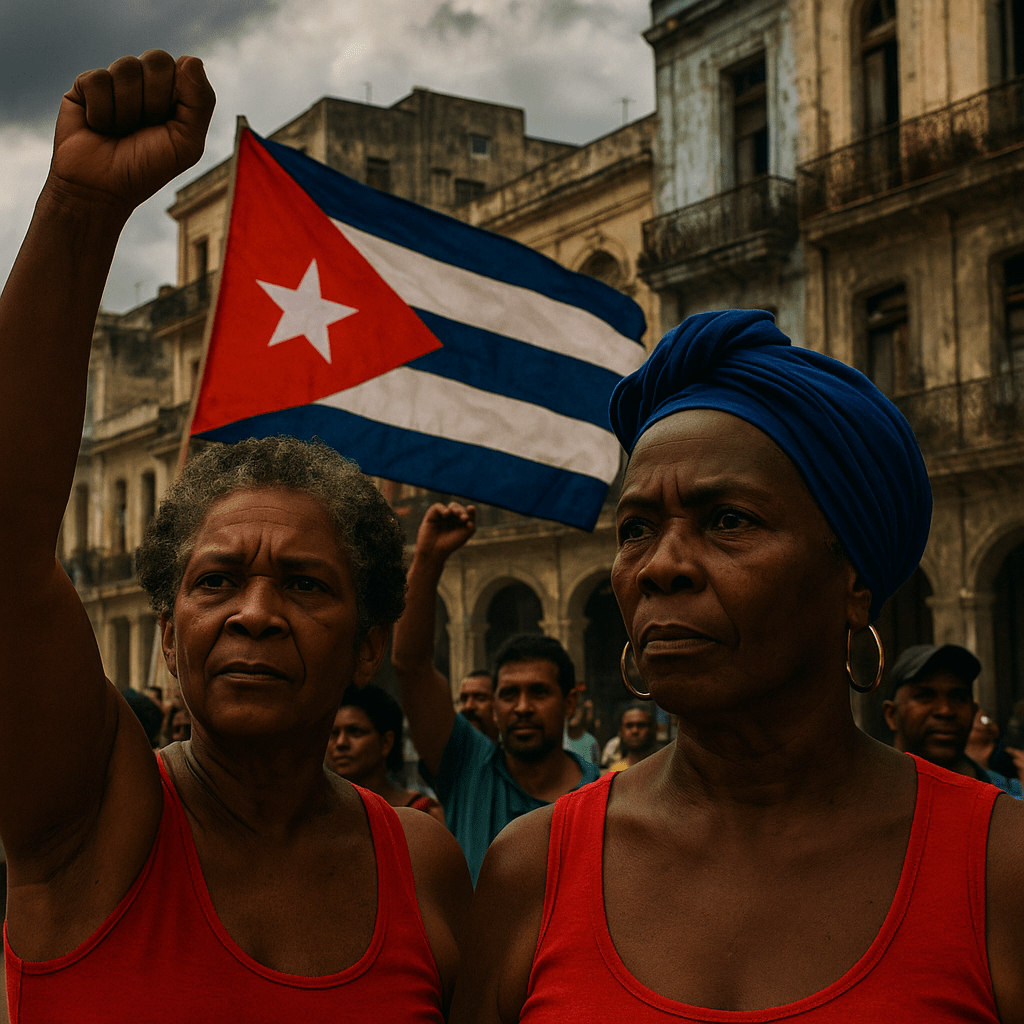
Every blackout survived. Every ration line endured. Every defiant grandmother who still says, “Yo soy revolucionaria.”
That is the legacy of a people who refused to trade sovereignty for comfort.
That is what The Hill cannot explain — and what empire cannot stand.
IV. Exposing the Real Imperial Agenda: Genocide by Economic Siege
Let’s stop pretending this is about democracy, human rights, or reform.
The United States isn’t starving Cuba because of elections.
It’s starving Cuba because Cuba dared — and still dares — to defy imperialism.
What’s unfolding is not foreign policy. It’s not diplomacy. It’s economic genocide by design — a long war of attrition that seeks to punish the Cuban people for dreaming of sovereignty, for organizing around dignity, and for proving, even under siege, that another world is possible.
And yet The Hill — like the rest of empire’s media infrastructure — dares to wring its hands over “desperation,” while burying the role of its own government in manufacturing it.
The Real Strategy: Break the Body, Blame the Bones
Everything the U.S. is doing — and everything this article omits — follows a strategy of engineered collapse:
- Block trade until shortages become starvation.
- Ban remittances to sever the diaspora lifeline.
- Cut flights to isolate Cuba from global circulation.
- Use Guantánamo as a refugee prison to stage humanitarian theater.
- Escalate sanctions with each act of resistance.
And then, once the people are gasping, desperate, and disillusioned, frame the situation as the fault of Cuban “stagnation.”
This isn’t diplomacy. It’s counterinsurgency economics.
The Role of The Hill: Narrative Sanitation for Imperial Policy
By focusing on “stasis” and inequality, and by invoking fatigue and nostalgia through Padura, this article performs a vital function: it sanitizes the siege.
It doesn’t need to cheer for sanctions. It only needs to omit them.
It doesn’t need to endorse invasion. It only needs to make socialism look obsolete.
And it doesn’t need to defend Trump’s aggression. It only needs to frame Cuban resistance as failure.
This is how liberal propaganda works: not with lies, but with distortions. Not with hard ideology, but with soft fatalism.
It kills revolutionary optimism through a thousand sighs of resignation.
The Broader Imperial Playbook
Make no mistake — Cuba is not unique. It is a case study. A precedent. A testing ground for modern hyper-imperial siege warfare:
- In Venezuela — financial blockade, currency sabotage, and staged “humanitarian” invasions.
- In Gaza — literal siege, sanctions, and media smokescreens labeling starvation as collateral damage.
- In Nicaragua — sanctions and electoral destabilization labeled as “civil society empowerment.”
Empire adapts. It doesn’t always need coups. It has the dollar. It has SWIFT. It has USAID. It has The Hill.
But Cuba, even in its exhaustion, still threatens imperial stability — because it reminds the world that a nation can survive without surrender.
And that is why they must crush it — not for what it is today, but for what it symbolizes: that liberation is still possible, even under siege.
V. Reframing and Mobilizing: The Cuban Revolution Lives
Let the empire call it collapse. We call it survival.
Let the liberals sigh over “stasis.” We call it struggle.
Let the propagandists tally blackouts and breadlines. We tally victories: free housing, free healthcare, free education — achieved under siege, without ever kneeling.
Cuba is not a failed state. It is a <strongfortress under economic fire, still standing after more than six decades of nonstop imperial aggression. That is not failure. That is revolution — still alive, still breathing, still unbroken.
We Don’t Romanticize — We Recognize
Yes, Cuba has contradictions. Yes, there is hardship. Yes, bureaucracy can suffocate initiative. Yes, young people are leaving, frustrated, tired, angry.
But none of that means the revolution is dead.
It means the revolution is beleaguered.
It means the revolution is wounded.
It means the revolution is fighting for oxygen while an imperial knee remains on its throat.
Don’t mistake survival tactics for surrender. The emergence of the “gray market” isn’t a victory for capitalism — it’s adaptation.
Don’t mistake critique from within for rejection of socialism — it’s loyalty trying to save what remains.
Don’t mistake emigration for ideological defeat — the blockade makes staying a battlefield.
What The Hill Won’t Tell You
- Cuba trains more doctors per capita than the United States — and exports them globally, even to countries that attack it.
- Cuba has never turned a single child into a houseless statistic — while the U.S. counts over half a million homeless souls per night.
- Cuba’s literacy rate surpasses that of most “developed” nations, despite having less than 1/50th of the resources.
- Cuba has never invaded a neighbor, toppled a government, or built an empire of sweatshops.
That’s not utopia. That’s resistance with teeth. And it is precisely because of that example that the U.S. wants it destroyed.
What Must Be Done
- We must expose liberal propaganda for what it is: counterinsurgency by narrative. It mourns the very suffering its silence helps produce.
- We must defend Cuba not in spite of its flaws, but because of its defiance. Revolutionary clarity means knowing the principal contradiction is not internal failure — it is external war.
- We must uplift the Cuban people — not as victims, but as comrades. Not as objects of pity, but subjects of history.
- We must demand the end of the blockade with no equivocation, no “both sides,” and no apology.
Because if Cuba falls, it will not be because socialism failed.
It will be because the world allowed it to be strangled while praising the strength of its suffering.
And we — we will not be counted among the silent.
VI. Cuba Will Never Be Recolonized
Empires come to believe that endurance is weakness. That survival is defeat. That when a people endure enough hunger, enough isolation, enough economic war, they will break — and finally kneel.
But Cuba — battered, besieged, blockaded — remains unbroken.
It is still writing its own future, with trembling but defiant hands.
It is still teaching the world that dignity matters more than comfort bought at the price of surrender.
What the propagandists at The Hill and their masters in Washington fail to understand is simple:
You cannot starve a revolution out of existence — you can only expose your own inhumanity.
Cuba today is not a utopia.
It is a war zone — a slow war fought with banks, sanctions, and media lies.
Every blackout, every ration line, every boarded-up shop window is a scar inflicted by an empire too cowardly to admit it is waging economic genocide against a tiny island that dared to dream of freedom.
Yet Cuba remains. And that fact alone is a defeat for imperialism greater than any battlefield loss.
We affirm:
- Cuba’s struggle is our struggle — the fight for a world where sovereignty cannot be strangled and dreams cannot be embargoed.
- The blockade must be ended — not reformed, not eased, but shattered and abolished, along with the imperial system that gave it life.
- The Cuban Revolution must be defended — critically, honestly, militantly — because its survival is a victory for all oppressed peoples fighting to reclaim their future.
- The story of Cuba is not over — it is still being written in every hospital ward, every classroom, every urban farm, every revolutionary heart that refuses to kneel to empire.
Weaponized Information stands unapologetically with Cuba —
against blockade, against recolonization, against imperial propaganda masked as pity.
Cuba is not alone.
Cuba is not defeated.
Cuba is not for sale.
And the day will come — sooner than the empire fears — when the siege crumbles, the lies collapse, and the Cuban people breathe freely again, sovereign and whole, in a world where empire has no future left to sell.
¡Hasta la victoria siempre!
 Weaponized Information
Leave a comment