I. Silence in the Face of Sabotage
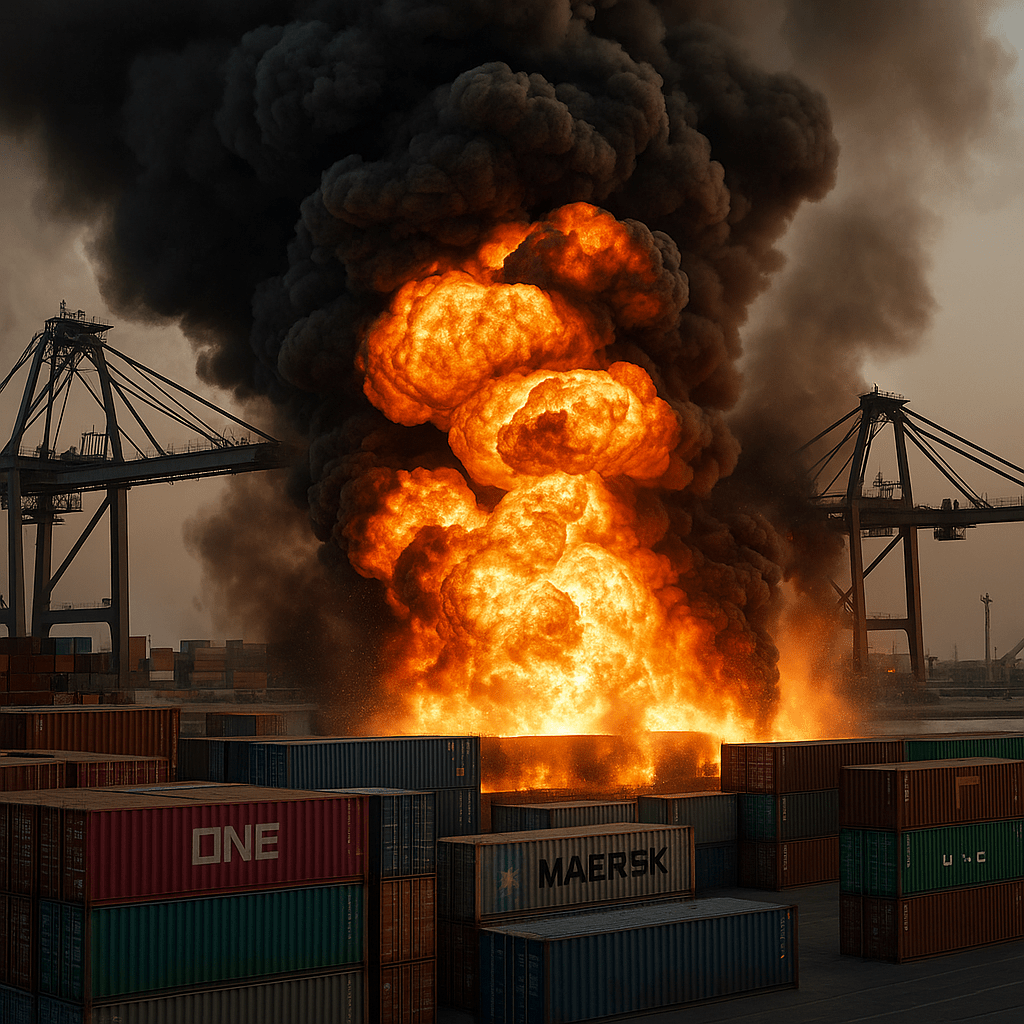
On April 27, 2025, a massive explosion rocked a major Iranian port facility.
Within hours, Western media outlets like CNN rushed to frame the event with their usual sleight of hand:
Iran, they suggested, was “tight-lipped,” perhaps embarrassed, perhaps covering up internal failures — yet another sign, they implied, of the Islamic Republic’s supposed instability and incompetence.
But to those who have studied imperialism’s methods — those who know how empire wages war without openly declaring it — the real story looks very different.
The explosion was almost certainly not an accident.
It fits a long historical pattern:
covert sabotage operations targeting Iran’s critical infrastructure — orchestrated by the United States, Israel, or their regional proxies — aimed at weakening Iran’s strategic position, especially at moments of rising multipolar strength.
From the 2010 Stuxnet cyberattack on Iranian nuclear facilities, to the string of assassinations of Iranian scientists, to the bombing campaigns against supply routes in Syria and Iraq, the technofascist empire has always preferred covert war against Iran’s sovereignty over open confrontation.
This explosion — occurring amid escalating Red Sea tensions, the rise of BRICS+, and the crumbling of U.S. maritime supremacy — cannot be understood outside that imperialist context.
Iran’s strategic ports are vital nodes in a multipolar logistics and energy architecture that threatens U.S. dominance over chokepoints like the Bab-el-Mandeb, Suez Canal, and Strait of Hormuz.
Weakening Iran’s infrastructure weakens the emerging global economic corridors challenging imperial control.
Weaponized Information cuts through the noise:
This is not about “Iranian embarrassment.”
It is about imperial sabotage — economic warfare masked as unexplained incidents — aimed at derailing the inevitable erosion of U.S. imperial hegemony.
We do not accept the empire’s framing.
We excavate it.
We expose it.
And we prepare our cadres for the real struggle unfolding behind every explosion, every headline, every strategic silence.
II. Excavation of the Propaganda
CNN’s April 27 article titled “Iran tight-lipped after major port explosion” is a textbook example of how imperialist media manufactures narrative warfare to delegitimize sovereign states resisting U.S. domination.
The techniques deployed are not neutral mistakes.
They are deliberate weapons — crafted to erode Iran’s international standing, sow doubt about its sovereignty, and obscure the fingerprints of imperialist aggression.
Let’s break down CNN’s propaganda methods:
- Framing Iranian silence as “suspicious.”
By repeatedly emphasizing that Iran is being “tight-lipped,” CNN insinuates guilt, incompetence, or internal disarray — while refusing to acknowledge that strategic silence has historically been Iran’s tactic to avoid giving pretexts for escalations initiated by hostile powers. - Omitting the long record of imperialist sabotage against Iran.
Nowhere does CNN mention the extensive history of attacks on Iranian infrastructure, including the Stuxnet cyberattack in 2010 (carried out by the U.S. and Israel), or the repeated Israeli and US bombings of Iranian logistics hubs across Syria and Iraq (Associated Press, 2023). - Suggesting “internal negligence” without evidence.
The article hints that the explosion could be due to Iranian incompetence — without presenting a shred of empirical evidence to support this. It’s pure insinuation designed to poison the reader’s perception. - Passive voice to conceal imperial agency.
Instead of asking who benefits from the attack — or which imperial powers have conducted similar operations — CNN writes as if explosions just “happen,” stripping agency and shielding U.S./Israeli culpability. - Downplaying the strategic significance of Iran’s ports.
There’s no discussion of why these ports matter geopolitically: their role in the International North-South Transport Corridor (INSTC), their connection to BRICS+ trade realignments, and their importance in bypassing imperialist-controlled chokepoints like the Suez Canal.
This is not journalism.
It is narrative counterinsurgency.
CNN’s true function is not to “report” the explosion — it is to preemptively frame any Iranian response as irrational, any Iranian resilience as weakness, and any imperialist aggression as a “mystery” unworthy of investigation.
Weaponized Information understands:
Language is a battlefield.
Frames are fortresses.
Imperialist media is a logistics arm of U.S. information warfare — no less crucial than aircraft carriers and sanctions regimes.
We don’t decode CNN.
We demolish it — brick by brick, lie by lie.
III. Material Analysis: Sabotage at the Maritime Nerve Center
On April 26, 2025, an explosion ripped through the Shahid Rajaei port in Bandar Abbas — Iran’s most strategically vital commercial hub. Over 70 people were killed, and more than 1,200 injured, as a massive fire erupted in a section of the port reportedly containing ammonium perchlorate, a dual-use chemical employed in both industrial production and missile fuel. Iranian authorities have suggested negligence — but have not ruled out foreign sabotage. [AP]
At the same time, Iranian cybersecurity forces reported repelling a major cyberattack on national infrastructure — one of the largest since the wave of digital offensives in 2021 and 2023, which Iran publicly attributed to Israeli and U.S. intelligence services. [Reuters] The overlap in timing is impossible to ignore. This is hybrid warfare — not random disaster.
Shahid Rajaei port isn’t just another dock. It handles over 90% of Iran’s container traffic and roughly 70% of its total maritime trade. Located at the Strait of Hormuz — a chokepoint through which one-third of global seaborne oil passes — the port is a vital artery in Iran’s economic survival and its integration into multipolar trade corridors like the International North-South Transport Corridor (INSTC). [PressTV]
This is precisely why it’s a target.
The United States and Israel have a long, documented history of sabotage operations targeting Iranian infrastructure: from the joint cyberattack that unleashed the Stuxnet virus in 2010, to the assassinations of nuclear scientists, to repeated bombings of Iranian supply routes in Syria and Iraq.
And let’s not forget: just two years ago, the Biden administration celebrated the successful sabotage of the Nord Stream pipeline — a clear act of imperial aggression against multipolar energy corridors, thinly veiled as a “mystery.” This is the playbook.
Iran’s so-called “tight-lipped” posture is strategic. Tehran has consistently refrained from immediately blaming external powers in such attacks, especially when escalation could provide the pretext for war — a trap laid by imperialist provocation. But the pattern speaks louder than any official statement.
When a BRICS-aligned sovereign state with regional influence is destabilized — always through “accidents,” “mysteries,” or anonymous airstrikes — we must follow the logic of history, not the lies of CNN.
This explosion was not simply a failure of safety protocols.
It was a message: a reminder that U.S. imperialism will burn grain silos, blow up pipelines, and ignite shipping corridors to stop the rise of a sovereign world.
But what empire forgets is that every act of sabotage also exposes its desperation — and sharpens the clarity of those who will bury it.
IV. Chokepoint Warfare: Ports, Power, and the Global Struggle for Logistics
To understand why an explosion at an Iranian port sends shockwaves through the global system, we have to understand the stakes: this isn’t just about regional infrastructure — it’s about control over the arteries of global capitalism. This is chokepoint warfare, and the Shahid Rajaei port sits on one of the empire’s most vulnerable pressure points: the Strait of Hormuz.
Roughly 21 million barrels of oil pass through that narrow corridor. It’s the lifeblood of the imperial core’s industrial and financial systems. And any disruption — be it military, cyber, or covert sabotage — can send prices skyrocketing and markets panicking.
Iran knows this. That’s why it’s been fortifying its port infrastructure, expanding ties with China, India, and Russia, and anchoring itself deeper into the BRICS+ economic architecture. The Shahid Rajaei port is a critical hub in the International North-South Transport Corridor (INSTC), a multipolar logistics artery linking Russia, Central Asia, Iran, and India — bypassing both the Suez Canal and the empire’s stranglehold over maritime trade routes.
This is what the explosion targets: not just Iranian sovereignty, but multipolar logistics sovereignty.
The same way the U.S. blew up the Nord Stream pipeline to block European-Russian energy integration, it now works — either directly or through proxies like Israel — to sabotage infrastructure in the Red Sea, Persian Gulf, and Levant that could empower a post-dollar, post-NATO world economy.
This isn’t new. From the Bab el-Mandeb Strait (where the Ansarallah now exert power), to Panama (where BlackRock is expanding its control), the imperialists treat logistics like battlefields. The U.S. Navy, AFRICOM, CENTCOM — they’re not just patrolling oceans; they’re defending chokepoints. They’re enforcing a global blockade against sovereignty.
Iran’s ports are thus more than targets — they are frontlines. The empire doesn’t need to invade Tehran to try and crush the revolution. It just needs to disrupt trade, cut off energy flows, isolate regional integration, and destabilize multipolar infrastructure. One explosion at a key port can set back months of economic planning, reroute oil shipments, rattle foreign investors, and give Wall Street time to breathe.
But this is a losing strategy. For every chokepoint the empire tries to militarize, a thousand workarounds emerge. Belt and Road. BRICS+ digital payment systems. INSTC. South-South trade pacts. Chinese-built ports in Africa. Russian-Iranian oil corridors. It’s all slipping through their fingers.
The explosion at Shahid Rajaei was a tactical hit in a larger war — a war for control over the logistical skeleton of the world economy.
But this skeleton is cracking. And out of its fractures, a new order is forming — no longer centered in Washington or London, but in the cooperative resistance of the formerly colonized world.
V. Conclusion: Logistics Is Class War
What exploded in Shahid Rajaei was more than a shipping terminal. It was a pressure point in the imperialist world system — a node in the growing network of sovereignty and resistance that threatens to break the spine of U.S. hegemony. The blast was loud, but the real detonation was geopolitical.
The imperialists understand that in the 21st century, logistics is class war. Control over ports, straits, pipelines, and railways is control over labor, capital, food, fuel — life itself. And when empire begins to lose control of that infrastructure, it reaches for sabotage, blockade, and information warfare.
They want us to believe this was just an industrial accident. Just a “tight-lipped” regime fumbling safety protocols. But history teaches us otherwise. From Nord Stream to Stuxnet, from the IRGC assassinations to cyberattacks on gas stations — the empire always masks its war on sovereignty as “technical issues” or “mysteries.” It’s the lie they use to keep the public asleep while the machinery of conquest keeps running.
But we are not asleep. We know the smell of sabotage. We know how they strike — and why.
This wasn’t just an attack on Iran. It was an attack on a future where ports link the Global South, not the settler metropoles. A future where BRICS+ trade bypasses Wall Street, and where the Strait of Hormuz is a corridor of cooperation — not a gun to the head of the world.
The U.S. technofascist empire cannot win this war with bombs and tariffs. Because this isn’t just a material war — it’s a war of will. And Iran’s will, like that of Yemen, Palestine, Venezuela, Cuba, and so many others, is forged in fire.
They can strike a port.
But they cannot sink the tide.
Weaponized Information stands with all those defending their sovereignty not just with soldiers, but with steel, ships, circuits, and strategy. Because in this war — the war for the future of the planet — every container yard is a battlefield. Every pipeline is a line in the sand. Every port is a front in the global class war.
And the global South is no longer unarmed.
 Weaponized Information
Leave a comment