Written By Prince Kapone | Weaponized Information | April 28, 2025
I. The Collapse They Keep Predicting, But Never Arrives
Every few months, Western media churns out a fresh wave of “China is collapsing” narratives. Every tariff, every logistics reroute, every tactical adaptation by Chinese firms is seized upon as “proof” that Beijing’s power is crumbling and that the empire’s global supremacy is safe once again.
But the real story — the one they dare not fully explain to their domestic populations — is very different.
China is not collapsing.
China is adapting.
China is weaponizing economic flexibility at a scale imperialism cannot easily defeat.
And in doing so, it is exposing the fundamental weakness of the settler-colonial world order.
The April 28 Bloomberg article about Chinese firms shifting portions of their exports through Indian suppliers is a perfect case study of imperialist propaganda in action.
At first glance, it suggests a China on the defensive — scrambling to survive under the pressure of Trump’s (and now Biden’s) escalating economic warfare.
But dig deeper — and a different reality emerges:
China is diversifying its logistics networks, integrating Global South production partners, and accelerating the construction of a multipolar economic bloc that can outmaneuver U.S. sanctions, tariffs, and blockades.
What the empire calls “supply chain fragility” is actually multipolar logistical sovereignty in the making.
What Bloomberg paints as desperation is, in material terms, a profound act of geopolitical counteroffensive — forging new production corridors, new labor alliances, and new trading partnerships outside direct imperial control.
This article is not about China’s weakness.
It is about imperialism’s fear.
Fear that the world it built on cheap colonial labor, weaponized trade agreements, and maritime chokepoint dominance is slipping away — and no amount of tariffs or naval deployments can stop the coming rupture.
Weaponized Information excavates the truth beneath the narrative warfare.
China’s recalibration is not surrender.
It is strategic repositioning — the organized, methodical response of a sovereign power preparing for a long war against settler-colonial capitalism on the global stage.
II. Excavation of the Propaganda
Bloomberg’s April 28 article, titled “Chinese Firms Turn to Indian Exporters to Help Fill U.S. Orders”, exemplifies the subtle but systematic ways Western media manipulates economic developments to preserve imperial illusions.
Rather than honestly reporting on China’s strategic recalibration under hostile conditions, Bloomberg engages in several sleights of hand:
- Framing China’s adaptation as evidence of weakness.
The article implies that Chinese firms outsourcing production assistance to Indian suppliers is a desperate, defensive maneuver — ignoring the fact that logistical diversification is a normal, rational, and often advantageous strategy in a multipolarizing global economy. - Erasing the context of U.S. economic warfare.
Nowhere does Bloomberg fully contextualize why Chinese exporters are adjusting their supply chains: because the U.S. launched an aggressive, unilateral trade war involving punitive tariffs, export controls, secondary sanctions, and logistical blackmail against Chinese industries. - Overstating internal contradictions between China and India.
The article hints that India is “replacing” China as a supplier for U.S. markets — stoking Western fantasies of turning India into a strategic counterweight to China — without seriously examining India’s own contradictory class structure, dependence on Chinese inputs, or desire to preserve sovereign multipolar ties through forums like BRICS and the Shanghai Cooperation Organization (SCO). - Minimizing China’s agency.
Chinese firms are portrayed as passive actors buffeted by forces beyond their control — not as active strategists reshaping global supply chains through South-South cooperation, logistics investment, and alternative corridor building (Belt and Road, China–Pakistan Economic Corridor, etc.). - Masking imperial panic.
Bloomberg’s portrayal of China’s adaptation hides the real fear of U.S. strategists: that the Global South is integrating beyond the empire’s control — creating supply, energy, financial, and technological networks that no longer pass through settler hands.
This propaganda operation is not accidental. It is part of the larger counteroffensive of the imperial information complex — desperately trying to maintain illusions of Western supremacy in the face of an irreversible material decline.
Weaponized Information understands:
Language is a battlefield.
Framing is a weapon.
Misrepresentation is counterinsurgency.
By dissecting these narrative tactics, we break their ideological siege and prepare the ground for revolutionary clarity about the real dynamics shaping this era of global rupture.
III. Material Analysis
Beneath the propaganda and rhetorical smoke, the material reality of China’s supply chain adaptations is sharp, strategic, and revolutionary in its implications.
First, it is important to recognize the basic economic facts:
- Since 2018, the U.S. empire has launched escalating rounds of tariffs, sanctions, and investment restrictions aimed at slowing China’s technological development and decoupling critical supply chains from Chinese control.
- China responded not by collapsing, but by systematically recalibrating its industrial and logistical architecture — prioritizing domestic production upgrades (“dual circulation” strategy), regional integration (RCEP), and Global South trade corridors (Belt and Road Initiative).
- In the face of new tariffs and shipping disruptions, some Chinese firms are temporarily using Indian suppliers or logistics partners to circumvent U.S. punitive measures — an example of tactical flexibility, not strategic dependency.
- Data shows that Chinese investment in third-country logistics hubs — including Vietnam, Malaysia, Mexico, and India — has increased substantially since 2019, as part of a broader diversification strategy to mitigate exposure to U.S. imperial sabotage.
- Despite Western narratives, China remains the core engine of global manufacturing:
as of 2024, China still accounted for over 28 percent of global manufacturing output — more than the United States, Japan, and Germany combined. - India’s role, while growing, remains largely complementary rather than competitive:
Indian firms often rely on Chinese machinery, components, and technical inputs to fulfill U.S. orders — a fact routinely omitted in Western reporting. - Moreover, India’s integration into Western-led “friendshoring” supply chains is fragile and limited:
infrastructure bottlenecks, labor issues, political instability, and multipolar diplomatic commitments constrain New Delhi’s capacity to fully replace Chinese production for U.S. markets.
In material terms, China is not being “outmaneuvered” by imperialist pressure.
It is reorganizing the geography of production — building redundancy, deepening South-South trade links, and reducing dependence on colonial chokepoints like the Suez Canal and U.S.-controlled maritime corridors.
Where Western media sees “retreat,” a materialist analysis sees tactical dispersion, strategic depth, and proactive logistics warfare — a fundamental preparation for the long arc of global class struggle in the multipolar age.
It is not China that is being isolated.
It is the United States that is retreating into a shrinking imperialist-core alliance — Europe, Japan, Australia — while the Global South consolidates its own systems of survival and sovereignty.
The material movement of history is not flowing toward imperial restoration.
It is flowing toward imperial fragmentation — and China’s supply chain recalibration is both a symptom and an accelerant of that historic rupture.
IV. Imperialist Recalibration
The U.S. ruling class is not naive.
They know they are losing grip on the world’s material infrastructure.
They know their era of uncontested logistical, financial, and technological supremacy is coming to an end.
In response, they are not engaging in honest competition.
They are recalibrating their imperialist strategies — fusing economic warfare, military pressure, and propaganda operations into a desperate counteroffensive aimed at preserving settler hegemony over a fragmenting global system.
Three pillars define this recalibration:
- Reshoring and Onshoring:
The attempt to repatriate key manufacturing, technological production, and energy processing back to U.S. soil — to create “economic fortresses” isolated from multipolar disruptions.
This is sold to the public as “bringing jobs home” but in reality is a counterinsurgency tactic to defend the imperial core from economic rebellion abroad and unrest at home. - Friendshoring and Alliance Control:
The effort to divert supply chains to traditionally US-allied states like India, Vietnam, Mexico, and others — not out of respect for their sovereignty, but as neocolonial proxies to preserve imperial access to labor and resources under more favorable conditions.
The goal is to reorganize production around a “trusted” network, with the U.S. as undisputed center, bypassing China’s gravitational pull. - Chokepoint Militarization:
From the Red Sea to the Taiwan Strait to the Panama Canal, the U.S. settler empire is escalating military deployments to control critical commercial arteries.
The aim is to secure shipping lanes, pipeline routes, and satellite corridors that can be weaponized against any nation refusing to submit to imperial diktats.
But these recalibration strategies are riddled with contradictions:
- The U.S. economy is hollowed out — it no longer possesses the industrial base to fully reshore critical sectors without massive, slow, and costly reconstruction.
- US allies like India, while temporarily willing to benefit from U.S. supply chain diversification, remain committed to maintaining sovereignty within BRICS+ and other multipolar blocs.
- Chokepoints themselves are increasingly vulnerable: the Houthis (Ansarallah) can strike U.S. naval assets in the Red Sea, Iran can block the Strait of Hormuz, and multipolar forces can bypass maritime corridors altogether through land-based Belt and Road alternatives.
Imperialist recalibration is not a plan for victory.
It is a plan for slow-motion retreat — to buy time, to fracture resistance where possible, to sabotage multipolar unity through economic blackmail and information warfare.
It is a plan rooted in weakness, not strength.
In defensive desperation, not strategic superiority.
In the crumbling facade of an empire that can no longer dominate the world economy by consent — only by coercion, collapse, and counterinsurgency.
V. China’s Counteroffensive
While U.S. imperialism recalibrates through tariffs, sanctions, and militarized chokepoint control, China has launched a far more expansive and strategic counteroffensive — one grounded in historical materialism, multipolar sovereignty, and the logistical warfare of the 21st century.
China’s response is not defensive retreat.
It is methodical adaptation: building a parallel global architecture that bypasses imperialist control and integrates the Global South into a new economic and political geography.
Five key pillars define China’s counteroffensive:
- The Belt and Road Initiative (BRI):
Launched in 2013, the BRI is the largest infrastructure and logistics development project in human history — connecting Asia, Africa, the Middle East, Europe, and Latin America through railways, highways, ports, energy pipelines, and fiber-optic networks.
The goal: create supply and trade corridors that cannot be easily blockaded by U.S. naval power. - BRICS+ Expansion:
China, alongside Russia, Brazil, South Africa, and other rising powers, is expanding BRICS into BRICS+ — integrating nations like Indosnesia, Iran, Egypt, the UAE, and Ethiopia.
This bloc aims to establish a multipolar financial, technological, and diplomatic alternative to U.S.-led institutions like the IMF, World Bank, and SWIFT. - De-Dollarization:
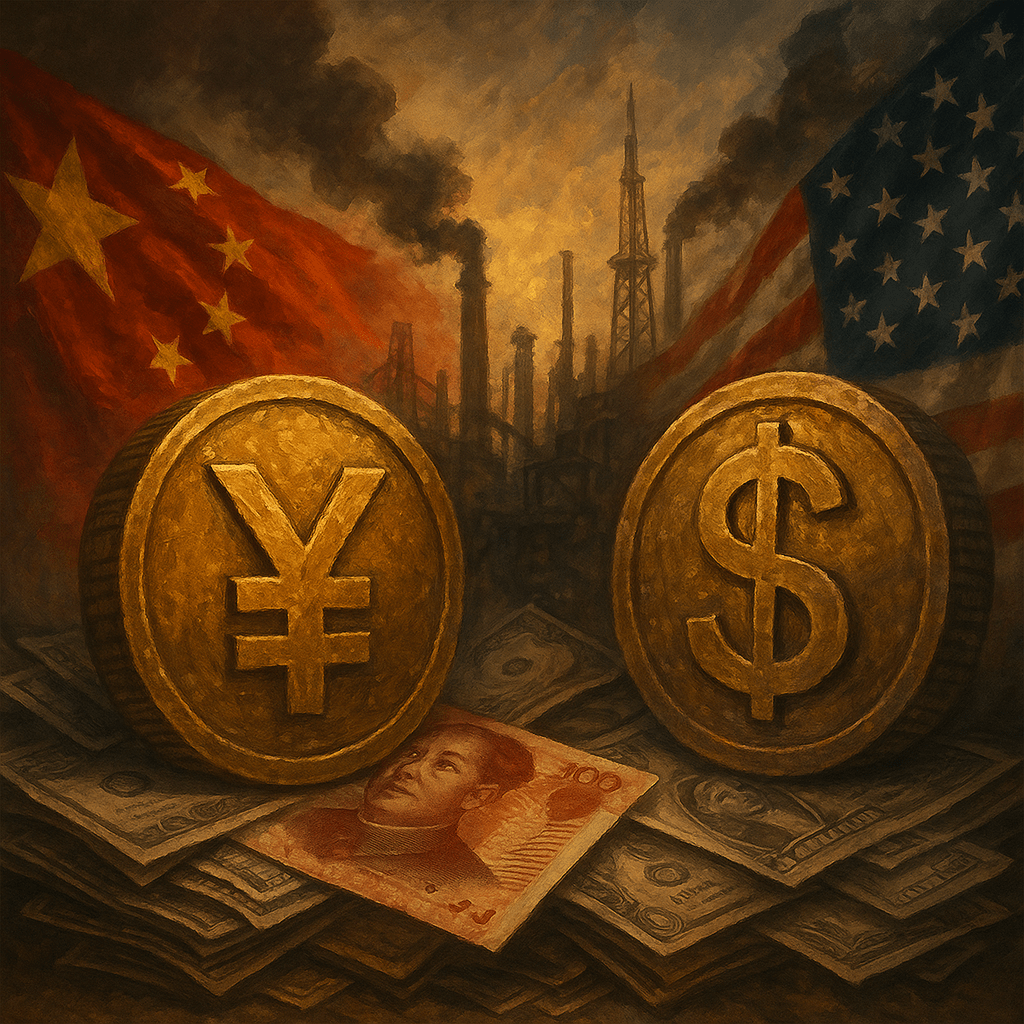
China has led efforts to reduce global dependency on the U.S. dollar — expanding bilateral trade in local currencies (yuan-ruble, yuan-riyal, etc.), launching a digital yuan, and supporting regional payment systems outside of SWIFT’s surveillance architecture.
De-dollarization strikes at the heart of U.S. imperial financial dominance. - Technological Sovereignty:
Facing U.S. chip sanctions, China has accelerated domestic production of semiconductors, 5G infrastructure, quantum computing, and AI technologies — ensuring that future global technological standards are not dictated solely by Silicon Valley and Washington. - South-South Labor and Production Alliances:
By forging manufacturing partnerships across ASEAN, Africa, Latin America, and Central Asia, China is building a distributed industrial ecosystem that reduces vulnerability to imperialist blackmail or chokepoint sabotage.
China’s counteroffensive is not only economic.
It is geopolitical, technological, infrastructural, and ideological — based on the historic understanding that no empire lasts forever, and that survival under siege requires both flexibility and strength.
While U.S. imperialism clings to coercion and siege tactics, China builds bridges — literal and figurative — across continents.
While the technofascist empire militarizes oceans, China lays fiber-optic cables under them, rails over them, and roads through them.
In the long war of logistics, technology, finance, and ideology, China’s multipolar counteroffensive is systematically eroding the material foundations of imperial dominance.
It is not China that is desperate.
It is imperialism that is cornered — and bleeding through every ruptured supply chain, every bypassed dollar transaction, every liberated corridor of sovereign development.
VI. The World Won’t Be Recolonized
Behind the headlines and sanitized economic forecasts, this is what’s really happening:
The United States — the declining center of global imperialism — is waging a total economic, technological, and informational war to preserve a crumbling system of global domination.
And China, through material adaptation and strategic counteroffensive, is refusing to bow.
What Bloomberg paints as a “desperate rerouting of supply chains” is in fact a profound recalibration of the global economy — away from Western monopolies, and toward sovereign, multipolar development.
What the U.S. calls “decoupling” is actually self-isolation.
What it frames as “friendshoring” is just recolonization by another name — and it is already falling apart.
China is not alone in this resistance.
Every nation forced to choose between starvation and submission, between dependence and dignity, is watching — and many are joining.
Through BRICS+, through de-dollarization, through Belt and Road, through South-South integration, the architecture of imperial control is being dismantled — corridor by corridor, pipeline by pipeline, strike by strike.
This is the real battle unfolding behind the logistics reports and tariff spreadsheets.
It’s a war over who gets to shape the future:
a dying empire that extracts and destroys, or a rising coalition that builds and defends sovereignty, even under siege.
The U.S. cannot recolonize the 21st century.
Not through bombs, not through blockades, not through Bloomberg.
Weaponized Information exists to make that fact unignorable.
To arm the people — intellectually and ideologically — for this global realignment of power.
To expose every lie of empire, and affirm every act of adaptation, every pivot, every refusal as part of a global offensive against imperialist supremacy.
Let the imperialists panic.
Let their analysts lie.
Let their sanctions stack up like crumbling bricks.
This world is not theirs to dominate anymore.
China is adapting.
The South is rising.
And the world won’t be recolonized.
 Weaponized Information
Leave a comment