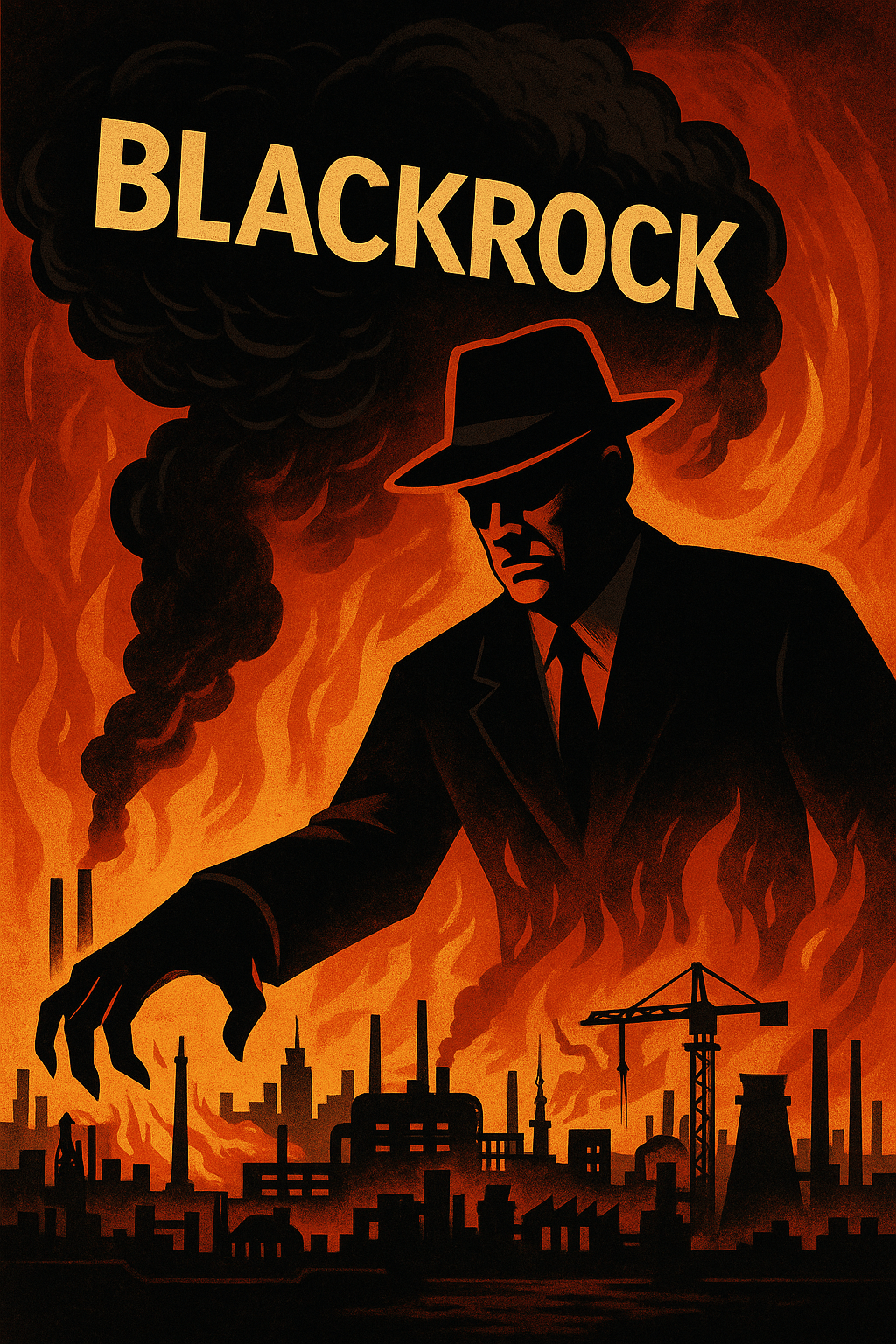
By Prince Kapone | Weaponized Information | April 29, 2025
I. Propaganda by Investment: Who Built the Narrative and Who Benefits
Every empire needs its scribes. And in the age of technofascism, those scribes wear tailored suits, run media conglomerates, and write propaganda dressed as business journalism. Fortune Magazine is one such operation — and their latest love letter to BlackRock’s economic conquest of the United Kingdom is a masterclass in imperial narrative laundering.
On the surface, the article appears as a glowing profile of Larry Fink, CEO of the world’s largest asset manager. It frames Fink as a savvy investor making a bold contrarian bet — doubling down on the “undervalued” UK economy while others panic. It positions BlackRock as a stabilizing force, bringing capital and confidence back to Britain amid a dark economic outlook. But beneath this surface lies a sophisticated apparatus of ideological manipulation — and a set of talking points that must be dissected and destroyed.
Talking Point #1: “The UK has discovered its capitulation point.”
Presented as a moment of clarity and renewal, this phrase is perhaps the most chilling in the entire piece. What does Larry Fink mean by “capitulation”? He’s not talking about macroeconomic indicators or policy shifts. He’s talking about class surrender. About the moment when a society — exhausted by austerity, demoralized by economic precarity, and abandoned by its own state — finally drops its resistance and allows finance capital to take full control. In this framework, poverty, deregulation, and despair aren’t crises — they’re prerequisites for conquest.
Talking Point #2: “The market is undervalued.”
This is standard capitalist euphemism. In plain terms, it means public assets, companies, and infrastructure are being liquidated at fire-sale prices. BlackRock isn’t investing out of confidence in Britain’s long-term trajectory — it’s moving in because the country has been economically gutted. The market is “undervalued” because the working class has been disciplined, public resistance has been neutralized, and the state is handing over the keys to Wall Street.
Talking Point #3: “The Labour government’s pro-growth agenda.”
Fortune parrots this phrase with no critique. But what does “pro-growth” mean in this context? It means deregulation, privatization, and austerity repackaged as reform. It means dismantling what’s left of the public sector and opening every corner of the economy to global finance. Starmer isn’t rebuilding Britain — he’s preparing it for recolonization by capital. And Fortune is helping him do it.
Talking Point #4: “Public pessimism is overblown.”
Fortune acknowledges that public sentiment is at its lowest point since 1978 — yet immediately pivots to Fink’s “cheerier” outlook. The implication is clear: the people don’t know what’s good for them, but the billionaire investor does. It dismisses working-class despair as irrational while valorizing elite confidence as visionary. This is propaganda meant to delegitimize popular consciousness and elevate ruling-class optimism as truth.
Talking Point #5: “Fink wants to unify his 3,000 London employees under one roof.”
This detail, seemingly innocuous, is actually telling. It reveals the scale of BlackRock’s institutional power — thousands of employees already embedded in the UK economy, with plans to expand further. But Fink’s frustration isn’t about space — it’s about speed. He wants to build an HQ because existing real estate isn’t sufficient for his imperial footprint. This is not mere investment. It’s occupation.
Who Built This Narrative?
Fortune Magazine is owned by Chatchaval Jiaravanon, a billionaire member of Thailand’s powerful CP Group dynasty. CP Group is both:
- A major business partner of BlackRock, which holds shares in CP-affiliated companies like CP All, CP Foods, and True Corp.
- An active collaborator seeking BlackRock’s investment to back acquisitions (such as Seven & i in Japan) and expand its global reach.
This means Fortune’s “journalism” is not neutral. It is class warfare by proxy — a media arm of comprador capital celebrating the looting of a collapsed former empire by global finance.
Who Benefits?
- BlackRock gains more control over Britain’s financial and real estate sectors, profiting off collapse.
- CP Group gains ideological proximity and business leverage through its media outlet’s support.
- Wall Street and the technofascist bloc strengthen their position in Europe amid growing multipolar realignment and U.S. financial realignment under Trump 2.0.
Who Pays the Price?
- The British working class, whose pensions, public services, and social protections are being gutted for investor returns.
- British sovereignty, as more national functions are transferred to foreign monopolies and corporate cartels.
- Democracy itself, replaced by technocratic governance directed by billionaires, not ballots.
In the final analysis, the “capitulation point” is not just a metaphor for British economic exhaustion. It is a celebration of conquest — a public declaration that the class war has been won, and the pillaging can proceed.
Our task now is to expose every talking point for what it is: a bullet fired in the name of capital, aimed at the heart of a defeated people.
But we’re not done yet. Now we tear the mask off the so-called facts.
II. Extracting the Objective Facts from Fortune’s Narrative
Once we cut through the ideological fog, what remains are the raw facts — buried under layers of euphemism, investor optimism, and media choreography. Let’s excavate what the Fortune article actually reveals — not what it pretends to say.
1. BlackRock is going all in on the UK — “across the board.”
Larry Fink makes it clear: BlackRock is aggressively acquiring UK assets, including major stakes in finance firms like NatWest, Lloyds, and St. James’s Place. This is not selective investment — it’s a structural realignment of capital, targeting Britain as a front for high-return extraction.
2. “Capitulation point” signals peak investor opportunity.
Fink isn’t betting on long-term growth. He’s betting that the UK has been beaten into submission. The economic discipline of austerity, deregulation, and privatization has softened the ground for rapid capital expansion — without resistance from unions, public institutions, or regulatory agencies.
3. Labour’s “pro-growth” agenda is investor-friendly neoliberalism.
Fortune presents Labour’s new leadership under Keir Starmer as pragmatic and “focused on hard issues.” What it omits is that Starmer has adopted much of the Tory economic playbook: no reversal of austerity, no meaningful public ownership agenda, and open courting of private capital. This is what Fink calls “resonant.”
4. BlackRock is bullish in the face of public pessimism.
Despite widespread economic despair in the UK — with a record 75% of the population expecting things to get worse — Fink sees a strategic window. According to Ipsos MORI’s Economic Optimism Index, British public sentiment is worse than during the 2008 crash or the 1980s global recession. BlackRock isn’t blind to this. It’s banking on it — as a sign that conditions are ripe for total acquisition.
5. Billionaire exodus underscores elite fracture, not recovery.
In contrast to Fink’s optimism, UK billionaires like the Livingstone brothers are fleeing. This isn’t because of anti-capitalist hostility — it’s because even the super-rich know the UK is no longer a safe long-term capital haven. The rich are retreating. BlackRock is consolidating. This is a classic imperial pattern: private capital fills the vacuum left by a collapsing national bourgeoisie.
6. Economic indicators confirm structural decline.
- The UK’s Purchasing Managers’ Index (PMI) dropped to its lowest level since 2022, indicating shrinking business activity.
- Reports cite declining investor confidence and rising fears of a tariff-induced recession as the Trump administration threatens retaliatory trade penalties.
- Public finances remain squeezed, with welfare, energy subsidies, and pensions on the chopping block — all to attract private capital and “rebalance” the budget.
7. BlackRock wants more physical presence — and real estate control.
Fink is not just buying stock — he’s complaining about a lack of physical office space. With over 3,000 employees already in London, BlackRock is preparing to expand its physical and political footprint. Fink laments not being able to break ground on a new HQ. Translation: capital wants to dig in — literally.
8. BlackRock was courted directly by the Labour government.
According to Bloomberg, Chancellor Rachel Reeves and other Labour figures have actively lobbied BlackRock and other financial firms to “rebuild Britain.” This is the post-democratic era in motion: national economic strategy now means convincing asset managers to colonize your economy for you.
9. Fink’s outlook shifted after regime change.
Fink’s optimism is “cheerier” than it was during Sunak’s tenure — not because of a change in material conditions, but because the political mood has turned fully toward deference to capital. Starmer and his cabinet are not adversaries to BlackRock. They are managers for its interests.
What all of these facts reveal is simple: this is not a story of renewal. It is a story of structural collapse being exploited by global capital — rebranded as “confidence.”
The numbers don’t lie. The public is in despair. The institutions are gutted. The economy is in freefall. And Wall Street — through BlackRock — is moving in like a vulture over a carcass.
Now that we’ve unearthed the facts, we’ll plug them back into the machine they came from — and expose the larger historical and imperial structure that birthed this moment.
III. Contextualizing the British Crisis: Imperial Decay and Financial Colonization
The fall of Britain is not an isolated accident. It is the logical, inevitable outcome of imperial decline in the age of technofascist hyper-imperialism. What we are witnessing is the collapse of a former colonial power — not under bombs or foreign invasion — but under the far more efficient instruments of neoliberal austerity, financial warfare, and class betrayal from within.
The Long Arc of Decline
Since the end of World War II, Britain’s role as a global imperial hegemon has eroded. First, it lost its colonial possessions; then, it lost its industrial base; now, it loses even the illusion of sovereignty.
The seeds of this collapse were sown through decades of neoliberal restructuring:
- Thatcherism gutted the unions, sold off public housing, and privatized critical industries.
- Blair’s New Labour entrenched financial deregulation, tied Britain’s economy to Wall Street, and deepened the service-sector dependency model.
- Brexit severed Britain from its largest trading bloc while offering no viable alternative path for industrial or economic revival.
- COVID-19 exposed the rot in Britain’s public health, logistics, and governance systems — leading to mass death, economic paralysis, and skyrocketing inequality.
Each stage of collapse created new openings for financialization, privatization, and asset stripping. Each wave of crisis was met not with reconstruction — but with deeper submission to global capital.
The Financialization of a Dying Empire
Britain’s economy today is not a productive economy — it is a renter economy. An economy where profits come not from producing goods, but from extracting rents through finance, insurance, real estate, and speculation.
- The City of London — once the merchant capital of empire — now functions as a pirate ship for global finance, laundering wealth while cannibalizing its own domestic economy.
- The housing market has been transformed into an asset class for foreign investors and private equity — pricing out millions of working-class Britons from basic shelter.
- The National Health Service (NHS), once a beacon of social progress, has been hollowed out by privatization, outsourcing, and underfunding — preparing it for eventual acquisition by corporate interests.
This is not “mismanagement.” It is design. The British economy has been deliberately restructured into a carcass — primed for vulture capital to pick clean.
Britain’s “Capitulation Point” Was Decades in the Making
By the time Larry Fink declared Britain ready for conquest, the country had already been softened through a thousand cuts:
- Decades of austerity left public services in ruins.
- Deindustrialization gutted the working class, concentrated wealth in finance and real estate, and shattered the social fabric of industrial towns.
- Brexit was leveraged not for sovereignty, but to further deregulate markets, suppress wages, and attract capital through desperation.
- COVID mismanagement accelerated death, debt, and despair — and transferred even more public wealth to private hands.
- Trump 2.0’s economic war (through tariffs and financial bullying) isolates Britain further, making it even more dependent on Wall Street’s mercy.
Thus, the “capitulation” Fink sees is not a sudden shift — it is the final stage of a managed decline engineered by Britain’s own comprador elites and their American financial patrons.
The Labour Party as Capital’s Custodian
Keir Starmer’s Labour Party does not represent a break with this trajectory — it is its continuation. Starmer’s so-called “pro-growth” platform amounts to a public pledge to international finance: Britain is open for business, open for asset stripping, open for recolonization.
Gone is the language of public ownership, worker empowerment, or democratic economic planning. In its place: deregulation, privatization, and full-spectrum submission to Wall Street.
BlackRock’s bullishness is not based on hope. It is based on foreknowledge. They know the new Labour government is their subcontractor — tasked with managing Britain’s transition from decaying state to fully financialized colony.
The Logic of Imperialism Reversed
Once, Britain imposed financial dictatorship on India, Africa, and the Caribbean. Today, the descendants of that empire are learning a brutal lesson: what they once exported, they now experience.
Hyper-imperialism, technofascism, and global capital accumulation do not respect national flags. They do not spare former masters of empire. They devour all who fall — whether in Lagos or London, Karachi or Kent.
Britain’s working class — battered, betrayed, and burdened by memories of imperial glory — now stands as the newest victim of the very system their ancestors helped build.
There is no special exemption. There is no imperial karma to save them.
Only one law now governs: submit, or resist.
Next, we expose how this technofascist strategy is being applied systematically — and why BlackRock’s conquest of Britain is just the beginning.
IV. Exposing the Real Strategy: Hyper-Imperialist Extraction and Britain as Test Case
The Fortune article presents BlackRock’s investment in Britain as a moment of faith — a vote of confidence in a struggling economy. But beneath this façade lies the true nature of the strategy: hyper-imperialist extraction.
This isn’t about rebuilding Britain. It’s about converting national collapse into global profit. BlackRock isn’t gambling on British recovery — it’s orchestrating a transfer of sovereignty from a decaying nation-state to the dictatorship of capital. The UK is the laboratory. The model. The test case for what comes next in a collapsing imperial core.
“Capitulation” as Capitalist Doctrine
Fink’s use of the term “capitulation point” is not offhand — it is doctrinal. It refers to the stage at which a people have been sufficiently broken by crisis, sufficiently demoralized by propaganda, and sufficiently isolated by policy that capital can seize total control with little resistance.
This is not a metaphor. It’s a milestone — a red flag on the monopoly capitalist roadmap that says: “It’s time. Move in.”
Asset Stripping Disguised as Investment
BlackRock’s “across the board” acquisitions aren’t long-term bets on British productivity. They are opportunistic seizures of undervalued infrastructure, services, and financial institutions made cheap by engineered crisis. This includes:
- Purchasing controlling interests in high-yield finance firms like NatWest and Lloyds.
- Expanding real estate holdings amid a commercial property collapse, ensuring control over land, logistics, and city centers.
- Positioning to acquire infrastructure — telecoms, energy, transportation — as austerity forces further privatization.
This is not “investment.” This is colonial looting with spreadsheets. And just like in the Global South, the IMF isn’t needed when Wall Street can do it directly.
The UK as the Panama Canal of the North
This operation mirrors BlackRock’s financial coup in Panama. There, a U.S. proxy government ousted Chinese infrastructure contracts and handed port operations to a BlackRock-led consortium — consolidating Washington’s grip over a major logistics chokepoint.
Now, the UK serves a similar purpose: not as a logistics hub, but as a political and financial chokepoint in Europe. By conquering the UK economy:
- BlackRock gains strategic leverage over EU finance and energy policy via London.
- Wall Street controls a key node of NATO’s soft-power influence and wartime economic coordination.
- The U.S. empire projects capitalist dominance deeper into Europe — bypassing public resistance and democratic procedure.
Britain has become a financial Gibraltar — not a stronghold for national defense, but a fortress for imperial accumulation.
Technofascism by Other Means
BlackRock’s role in Britain is not limited to finance. It’s an extension of the technofascist model:
- Through asset ownership, BlackRock dictates policy not through votes, but through capital flows.
- Through ESG narratives, it enforces ideological discipline — redefining austerity and deregulation as “sustainability.”
- Through partnerships with media like Fortune, it manufactures legitimacy and suppresses critique.
This is how finance capital governs in the 21st century: not by lobbying governments, but by becoming the government.
And Make No Mistake — This Is a Test
Britain is not the endgame. It’s the pilot program. A failed imperial power with just enough infrastructure, just enough global credibility, and just enough political obedience to serve as the perfect proving ground.
What they do in Britain will be exported:
- To Italy, Greece, and France — already buckling under debt, austerity, and political fragmentation.
- To Japan and South Korea — increasingly militarized and financially precarious.
- And eventually to the United States itself — where the same strategy is already underway in Detroit, New Orleans, and entire sectors of the post-industrial Midwest.
This is not speculative. It is already happening. And BlackRock is the spearpoint.
It is not just a company. It is an imperial instrument. A soft-power weapon. A boardroom army operating under the banner of finance, backed by the force of the U.S. state, and defended by a global media complex that prints conquest as investment and suffering as growth.
The UK is only the beginning.
And if we don’t name it, expose it, and confront it — it won’t be the last.
V. Revolutionary Reframing: Wall Street Didn’t Save Britain — It Bought It
The time for illusions is over. Larry Fink is not a savior. BlackRock is not “investing” in Britain — it is buying a collapsed colony. And Fortune Magazine isn’t reporting the news — it’s cheering the conquest.
What the capitalist press calls a “capitulation point” is, in revolutionary terms, the moment of maximum vulnerability for the working class. It’s the moment when privatization appears inevitable, when resistance feels futile, and when despair is so deep that imperialism walks in through the front door unopposed. This is not investment — this is recolonization through capital.
The False Savior: Finance Capital as Neo-Colonial Governor
There is no recovery plan. There is no economic sovereignty. There is only financial occupation.
- BlackRock owns your hospitals, your housing, your pensions, your debt.
- They control your politicians, your public discourse, your infrastructure strategy.
- And when the economy collapses, they don’t suffer — they buy.
This is not a “British recovery” — it’s a British liquidation. A country put on the auction block, its working class asked to smile while their lives are turned into dividends.
The New Feudalism: Rentier Imperialism in the Heart of Europe
Under technofascism, there is no need to drop bombs or install puppet regimes. You just buy the country and rent it back to its own people.
- Housing becomes a global asset, priced by absentee landlords.
- Energy becomes a privatized chokehold, throttled for shareholder value.
- Public transport, hospitals, pensions, water — all turned into speculative capital flows.
The British people are no longer citizens — they are tenants in a global empire of finance.
The Starmer Illusion: Labour as Middle Management for Wall Street
What the Tories began, Starmer’s Labour is finishing. Fortune praises Labour’s “pro-growth” agenda, but let’s call it what it is: a mass surrender of political power to unelected financial oligarchs.
- The UK no longer debates what kind of society it wants — it debates what BlackRock will allow.
- The political class no longer governs — it facilitates the desires of finance capital, packaging austerity as “efficiency” and privatization as “innovation.”
Democracy in Britain is a hollowed shell.
The only real government now is the boardroom.
Resistance Is Still Possible — But Only With Revolutionary Clarity
The answer is not a gentler capitalism or a more “socially conscious” investor. The answer is not in ESG metrics or stakeholder capitalism. The answer is to reclaim power from finance itself.
To do that, we must reject every lie they’ve told:
- That the market knows best.
- That there is no alternative to privatization.
- That growth must come at the expense of sovereignty.
- That recovery is impossible without Wall Street’s permission.
We must name the enemy clearly: not just BlackRock, but the system of monopoly finance capital that governs without elections, colonizes without armies, and destroys without bullets.
This is not just about Britain. This is about every worker, every tenant, every nurse, teacher, and pensioner in the imperial core and across the Global South who has ever been told their suffering is necessary for “economic growth.”
Britain did not collapse because socialism failed. It collapsed because capitalism succeeded — in transferring wealth upward, transferring power away from the people, and transferring sovereignty to capital.
The answer is not to beg for inclusion in this machine.
The answer is to smash it — and build something human in its place.
VI. Militant Conclusion: From Capitulation to Class War
They call it a “capitulation point.”
We call it a flashpoint.
A moment where the illusions fall away.
Where the mask of investor benevolence cracks.
Where we see clearly — not just who rules, but how they rule.
And we decide: we will not be ruled like this anymore.
BlackRock did not “save” the UK. It did what imperial capital always does — wait for the collapse, then buy the ruins.
This is not new. It is the same model the empire deployed in Chile, in Greece, in Detroit, in Panama — only now it wears a tie, not a uniform. It signs contracts, not coup decrees. It smiles for interviews instead of marching with bayonets.
But the result is the same: a conquered people, a stolen economy, a hollowed state.
What Comes Next?
If this model is allowed to succeed in Britain, it will be exported everywhere.
The same playbook — financial warfare, manufactured crisis, media collaboration, privatized recovery — will be deployed across Europe, the Global South, and eventually even inside the U.S. itself.
This is the vanguard of technofascism — not a turn away from empire, but its consolidation through finance, surveillance, and algorithmic control.
And make no mistake: it will not stop with pensions and public housing. It wants everything.
But There Is Another Way
The truth is simple: there is no democracy under capitalism.
Not when private capital governs our lives more completely than any parliament.
Not when Wall Street dictates national policy, and billionaires become unelected emperors.
We don’t need more “responsible investing.” We don’t need better PR from BlackRock.
We need revolutionary confrontation with the global financial dictatorship.
Reclaim the Future — Or Be Sold It Back at Interest
The British people must reject their role as renters in their own country.
The working class must recognize that no party, no politician, no private “investor” will save them.
Only organized resistance, guided by revolutionary clarity, will break the chains.
This means:
- Seizing back public assets from private hands.
- Shattering the control of firms like BlackRock through direct confrontation, not negotiation.
- Building alliances across borders to combat the unified front of global finance.
- Reconstructing sovereignty, not through nationalist nostalgia, but through proletarian internationalism and democratic ownership of the means of life.
Because if we don’t — if we continue to believe that investment equals salvation, that capital has a conscience, that Wall Street can be reasoned with — we will be made slaves on the very land we were born on.
Let it be known: Britain is not a failure.
It is a warning.
And what we do next determines whether that warning becomes a prophecy — or a rallying cry.
From capitulation to class war.
From finance to freedom.
From technofascism to liberation.
The line has been drawn.
The time to choose a side is now.
 Weaponized Information
Leave a comment