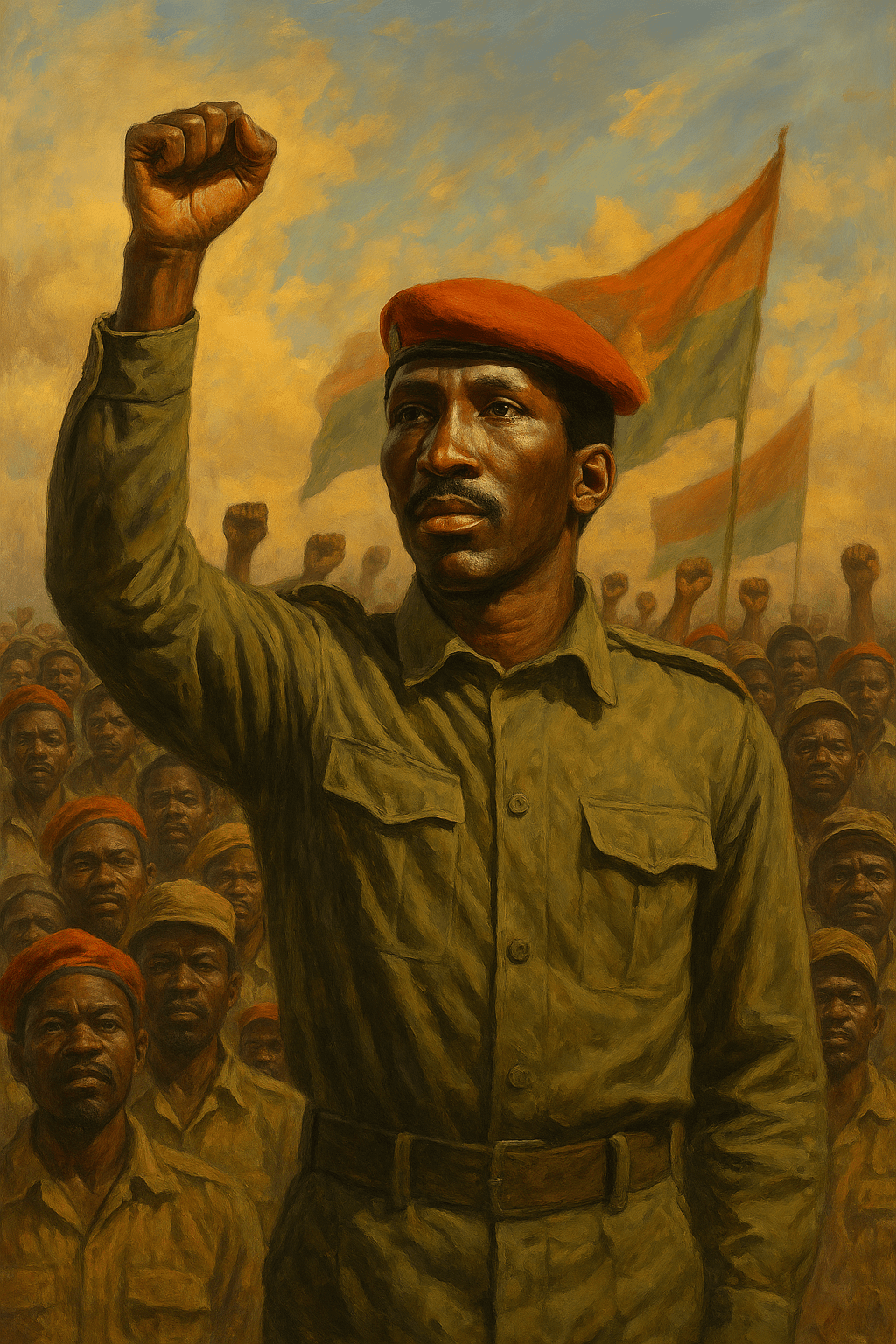
Thomas Sankara: The Upright Man and the Struggle for a Free Africa
Revolutionary Legacy Series | Weaponized Information
Epigraph:
“You cannot carry out fundamental change without a certain amount of madness. It comes from nonconformity, the courage to turn your back on the old formulas.”
— Thomas Sankara
Introduction
Thomas Sankara was not simply a political leader. He was the living embodiment of what it means to build revolution under siege, to govern not with privilege but with sacrifice, and to refuse the chains of debt, dependency, and despair crafted by imperialism for the Global South. In four short years—from 1983 until his assassination in 1987—Sankara transformed Burkina Faso from one of the most exploited corners of the world into a laboratory of revolutionary hope. He launched mass literacy programs, liberated women from feudal shackles, fought desertification, and made his country nearly self-sufficient in food production—all while refusing aid from the very imperialist institutions designed to keep Africa on its knees.
His government built schools, hospitals, railroads, and irrigation systems without falling into the traps of World Bank loans or IMF “assistance.” His words before the Organization of African Unity in Addis Ababa—denouncing debt as a form of neocolonialism—still thunder across generations of revolutionaries. His audacity, his discipline, and his devotion to the working and peasant classes of Africa made him a target—not only for his internal enemies, but for the global ruling class.
This is no neutral history. We do not judge Thomas Sankara by the standards of the imperialists or the comprador classes who assassinated him. We judge him by the standards of the colonized masses he fought for. We at Weaponized Information honor Sankara as he lived: upright, unbowed, and uncompromising. He was not a “benevolent reformer” or a “charismatic leader” in the liberal sense. He was a revolutionary who wielded power as a weapon of liberation—and paid the ultimate price for it.
This biography is written in that spirit. It is an attempt not just to remember Sankara, but to study him as a guide for the revolutionary struggles of our time. It is a tribute from the colonized and oppressed to one of their greatest sons.
Part I: Origins of a Revolutionary (1949–1966)
Thomas Isidore Noël Sankara was born on December 21, 1949, in Yako, a dusty town in the northern reaches of what was then French Upper Volta. He came into a world defined by colonial degradation, where African life was cheap and African futures were chained to the fortunes of French imperial capital. His father, Joseph Sankara, had served in the French army during World War II—a reminder of the empire’s ability to conscript Black bodies to fight its wars while denying them dignity at home. His mother, Marguerite, nurtured in him a fierce spirit of independence.
Young Sankara witnessed the grinding poverty, feudal hierarchy, and racial humiliation that defined colonial life. But unlike many of his contemporaries, he refused to accept it as natural. From an early age, he showed signs of nonconformity: questioning authority, excelling academically, and pushing against the inherited fatalism of his social environment.
In 1962, he enrolled in a military academy in Kadiogo, Ouagadougou—the capital. There, he received a colonial education designed to produce obedient administrators for the French-controlled African states. But Sankara absorbed something different. In military discipline, he saw not a tool of colonial repression, but a possible instrument of liberation. At the academy, he was exposed to broader political ideas, including anti-imperialist currents sweeping the continent: the Algerian Revolution, Ghana’s independence under Kwame Nkrumah, and the writings of Frantz Fanon.
More crucially, Sankara’s brilliance earned him a scholarship to study in Madagascar in 1970. There, at the Antsirabe military academy, he encountered a volcanic political climate: student protests, labor strikes, and a leftist uprising against the neo-colonial government. In Madagascar, Sankara was radicalized. He devoured Marxist-Leninist literature, studied the Chinese and Cuban Revolutions, and witnessed firsthand the explosive power of mass mobilization.
By the time he returned to Upper Volta in 1973, Sankara was no longer merely a soldier. He was a revolutionary in uniform. A man convinced that colonialism was not a historical accident but a living system—and that liberation would require not polite reforms, but a social revolution led by the oppressed themselves.
Part II: A Soldier and a Revolutionary Mind (1966–1973)
Upon his return to Upper Volta in 1973, Thomas Sankara entered a country still shackled to the whims of French imperialism. The formal flag of independence had been raised in 1960, but the economic, political, and cultural realities of colonial domination remained deeply entrenched. The army, into which Sankara was integrated as a young officer, reflected these contradictions. It was a force trained to defend borders drawn by Europeans, to preserve elites installed by colonial compromise, and to discipline the poor, not liberate them.
But Sankara was not content to play the role assigned to him. He immersed himself in revolutionary study even within the barracks. He taught Marxism and anti-imperialist thought informally to soldiers and lower-ranking officers. He organized study circles and clandestine political discussions. For him, the military could be more than an instrument of repression — it could become a motor of transformation, provided it was ideologically purified and tied directly to the working class and peasantry.
During this period, Sankara began building alliances beyond the army. He forged strong relationships with militant trade unions, radical student groups, and peasant organizations. His growing reputation as an incorruptible patriot and a disciplined revolutionary made him stand out in a sea of cynical opportunists who dominated Voltaic political life.
In 1976, alongside other like-minded soldiers such as Blaise Compaoré and Jean-Baptiste Lingani, Sankara helped found the clandestine “Communist Officers’ Group” (Regroupement des officiers communistes, ROC). This underground revolutionary nucleus was committed to overthrowing neocolonial domination and creating a popular revolutionary government. It was a calculated risk: discovery could mean prison or death. But Sankara understood that the path to emancipation required the conquest of state power—not its avoidance.
By the late 1970s, as political crises deepened in Upper Volta and mass discontent simmered, Sankara’s dual reputation as a brilliant military strategist and a principled revolutionary placed him increasingly in the crosshairs — both of the Voltaic ruling class and their French patrons. Yet he remained steadfast, refusing every offer of personal advancement that required the abandonment of his revolutionary commitments.
The stage was being set. A new kind of leader — one shaped not by colonial universities or foreign capitals, but by Africa’s villages, fields, and working-class struggles — was preparing to step into history.
Part III: Rise of a Revolutionary Leader (1973–1983)
Throughout the 1970s, Thomas Sankara moved steadily from revolutionary organizer to a national figure of growing influence and controversy. His loyalty to the working classes, his refusal to enrich himself, and his clarity of purpose made him beloved among youth, workers, and peasants—but a dangerous threat to the neocolonial elites and their French backers.
In 1981, Sankara was appointed Secretary of State for Information under the military-led government of Colonel Saye Zerbo. It was a strategic opportunity, and Sankara used the position to promote transparency, denounce corruption, and advocate for radical reforms. But his revolutionary honesty quickly made him an internal enemy. Frustrated by the regime’s unwillingness to break with French neocolonialism, he resigned in protest in 1982, famously stating: “Misery and hunger are not prerequisites for dignity. We refuse to beg.”
His resignation electrified the masses and enhanced his reputation as a principled revolutionary. In 1983, after a series of chaotic shifts in the Voltaic government, Sankara was named Prime Minister under the short-lived presidency of Jean-Baptiste Ouédraogo. From that post, Sankara intensified his criticism of the ruling order, meeting openly with Libyan, Cuban, and Ghanaian revolutionaries, and mobilizing a broad base of support across the country.
But the neocolonial powers moved swiftly. Under pressure from France and internal elites, Sankara was arrested and imprisoned on May 17, 1983. His arrest triggered mass uprisings across the country, especially among students, trade unionists, and junior soldiers. Demonstrations, strikes, and barricades erupted in Ouagadougou and beyond, demanding his immediate release.
On August 4, 1983, the tide turned. In a coordinated uprising led by Blaise Compaoré and other revolutionaries within the army, Sankara was freed and swept into power. The military barracks became the spark of a national revolution. The old colonial name “Upper Volta” was thrown into the dustbin of history. Sankara renamed the country Burkina Faso — “The Land of Upright People.” It was not a mere rebranding; it was a declaration of a new path: one of dignity, sovereignty, and popular revolution.
In one bold move, Sankara had broken the cycle of neocolonial subservience. He stood not as a puppet of the West, nor as a comprador in uniform, but as the living embodiment of the dreams of the colonized. The Burkina Revolution had begun.
Part IV: The August Revolution and Building the New Burkina Faso
With the successful August 4, 1983 uprising, Thomas Sankara and the Council of the National Revolution (CNR) launched one of the most ambitious and daring revolutionary projects of the late 20th century. Sankara did not seize power to occupy office. He seized it to dismantle the colonial state, root and branch, and to build a new society from below.
From the outset, the Burkina Revolution broke decisively with the formulas of Western-backed “development.” Sankara emphasized mass mobilization, self-reliance, and the dignity of labor. “He who feeds you, controls you,” he declared, inaugurating a national campaign for food self-sufficiency. In just four years, Burkina Faso doubled its wheat production, achieved near-complete food sovereignty, and dramatically reduced its dependence on imported staples.
The revolution placed women at the center of the struggle. Sankara banned forced marriages, criminalized female genital mutilation, and appointed women to high government positions. He created a Women’s Brigade in the revolutionary armed forces and insisted: “The Revolution cannot triumph without the liberation of women.” In a continent still scarred by patriarchy and feudal oppression, this was nothing short of seismic.
Environmental restoration was another front of struggle. Sankara initiated mass reforestation projects, building “green belts” to fight desertification. Millions of trees were planted. Local communities were organized to rehabilitate land and water resources. Environmental protection was framed not as a luxury, but as a revolutionary necessity.
Politically, the revolution decentralized power through the creation of Committees for the Defense of the Revolution (CDRs)—popular assemblies at the village, neighborhood, and workplace level. These organs became schools of self-governance, education, and vigilance against counterrevolutionary activity. The CNR also dismantled the bloated bureaucracies of the old colonial state and rooted out corruption with militant discipline.
Sankara slashed the salaries of government ministers (including his own), sold off the fleet of government Mercedes Benz cars, and replaced them with humble Renault 5s—the cheapest car available in Burkina Faso. Symbolism mattered. Sankara lived modestly, refusing the privileges that so often rot revolutionary leadership from within.
Health and education were revolutionized. In a single week, over 2.5 million Burkinabé were vaccinated against meningitis, yellow fever, and measles—one of the fastest mass vaccination campaigns in African history. Primary school attendance skyrocketed. Literacy campaigns mobilized tens of thousands. The Revolution did not wait for foreign “aid”; it moved on the energy and creativity of its own people.
In every field, the Burkina Revolution advanced a simple but profound truth: that the colonized can build their own future without charity from their oppressors. Sankara’s government showed that a small, poor, landlocked African country—if guided by revolutionary principles and organized mass action—could stand tall in the face of global imperialism.
Part V: Sankara and the Global Stage (Internationalism and Confrontation with Empire)
Thomas Sankara understood that Burkina Faso’s revolution was inseparable from the wider struggle against imperialism worldwide. From the beginning, he cast the destiny of his small nation as bound up with the liberation of Africa and the Global South as a whole. His internationalism was not rhetorical—it was militant and practiced.
Sankara forged strong ties with revolutionary states and movements: Cuba under Fidel Castro, Libya under Muammar Gaddafi, Ghana under Jerry Rawlings, Mozambique’s FRELIMO, Angola’s MPLA, and South Africa’s ANC. Burkina Faso became a training ground and safe haven for African revolutionaries, just as Guinea under Sékou Touré had been a generation earlier. Sankara viewed these alliances not as “diplomacy” but as building blocks of a future Pan-African socialist federation.
His speeches on the international stage electrified oppressed peoples and terrified imperialists. Most famously, in 1984 at the United Nations General Assembly, Sankara delivered a fiery denunciation of colonialism, racism, and capitalist exploitation. Speaking for the “wretched of the earth,” he lambasted the Western powers for their hypocrisy, called for the dismantling of apartheid, and reaffirmed the right of all peoples to self-determination.
In 1987, at the Organization of African Unity (OAU) summit in Addis Ababa, Sankara delivered what would become one of his most legendary interventions. He called for a collective African refusal to pay the odious foreign debts imposed by former colonial powers. “Debt is a cleverly managed reconquest of Africa,” he thundered. “Those who led us into debt were gambling… We cannot pay, and we will not pay!” His call to action was met with thunderous applause from the African masses—and deep alarm from Western financial institutions.
But Sankara’s clarity made him a marked man. His uncompromising stance against French neocolonialism, his refusal to be bought by “aid” programs, and his efforts to organize Africa into a collective revolutionary bloc threatened the very foundations of the postcolonial imperialist order.
In the eyes of empire, Sankara had committed the ultimate sin: proving that another path was possible—not just rhetorically, but materially and organizationally. A path based not on dependency, but on dignity. Not on subjugation, but on sovereignty. Not on capitalism, but on socialism.
The noose was tightening. And the forces of reaction were preparing to strike.
Part VI: Contradictions, Challenges, and Betrayal
Revolution is never a straight line. Even as Thomas Sankara and the Burkinabé people achieved extraordinary gains, contradictions within the revolutionary process began to sharpen. Some came from outside—the relentless pressure of imperialist encirclement, economic blockades, and covert operations. Others grew from within—the inevitable frictions of building socialism in a country battered by centuries of colonial underdevelopment.
The revolutionary tempo demanded sacrifice and discipline. But not all sections of the population, especially segments of the petty bourgeoisie and traditional elites, were willing to surrender their privileges. Discontent brewed among traders affected by anti-corruption campaigns, among landlords undermined by land reforms, and even among parts of the officer corps who resented Sankara’s push for egalitarianism within the military itself.
The Committees for the Defense of the Revolution (CDRs), designed to deepen popular power, sometimes fell prey to bureaucratic rigidity or local abuses of authority. Sankara acknowledged these problems openly, insisting on continuous self-criticism and correction. But the pressures were mounting—and not only from internal contradictions.
France, Côte d’Ivoire under Houphouët-Boigny, and other reactionary regimes viewed Sankara’s revolution as a virus that needed to be contained or destroyed. Subversion efforts escalated. Isolation on the international stage deepened. Economic sabotage intensified. And within the inner circles of power, opportunism began to surface.
At the center of this brewing counterrevolution was Blaise Compaoré—one of Sankara’s closest comrades during the August Revolution, but a man increasingly drawn to the siren songs of compromise and personal ambition. Western powers, sensing a crack in the revolutionary front, nurtured it quietly.
In the end, Sankara’s greatest vulnerability was not external. It was betrayal from within. Those who could not match his incorruptible spirit, who could not endure the discipline of revolutionary struggle, became the tools of imperial restoration.
The clock was ticking toward tragedy.
Part VII: The Assassination and the Immortal Legacy
On October 15, 1987, Thomas Sankara was assassinated in a carefully orchestrated coup led by Blaise Compaoré. The man who had once marched beside him now became the instrument of his betrayal. In less than fifteen minutes, the dreams of the Burkina Revolution were drowned in blood.
Sankara was killed alongside twelve of his closest comrades in a hail of gunfire at the headquarters of the National Council of the Revolution. His body was hastily buried in an unmarked grave. Compaoré, backed by imperialist forces eager to restore neocolonial “normalcy,” seized power the same day. In speeches, Compaoré spoke of “rectifying the revolution.” In practice, he dismantled it, brick by brick, returning Burkina Faso to the fold of IMF programs, French tutelage, and comprador rule.
But revolutions are not so easily buried. Though Sankara’s physical body fell, his spirit refused to die. His speeches, writings, and deeds—crystallized in the memories of the people—continued to circulate across Africa and the world. His call for dignity, autonomy, and mass mobilization echoed through every village that remembered free vaccinations, through every field that remembered collective farming, through every school that remembered the spark of literacy.
Sankara’s assassination was not the death of an individual. It was the martyrdom of a revolutionary line. A line that sees the liberation of the colonized as non-negotiable. That understands that imperialism will destroy with one hand while pretending to offer “development” with the other. That insists that sovereignty without socialism is a lie.
Today, Thomas Sankara remains one of the clearest examples of revolutionary leadership in the era of neocolonialism. He demonstrated that the oppressed are not fated to beg at the tables of the rich. They can stand upright. They can build. They can resist—and they can win, even when victory is stolen, because the example itself continues to inspire.
In the fields of Burkina Faso, in the radical student movements of Africa, in the insurgent dreams of the working class worldwide, Sankara still walks. Upright. Unbent. Unbroken.
The Lessons of Sankara for the Global South Today
Thomas Sankara’s life was short, but his revolutionary impact stretches beyond the decades that have passed since his assassination. His commitment to self-reliance, dignity, and organized mass struggle offers a strategic guide for all movements resisting recolonization, technofascism, and the suffocating grip of global capital today.
He taught that true independence is impossible without economic autonomy. That debt is a weapon of recolonization. That sovereignty means taking control over food, water, health, education, and culture. That liberation is not handed down by elections or foreign “aid”—it is built from below, through mass mobilization and revolutionary organization.
Sankara understood that the fight against imperialism must be waged on every front—economic, cultural, ideological. He insisted that women must not simply be included in revolution, but must be among its leaders. He recognized that environmental degradation was not merely a technical issue but a political one—linked directly to colonial exploitation of land and resources.
Above all, Sankara rejected the false choices imposed by the imperialist world order. He showed that an African nation, even one with almost no wealth, could organize itself with the power of collective labor and revolutionary imagination. Burkina Faso under Sankara was proof that another world was not just possible—it was already being built.
Today, as new forms of empire tighten their grip—from militarized borders to structural adjustment 2.0 to the digital colonization of minds—the memory of Sankara stands as a battle cry. He reminds us that survival without dignity is not living. That freedom without socialism is just a new kind of bondage. That revolution is not a slogan—it is a process, a duty, and a necessity.
Thomas Sankara lives. In every peasant who demands land. In every worker who rejects exploitation. In every woman who refuses patriarchy. In every young rebel who chooses to organize rather than to kneel. Sankara lives—and the revolution he dreamed of remains unfinished. It is ours to complete.
Bibliography
- Murrey, Amber, editor. A Certain Amount of Madness: The Life, Politics, and Legacies of Thomas Sankara. Pluto Press, 2018.
- Peterson, Brian J. Thomas Sankara: A Revolutionary in Cold War Africa. Indiana University Press, 2021.
Further Reading:
For deeper investigations into imperial sabotage against African revolutions, explore our article: Operation Persil: France’s Dirty War on Revolutionary Guinea.
 Weaponized Information
Leave a comment