By Prince Kapone | Weaponized Information | April 27, 2025
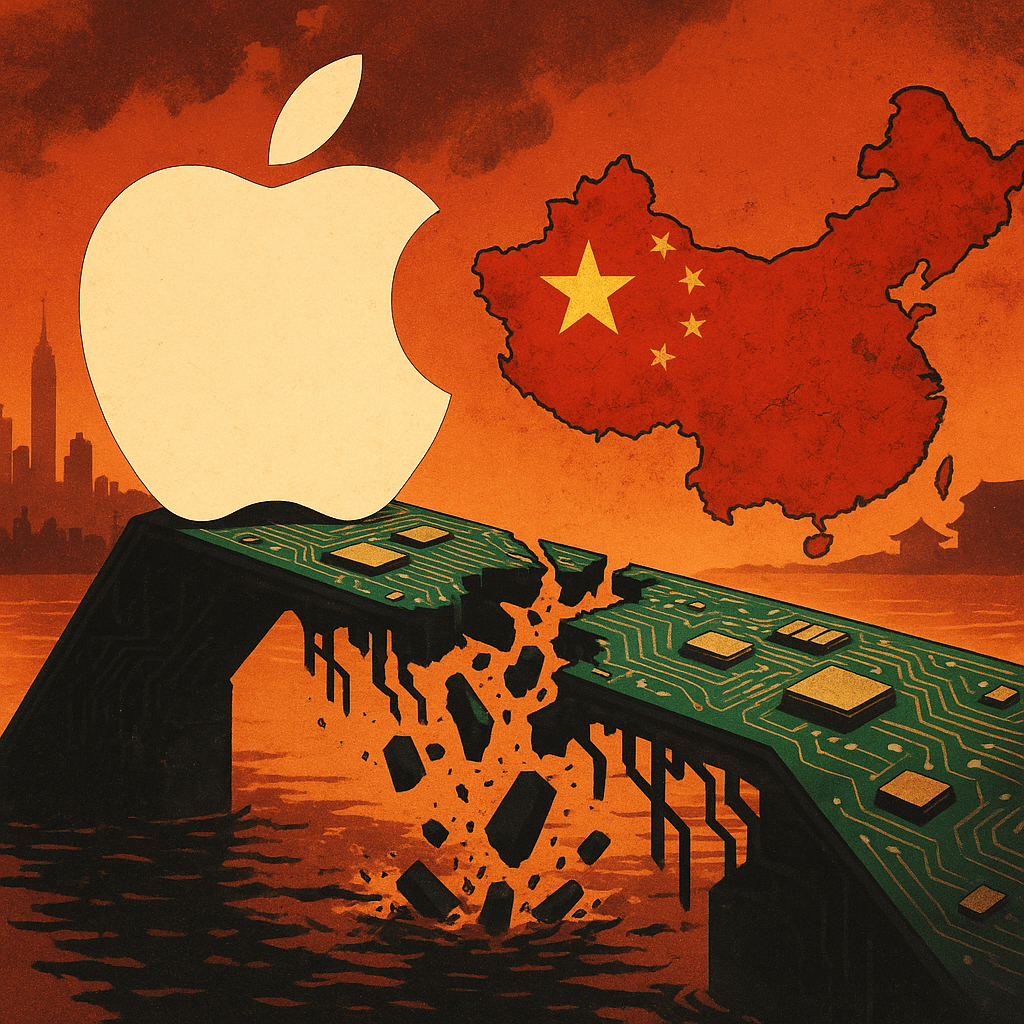
In a move that speaks volumes about the accelerating economic war between the United States and China, Apple Inc. — the crowned jewel of American techno-capitalism — is shifting the assembly of iPhones for the U.S. market out of China and into India. Behind the corporate jargon of “supply chain diversification” and “resiliency,” what we are witnessing is a realignment of imperial strategy: the weaponization of production itself in service of a dying empire.
According to reports from 24/7 Wall St., Apple plans to relocate all U.S.-bound iPhone production to India by the end of 2026, aiming to more than double its output there to over 80 million units per year. This seismic shift is being driven not by the invisible hand of “market forces,” but by the iron fist of U.S. state policy: tariffs of up to 125% on Chinese goods, aimed directly at kneecapping China’s high-tech sector and preserving U.S. global dominance.
These tariffs are not the product of “free trade” ideology. They are acts of economic warfare—tariffs as sanctions, sanctions as siege. If Apple kept production in China, the resulting price hikes would devastate its U.S. sales, opening the door for rivals and undermining the brand’s imperial prestige. Apple is not “diversifying” because of a strategic business decision; it is being forced by Washington’s technofascist project to realign its operations in preparation for deeper and more open confrontation with China.
But the material base of this story goes even deeper. Apple’s decision comes amid falling sales in China — an 11% drop in revenue to $18.5 billion last quarter alone, according to The Times UK. Chinese consumers, increasingly nationalistic in the face of U.S. hostility, are turning toward homegrown brands like Huawei and Xiaomi. At the same time, Beijing’s tighter regulations over AI development are limiting Apple’s ability to roll out its next-generation, AI-integrated devices inside the Chinese market.
In short: China is no longer the cheap, docile colony of the 1990s that Silicon Valley once plundered at will. It has matured, industrialized, and now poses a direct economic, technological, and political challenge to U.S. imperial supremacy.
Apple’s retreat is not just a business move. It is a battlefield maneuver in a new Cold War — a war fought not only with sanctions and battleships, but through the supply chains that thread the global economy together. Capital is being ordered to reconfigure itself around new lines of confrontation: “friendshoring” production to countries like India, Vietnam, and Mexico that are seen as more reliable junior partners of the U.S. empire.
But this strategy carries enormous risks. India is not China. Its manufacturing infrastructure, while rapidly improving, is still years behind China’s scale, efficiency, and technical capability. Labor conditions are volatile, worker militancy is growing, and political stability is far from guaranteed. In their desperate drive to isolate China, U.S. corporations are risking disruptions and contradictions they can barely control.
Apple remains, for now, the world’s most valuable corporation, sitting atop a $3.1 trillion market capitalization. But this latest maneuver reveals a deep strategic anxiety. American tech giants can no longer take for granted their access to global markets and cheap labor. They are being dragged by the logic of imperial decay into costly, inefficient, politically risky reorganizations of production — all to sustain a crumbling hegemony.
Meanwhile, the broader cost is borne not by the corporate titans but by workers across the globe. Indian workers will be subjected to intensified exploitation to meet Apple’s production quotas. Chinese workers will face layoffs and instability. U.S. consumers will be handed higher prices, fewer choices, and a steady drumbeat of anti-China propaganda to make them grateful for it.
In the end, Apple’s “walk away” from China is not an act of strength, but a symptom of weakness. It is the retreat of an empire that once demanded the entire world be its factory — now scrambling to reconstruct its empire at higher cost, under worsening conditions, in the vain hope of holding back the multipolar tide.
This is not “decoupling.” This is economic trench warfare.
And history teaches us: trench wars only end one way — in exhaustion, collapse, and the birth of something new.
 Weaponized Information
Leave a comment