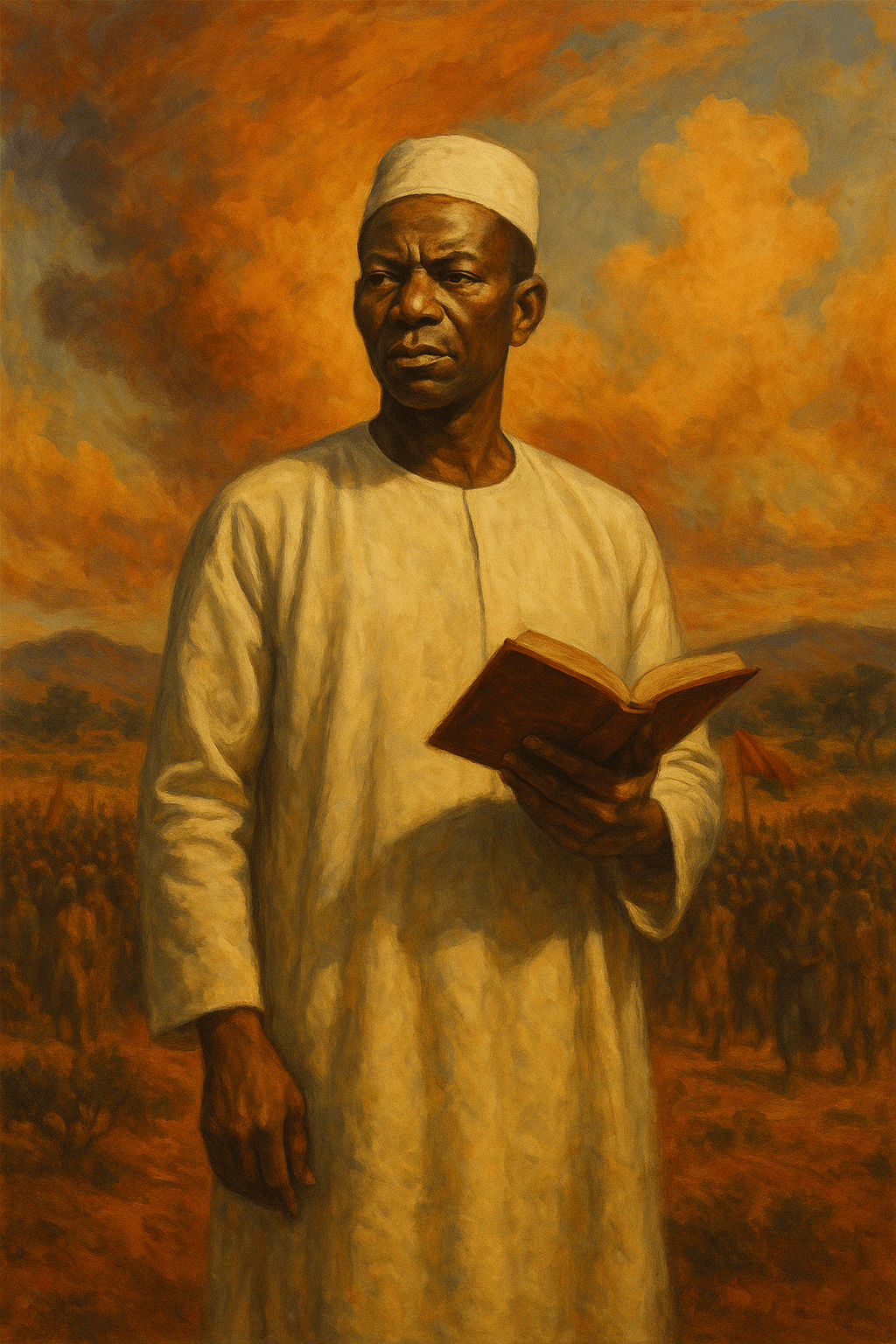
“There is no true independence without economic sovereignty.”
— Modibo Keïta
The Revolutionary Schoolmaster
Modibo Keïta didn’t rise to power through the barrel of a gun. He came with a book in one hand and socialism in the other. A teacher by training, a revolutionary by necessity, Keïta led Mali through one of the most audacious and principled attempts at African independence in the post-colonial era.
He didn’t just want freedom from the French flag—he wanted freedom from the French bank, the French corporation, the French curriculum, and the French logic that said Africa must always serve Europe.
In 1960, when Mali broke from the French colonial empire, Keïta refused to play the game of symbolic independence. He cut ties with the CFA franc. He refused neocolonial aid with imperial strings attached. He nationalized land and banks, launched state-led development projects, and backed full decolonization across the continent.
For that, he was targeted, isolated, and overthrown.
But for a brief moment, Mali stood as a revolutionary beacon of what real sovereignty could look like.
Part I: From Educator to Anti-Colonial Organizer
Born in 1915 in French Sudan (now Mali), Modibo Keïta was educated in the French colonial system—but never absorbed into it. He became a teacher, but he never accepted that education should produce colonial subjects. He wanted to produce African thinkers, African scientists, African leaders.
He was an early member of the Rassemblement Démocratique Africain (RDA), a pan-African socialist party tied to the global anti-colonial movement. As the winds of independence swept across Africa after World War II, Keïta emerged not just as a politician, but as a theorist of liberation.
He was influenced by Marxism, but grounded in the concrete realities of the Sahel. He saw the peasantry and the rural masses not as backward, but as the revolutionary base of the new society.
When Mali achieved independence in 1960, Keïta was elected president. And he immediately got to work dismantling the colonial economy.
Part II: The War for Economic Independence
Keïta’s first act of rebellion was economic.
He pulled Mali out of the CFA franc zone—a currency system invented by the French to keep its former colonies financially shackled. In its place, Keïta created a national currency and central bank. He nationalized key industries. He collectivized agriculture. He launched literacy campaigns and technical schools, rooted in African languages and Malian realities.
Mali’s path was not “market friendly.” It was people-centered.
But the empire never left. France and its allies waged a cold war on Keïta’s experiment. They froze aid, sabotaged trade, and launched a propaganda war, painting Keïta as a dictator for implementing state-led development. Internally, a comprador class and reactionary military began conspiring. The economy struggled under embargo and sabotage, and bureaucratic contradictions began to mount.
In 1968, a coup backed by imperialist networks removed Keïta from power. His regime was replaced with a more “moderate” military junta open to foreign capital and the CFA franc. Keïta was imprisoned until his death.
He died in captivity. But not in defeat.
Part III: Legacy in the Age of AFRICOM and Technofascism
Modibo Keïta’s vision is more relevant now than ever. In an age where France still holds economic control over 14 African countries through the CFA franc, and the U.S. runs military bases across the Sahel under AFRICOM, the question he raised—what does real independence look like?—remains urgent.
Today, Mali is once again in revolt. Military leaders have expelled French troops, criticized the CFA franc, and begun searching for alternatives. But without Keïta’s socialist compass, without his commitment to the masses and to production rather than extraction, the road ahead remains uncertain.
Keïta’s politics weren’t about nationalism for its own sake. He believed in Pan-African socialism. In federation. In unity. In building up the productive forces of Africa by and for Africans—not by selling them off to the highest bidder.
In a continent still haunted by coups, IMF structural adjustment, and NGO neocolonialism, Keïta’s path—however flawed and unfinished—remains a revolutionary map for what could be.
Conclusion: The Lesson of Modibo Keïta
Modibo Keïta was not a puppet. He didn’t ask France for permission. He didn’t beg the World Bank for help. He didn’t build a comprador class to manage the masses. He put the people at the center of power and dared to imagine what Mali could be without colonial chains.
And for that, he was overthrown. Silenced. Erased from Western textbooks. But he remains a revolutionary ancestor whose legacy lives in every fight to reclaim land, knowledge, and dignity in Africa.
Modibo Keïta was not a reformer. He was a builder. A teacher. A revolutionary who believed the future belonged to the organized poor—and he gave his life trying to help them seize it.
 Weaponized Information
Leave a comment