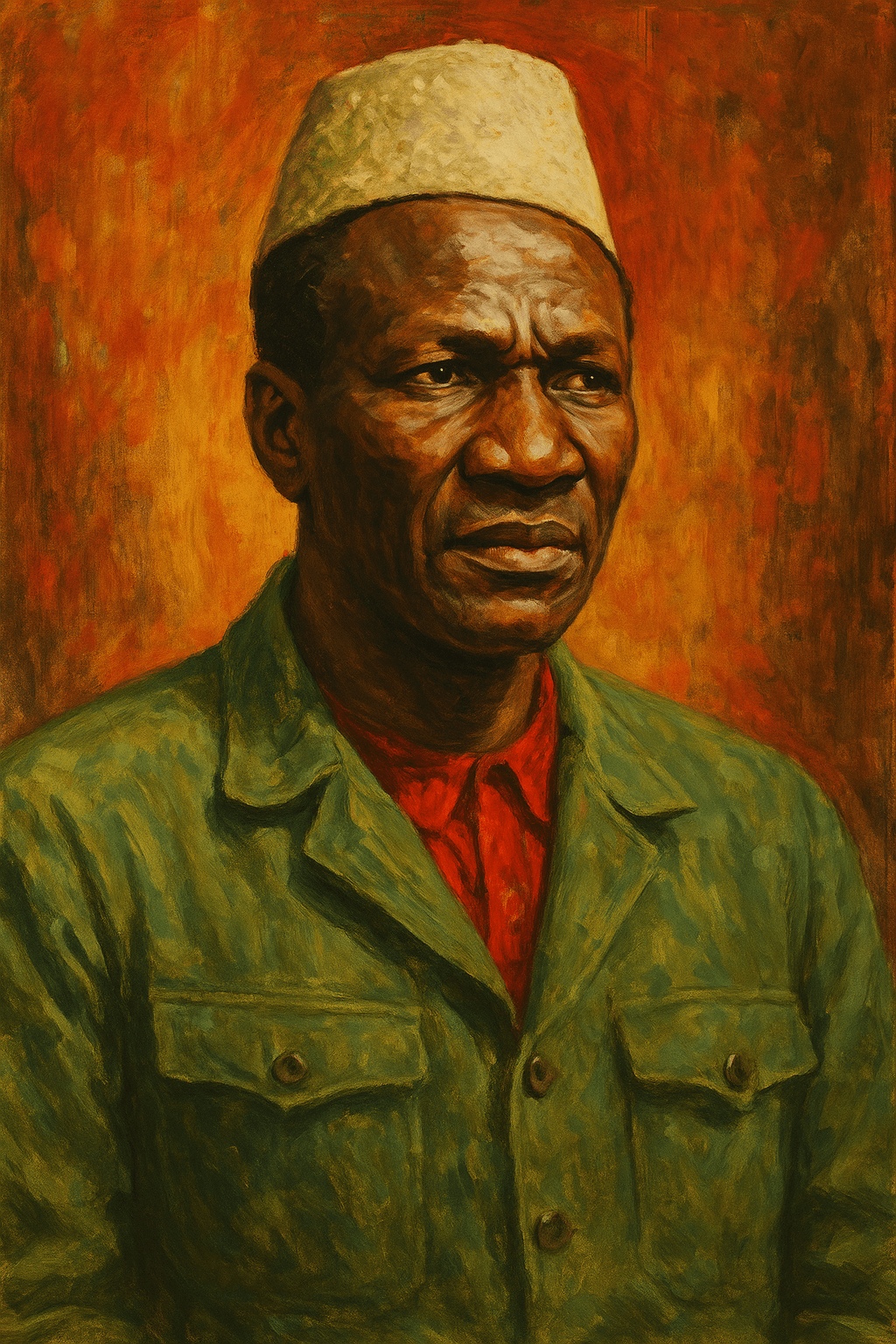
Part I: From the Colony to the Union Hall — The Early Life and Political Formation of Ahmed Sékou Touré
Ahmed Sékou Touré was born on January 9, 1922, in Faranah, a modest town along the Niger River in what was then French Guinea. The grandson of Samory Touré—the legendary West African resistance fighter who defied French conquest for years—Sékou inherited not just a name, but a legacy of anti-colonial defiance. From the beginning, his life bore the imprint of resistance.
He came of age under the brutal logic of French colonial capitalism: forced labor, extractive economies, racist education systems designed to produce clerks, not thinkers. But even within the narrow confines of colonial schooling, Touré stood out. Expelled from a Catholic technical school in Conakry for organizing a student strike, his first political act was not in a university hall—but in defiance of authority on behalf of collective dignity.
In the early 1940s, Touré entered the world of labor organizing through the postal service, one of the few colonial institutions that employed African workers in significant numbers. As a union leader in the PTT (Postes, Télégraphes et Téléphones), he quickly rose through the ranks—not through patronage, but through clarity, discipline, and a fierce commitment to class struggle. By 1948, he helped found the Confédération Générale des Travailleurs Africains (CGTA), an autonomous pan-African labor organization that challenged both French and comprador control.
Touré’s early speeches and writings from this period already reflect a dialectical understanding of colonialism not simply as a foreign occupation, but as an economic system rooted in the theft of African labor and the destruction of African social relations. He identified colonial domination as both material and psychological—requiring not only the expulsion of French governors, but the reorganization of African consciousness.
By the early 1950s, Touré was not just a labor leader—he was the face of a growing revolutionary current. In 1952, he took leadership of the Guinean branch of the Rassemblement Démocratique Africain (RDA), a pan-African political formation aligned with the French Communist Party. But unlike more cautious RDA leaders elsewhere, Touré refused to compromise on the core demand: complete independence.
His rhetoric sharpened. His mass base deepened. By 1956, he was elected to the French National Assembly. But he didn’t go to Paris to play the game—he went to expose it. He used the Assembly as a platform to denounce France’s plunder of Africa and to rally support for the liberation of all colonized peoples.
Everything converged in 1958. General Charles de Gaulle offered France’s African colonies a referendum: accept a new constitution and remain part of the so-called “French Community,” or choose immediate and total independence. Most African leaders chose caution. Touré chose clarity.
On September 28, 1958, Guinea voted overwhelmingly for independence. Touré famously declared: “We prefer poverty in liberty to riches in slavery.” That vote made Guinea the first French colony in sub-Saharan Africa to break free. But it also made it the target of a vicious, organized campaign of neocolonial retaliation.
In that moment, Touré stepped fully into his role—not just as a statesman, but as a revolutionary. A man who had risen from the shop floors and union halls to strike a blow against one of the most entrenched colonial empires in the world.
Part II: Building a Revolutionary State Under Siege
Guinea’s declaration of independence was not met with silence—it was answered with sabotage. France, humiliated by Touré’s defiance, withdrew overnight in a tantrum of imperial destruction. Colonial administrators looted government archives, dismantled communication lines, and poured cement into toilets in public buildings. But the imperial tantrum did not stop there. What followed was Operation Persil—a covert war of economic destabilization, counterfeit currency, and attempts to sow internal unrest.
Touré and the Democratic Party of Guinea (PDG) responded with resolve. Independence was not to be a flag and a national anthem—it was to be economic, cultural, and psychological liberation. The young Guinean state immediately embarked on a program of nationalization, land redistribution, industrialization, and mass literacy. It sought to dismantle the colonial economy and replace it with a socialist economy grounded in the needs of the people—not foreign banks.
But the cost was high. With France and the West shutting Guinea out of aid, credit, and trade, the country turned east—toward the Soviet Union, China, Ghana, and the wider socialist and non-aligned world. Touré became a founding member of the Non-Aligned Movement, alongside Nasser, Nehru, Tito, and Nkrumah. Guinea positioned itself as a Pan-African hub of anti-imperialist resistance.
Internally, Touré emphasized mass political education. PDG cells were organized in every village. Cultural imperialism was identified as a key enemy. Colonial languages, customs, and mentalities were critiqued, and a renaissance of African identity was encouraged through music, dance, oral tradition, and revolutionary theater. Liberation was not just in policies—it had to live in the people.
But the revolution was not immune to contradiction. As imperial pressure mounted—from economic sabotage to assassination plots—Touré moved to tighten party discipline. Internal dissent was interpreted as counterrevolutionary activity. Guinea’s security apparatus expanded. Prisons were filled with both saboteurs and political rivals. The West labeled him a tyrant. Touré called it revolutionary vigilance.
In truth, Guinea was not a dictatorship in the capitalist sense—it was a party-state forged in struggle, navigating the impossible contradictions of building socialism in a world still run by imperialism. Touré ruled not to enrich himself, but to shield a fragile revolution from destruction.
And despite it all—Guinea built. By the mid-1970s, the country had achieved significant gains in health, education, and agricultural output. It hosted liberation movements from across Africa, including the ANC, PAIGC, and MPLA. Touré gave sanctuary to Kwame Nkrumah after his CIA-backed overthrow. Guinea became more than a nation—it became a base camp for the unfinished struggle of the continent.
Part III: Revolutionary Theory and the Battle for African Liberation
Ahmed Sékou Touré was not just a tactician of independence—he was a theorist of revolutionary transformation. His speeches and writings—especially those compiled in Strategy and Tactics of the Revolution and Africa and Imperialism—laid out a coherent worldview grounded in Marxist-Leninist thought, Pan-African unity, and cultural revolution. For Touré, national liberation could not end at the flagpole. It had to uproot the colonial logic embedded in the mind, the economy, and the state.
He identified imperialism as a “permanent aggression,” not merely a foreign policy, but an organizing principle of global capitalism. He exposed neocolonialism as the reconfiguration of colonial domination through monetary dependency, cultural penetration, and elite comprador collaboration. To defeat it, he argued, Africa needed to build socialism—not as an imported doctrine, but as the organic result of African communal traditions, adapted and developed through class struggle.
Touré emphasized the political necessity of cultural revolution. In his eyes, colonialism had disfigured African consciousness—teaching self-hate, passivity, and blind imitation of the West. To reverse this, the Guinean Revolution emphasized national languages, traditional art forms, and indigenous history—while simultaneously developing a modern, scientific socialism rooted in production and class organization. This was not nostalgia—it was a revolutionary weapon.
But Touré’s most enduring theoretical intervention may be his understanding of praxis—the fusion of action and theory in the service of the people. He insisted that the revolution must be lived. That its ideas must be tested in the field, in the factory, in the school, in the party. His cadres were not bureaucrats—they were servants of the people, held to the highest standards of discipline and moral integrity.
His writings warned repeatedly against the corrupting influence of the petty bourgeoisie—the social class most vulnerable to compromise, egoism, and betrayal. He argued that a revolution must not only defeat external enemies, but continuously rectify its internal contradictions. To that end, Touré advanced the concept of the “Permanent Revolution,” not in the Trotskyist sense, but as a national ethos of vigilance, self-criticism, and dialectical development.
Touré’s Guinea became a training ground for liberation movements across the continent. He supported the PAIGC in Guinea-Bissau, the ANC in South Africa, and the MPLA in Angola—not with slogans, but with weapons, sanctuary, and political education. Guinea’s revolutionary theory was not just for itself—it was for all oppressed peoples.
Part IV: Contradictions, Legacy, and Lessons for the Global South Today
Ahmed Sékou Touré died in 1984 while receiving medical treatment in the United States—a bitter irony for a man who spent his life struggling to break Africa free from Western domination. His death marked the end of an era in Guinea, and in many ways, the beginning of a more aggressive neoliberal pushback against the gains of national liberation movements. But his legacy endures.
Touré’s contradictions were real. The expansion of the security state, the suppression of dissent, the harsh treatment of opposition within the PDG—these are not minor footnotes. But we do not judge revolutions outside their context. Guinea was under siege. It faced sabotage, subversion, and economic isolation from its former colonizer and the broader imperialist world system. In that context, Touré’s methods were not simply repressive—they were strategic countermeasures against neocolonial warfare.
We at Weaponized Information do not use the liberal lexicon of “authoritarianism” to describe a government fighting to defend the people’s revolution. We understand that the monopoly press and imperial academia distort revolutionary history to discredit all anti-colonial struggle. But the working class remembers differently. The peasants who received land, the youth who learned to read, the African revolutionaries who trained in Guinea—they remember a nation that dared to fight.
Today, the lessons of Ahmed Sékou Touré could not be more relevant. In an age of debt traps, drone bases, and technofascist governance, the need for genuine sovereignty—economic, cultural, and psychological—is more urgent than ever. Touré’s commitment to socialist self-reliance, Pan-African unity, and revolutionary culture remains a guiding light for movements resisting recolonization under the banners of “development” and “democracy.”
His life teaches us that revolution is not a moment, but a method. That independence is not a ceremony, but a structure. And that the people are not spectators, but the true protagonists of history.
 Weaponized Information
Leave a comment